
Beat the Coverage
By JJ Birden
Life Sized Publishing (2026)
I first came upon JJ Birden when he was a sprightly track and field phenom at Lakeridge High, claiming state titles in the high hurdles and triple jump and nearly winning the Oregon 3A team championship by himself as a senior in 1983.
I followed him to the University of Oregon, where I covered him for The Oregonian when he became the Pac-10 long jump champion with a best of 25-8 3/4 and a member of the Ducks’ NCAA championship squad of 1984.
I watched as he walked on and made Oregon’s football team, then marveled as he carved out a seven-year NFL career, finishing with 244 receptions for 3,441 yards and 17 touchdowns.
But when Birden sent me a review copy of his latest book, I learned the backstory of his deliciously successful, but anything-but-easy, life.
Birden, 61, is now a motivational speaker, doing an average of two events a month and nearly 200 keynote speeches across the country since he entered the business in 2015. He and wife Raina make their home in Phoenix.
In “Beat the Coverage,” Birden uses life experiences to offer guidelines for people to achieve success in all walks of life. He also provides glimpses of the route he has taken to get there, beginning with his childhood in a single-parent, north Portland home to being bussed to high school in Lake Oswego, where he learned the world was much larger than he had realized.
I had no idea that JJ and Raina had a household of 10 after they took in, then adopted, the five children of JJ’s wayward sister, adding them to their three biological kids to make it a true “Birden Bunch” story.
“One minute, you are a family of five,” JJ tells me. “Then you are 10. It was learning on the go for my wife and me. It was important to us to keep the five children together. It was hard, it was expensive, it was crazy at times, but it was worth it. (The children) are all out of the house now and doing well.”
Birden wrote and published his first book — titled “When Opportunity Knocks, 8 Surefire Ways to Take Advantage” — in 2015. It was more motivational than instructional.
“I was just starting to (make speeches),” he says. “I wanted to have a book to validate what I was doing. The depth (in the first book) wasn’t what this new book has.”
Birden tells personal stories, all of them connected to “coverage” in some way, and offers suggestions and solutions for the readers to take in addressing challenges in their lives. The idea is to help individuals and organizations win when the odds aren’t even — to beat the coverage, in football parlance.
Birden says he was 5-9 and 133 pounds when he arrived on campus as a freshman at Oregon. He was on a track and field scholarship, but sought a chance to play football. The first spring, he watched football practice for a few days and drew up enough courage to approach Coach Rich Brooks for a tryout. “You’re too small,” Brooks told him. But Birden persisted and got the tryout, which set him up for the ultimate challenge.
“You walk in there the first day, and there are 13 wide receivers, and you’re No. 12,” he says. “But my mindset was, ‘I believe in myself, I’m going to do the work. I may not always be great, but I’m going to stay in there.’ ”
Birden made the team and became a four-year football letterman, though not a star, catching 45 passes for 739 yards and one touchdown during his career with the Ducks.
“Oregon never sent me a courtesy letter or anything out of high school,” he says. “But because I went to Brooks, I created an opportunity. Once he said yes, I had to take advantage of it. And it was a tough learning curve.”
Not surprisingly, he went undrafted by the NFL. Not surprisingly, he didn’t let that deter him. He experienced some rejection and spent two years on practice squads, but eventually enjoyed a seven-year playing career for the Kansas City Chiefs and Atlanta Falcons. Birden finished with 244 receptions for 3,441 yards and 17 touchdowns, including a 90-yard scoring play as a rookie in 1990. In nine playoff games, he caught 33 passes for 427 yards and 3 TDs.
Later, after his football career ended, he realized he had come upon something important.
“Whether you are trying to make an NFL roster, build a business, lead a team, advance your career or navigate a major life transition, the challenges are remarkably similar,” he writes. “You will have to prepare. You will have to adapt.
You will have to perform under pressure. You will have to respond to setbacks. And you will have to recognize and seize opportunities when they appear.”
That ultimately led him to writing his most recent book.
“I found that, over the last 40 years, there had not been an NFL player who played longer than me who weighed under 160,” he tells me. “There are so many people who have dealt with obstacles, challenges and adversity and given up. I thought, ‘I have lived the road map of overcoming challenges. When I started my speaking business, I got 22 no’s before I got a yes. Here is an opportunity to help other people.’
“With this book, I wanted to make sure there was a clear message that was relatable to everyone. At this point in my life, I am able to teach people better.”
With each chapter, Birden lays out six strategic steps in terminology that is clear, concise and, well, familiar to him.
“Football is the metaphor, because it’s my experience,” he says. “But everybody faces some kind of obstacle or challenge in their career or their life. My goal is if they follow my framework, no matter what they are pursuing, they will put themselves in a better position to conquer it.
“I first was writing the book for the corporate world. But as I continued to write, I thought, ‘This is really for everybody.’ ”
Later this month, Birden will be inducted into the Missouri Sports Hall of Fame, a nod to his five seasons with the Chiefs. Not bad for someone who small enough to fight as a middleweight. No question, JJ beat the coverage.

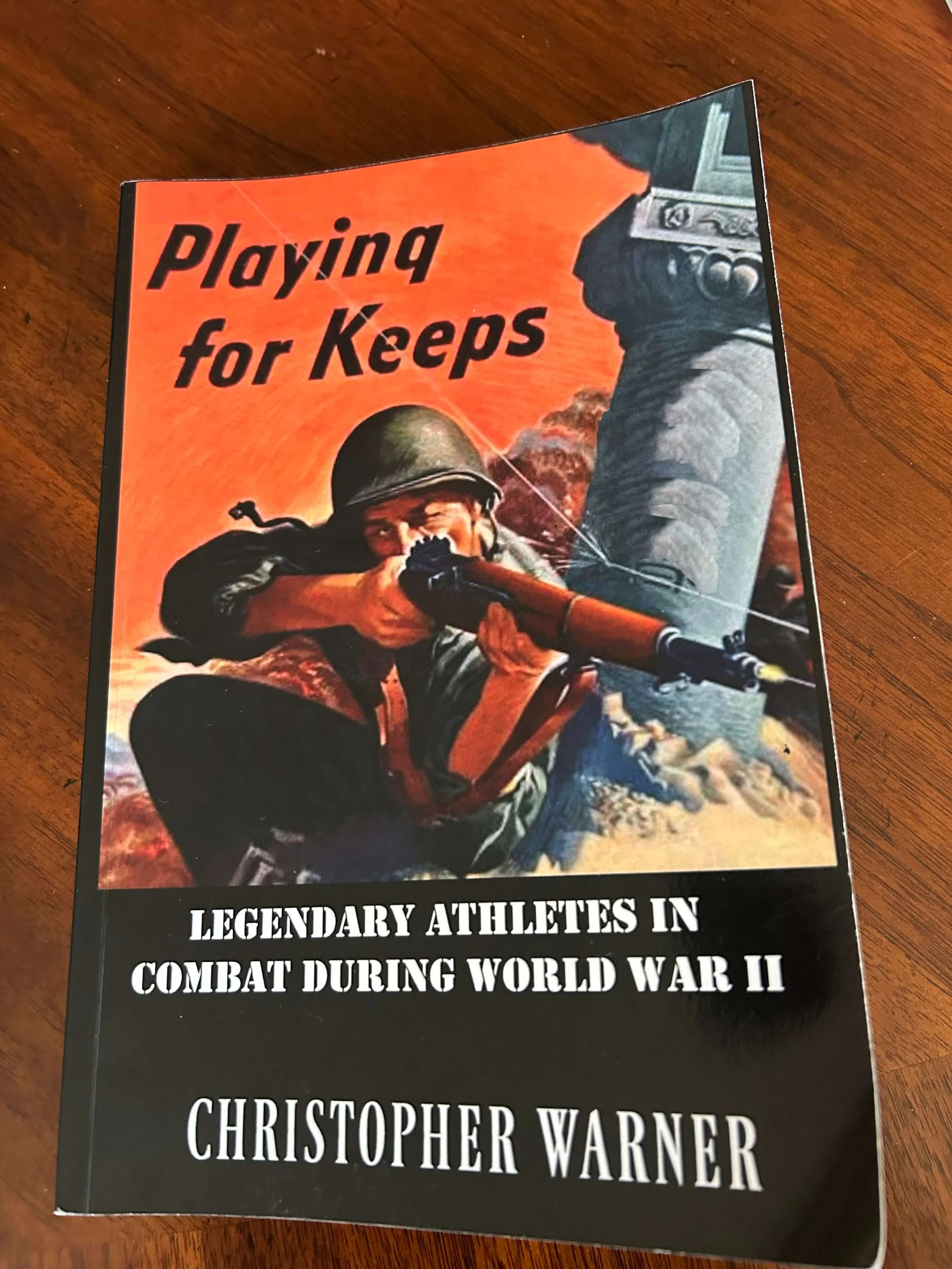
Playing for Keeps
By Christopher Warner
NFB Publishing (2025)
Not long ago, I reviewed “The Cloudbuster Nine,” a book about Major League players who were cadets in the U.S. Navy’s pre-flight training program in North Carolina during World War II.
Warner’s subject is similar, a collection of chapters on famous athletes who waged combat for the country doing military service in WW II.
Warner was a crack athlete himself. The Lake Oswego resident was an All-America decathlete at New Mexico and once competed on the U.S. national bobsled team. His interest in his recent book project was kindled by the legacy of an uncle who was a flight officer, flying combat gliders in WW II.
The author profiles 16 athletes from a variety of sports who represented nearly every branch of the service in WW II.
“That was important to me,” Warner says. “Baseball was clearly the most popular sport in America, and I could have done a book specifically on baseball players in the war. But I wanted to show a cross-section. I wanted to show that this was all hands on deck, and to shine a light on athletes who were famous at the time but whose legacies have diminished.”
I had heard of all but four of the featured athletes, and was aware that baseball legends Bob Feller and Warren Spahn were among the most willing to serve their country during WW II. Warner’s book fills in depth on them and the other subjects, who in a very different world were willing to offer their services during that critical time in world history.
“They were patriotic, but it’s not like they wanted to be John Wayne,” Warner says. “Maybe for a minute, until they realized what the conflict was really about and how horrific it was. They saw (their service) as a duty, a job that had to be done, and they did it.”
None of Warner’s subjects are alive today, but he says he conducted hundreds of interviews with friends and relatives, all the while doing extensive research of biographies, history books and national archives.
Some of the athletes lived to a ripe old age. Others were killed in combat. Olympic bobsled champion Billy Fiske, somehow flying for the British Royal Air Force in Germany in his 30s, engaged in 42 “sorties” — bombing missions — over a 27-day period. Fiske died at age 29 in 1940 when his Hawker Hurricane was hit by enemy fire over England.
Another was Al Blozis, a 6-6, 250-pound physical specimen who played football for the New York Giants and a world-class thrower who would have been favored to win both the shot put and discus at the 1940 Olympics had war not intervened. The son of immigrants from Lithuania, “the Human Howitzer” died at age 26 while fighting with the U.S. Army in France in 1945.
“His story is especially heartbreaking,” Warner says. “He was a Georgetown graduate, a standout athlete, a guy who could have been a future senator, or maybe president. As a son of immigrants, he wanted to fight for his country.”
With several of the athletes, including blacks Emlen Tunnell, Leon Day and Harrison Dillard, their service was tainted with racism of the day. Also, Takashi “Halo” Hirose, a Japanese-American swimming national champion from Hawaii who volunteered to fight in Europe as part of the 442nd “Nisei” Regimental Combat Team in 1941.
“For them, it was a battle on two fronts,” Warner says. “I didn’t set out to make that a theme, but as it turned out, over half (of the athletes profiled) were either sons of immigrants or minorities. They didn’t have it easy, but they felt, ‘Hey, I’m an American. I want to prove I’m just as American as anyone. That was especially true in the case of Hirose.”
Spahn had already pitched in the big leagues when he was drafted into the Army and served as a combat engineer from 1942-46, engaging in counter-mobility operations, clearing landmines, destroying enemy strongpoints and constructing roads and bridges. He was also called upon to fight in the most horrific of conditions, earning a Purple Heart for his contributions.
Football great Chuck Bednarik got drafted as soon as he turned 18, but that was his wish.
“I couldn’t wait to go to war,” said Bednarik, who was stationed in England. He operated a .50-caliber machine gun on a 10-man crew that performed bombing missions behind enemy lines in Germany. After the required 30 missions, Bednarik was granted his release, having had his fill of warfare.
“When we got back to England, I got out and kissed the plane, kissed the ground and announced that I was never going to fly again,” he said.
Bednarik, the NFL’s last “Iron Man” (two-way player), lived to 90, though he suffered from Alzheimer’s that may have been impacted by football-related injuries. At least he survived the war to lead a long, productive life.
► ◄
Readers: what are your thoughts? I would love to hear them in the comments below. On the comments entry screen, only your name is required, your email address and website are optional, and may be left blank.
Follow me on BlueSky.
Follow me on X (formerly Twitter).
Like me on Facebook.
Find me on Instagram.
