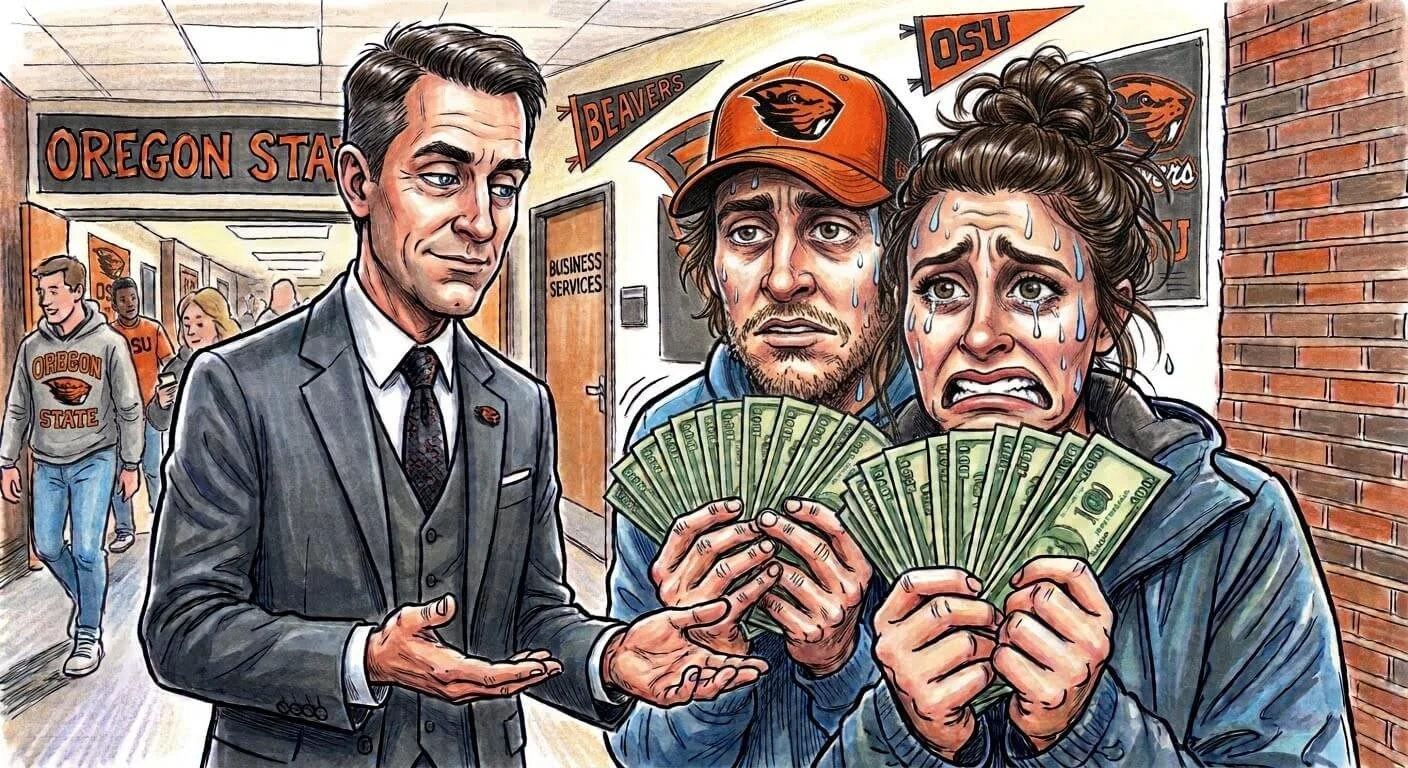
The biggest controversy within the Oregon State athletic department these days has nothing to do with what is happening at Reser Stadium or Gill Coliseum.
Many Beaver baseball fans are up in arms over the OSU athletic department’s decision to “re-seat” season ticket-holders for games at Goss Stadium in 2027. The operative phrase is “Beaver Points.” Back to that in a minute.
Goss Stadium’s current capacity is just shy of 4,000, though 1,400 permanent outfield seats will be added ahead of the 2028 campaign.
The stadium for the 2026 season was “essentially sold out,” OSU athletic director Kevin Griffin told me recently. “Almost all of the seats are accounted for through season tickets.”
There are currently 854 season ticket-holders and a waiting list of about 150, says an athletic department source.
Fans who have held season tickets in the same spot for years — in some cases, for decades — are being asked to make sizable donations in order to guarantee the option to keep their seats for the upcoming season.
How sizable? I interviewed a dozen season ticket-holders, and the amount varied widely — from a low of $5,000 for a four-year commitment for two seats, to one seat requiring more than a projected $328,000.
“That is about what it would cost to join Cypress Point,” quips Bob Keith, the season ticket-holder in the latter predicament. “They are making this a country club affair.”
For many years at Oregon State, those who hold season tickets for football and men’s basketball have been required to contribute what is essentially a personal seat license (PSL) on top of the price of the tickets they purchase. Until now, that has not been asked of those who buy season tickets for baseball.
The advent of NIL and revenue-sharing has changed the financial burden of major-college sports. The dissolution of the old Pac-12 has changed things, too. During the last fiscal year of the former Pac-12 (2023-24), media rights distribution per school was $21 million a year with Fox and ESPN. When bundled with Pac-12 Network, NCAA basketball tournament, bowl games, CFP and corporate funding, the total payout averaged between $35 and $37 million annually.
The current media-rights package in the restructured Pac-12 is estimated to be between $7 and $12 million per school, with total distribution at about $13 million for the two legacy schools — Oregon State and Washington State. That’s a loss in media-rights revenues of about two-thirds, or at least $22 million a year.
OSU officials are looking at ways to make up the difference. Evidently, one way is through requiring PSLs in baseball, and instituting a re-seating program that will allow others to bid for the primo seats in Goss.
The re-seating is being done through a program related to “Beaver Points,” which are accumulated primarily through financial contributions to Oregon State athletics.
“The system has been in place here for years,” Griffin says. “You get your Beaver Points based on a variety of ways in supporting the university through (a history of) ticket purchases and/or giving.”
That is not just for support of baseball, but for financial and other contributions to athletics and the university. Though a total history of giving is considered, points are weighted for recent contributions, and football gets the biggest payback.
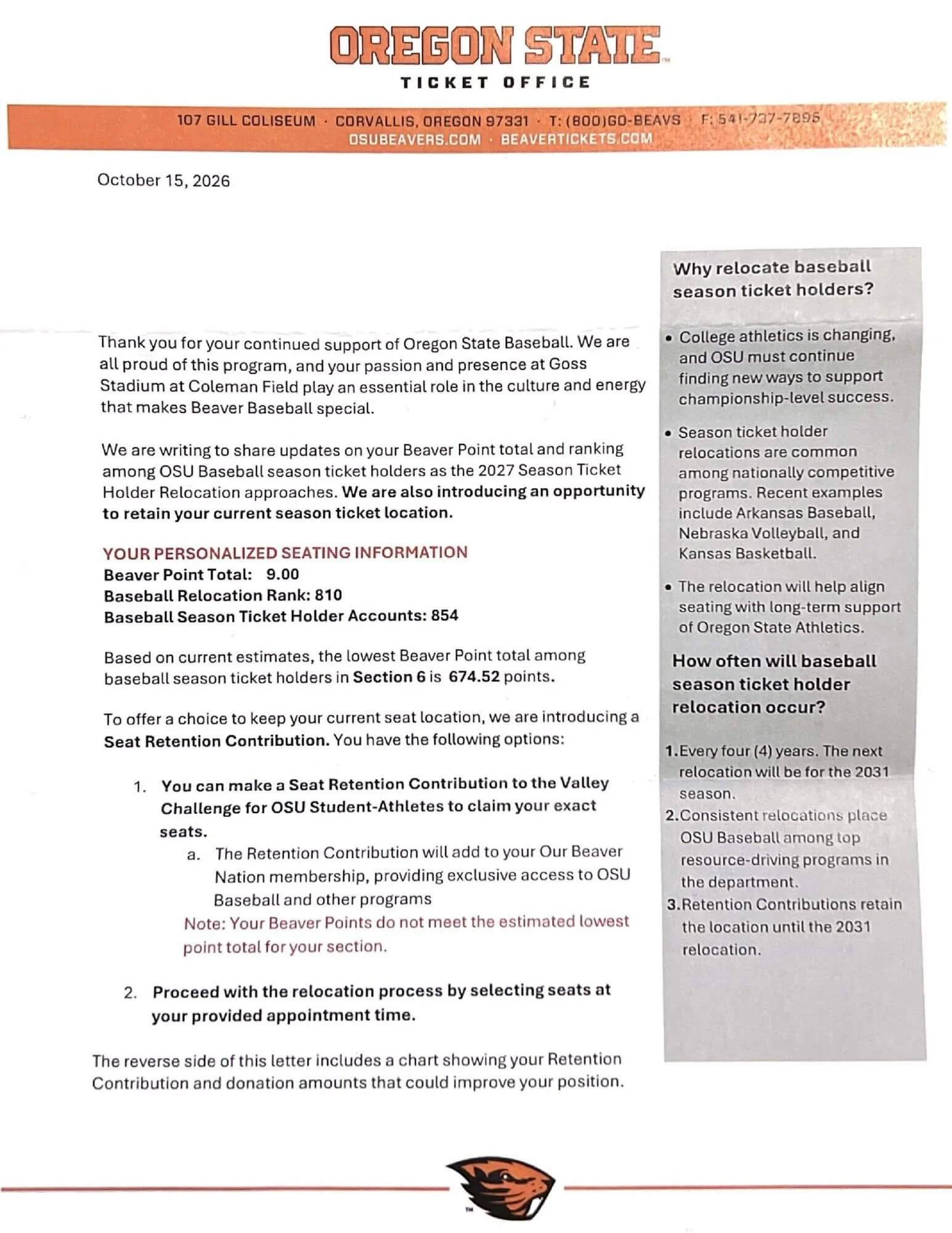
A year ago, baseball season ticket-holders received a letter in the mail, alerting them to the new policy. The letter was signed by Scott Barnes, Griffin’s predecessor. It outlined the upcoming changes but didn’t specify the way season ticket-holders could maintain their seats. Griffin, who assumed his athletic director post in July, authorized a new letter that reached season ticket-holders in mid-October.
“When the decision was ultimately made, there was not a lot of clarity about what that meant,” Griffin tells me. “We needed to be more transparent about what it would take in terms of a seat contribution relative to a donation. Instead of just saying we are going to re-seat and re-price the entire building, we communicated the opportunity to retain the seats where they have been sitting for some matter of years. It was, ‘Here is what it could look like if you want to stay in your same seat, based on projections of what we think might happen.’ ”
The recent letter offered season ticket-holders two options:
• They can make a seat retention contribution to the “Valley Challenge for OSU Student-Athletes” to claim their “exact seats” for next season.
• Without a donation, they can proceed with the relocation process by selecting seats “at your provided appointment time.”

During the first week of January, ticket locations will be allocated to season ticket-holders who elected to make a seat retention contribution. For those who don’t make donations, the appointment time would come sometime after the second week of January.
“It will be based on your Beaver Points,” says one source with knowledge of the process. “If your original seats are still available, you can select them, or choose any other available seats if you prefer those, up to the same number of seats you previously held. If they are not there, you select any place else in the park that is open when your lottery number is up.”
Contributions are based on a four-year period from 2027-30. The OSU athletic department intends to go through the relocation process every four years.
“It’s not just us,” Griffin says. “This is common practice in the industry. A football re-seat happens all the time. A baseball re-seat happens all the time. It’s not any different than you see at any university.”
It is true that some schools have re-seating policies in some sports. Gonzaga basketball is an example. The Bulldogs go through the re-seating process every five years, taking into account historical giving to the athletic department and longevity as a season ticket-holder. Some major college baseball programs — largely in the SEC or ACC — have re-seating systems. Arkansas re-seats every five years. LSU and Miami do it every year.
“But I don’t know of a single (baseball program) out West that has even considered it,” says Mark Garland, a Bend resident who covers the national baseball scene for “College Baseball 365,” a podcast. “Many of them make requests for donations or bump up season-ticket prices — that’s all common. But not a re-seating program. The numbers I got from Arkansas, the dollar amount wasn’t near the amount Oregon State is asking.”
In the letter distributed in October, season ticket-holders were alerted to their Beaver Points total, to their relocation rank (1 through 854) and projected financial contribution for seat retention. In addition, there are suggested donations for increasing the fan’s position in relocation rank (from 25 to 100 spots).
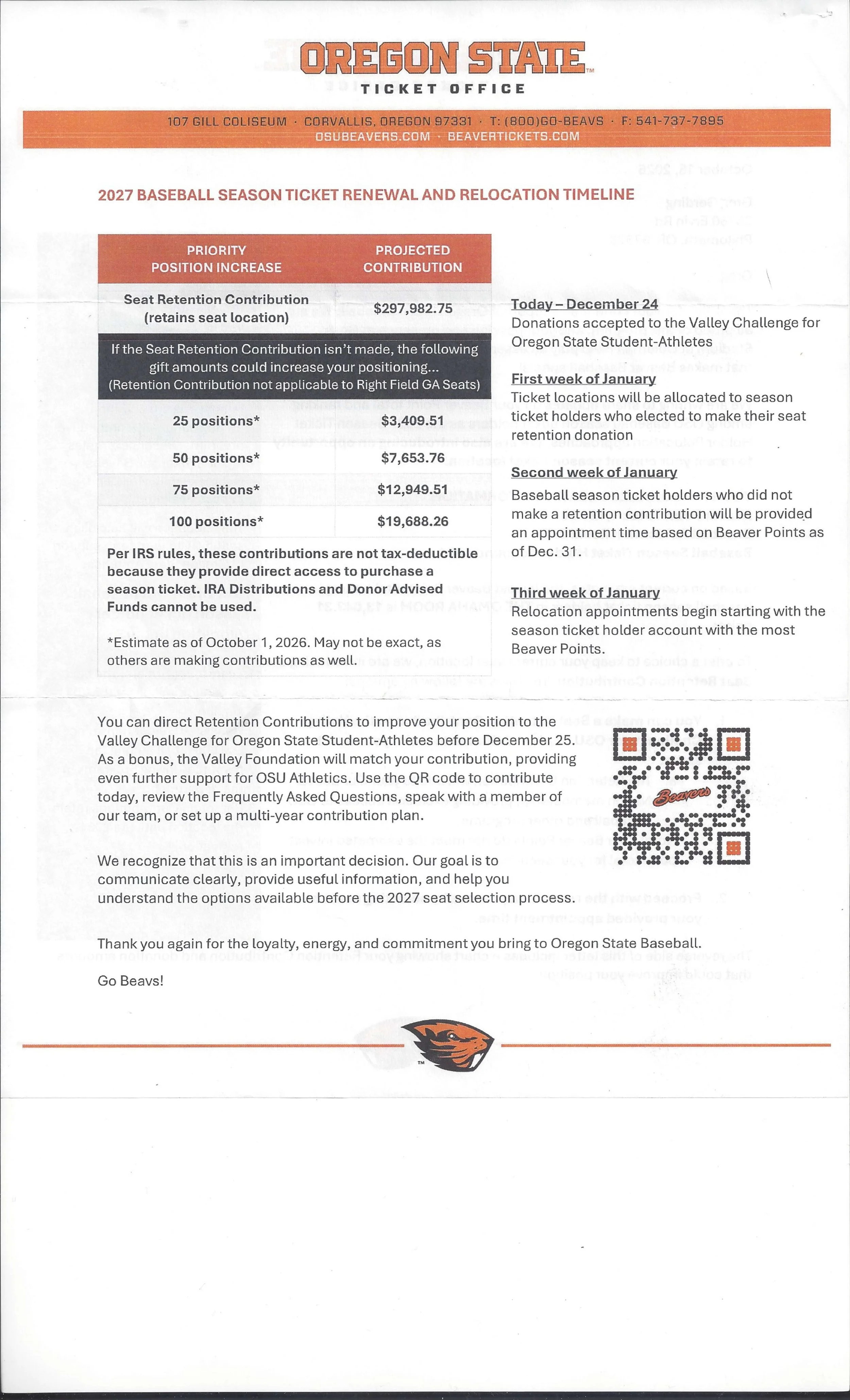
And by the way, several people told me that their donations are not tax-deductible.
“There is a value that is tax deductible, but I am not a lawyer,” Griffin says. “I can’t comment on that.”
Griffin is quick to point out that the numbers are only projections, and that nobody will be losing their season tickets.
“I have heard from some who think they are getting completely removed from the stadium,” he says. “That is not the case. Everyone who had season tickets last year can continue and not even make a donation. That is what gets lost. I don’t know if people are reading that part of the message.
“If they have season tickets, they will still have them in the stadium. It is essentially an auction based on the Beaver Points you have. If no one participates in the auction, it is what it is. It is a moving market. While people might be shocked with, ‘I may owe $44,000 over the next four years,’ that is what other people have been donating while earning Beaver Points. This happens in our business all the time.”
Chances are slim to none, of course, that no one participates in the auction. Also, seat relocation might not be to the liking of fans who have had good seats for years. When Griffin says “in the stadium,” does he mean they could be moved to the outfield? A couple of season ticket-holders I interviewed said they were told by an athletic department official that could be the case.
Here are a few of their stories.
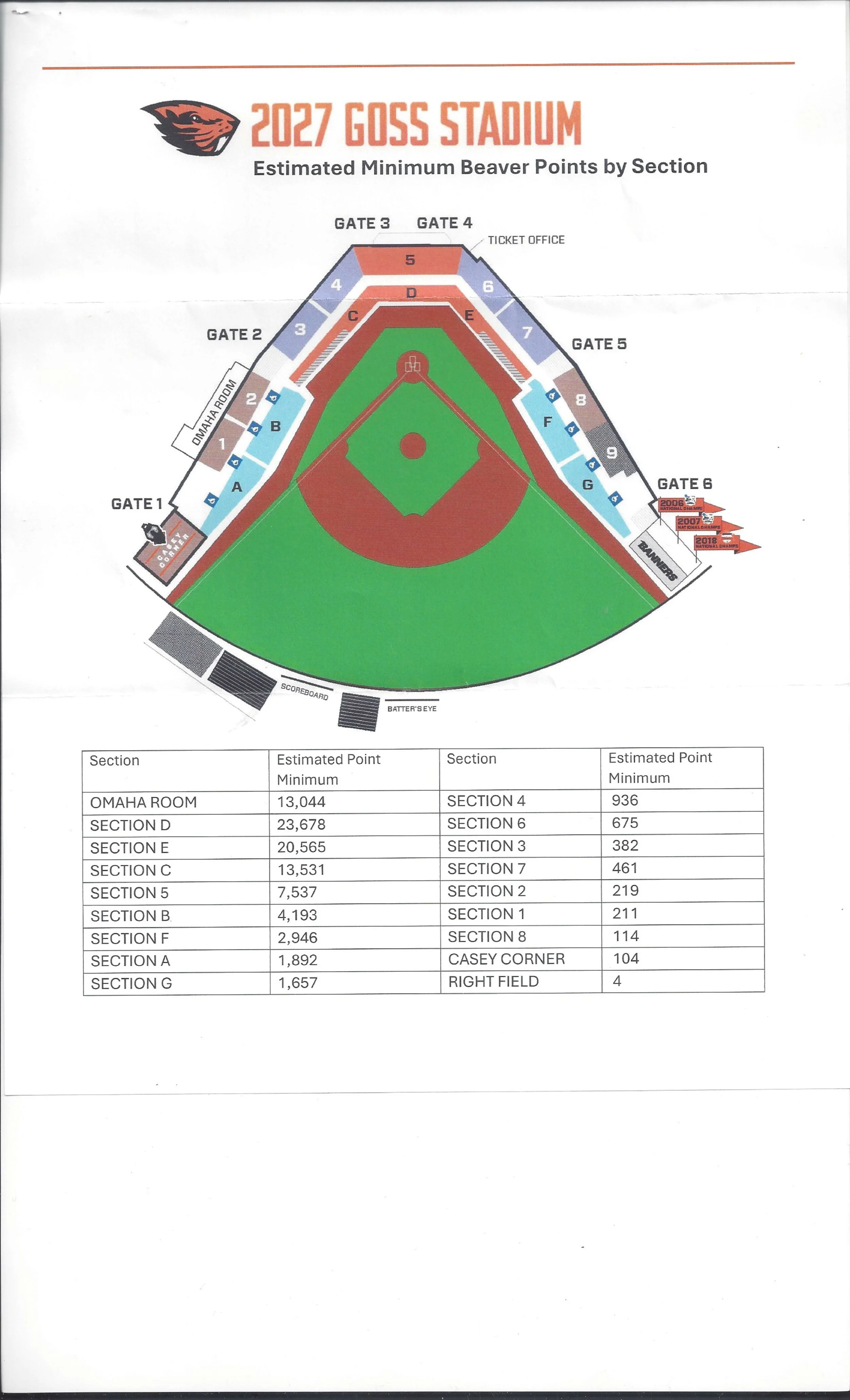
• Coleen Montgomery and her husband, Jim, have held four baseball season tickets for 20 years. They paid $1,000 per ticket last season for their seats in section B, along the first-base line. They have 572 Beaver Points. Their relocation rank is 456. Estimates by OSU officials are that the lowest total among season ticket-holders in their section will be 4,192 Beaver Points. In other words, they are 3,620 points short of the minimum. Donation necessary to retain their seats: $90,512. With a $3,858 donation, they could increase their standing by 25 positions. For $15,803, they could move up 100 positions.
“I am furious about it,” Coleen says. “The majority of (season ticket-holders) I have talked to agree. They say they will have to let them go. They can’t afford to pay that. Who is going to pay that money? We are not living in Martha’s Vineyard. This is Corvallis. This is college baseball. Shouldn’t you be able to take a family? Who can afford this?
“My parents had season tickets first, and we took them over. We go to dinner with people in our section. We have traveled to Omaha together. We go to Surprise every year. We went down to Dallas to watch the series down there last season. We go to every home game.
“If we can’t make it to every game, we either give the tickets away or sell them to somebody I know will be sitting in the seats. We make sure those seats are used, that we have people there for the players. We go to games when it is 37 degrees, windy and rainy. We tough it out and stay til the end of the game. If those boys are going to be playing in that weather, we are going to watch them and cheer them on. The team deserves that.”
When she received the first letter from Oregon State a year ago, Montgomery wrote a two-page letter to Barnes. She got no response.
“You are basically selling these tickets to the highest bidder,” she wrote. “Why don’t you ask the student-athletes what they would rather have — more money or fans in the stadium? For a northern school, to have the fans in the stadium with the weather we have, it is phenomenal. Those are people who live and breathe Beaver baseball. They have committed to this program, to be there, to cheer that team on. But they are not multi-millionaires.”
The Montgomerys have considered donating more money to move up the Beaver Points list, “but that isn’t going to guarantee anything,” she says. “Because if everybody in front of you is doing the same thing, you’re not gaining. They say you can pay it over time. Seriously? The dollar amount is crazy. And who came up with that dollar amount?”
Would the Montgomerys be willing to settle for lesser seats?
“Potentially, but it would depend on where they are,” Coleen says. “I am not going to sit out in the outfield. When they did a stadium expansion years ago, they asked us to contribute to that. Our tickets were $500 a seat and they doubled it, for what they said would be four years. After the four years, the price never went down. Never any explanation. We thought, OK, fine, we’ll continue. We have been loyal fans, have stuck with the program through even the years when they weren’t as good. Where is the loyalty from them toward us?”
Montgomery admits she is not sure what to make of the re-seating procedure or their chance to retain their seats.
“It’s a crap shoot,” she says. “I guess we will find out in January.”
• Gary Roush has been a baseball season ticket-holder for 20 years, currently with two seats in Section B. He also holds season tickets for football and men’s and women’s basketball. Roush has 1,108 Beaver Points. His relocation rank is 377. His projected seat retention price: $77,090.
“Not very nice thoughts come to mind,” Roush says. “ I have excellent seats — second row, right off first base. The people who sit around us, we call ourselves ‘The Beaver family.’ None of us are happy about this. I am not going to pay that. I am retired and could do a lot more with my $77,000.”
Roush wonders how much more he is supposed to do than hold season tickets in four sports. He is likely to play a waiting game on the baseball tickets.
“I am guaranteed season tickets somewhere, but where will they be?” he says. “If they say I have to move, I will not be a happy camper. If it came down to the outfield, I would not get tickets, period. If it came down to being above my seats now, where the bench seats are, I would just say screw it. It would probably be cheaper for me to support the team by just going to away games.”
• Matt Crawford has had four season baseball tickets for 14 years in Section A, located along the first-base line between the Omaha Room and Casey’s Corner. He has accumulated only 55 Beaver Points. His relocation rank is 713. The lowest projected Beaver Points total in his section is 1,891. Projected seat retention price: $45,903.
“I appreciate how they want to make sure the fan base is viable, and that they are economically sound in the world we are living in,” Crawford says. “But I am not sure the way they are going about it is the best way. It seems like a money grab, where they have some more financially independent people who are able to possibly buy tickets and are higher in the donor class.
“We have spent more than $40,000 on tickets over the last 14 years. Whenever we make the Regionals or Super Regionals, we’re in. That darn near doubles your annual season ticket price amount. We chase the team a lot. We go to seven weekend series a year. We do Surprise, we have gone to Texas a couple of times, we go to California and Arizona for conference road trips. We put a lot of money, time and support into Beaver baseball. We think our loyalty to the program should hold a little weight.
“They said they could guarantee us outfield tickets. We are not sure we would want to be there. I guess I can just watch on TV. I am not able to contribute $45,000, nor am I willing to do that. If they come up with a price that we can live with, we absolutely will.
“I can understand the decision in one way, but it doesn’t make it very appetizing for us to continue with it. At a certain point, you draw a line in the sand and make a decision. Some of it is money, but we are also a little sour on the way we feel they are treating loyal fans. At some point, the return of investment isn’t there anymore.”
• Lynda Mitchell are her husband Terry have been baseball season ticket-holders for only two years, with three seats in section 6, close to home plate on the third-base side. They came off the waiting list to land season tickets for the 2025 season. They have only nine Beaver Points. Their relocation rank is 810. Projected seat retention price: $16,638.
“We were really excited to get these tickets,” Lynda says. “When we got the first letter (about re-seating), we called into the ticket office right away. It wasn’t clear what they were doing. There was no point person to talk to, no person in charge who they would let anybody talk to. I have heard that from a lot of people. You are talking to people just working in the office, selling the tickets, and they don’t really know anymore than you do. When I asked if there was a point person heading it up, the response was, ‘We don’t know.’ It was obvious they weren’t taking any formal input, thoughts or complaints from season ticket-holders.”
Another season ticket-holder, who chooses to remain anonymous, confirmed Lynda’s account.
“The disdain for the athletic department in this situation is high,” she says. “We never got an opportunity to talk with anybody. We sent a letter to two assistant athletic directors and never got a response. It never appeared to be passed on to whoever should have gotten the letter. Who was at the table who represented us? Could they have held a public forum to gather opinions and let people speak their mind? There are a whole bunch of ways it could have been done.”
(When I mentioned to Griffin that several season ticket-holders said they had called the ticket office and gotten the runaround, he said, “That’s not true. I have sat in the building and listened to phone calls as they come in. Send (any questioners) to me, and I will make sure everyone gets squared away.”)
When Lynda Mitchell learned that while she might not retain her seats, she will be able to have them somewhere, she says that appeased her “completely.”
“That brings the temperature down a little bit,” she says.
Would she consider moving seats?
“Maybe,” she says. “I am not keen on going to the outfield, but I would go as far as Casey’s Corner, or the equivalent (on the third-base side).”
Mitchell knows, however, that she won’t be paying the seat retention price.
“I don’t know of anybody who is going to pay what they are asking,” she says. “Those arbitrary, crazy numbers — we have no idea how they got them. I thought my number was really high, but it’s lower than a lot of others. The loyalty of the fan base doesn’t matter. There is a lot of talk there are some high rollers out there who have been wanting the good seats at Goss. Well, now they will get their chance. It has been a super frustrating process.
“It is hard to argue with the quality of product. The value of our team and coaching staff is top-notch. But I think where they made the fatal mistake in all of this was not having some season ticket-holders of the regular kind at the table. That would have helped guide the messaging and the understanding to the athletic department about the special effect fans have with that team —what we bring to our players and coaches as we watch them play.”
• A long-time season ticket-holder, who also asks for anonymity, has accumulated a boat-load of Beaver Points through his many years of support. He also has season tickets to football and men’s and women’s basketball, has given to the OSU capital campaign and was an “Our Beaver Nation” board member. His projected cost to hang onto his baseball seats is $5,000, and he will likely pay it. He understands where the fans are coming from, but also gets the athletic department’s stance.
“There has been vehement feedback,” he says. “The problem is, the actual amount they have to give to keep their seats won’t be known until all the responses are in. So there is a great degree of uncertainty, and if you haven’t contributed much in the past, you are not going to be in a good position.
“(Baseball season ticket-holders) have been dedicated fans, but they have been getting a bargain. That’s the problem. The bargain they have been getting is gone. That is what has happened.”
• Bob Keith is finding that out. The man known to comrades in Section C as “Bullet Bob” has been a baseball season ticket-holder for 25 years, with one excellent seat located in the second row behind the visitors’ dugout. Keith paid $630 for his season ticket last season. He has 379 Beaver Points. Projected cost to retain his seat in 2027: $328,780.
Would he consider downgrading?
“I have enough points, though I would still have to pay more, to sit in section 2 below the Omaha room,” he says. “But I don’t know the cost. That’s the missing link. I won’t know until the meeting in January. And that sucks.”
• Greg Gerding has gotten the picture, too. Gerding has had two baseball season tickets since 2011, the last 11 years in the Omaha Room, a plum spot along the first-base line. He has 1,124 Beaver Points, which puts him 375th in the relocation rankings. For him to retain his seats, the projected retention cost is $297,982. He sees the handwriting on the wall.
“It is absurd to ask that much,” says Greg Gerding, a long-time baseball season ticket-holder who also holds football season tickets. “That is ridiculous.
“They are saying, ‘You have a good deal going where you are right now, based on your Beaver Points.’ Unfortunately, that is going to change, and other people will move into the Omaha Room. There are apparently a lot of big guns who have donated more over the years, or have been season ticket-holders longer.”
Gerding may be willing to move.
“I will see where they offer me,” he says. “They say they will get me seats somewhere. I will deal with what they tell more. Or maybe our athletic director will re-think the whole deal.”
That is not going to happen. I started to ask Griffin if he has sympathy for the loyal, long-time season ticket-holders who will likely be losing their seats. He broke in before I could finish my sentence.
“Wrong question,” he said. “Of course I have sympathy. But it is not about sympathy. This is the way the business works. Frankly, it wasn’t communicated earlier, and I wish it had been. Now we are trying to do a better job of making sure people understand it.
“We have subsidized college athletics from donors and universities as opposed to fans paying for what the value is. This is the reality of where we are in college athletics. It is not something I designed. It is the reality of where we are.”
► ◄
Readers: what are your thoughts? I would love to hear them in the comments below. On the comments entry screen, only your name is required, your email address and website are optional, and may be left blank.
Follow me on BlueSky.
Follow me on X (formerly Twitter).
Like me on Facebook.
Find me on Instagram.
