A few sports books to consider (besides ‘Scrolls of a Sports Scribe’) …
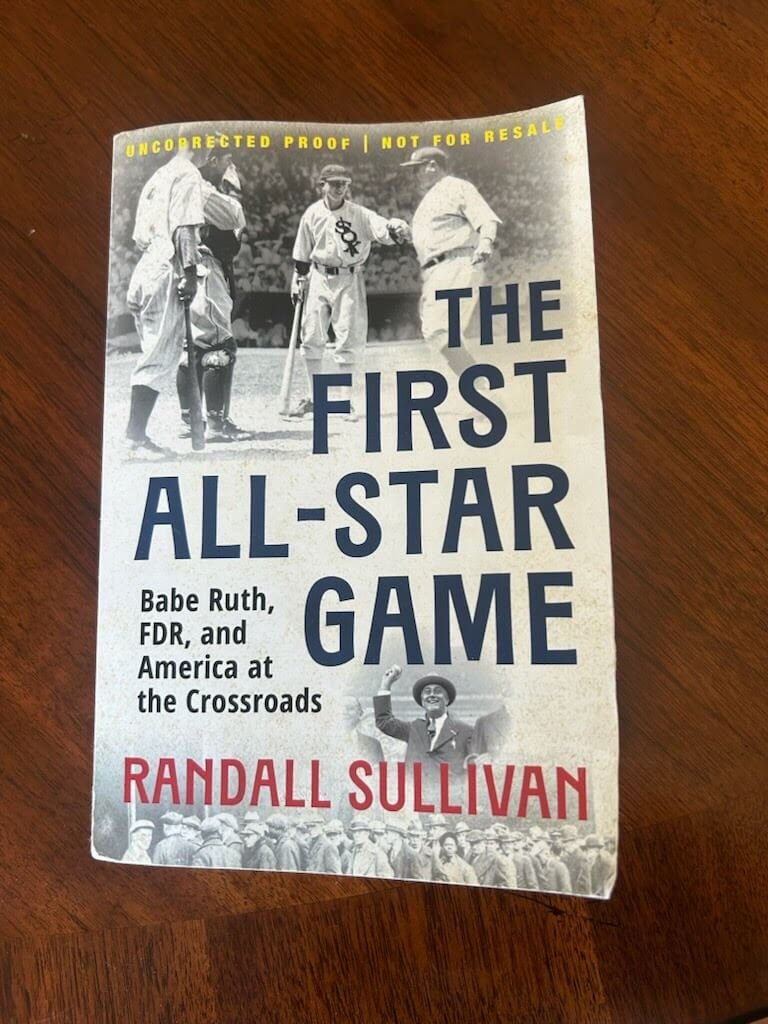
The First All-Star Game
By Randall Sullivan
Atlantic Monthly Press (2026)
The book title is a misnomer. Yes, the initial Major League Baseball All-Star Classic, held in 1933 at Chicago’s Comiskey Park, is featured. But the book covers so much more, offering a mini-history lesson on professional baseball in America during the opening decades of the 20th century.
And on life in America — heck in the world — during that time, too. Honestly, FDR hasn’t gotten this much publicity since his death more than 80 years ago. Randall Sullivan educated me on more than I bargained for in this book of more than 400 pages, with primary focus on what was billed as “The Game of the Century.”
Sullivan, incidentally, is a Sunset High grad who got his bachelor’s degree from Oregon in 1974. He evidently made a ton of money writing a book about the “Billionaire Boys Club,” a group of young adults in southern California who made tons more money facilitating a Ponzi scheme. A murder from within and subsequent trials added to a story that was eventually turned into a TV mini-series.
In this book, the author’s exhaustive research takes the reader back to the early 1870s and the beginning of pro baseball with the National Association of Professional Base Ball Players, setting the table for the National League (erstwhile known as the “Senior Circuit”) and American Association, and, in the late 1890s, American League. He eventually gets us to the 1930s and the brainchild of Chicago Tribune sports editor Arch Ward, the first All-Star Game, proposed as a highlight of the 1933 World’s Fair. (That’s right: sportswriters had some pull in those days.)
Not surprisingly, Babe Ruth gets a major chunk of attention. But every single player on both teams in the game gets a mini-profile, with plenty of background and context on the careers of each.
Some were players that people familiar with the history of the game recognize, players such as Lou Gehrig, Lefty Grove, Joe Cronin, Bill Dickey, Jimmie Foxx, Frankie Frisch, Bill Terry, Gabby Hartnett, Carl Hubbell, Lefty O’Doul and Paul Waner. There are others you likely never heard of, but you will know all about after reading the book. Such as:
“The St. Louis Browns’ Sam West was the best centerfielder in baseball defensively and a fine hitter, too, one who would bat above .300 10 times over his career despite having chopped off two fingers of his right hand in his family’s kitchen as a boy growing up in Rule, Texas.” That’s a lot of info in one sentence.
There is a treasure trove of sidebars, anecdotes and statistics from the era leading up to the game, along with some peripheral information that may have little connection but still holds interest. There is a strong section on black baseball and the Negro Leagues, including some good stuff on Satchel Paige. (I agree with Sullivan’s assertion that, while there was some good ball played in the Negro Leagues and some outstanding players, their statistics should not be incorporated with the Major Leagues. Records in those years were dicey, and the level of play in general not to the standards of MLB.)
The author offers some perspective to and history behind a shaky relationship between Ruth and Gehrig for several years, and the amazingly toxic relationship between legendary manager John McGraw and the most famous umpire of the day, Bill Klem.
Finally, on page 366, Sullivan gets to the game itself, which was in many ways anticlimactic. But it was, as he writes, “a resounding success,” making more than $45,000 in net receipts — a lot of money during the heart of the Great Depression — and setting the foundation for the organization that has helped hundreds of former players with financial or medical issues through the years.
If you love baseball and/or American history, I strongly recommend this book. It will take awhile to get through it, but it is worth the time.
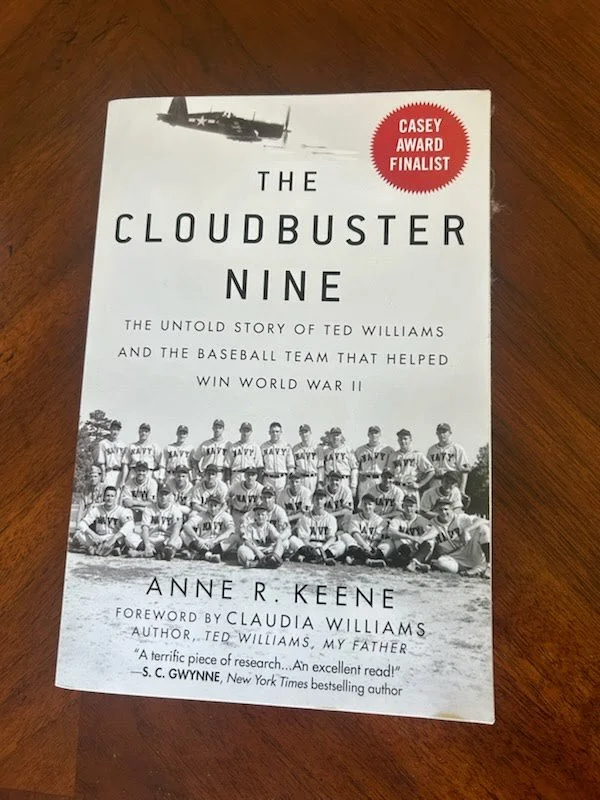
The Cloudbuster Nine
By Anne Keene
2018
This is another baseball history book, but really not a sports book. My son Troy gave me this book about an overlooked if not forgotten baseball team that gathered during World War II.
The author is the daughter of Jimmy Raugh, who had been the batboy for the “Cloudbuster Nine,” a group of MLB and pro players who were cadets in the U.S. Navy’s pre-flight training program. Raugh later pitched for the University of North Carolina and in the minor leagues, where at one point he was managed by Johnny Pesky with the Victoria Rosebuds of the Double-A Texas League.
Pesky, the Portland native who rose to stardom as shortstop of the Red Sox, is one of the central figures in the book along with his Boston teammate, the legendary Ted Williams.
(The following is a link to a story I wrote on Pesky with the Portland Tribune in 2004:)
https://portlandtribune.com/2012/08/22/diamond-life-johnny-pesky/
It was such a different world then. Many big-leaguers volunteered for service in the military, proud to fight for their country and freedom in the world, interrupting their baseball careers for the greater cause. Patriotism had a different meaning than it seems to today.
As part of the V-5 Naval Aviation Cadet Program, which had been created in 1935, the Cloudbusters gathered at the North Carolina campus in Chapel Hill. It was one of nine campuses across the country utilized to train men to become fighter pilots. During the war, 80,000 men cycled through the pre-flight training programs, including MLB players and football luminaries as well as men who became astronauts, U.S. presidents and Hollywood entertainers.
Plenty of names are dropped in the book that I recognize. From baseball, Dom DiMaggio, Pee Wee Reese, Bobby Brown, Hank Greenberg, Charlie Gehringer and Johnny Sain. And other sports figures such as Cornelius Warnerdam, Bear Bryant, John Wooden, Frank McGuire, Tippy Dye, Otto Graham, Gene Tunney and Tom Hamilton, who one day would become the first commissioner of the Pac-8. Also, John Glenn and George H.W. Bush.
The Cloudbusters played 40-some games against military, service and college opponents, and even against the Yanklands, a team managed by Babe Ruth. (Ruth took his final plate appearance wearing his No. 3 jersey at Yankee Stadium against the Cloudbusters that summer, drawing a walk.) The Cloudbusters didn’t lose many of them.
Keene interviewed a number of people and their descendants from those who played with the Cloudbusters, including Ivan Fleser, at 96 the last living player off the team. Those interviews and Keene’s research provided a number of anecdotes that put that period in perspective some 75 years later.
There were a few sections that I found myself skimming through midway through the book, but on balance, it was a worthy read. Keene writes well and tells the story of a team I had no idea even existed, but should not be forgotten.

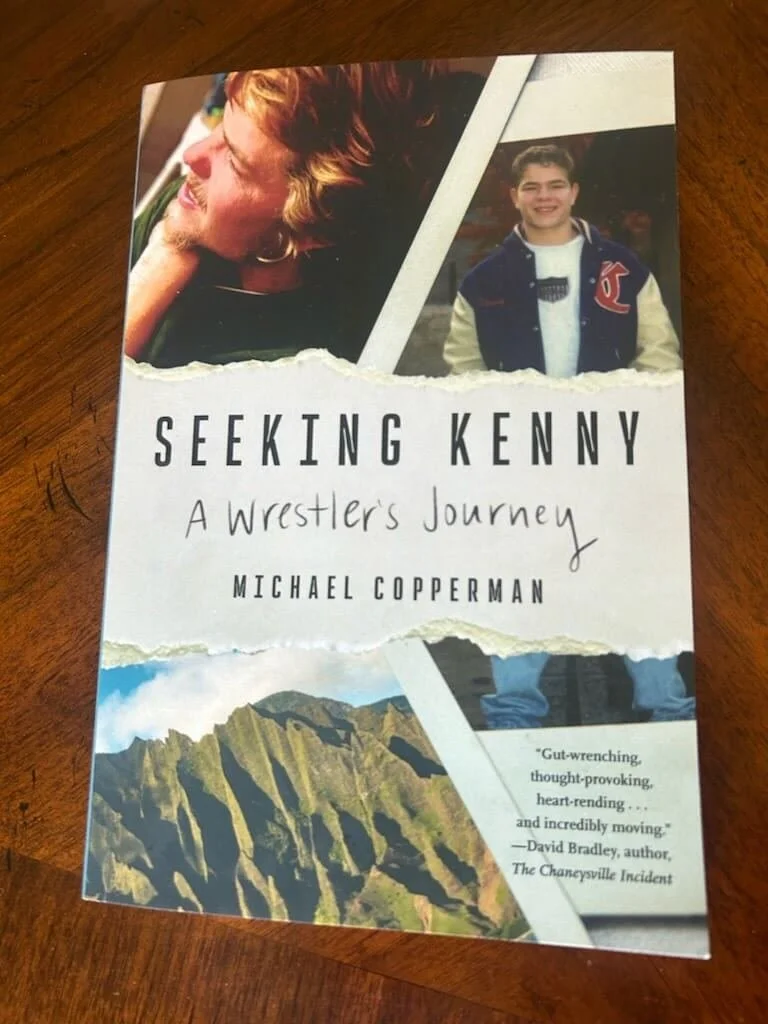
Seeking Kenny: A Wrestler’s Journey
By Michael Copperman
University of Iowa Press (2026)
When I read the first few chapters of this book, I was afraid it was going to be as much about the author as about the protagonist himself.
As it turns out, Michael Copperman introduces himself as a wrestler of some repute, then pretty much gets out of the way and turns things over to the life of Kenny Cox — an interesting one at that.
Copperman calls Cox “the most decorated prep wrestler in U.S. history,” which is hyperbole. But Cox was a standout at Churchill High in the late 1990s, the 1997 Asics High School Wrestler of the Year. He was a three-time state champion and won five Junior National titles while in high school, amassing a record of 155-7. Copperman was a successful wrestler himself at South Eugene High, a year behind Cox in school, and went on to wrestle at Stanford.
The author, now an assistant professor at Michigan State, writes with a certain infatuation about Cox. They were teammates on a couple of Oregon teams that competed at the Junior Nationals and later coached together at South Eugene.
The story is told primarily through the eyes of parents George and Vivien, Kenny’s three sisters and many of those who spent time around Cox during his life.
Copperman paints a picture of a person who was very much a paradox — on one hand a loving, caring person, adored by his family, liked, respected and admired by his friends. “He had a kind-hearted nature,” one sister said. On the other hand, he was someone with bipolar tendencies who lived with bouts of depression and dealt with mental issues that may have led to an untimely death at 31 in 2009.
Cox wrestled, though unsuccessfully, at Oregon, where he was never a regular through parts of his three seasons. The biggest issue was extreme difficulties with cutting weight, a subject Copperman emphasizes as having been a horror story not only for Cox but for many of those in the sport in that era.
From childhood, Cox loved nature and being outdoors — fishing, hiking, camping, exploring. He was independent from his early years — he proposed to his parents a three-week solo trip in the woods in the summer of 1992, when he was turning 14 (after negotiations, it became a week).
He loved to push others to see what they could achieve, but especially within himself. At age 25, he completed a difficult 31-mile race along the McKenzie River with little training or preparation.
The Cox family was deeply religious. Before his high school matches, Kenny’s father would take him aside on the mat, massage his arms and shoulders and recite verses from the New Testament. Until he was 22, Cox was devoted mostly to wrestling and his Christian faith.
There is no doubt Kenny was different. As a young adult, he bought a house in Oregon, rented it out and slept in a teepee in the backyard for four years. Once, while visiting friends before Christmas, they woke up in the early morning hours and saw him sitting by the tree naked. He looked at them and said, “You realize this is the end? The world is ending.” (The author’s inference is that the behavior wasn’t drug- or alcohol-induced.)
As he came to adulthood, Cox decided he did not want any part of the nine-to-five, business-suit working world. He became a loner, embarking on a seven-month odyssey from Oregon to Mexico and back on foot — much of it barefoot after being robbed of many of his possessions. On that trip, he took on odd jobs and became a dumpster diver to keep food in his belly.
The last four months of his life were in Kauai, when he lived on a farm and worked there for food, rent and $50 a month. Ironically, his parents had come to visit him when he died from what was diagnosed as acute hemorrhagic pneumonia with sepsis.
His epitaph: “Lover of nature, others and the truth.” I would add: “Good man. Bad ending.”
► ◄
Readers: what are your thoughts? I would love to hear them in the comments below. On the comments entry screen, only your name is required, your email address and website are optional, and may be left blank.
Follow me on BlueSky.
Follow me on X (formerly Twitter).
Like me on Facebook.
Find me on Instagram.
