Talking ‘Miz-zles,’ along with minor-league marvels Rick Sweet and Dave Brundage
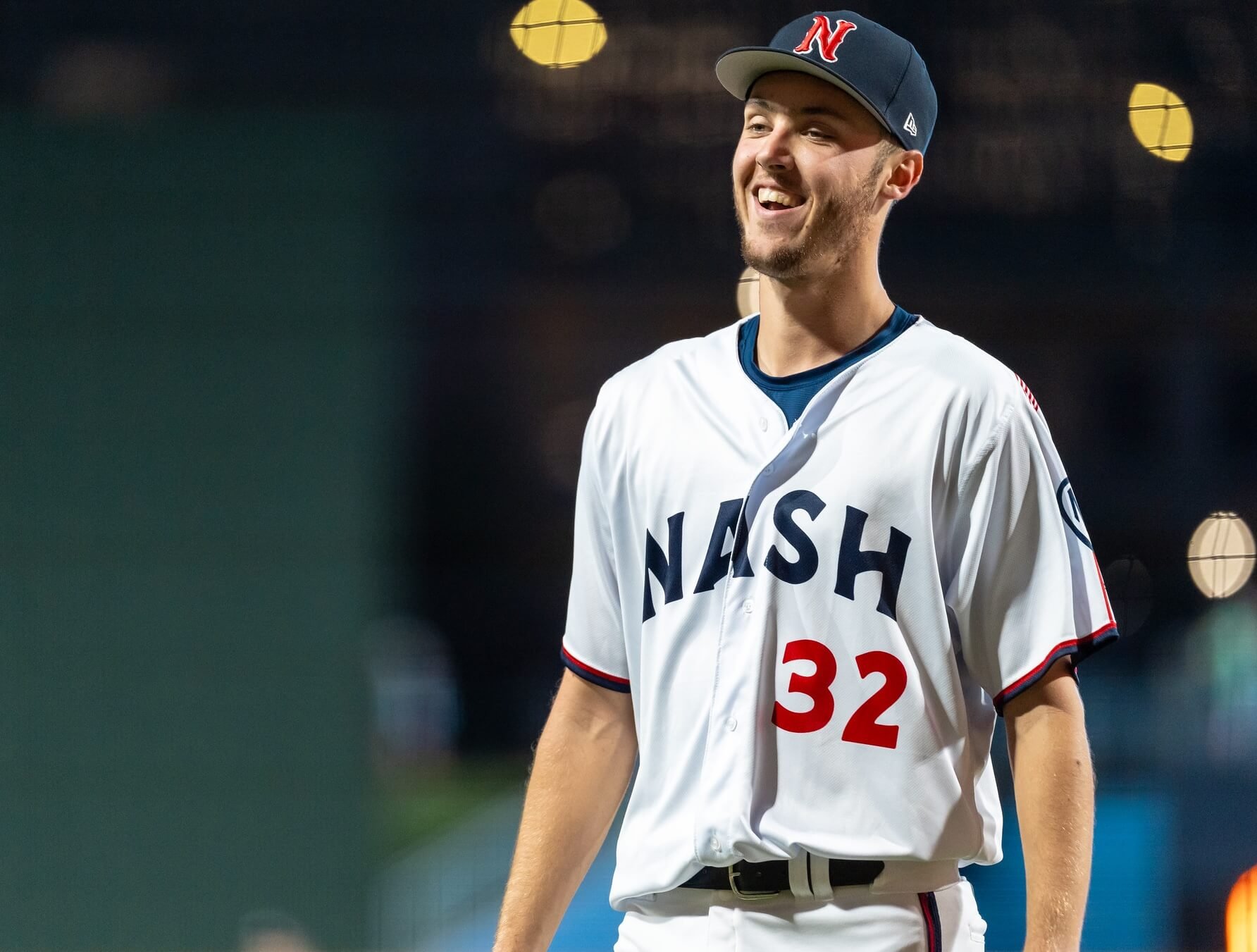
In his first full major league season, Milwaukee pitcher Jacob Misiorowski is throwing harder and faster than anyone before him (courtesy Nashville Sounds)
Jacob Misiorowski hasn’t just taken Major League Baseball by storm.
More like by tornado, or something even greater.
“Hurricane Miz” has been in full force for the Milwaukee Brewers this season.
The 24-year-old right-hander is blowing away hitters with a heater the likes of professional baseball has never seen in its 150 years of existence.
From Walter Johnson to Bob Feller to Nolan Ryan to Shohei Ohtani, starting pitchers have never thrown a fastball with the velocity and frequency of the 6-7, 200-pound Misiorowski.
“There is nobody out there like him — never has been,” says Rick Sweet, the manager of the Triple-A Nashville Sounds, who managed Misiorowski during parts of the 2024 and ’25 seasons. “He sizzles, and it is all the time. He throws it in the first inning and his last, and he doesn’t get under 100 (miles per hour).
“You can tell I get excited about him. He is the most exciting pitcher I have ever had. It just happened. He quickly became what he is — dominating.”
This is a hybrid column, about not only the Brewers’ young pitching phenom but also about Sweet, the Longview, Wash., native who will one day soon hold the record for career victories for minor league managers. And also about Dave Brundage, the Salem native who is closing in on the 2,000-win mark as a minor league manager himself.
Let’s focus first on Misiorowski, who is throwing the baseball with more velocity and rapidity than any pitcher in the game’s history. He has topped out this season with a pitch clocked on the radar gun at 105.5 mph against the Chicago Cubs in June, the highest of any starter in the Statcast era (since 2015). Reliever Aroldis Chapman’s 105.8 is the highest during that span.
And to Sweet’s point, Misiorowski does it again and again and again. He has the most 100-mph pitches in a game — an incredible 57 against St. Louis in May.
But “Miz” is not just a fireballer. He has become a complete pitcher in his first full big-league campaign. Milwaukee’s ace is 12-5 with MLB bests in ERA (1.75), strikeouts (210 in 139 innings) and opponents batting average (.151). And he has issued only 31 walks, or one every 4 1/2 innings, one of the best ratios in baseball.
“When ‘Miz’ took the mound last season, you could see he had electric stuff,” says Pat Casey, the former Oregon State coach now in his second full season working part-time in player development for the Brewers. “Now everybody is really pleased with how well he has commanded that stuff. As the season has gone on, he has just kept getting better and better. I am sure a lot of that comes from an inner confidence rising with each start.”
Misiorowski put together a scoreless streak of 29 1/3 innings in May. On June 12, “Miz” achieved what is known as a “Maddux,” going nine innings with fewer than 100 pitches. He threw a one-hit shutout on 95 pitches with 15 strikeouts in a 6-0 win over Philadelphia.
On Aug. 9, “Miz” reached 200 strikeouts in his 130th inning, becoming the second-fastest ever to do that, behind only Atlanta’s Spencer Strider (124th inning) in 2023.
In 23 starts, he has never allowed more than three earned runs, and has allowed one or fewer 15 times. The most hits he has yielded is six in a six-inning stint in a 6-3 10-inning loss to Pittsburgh. He has double-figure strikeouts in 10 games and has issued only four walks in his last 40 innings. The fastball has been only part of his repertoire.
“He is understanding how his breaking stuff moves and what he can do with it on any particular day,” Milwaukee manager Pat Murphy told reporters after his last start, in which he allowed five hits with one walk and six strikeouts over six innings in a 4-1 win over the Dodgers. “He executed pitches.”
Misiorowski was raised in Grain Valley, Mo., a town of 17,000 located a half-hour east of Kansas City, and grew up a fan of the Royals. He graduated from Grain Valley High in 2020 and committed to Oklahoma State. But it was the Covid year, and he decided to attend Crowder JC in Neosho, Mo., a bit closer to home. The slender right-hander pitched two games as a freshman in 2021 before a knee injury ended his season.
As a sophomore, Misiorowski went 10-0 with a 2.72 ERA and 136 strikeouts in 76 innings, earning second-team NJCAA All-America honors (there were pitchers who did better?). After the season, he participated in the MLB Combine and recorded the eight fastest pitches, averaging 99.8 mph. The Brewers — still a bit leery of control issues — took him with the 63rd overall pick in the second round of the 2022 draft. But he received a signing bonus of $2.35 million, more than double the slot value.
“Miz” quickly moved up in the Milwaukee farm system, arriving in Nashville at midseason 2024 after beginning the year in Double-A Biloxi. In 14 appearances, including two starts, with the Sounds, he was 0-1 with a 2.55 ERA, yielding only five hits with 10 walks and 22 strikeouts in 17 2/3 innings.
“He was a young kid, still only 22,” Sweet recalls. “We wanted him to focus on short spurts, because he had a tendency to be a little wild. He had a tremendous arm. When he was pitching for me, he would maybe touch 100 (mph), but was more at 96, 97. His off-speed pitches were OK, but he didn’t have that good command you have to have as a starter. We all thought he was going to be a starter, but we tried to break him in slowly.”
With Nashville in ’24, Misiorowski notched a little more than a strikeout an inning. In 13 games with the Sounds the next season, 12 of them starts, he fanned 80 in 63 1/3 innings. Somewhere in there, all the wires connected, Sweet says.
“I don’t know the exact date, but he pitched a ballgame, and all of a sudden, everything clicked,” he says. “And we thought, ‘OK, that’s what he could be.’ The velo was up a tick, but not tremendously. But his command of the off-speed stuff — the breaking ball and changeup — became equals to his fastball.
“He started playing with hitters. I’m telling you, he would stand on the mound, look into the dugout and nod at us like, ‘Watch this.’ He would rare back and throw 101 right by a (batter). Three or four pitches later, he would look in again like, ‘Watch this.’ He would drop a curveball on a (batter), and that guy would be diving out of the way, and the ball would break over the plate, and he would grin.
“He would throw a changeup and (the batter) would swing two times at it trying to hit that 100-mph fastball that, all of a sudden, was coming in at 88.”
Sweet soon had conversations with the powers-that-be from the parent club, including Murphy and pitching coach Chris Hook.
“I don’t know if it is going to last,” Sweet told them, “but this kid is getting it.”
“We kept an eye on him, and the velo kept perking up,” Sweet tells me. “I don’t want to say it happened overnight, but it did. He became ‘The Miz’ from one game to the next. It clicked for him, and he just kept getting better and better. Now he is in the big leagues and playing with batters up there.”
In June 2025, Misiorowski was promoted to the Brewers. In his debut, he threw five innings of no-hit ball, earning the win in a 6-0 victory over St. Louis and topping out at 102.3 mph. In the sixth, he felt cramps in a quad and calf and also turned an ankle while making his 81st pitch. He departed with four walks and five strikeouts.
A month later, after five outings, “The Miz” was named to the All-Star Game. He became the quickest player ever to make the Midsummer Classic, faster even than Pittsburgh’s Paul Skenes, who made it after 11 games in 2024. Misiorowski pitched in three games in the playoffs, going 2-1 with a 1.50 ERA, striking out 16 batters in 12 innings. He took the loss in a 3-1 setback to LA in the NLCS finale as the Dodgers completed a sweep on their way to a second consecutive World Series championship.
This season, it has been balls to the walls. The kid throws “Miz-zles” at batters, but he does it with ease.
“He has a very efficient delivery,” Casey says. “A lot of guys are what we call ‘max-effort pitchers.’ They put a lot of effort into trying to throw hard. He is an easy-effort, maximum-efficiency type of pitcher. What concerns (coaches) the most is when you see a pitcher do something that appears like it puts a lot of strain on the elbow or the shoulder. Maybe a guy is inefficient in his mechanics. With (Misiorowski), the delivery is clean, and the velo has increased like it should over time.”
Says Sweet: “You worry about arm problems, but his release point is so far out front, and he is so free and loose with his delivery.”
The Brewers have managed Misiorowski effectively this season. He has thrown 90 or more pitches 15 times, but he has normally pitched on an extra day or two of rest. He has thrown on five days rest only three times all season.

“The entire organization from the top down, they look after their arms,” Casey says. “ ‘Hooky’ and (assistant pitching coach) Jim Henderson are 100 percent looking out for him. It is about protecting the asset, but also it is figuring in the long haul. We want those guys at their peak when it means the most (in the postseason). They do an amazing job of managing the stress load.”
What kind of a person is Misiorowski?
“Great kid,” Casey says. “I know that only from being around him in the dugout. I haven’t gotten to know him personally. I am around hitters a lot more than pitchers. I know he is a tremendous teammate, that’s for sure.
“It is great to see players develop like that when they are young and eager to do well. There is a lot of pressure on those guys in the big leagues. He came up with a great staff last year, around pitchers like Freddie Peralta and (Brandon) Woodruff and (Abner) Uribe. He fit in with the older guys, and has taken it to another level.”
Sweet laughs when I ask the same question.
“You see that little smirk he gets on his face? That smirk tells you everything,” he says. “He is a happy-go-lucky kid. He likes to be at the ballpark. When you interview him, there is no cockiness to him, although don’t get me wrong, he is cocky. He is a great interview, a good kid, a good teammate, and he is special. He is fun to be around.”
How good can Misiorowski be? A better question would be, can he sustain his current excellence?
“I don’t know if he can get better,” Sweet says. “What is he gonna throw, 106? He will get better as he gains more knowledge of the league and hitters. Can his stuff get any better? I guess maybe the off-speed (stuff). But his stuff is so good now, it’s a matter of trusting it and letting it fly, and that’s what he does.”
► ◄
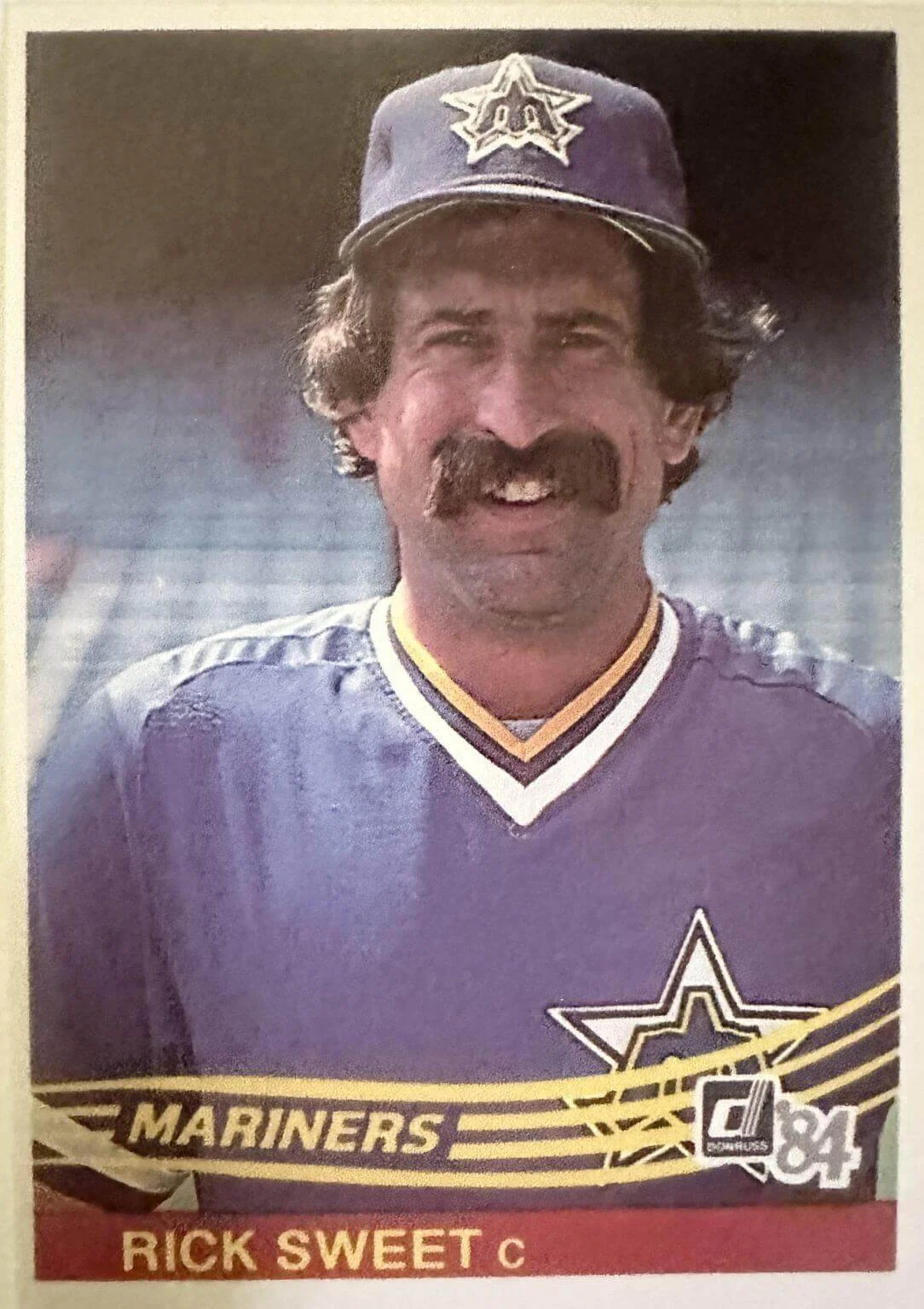
Sweet had his trademark Sam Elliott-like mustache even during his playing days with the Mariners
Since I have their attention, I ask Casey and Sweet about the evolution of pitching. Why are pitchers throwing so much harder in this era than any other?
“The physical training, the emphasis on nutrition,” Casey says. “They prepare so much earlier and better than we ever did before, everything from arm care to nutrition to weight-lifting — the things they do to create explosion.
“And with analytics, they can show them how to maximize efficiency in terms of velocity and how to load your lower half and deliver the ball. Pitchers get stronger earlier. When I was playing in the (Pacific Coast League), if a guy was throwing 95, he was up there. Right now, the average velocity in the big leagues is way up there. That’s what they do. It’s happening in front of our eyes every night.”
Sweet isn’t sure it is all for the better. It has created a bonanza, for sure, for arm surgeons.
“So many pitchers are getting hurt,” he says. “All people talk about is velocity. It starts when the kids are playing Little League, travel ball. All the kids try to do is throw harder. The arm is not made to do that, and that is why we have so many injuries.
“I have velo coaches tell me, ‘What do you want them to do, go back to throwing in the low 90s?’ I say well, (Greg) Maddux and (Tom) Glavine worked out pretty well. When they needed 97, 98 they could get it, but they were pitchers. What we have now is a whole heck of a lot of throwers, and all they talk about is how hard can you throw. That is what we teach. Throw as hard as you can every pitch. That is why we have so many blowouts of elbows and shoulders. It is all about velocity.”
There is danger, especially at a young age, to that.
“Some of the younger kids — in particular, between ages 12 and 17 — go to a lot of places, and some of the things they do creates velocity a little faster than they should, puts a lot of torque and stress on the throwing arm,” Casey says. “You want that to be a natural progression. You progress into that velocity through the efficiency of your mechanics. Young kids have to be careful about how quickly they start throwing hard. The number of arm surgeries has gone up astronomically over the last 15 years.”
► ◄
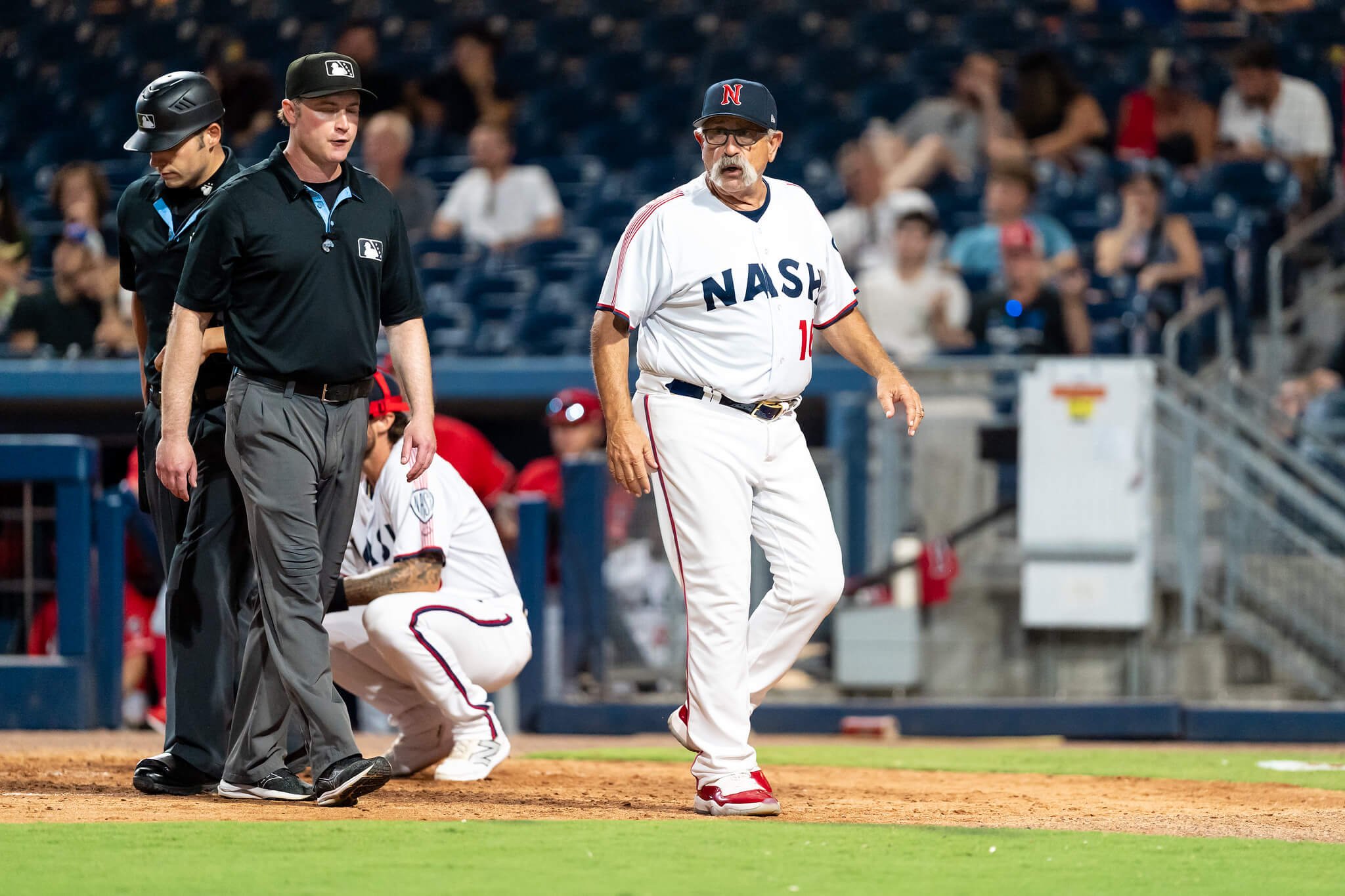
Rick Sweet says Misiorowski is “the most exciting pitcher” he has managed in a 36-year minor league career (courtesy Nashville Sounds)
Let’s turn our attention to Sweet, the mustachioed, seasoned grandfather who turns 74 on Sept. 7. He played one year of college ball at Lower Columbia CC in Longview, then two years at Gonzaga before a nine-year pro career as a catcher. He played three major league seasons, the last two with Seattle in 1982 and ’83. He hit .234 with six homers in 272 games in the big leagues.
Then Sweet embarked on a managerial career that has brought him to the doorstep of history. Through 36 years as a minor league manager — most of them at the Triple-A level — he has amassed a record of 2,503-2,294. The career record for most victories by a minor league manager is held by Stan Wasiak, who was 2,530-2,314 in 37 seasons, mostly in Single-A, before retiring in 1986.
Personal note: Wasiak managed the Salem Dodgers of the Northwest League from 1961-65. As a 10-year-old playing Little League in Corvallis during that time, I attended a kids camp the Dodgers held in Salem. Somewhere in a scrapbook in my attic, there is a newspaper clipping with a photo of Wasiak instructing me on my batting stance.
I knew Sweet when he served as manager of the PCL Portland Beavers from 2001-03, the first three seasons of Triple-A baseball in Portland since the franchise departed to Salt Lake City after the 1993 campaign. What was then known as PGE Park had undergone major renovations, and the ballpark was nice, if the stands mostly empty during Sweet’s three seasons during which the Beavers — a San Diego Padres affiliate — played about .500 ball. He recalls those years fondly.
“Portland was an absolute blast,” he says. “It was home for me. I was living in Vancouver. I was back with the Padres, whom I signed with (as a player out of college). It was a perfect situation for me. With the renovations to the ballpark, it was beautiful. It’s a soccer field now, but all those renovations were done for baseball.
“I really felt like we had things in a good place. I wanted to make sure it worked. Unfortunately, it didn’t work out, not only for me, but for the Beavers.”
Sweet began his managerial career in 1987 at age 34 with Bellingham, a Mariners’ affiliate in the low-A Northwest League, fashioning a forgettable 30-46 record but managing a rookie who would go on to bigger things — Ken Griffey Jr. Rick would move up to Double-A in 1990 and to Triple-A in 1993, a level in which he has managed for 26 of his 36 seasons.
Sweet has managed in 13 states and one Canadian province (Ottawa in 2000). He has been honored as his league’s Manager of the Year four times, including three times in the Triple-A International League. And in 2022 he was presented with the Mike Coolbaugh Award, given to a minor league figure who shows an outstanding work ethic, knowledge of the game and skill in mentoring young players.
Sweet has worked for eight major league organizations, the last 12 years with Milwaukee in Triple-A stops at Colorado Springs, San Antonio and Nashville. He has managed teams to 25 winning seasons, including his last nine in the Brewers’ chain — no small feat with players coming and going from a roster all season long. Last year, the Sounds used 75 players.
The Sounds were 65-57 through Wednesday this season. They finished second in the IL West’s first half at 43-32 but are currently seventh among 10 teams in the division’s second half at 22-25.
Now their manager is on the precipice of history. With 28 games remaining, it’s not going to happen this season. But next year — and there is no reason to believe he won’t be back to manage Nashville for a seventh straight season — Sweet will pass Wasiak as the winningest minor league manager ever.
“I try not to get too deep into it,” Sweet says. “This is my 53rd year in pro baseball (as a player, coach or manager). If you had told me when I was playing at Lower Columbia, and then while I was at Gonzaga, that I was going to do this, I would have said, ’You’re crazy.’
“But it has happened, and quite frankly, I am still having a blast. People ask, ‘Why are you still doing this?’ Because I keep having fun. The kids make it fun.”
One of his mentors was former Mariners manager Rene Lachemann, who in a June feature story on Sweet in The Athletic, said, “He was dedicated to being a great teammate, the type of person who’s not in it for his own ego.”
In that story, Rick said this about himself: “I like the fact that I have adjusted with the game — not to the game, with the game. I can honestly say I have never lied, I have never deceived. I think my reputation with players is, ‘When Sweetie tells you something, that’s the way it is.’ ”
Sweet has managed every year since 1987 except in 1996, when he was first base coach for the Houston Astros; in 2012 and ’13, when he worked as a roving catching instructor for the Cincinnati Reds organization, and in 2020 due to Covid. In 1984, he served as bullpen coach for the Mariners. He has never managed in the major leagues.
“I wish I had gotten a chance,” Sweet told The Athletic. “I am healthy enough. I could do it. I still want one of those clubs to say, ‘You know what? This isn’t working. Who’s the winningest manager in the minors? Let’s get somebody who’s never done it up here, but all he has done is win.’ I keep waiting for that, but it doesn’t happen. I would do anything to get an opportunity to see if what I do would work in the big leagues.”
► ◄
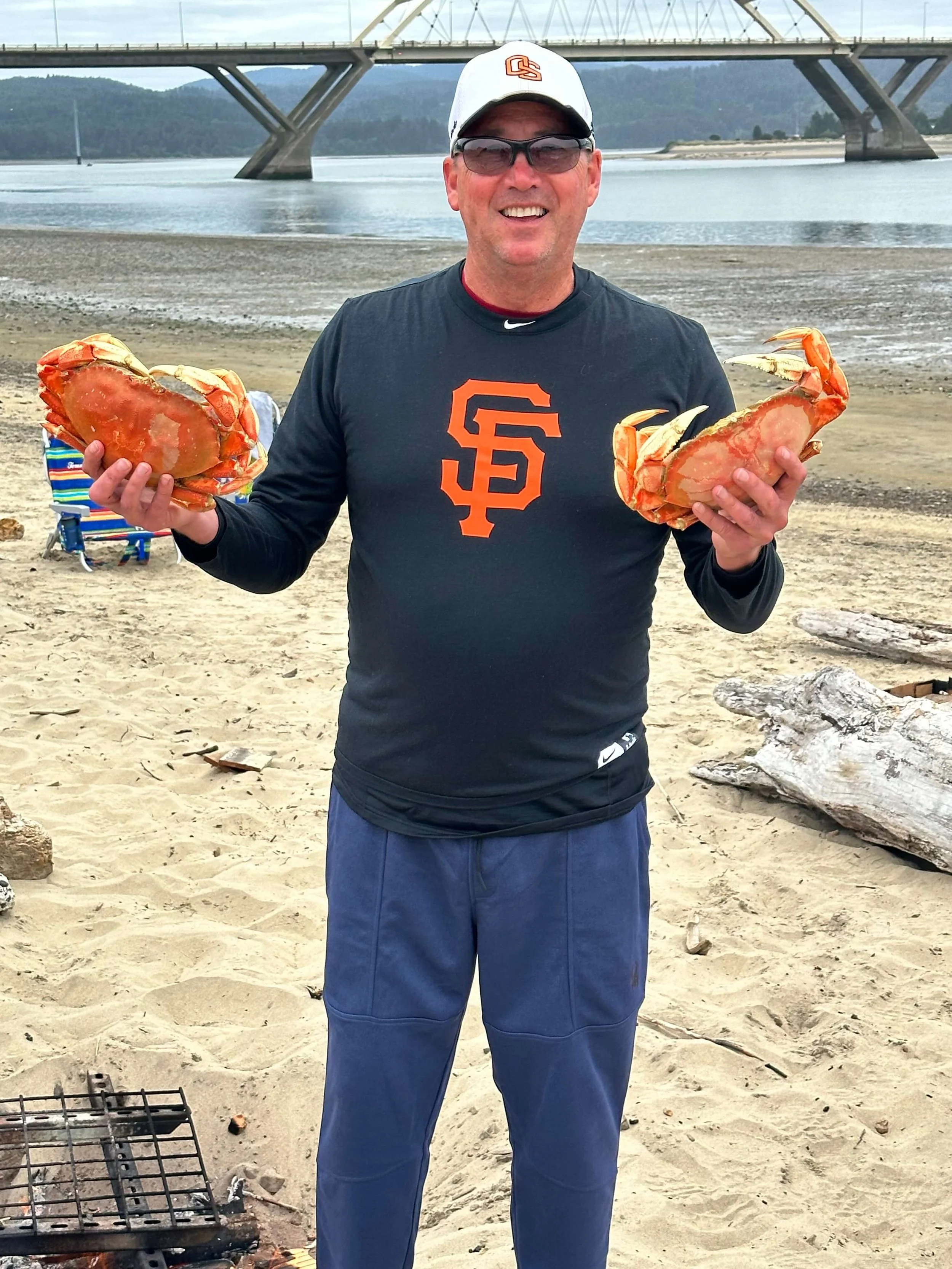
Salem native and former Oregon State star Dave Brundage is nearing his 2,000th win as a minor league manager (courtesy Dave Brundage)
Dave Brundage knows the feeling. Through a managerial career that has covered 28 seasons and nearly 2,000 victories, he has never had a sniff of the major leagues.
Brundage was an outstanding athlete at Oregon State, a left-handed pitcher and outfielder who was a second-team All-American and Pac-10 Northern Division Most Valuable Player as a junior in 1986. (He also punted 15 times in three games for Dave Kragthorpe’s OSU football team in 1985). During his junior year, Brundage hit .366 with eight home runs and 29 stolen bases. On the mound, he was 8-4 with a 3.19 ERA.
Taken in the fourth round of the 1986 MLB draft by Philadelphia, Brundage spent nine years in the minor leagues, the last six at the Triple-A level, mostly as a first baseman and outfielder. Those seasons were spent with the Calgary Cannons, for whom he hit .304 in 92 games in 1990 and .310 in 105 games in 1991, but low power numbers kept him out of the major leagues. Brundage’s career batting average was a solid .275, and he also pitched 41 games, 24 of them in 1994, his last season in pro ball, in which he carried a 2.96 ERA.
The next year, Brundage began his career as a manager with Riverside in high-A ball in the Mariners’ farm system. Except for three years from 1998-2000, when he was hitting coach at Triple-A Tacoma, he has been a manager every season since.
After six years as a Double-A manager, he moved up to manage at Triple-A Tacoma in 2006 and has been at that level since. He has managed for four organizations — Seattle, Atlanta, Philadelphia and, for the last 10 seasons, for San Francisco in Sacramento.
Brundage is working on his third straight winning campaign, and his River Cats are having a very successful season. Through Wednesday they were in first place in the PCL West’s second half at 28-19 after finishing second in the first half at 42-30. They are 70-49, running Brundage’s career mark to 1,978-1,972.
I have known Dave for many years; we are family by marriage. His late mother, Marcia, was married to my late uncle, Tom Pickens, for 27 years. Sweet knows Dave, too. Both of them managed in the International League from 2007-11 and in the PCL from 2017-19.
“I love Dave,” Sweet says. “We have known each other a long time. Brundy is a good baseball man. He is like me, a guy who truly enjoys what he does. He has been in the game a long time. I have managed against him and everything I know about him is, he is a good person, also.”
Brundage says good things about Sweet, too.
“Rick is a Northwest guy, so we have that natural connection,” Brundage says. “It is always fun to see him and say hello. I have so much respect for him because I know what he’s gone through to get there and survive and excel.
“The other day, somebody said, ‘You know Rick Sweet? You’re going to catch him.’ I said, ‘Hell no. I’ll be six feet under before I get remotely close.’ ”
Brundage, who turns 62 on Oct. 6, chuckles, then continues.
“Just being in the same conversation is humbling,” he says. “Rick is older than I am. There are some trying times at our level. This game beats you down. He and I have been (in the minors) pretty much our whole careers. I admire the way he goes about it. He knows everybody. Sometimes he seems like the mayor no matter what city he is in. His attitude is infectious.”
But Brundage’s longevity is extraordinary, too. He ranks third among current minor league managers in career victories, behind only Sweet and Pat Kelly, who is also coaching at the Triple-A level with the Louisville Bats. Kelly is at 2,127 wins and counting. Brundage knows Kelly. Besides managing against him, Dave coached Kelly’s son, Casey Kelly, with the River Cats in 2017 and ’18.
How does Brundage feel about nearing the 2,000-win plateau?
“Our team president brought it up earlier this season, but to tell you the truth, I have zero idea where I stand,” he says. “I don’t keep track of those things.”
When provided an update, he tells a story.
“My 1,000th win was in Gwinnett (in 2011),” he recalls. “I hadn’t been following along. We won the game, and afterward everyone came down onto the field and surprised me. They brought out a big champagne bottle. My players signed a base, and they gave it to me. I still have the base in my garage. What do you do with a base?”
What will 2,000 wins mean to him?
“It means you have put in the time,” Brundage says. “It means you have seen a lot of baseball, and I have had a pretty good seat along the way. It blows me away to hear that Rick has 2,500. I know the shoes he has walked in and understand the roads he has gone down to get to that point. As long as we’ve been doing this, baseball is imbedded in our blood.”
I ask if he is resentful that he has never gotten a chance at the major leagues.
“I’m not,” he says. “People ask me that an awful lot. It’s not what defines me as a manager. I love my job, and I have done my job. You don’t get to stick around if you don’t do your job. I am grateful I have gotten to coach and teach a lot of great players along the way. The stories that I have. … a lot of people have approached me about writing a book.”
Brundage says the best part of his job is getting to tell a player he is getting a promotion to the big leagues for the first time.
“I have probably done it over 1,000 times,” he says. “I know I have told a whole bunch of them the last two weeks since the trade deadline.
“Having to release somebody is the worst part of the job. With one, you are helping fulfill dreams. On the same night, you are taking somebody else’s dreams away. You just take the good with the bad along the way.”
Through most of his career, Dave and wife Dameron have made their home in Oregon. In recent years, that has been in West Linn.
“We have been married 30 years,” Dave says, “but I say 10, because I am gone so much. We make it work.”
The Brundages have three children. Oldest son Beau played outfield for two years at the University of Portland, hitting .378 in 53 games in 2018, and then spent four seasons the minor leagues. He is now working for Boeing in Charleston, S.C. Daughter Bayler just graduated from Portland State, where she played four years of varsity golf. Her twin brother Barret is currently at Oregon State.
Brundage isn’t sure about his future as a manager.
“I am going to sit down at the end of the season and evaluate with the family, see where I stand and figure out what I want to do,” he says. “Maybe something in a smaller capacity. But I don’t know the answer to that yet.
“If I do decide to walk away, I don’t want it to be anything big. I just want to do it on my own terms.”
There is no such indecision on the part of Sweet. He will be back with the Sounds in 2027 in pursuit of a record that he never intended on breaking.
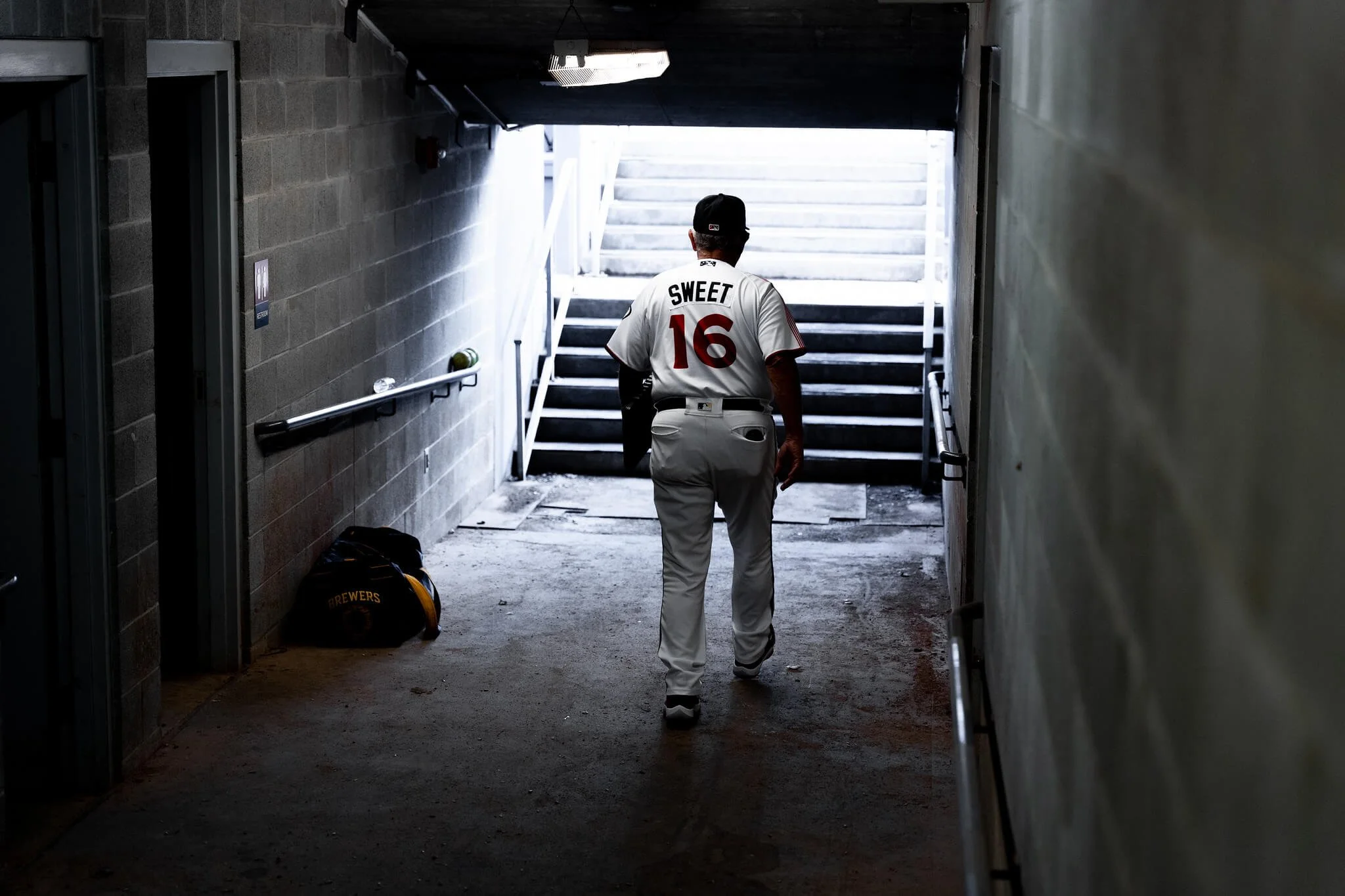
Sweet is closing in on a record for career wins by a minor league manager (courtesy Nashville Sounds)
Stan Wasiak never reached the major leagues, but he is represented at Cooperstown. The cap and lineup card from the 1985 game in which Wasiak broke the record is on display at the Baseball Hall of Fame. When Sweet breaks the record, the curators will probably ask for his mustache.
► ◄
Readers: what are your thoughts? I would love to hear them in the comments below. On the comments entry screen, only your name is required, your email address and website are optional, and may be left blank.
Follow me on BlueSky.
Follow me on X (formerly Twitter).
Like me on Facebook.
Find me on Instagram.
