Rick Adelman is gone, but definitely not forgotten
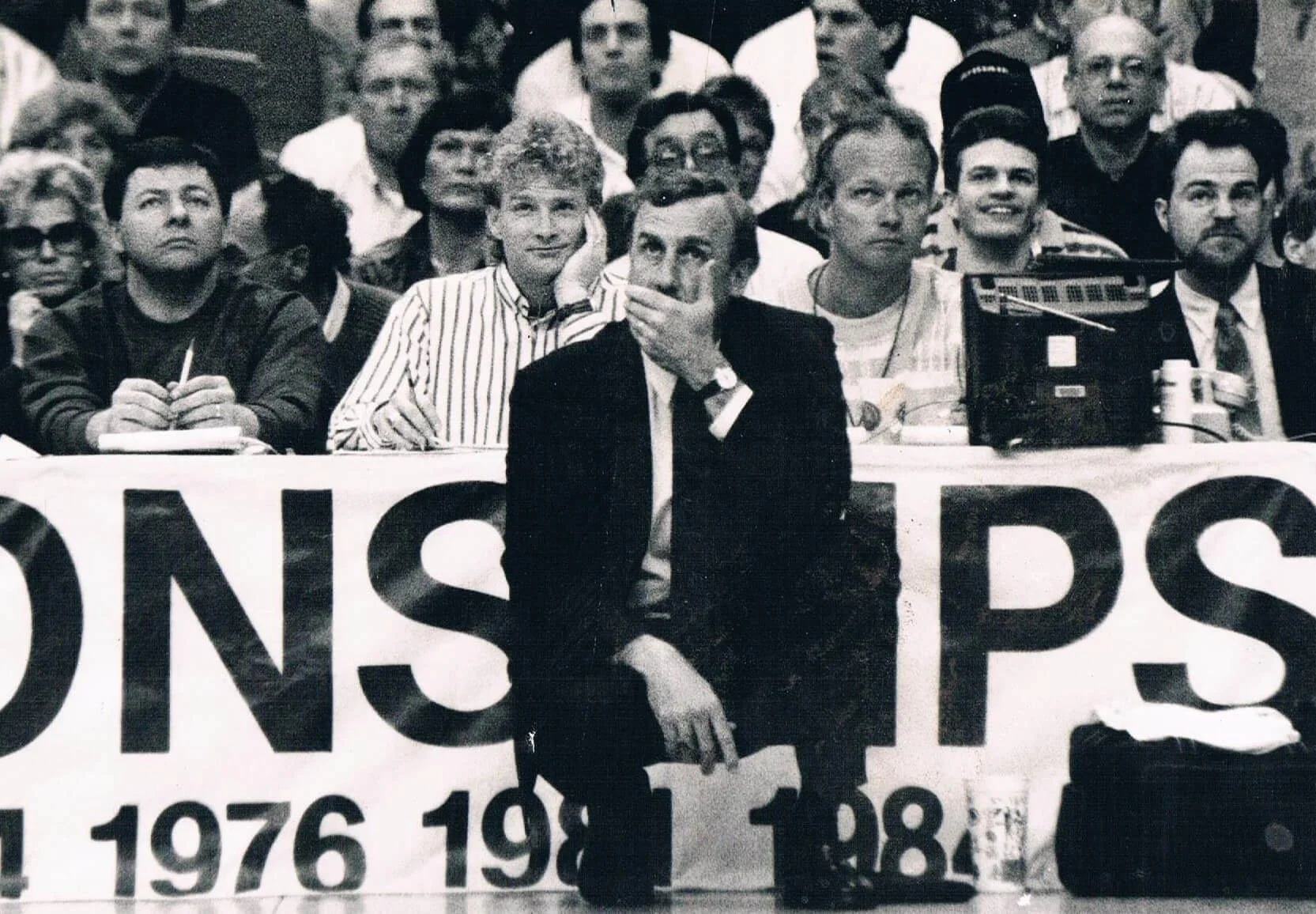
Rick Adelman during the 1990 NBA Finals. Behind him, from left, Paul Buker, Terry Frei and me along with Trail Blazers PR director John Lashway
The news that Rick Adelman had passed away swept across the NBA quickly on Monday. Before I had begun to reach out to people for a story on the Trail Blazers legend, I received a call from Clyde Drexler, who wanted to say a few things about his former coach.
“Such a good man, and a phenomenal coach,” Drexler told me. “We were as close as a player-coach relationship can be. Every player should be fortunate enough to be coached by Rick Adelman.”
That is the kind of respect Adelman commanded from those around him.
Adelman died in his sleep on Sunday at his Portland home, 15 days short of his 80th birthday. He had been dealing with health issues in recent years, including diabetes.
Adelman was head coach in Portland for only 5 1/2 seasons, but he was as connected to the fabric of the team, the city and the community as anyone in franchise history. He was starting point guard and captain of the first three Blazer teams, then was an assistant coach for Jack Ramsay and Mike Schuler before taking over as head coach midway through the 1988-89 season.
Coached by Adelman and led by the likes of Drexler, Terry Porter, Buck Williams and Jerome Kersey, the Blazers took off, reaching the NBA Finals in Rick’s first full season in 1989-90 and getting there again in ’92.
Paul Allen fired Adelman after back-to-back first-round playoff eliminations in ’93 and ’94, but he continued on with a distinguished 23-year head coaching career that included stops at Golden State, Sacramento, Houston and Minnesota.
By the time he retired in 2014, Adelman had accumulated 1,042 regular-season victories, which now ranks him 10th on the all-time list. His teams also won 79 playoff games, 14th-best ever. In 2021, Rick was inducted into the Naismith Basketball Hall of Fame. Two years later, he was honored with the Chuck Daly Lifetime Achievement Award by the National Basketball Coaches Association.
In a statement, NBA commissioner Adam Silver called Adelman “one of the most respected and accomplished coaches in NBA history.”
And now he is gone.
“I feel sad,” Rod Strickland told me late Monday night from his home in New York City. “Great man, great coach. He was a big part of my career.”
Williams, who played five seasons for Adelman in Portland, was emotional as we spoke on Monday.
“I never met a coach who, with only a few words, made as great an impact as Rick did,” said Williams from his home in Potomac, Md. “As iconic as he is in the sporting world and with the Portland community, I think 15 years from now people will appreciate him even more than they do today. His legacy will be (tied to) the impact he had on people.”
“Buck said it the best,” Strickland said. “I agree with that. Rick didn’t say a lot of words, but what he said meant something and gave you confidence.”
Over the past two days I have spoken with a number of those who were close to Adelman. Many used adjectives such as “innovative” and “humble.” Most also mentioned his devotion to family.
“Rick was a really good coach, and an even better man,” said Danny Ainge, who played for Adelman with the Blazers from 1990-92 and is now CEO of basketball operations with the Utah Jazz. “He was a good person, a family man. He had a big influence on my life.”
I came onto the Blazers beat for The Oregonian in 1989, working with Dwight Jaynes as we covered Adelman’s first full season as the team’s head coach. I couldn’t have had a better situation working the NBA for the first time. Dwight had covered the Blazers for five years and taught me the ropes. Rick was accommodating and as professional as any coach I have dealt with in the years since. I liked and respected him, and that went for assistant coaches John Wetzel and Jack Schalow and trainer Mike Shimensky, as well as that great group of players that averaged 60 regular-season victories through three seasons and reached the NBA Finals in 1990 and ’92.
Once I had gained Rick’s trust, I could go to him with questions that sometimes resulted in answers that were off the record, but always honest. It helped in my coverage of the team. I protected him when necessary but also gained a genuine perspective of what was happening with the Blazers, and could pass that on to the fans. Unlike some coaches, Rick understood that was a win-win situation. He knew we were doing our job, just like he was doing his.
Ramsay had the longest tenure as a Blazer head coach — 10 years — and won the franchise’s only championship in 1977. There is no doubting his greatness. For my money, though, Adelman stands as the greatest coach in club history. He had the best regular-season win-loss percentage (.654), the most playoff victories (40) and two of the team’s three trips to the Finals.
And he had the respect of so many of those he touched, not just in Portland but at all of his coaching stops, including the first one at Chemeketa Community College in Salem.
“Dad cared about the players and not himself,” David Adelman, Rick’s son, told me Wednesday night. “He believed in the group. He wanted the group to do well. He wanted his staff to do well. He was the guy in charge, but there was a genuine care there. That is hard to find in any aspect of life nowadays. When you are like that, people will follow you, because they believe you have their best interests at heart. He was always that way — with his family, with his players.”

Adelman grew up in Los Angeles. After a distinguished college career at Loyola Marymount — he averaged 21 points as a senior in 1967-68 — he made the San Diego Rockets as a seventh-round draft pick. A 6-1 guard, Rick averaged 6.3 points in 18.8 minutes a game on a team coached by Jack McMahon and led by Elvin Hayes and Jim Barnett. (Another reserve guard on that team: Pat Riley.) After two seasons in San Diego, Adelman was chosen in the expansion draft by Portland. Ironically, the Blazers also acquired Barnett in a trade for Larry Siegfried, whom they had taken in the expansion draft.
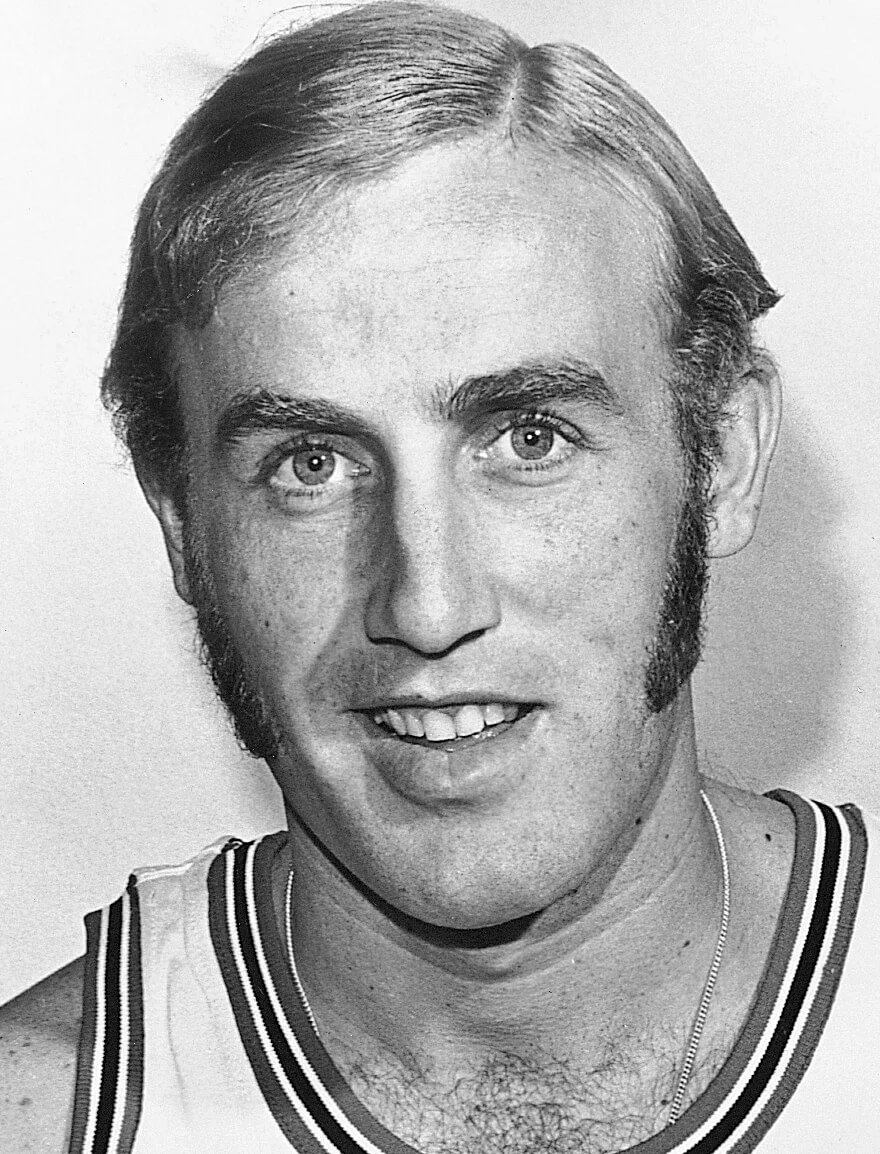
Rick was the captain of the inaugural Trail Blazer team (courtesy Bruce Ely)
So Adelman and Barnett, the former Oregon star, wound up playing three seasons together. The last one was as starters in 1970-71 on the inaugural Blazer team — Rick as the de facto point guard, Barnett as a 6-4 swing man in what amounted to a three-guard lineup including sharpshooting rookie Geoff Petrie.
Petrie was Co-Rookie of the Year with Boston’s Dave Cowens, averaging 24.8 points per game. Barnett was the No. 2 scorer with an 18.5-point average, which would be a career high over 11 NBA seasons. Adelman averaged a career-high 12.6 points and 4.7 assists.
“Rick wasn’t a big scorer, but he got the most out of his ability,” said Barnett, now retired and living in Orinda, Calif. “Jack McMahon liked him. He thought Rick could settle people down. We were a little rambunctious. The way I played, sometimes I was out of control. Rick was a very deliberate type of player who didn’t turn the ball over or make mistakes. He was a thinking-man’s player, because he didn’t have a lot of individual ability to score.”
Portland’s first-year coach, Rolland Todd, also looked at Adelman as a steady hand.
“I took chances,” Barnett said with a laugh. “I turned the ball over a heck of a lot more than Rick did. I was more risky.”
Barnett said he “absolutely” felt Adelman would wind up having a long, successful career as an NBA coach.
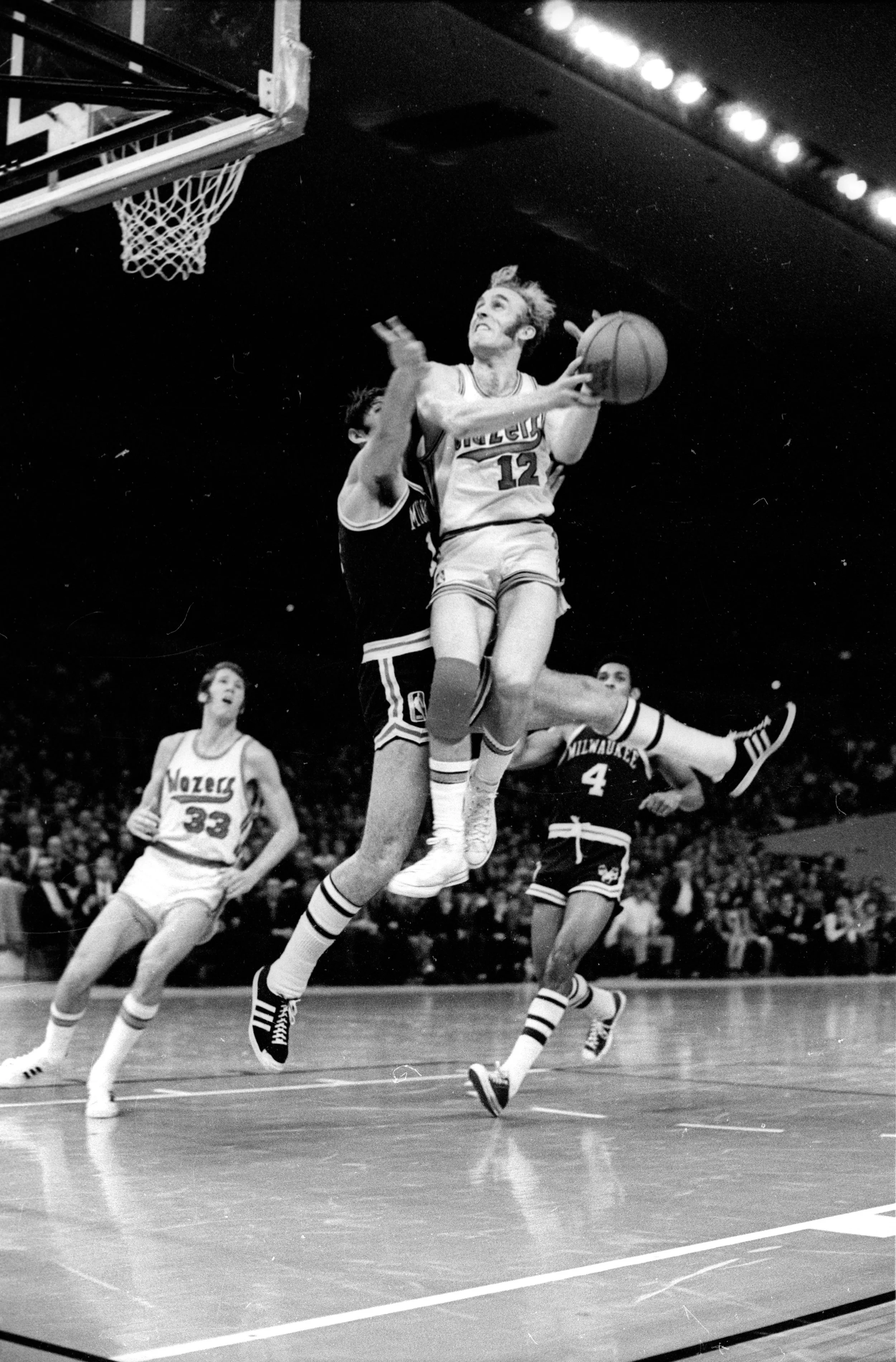
Adelman goes up for layup in a 1970 game against Milwaukee with teammate Jim Barnett (33) following the play (courtesy Bruce Ely)
“I thought that was where he would establish himself,” Barnett said. “I thought he would be a really good coach, and he was. He was made to be a coach. He knew how to play the game, knew how you needed to handle situations. He was a natural at that kind of thing. He was more suited to be a coach than a player.”
Petrie and Adelman roomed together on the road through Rick’s three years playing with the Blazers.
“We played golf and did a lot of stuff together during those years,” said Petrie, now retired and living in Granite Bay, Calif. “Even if those teams weren’t winning a lot, we had a lot of fun times. On the court, he was a consummate team guy. Because he was more of a role player than a star, he had that sense of how all players want to be treated. That contributed to his success as a coach.”
Adelman’s journeyman playing career took him to five teams in seven years ending in 1975. Career averages: 7.7 points, 3.5 assists. His longest stint anywhere was his three years with Portland, which became home for him and wife Mary Kay, who were married in 1970.
► ◄
In 1977, Rick began his coaching career at Chemeketa, displaying a willingness to learn the profession starting near the bottom level. Rick spent six years there, going 141-39 and claiming three conference titles or co-titles. After his playing career ended prematurely with a knee injury in 1976, Petrie stayed in Oregon and even served as interim coach at Willamette for a year.
“When Rick was at Chemeketa, I would sit on his bench some games and go to practice and help him with his team,” Petrie said.
In 1983, Adelman joined Ramsay’s staff as an assistant coach. The Blazers’ No. 1 draft choice was a youngster named Clyde Drexler.
“I was with Rick for 11 of my 11 1/2 years in Portland,” said Drexler, who beat Adelman to the Naismith Hall of Fame (class of 2004) and is now retired and living in Houston. “Rookies did a lot of stuff with assistant coaches in those days, so I spent a lot of time with Rick. He was awesome to work with. Always a source of support. Very positive. He was always on your side, every day. He was kind; he was smart. The ultimate gentleman.”
Over the next two years, the Blazers landed a couple of plums late in the draft — Kersey in the second round in 1985 and Porter with the 24th pick in 1986. Adelman, with help from Petrie, worked individually with both through the season and in the summers, helping them with shooting and developing their skills.
“Rick was incredibly important in my life, both professionally and personally,” said Porter, retired and living in Naples, Fla. “We spent countless hours together talking about the game and working through shooting sessions. He believed in me, trusted me and gave me the confidence to grow as a player.”
“I was really impressed with the way Terry developed into a very good player,” Ainge said. “Rick’s individual work with him must have paid off.”
In his first season with Portland in 1986-87, Schuler took the Blazers to a 49-33 record and was named NBA Coach of the Year. In 1987-88, the Blazers went 53-29, but both years they lost in the first round of the playoffs. In the middle of the next season, with Portland at 25-24, Schuler was fired and Adelman elevated to interim coach. The Blazers finished 39-43 and lost in the first round of the playoffs, but Allen — at the advice of many, including Drexler — kept Adelman on, signing him to a one-year contract as head coach.
In the 1989 offseason, the Blazers traded for Williams and added rookie Cliff Robinson, who served as a versatile front-line player and sixth man. The Blazers went 59-23 in the regular season and advanced to the Finals, losing in five games to defending champion Detroit. Adelman, who had made a believer out of Allen, got a multi-year contract extension and a well-deserved raise.
After the season, Petrie moved over from the radio booth into a front-office position as Portland’s senior vice president/operations. The next season, having added Ainge to the bench, Portland finished with the best regular-season record in the league at 63-19, going into the playoffs as co-favorites with Chicago to win it all. The Blazers hit a road block in the Western Conference finals, losing to the Lakers, who fell to the Bulls in the Finals in the first of their six championships through the ‘90s.
In 1991-92, Portland was 57-25 and returned to the Finals, only to lose in six games to Michael Jordan and the Bulls. One of the players who came off a loaded Blazer bench that season was Robert Pack, a mercurial rookie guard who arrived undrafted out of Southern Cal. Pack would go on to a 13-year playing career for seven NBA teams.
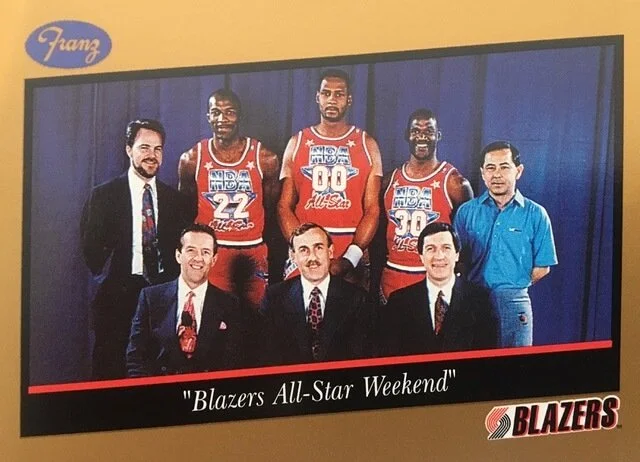
A Franz trading card with a photo of the Trail Blazers delegation that represented the franchise in the 1991 NBA All-Star Game at Charlotte. Front row from left, assistant coach Jack Schalow, Adelman and assistant coach John Wetzel. Back row= from left, PR director John Lashway, Clyde Drexler, Kevin Duckworth, Terry Porter and trainer Mike Shimensky (courtesy John Lashway)
“I learned more as I went on about how much of a players’ coach Rick was,” said Pack, now head coach of the Seattle Superhawks, who are 20-1 and favored to win the U.S. Basketball League championship. “He understood the game and how to handle young players. He gave me a fair shot to make the team, then had the confidence to put me in games during stretches of the season. And that helped give me confidence to be able to move on through the rest of my career.”
Pack puts Adelman “at the top” of the list of NBA coaches he played for.
“Sometimes, Rick would pull me aside to talk and ask me about other things besides basketball, about my family and things like that,” Pack said. “It made me realize how good a person he was. He was emphasizing doing the right thing.
“It was the perfect situation for me, being on a veteran team, but also to have a coach like Rick who had patience with me, who trusted me and put me out there where I would make mistakes but could learn from them. He was absolutely the perfect coach for me coming into the league.”
After retirement as a player, Pack put in 12 years as an assistant coach in the NBA.
“Rick set the tone for my career, and made me understand what a coach was supposed to do with young players,” Pack said. “That has helped me through my coaching career with handling young players and allowing them to make mistakes, to identify things about their game and showing them how to maximize their talents. He helped me become a better coach.”
Porter also had a long coaching career which began with a stint as an assistant with the Timberwolves under Adelman. Terry later served as head coach of the Milwaukee Bucks and Phoenix Suns and then at the University of Portland.
“As I was getting into coaching, Rick became an invaluable mentor,” Porter said. “His guidance, wisdom and friendship meant the world to me.”
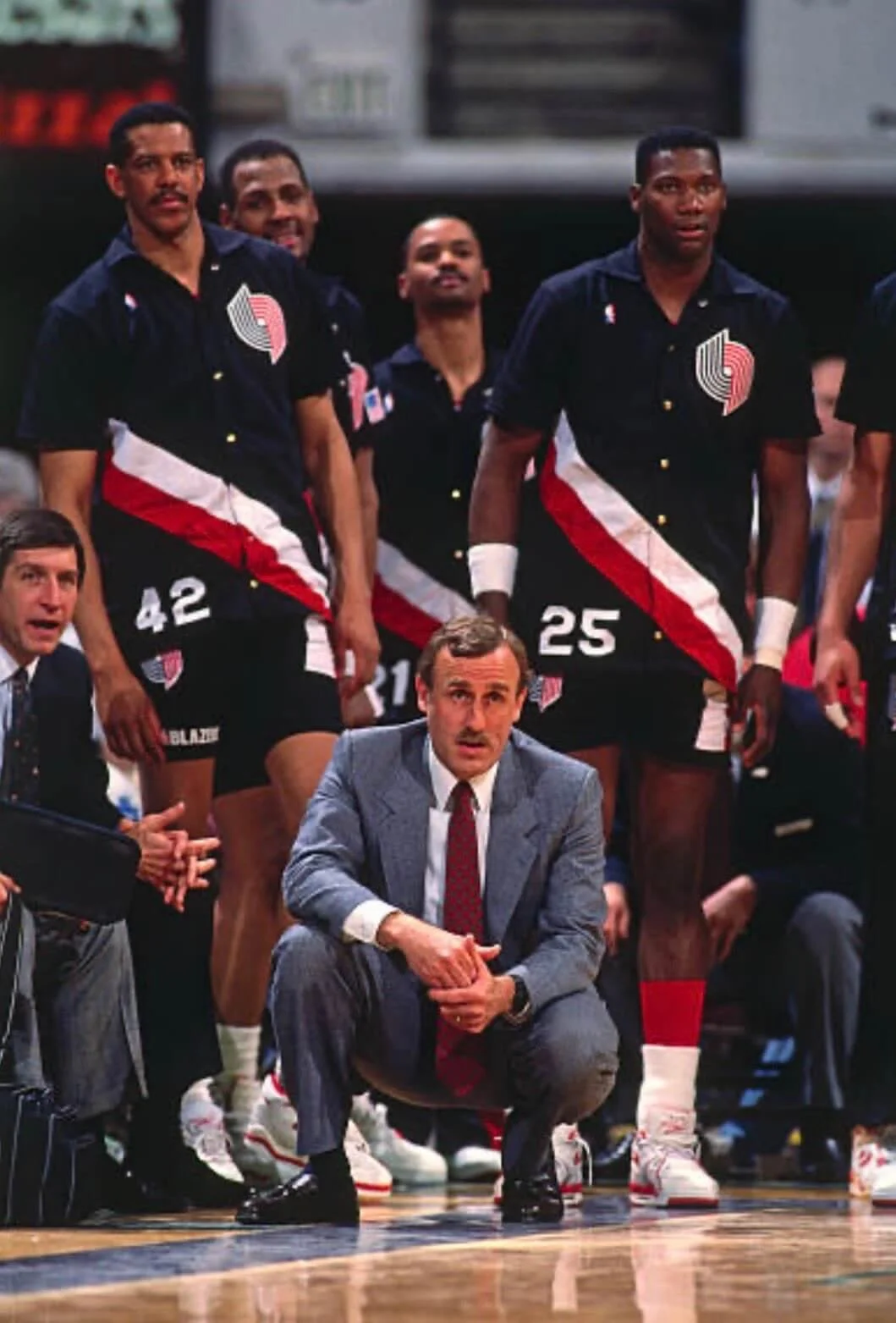
Adelman during the 1991 NBA playoffs, flanked by, from left, John Wetzel, Wayne Cooper, Kevin Duckworth, Danny Young and Jerome Kersey (courtesy John Wetzel)
► ◄
After adding Strickland and Mario Elie, the Blazers appeared loaded again in ’92-93, but Drexler was limited to 49 regular-season games due to injuries. Portland finished 51-31 and lost to San Antonio in the first round. A first-round ouster again the next season meant Adelman’s dismissal. Knowing what was coming and not in agreement with Allen’s decision to let Rick go, Petrie resigned a few days before Adelman was fired.
After a season away from the game, Adelman joined general manager Dave Twardzik as head coach at Golden State. Twardzik, a starting guard on Portland’s 1977 NBA championship team, had worked as radio analyst and in marketing for the Blazers and knew Rick well enough to be convinced he was a good fit for the Warriors.
It proved to be an ill-fated move for Adelman, the one coaching assignment of his career that failed. With a poor mix of players led by Latrell Sprewell and Tim Hardaway, Golden State went 36-46 and 30-52 and failed to make the playoffs both seasons. After the second campaign, both Twardzik and Adelman were fired.
“It didn’t work out, but Rick was the best,” said Twardzik, retired and living Pinehurst, N.C. “What you see is what you get, a commodity that is in short supply. There was nothing phony about Rick.
“The most impressive thing about Rick was not necessarily what he did on the basketball court. He always gave 100 percent to the coaching impression, but he also balanced his personal life and never compromised his love and commitment to his family. That was off the charts how strong he was in that part of his life.”
Rick and Mary Kay had four children of their own — R.J., who died in 2018 in an auto-pedestrian accident; Kathy, Laura and David. In 1993, the Adelmans adopted Caitlin and Pat after their mother, Mary Kay’s sister, was killed in a car accident.
“(Caitlin and Pat) became their children, just like their own,” Wetzel said. “They were much younger than (the four older kids), but Rick and Mary Kay stepped up to the plate big-time.”
Said Twardzik: “That should tell you all you need to know about Rick and Mary Kay Adelman.”
As adults, the Adelman children took after Pops. R.J. worked as a scout, assistant coach and executive for four NBA clubs. David, who got his NBA start as a player development coach under his father in Minneapolis in 2011, just completed his first full season as head coach of the Denver Nuggets after 14 seasons as an assistant in the league. Kathy was a renowned girls high school basketball coach in the Portland area for years. Like David, Pat put in time as boys basketball coach at Lincoln High.
In his years after retirement, Rick enjoyed watching his kids coach, including David’s work with NBA teams. Rick also spent much time attending sporting events of many of his 12 grandchildren in the Portland area.
“Lots of people who come through the NBA claim to be family first,” said John Lashway, who served as PR director of the Blazers from 1986-95. “But Rick consistently prioritized his role as a husband and father above everything else.”
► ◄
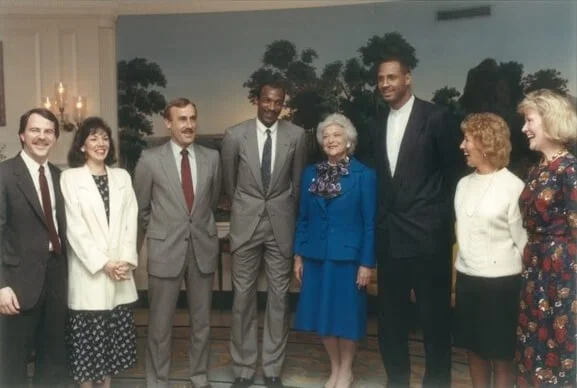
In June 1991, Rick and wife Mary Kay were part of a Trail Blazer entourage that visited the White House to be recognized for the team’s extensive community outreach and reading program as part of President George H.W. Bush’s “Points of Light” initiative. From left are public relations director John Lashway, Mary Kay, Rick, Clyde Drexler, Barbara Bush, Kevin Duckworth, administrative assistant Sandy Chisholm and media services manager Christee Sweeney (courtesy John Lashway)
In 1998, Petrie and Adelman hooked up again in Sacramento and had a terrific run with the Kings, making the playoffs eight straight seasons and winning 50 or more games five years in a row. Petrie, who gets my vote as the best general manager in Blazer history, and Adelman had a great working relationship both in Portland and Sacramento.
“We saw the game the same way,” Petrie said. “He had a great sense for an open-flowing offense, and he got some of that from Jack. He had different kinds of teams in Portland and Sacramento. It was an athletic, free-wheeling team in Portland. In Sac we had two bigs (Vlade Divac and Chris Webber) who were great passers, and we played off them, often from the high post. Rick had a way of figuring out how to take individual abilities and make it work. Two different styles of play, but the coach has to be able to figure that out.”
“Rick didn’t have a set system,” said Ainge, who played 14 NBA seasons, served as a head coach for 3 1/2 years and has been a successful executive in the league since 2003. “He played different styles based on the talent he had. He built a team around his guys, a system around his players as opposed to the other way around. He was very bright, way ahead of the time of analytics. He was really good at putting his players in a good place to succeed.”
Ainge also appreciated Adelman’s coaching style and comportment, saying it reminded him of two other coaches he played for, K.C. Jones and Paul Westphal.
“Being former players, all three of them had a calmness about them, a security in who they were,” Ainge said.
After Adelman left Sacramento, he had four successive winning seasons in Houston — the first two going 55-27 and 53-29 led by Yao Ming and Tracy McGrady. During the 2007-08 campaign, the Rockets had a 22-game win streak, fourth-longest in NBA history. Adelman finished his coaching career with three seasons in Minnesota, taking over a team that had gone 17-65 the previous season. Rick helped develop Kevin Love and brought the Timberwolves to the brink of the playoffs before resigning after the 2013-14 season — a move made in part because his wife, Mary Kay, was having health issues.
Love had the best statistical stretch of his career during his three years there under Adelman. The relationship between the two goes back to when Kevin, a Lake Oswego native, would visit the Adelman home. Kevin and Pat Adelman were teammates at Lake Oswego High.
“Coach allowed me to pick his brain about basketball and helped keep me focused toward the end of my high school career,” Love wrote Monday on Instagram. “Throughout that period, the Adelmans continually went out of their way to make me feel welcome.
“When Rick became my coach in the NBA, he immediately helped me become one of the most versatile and productive players in the league. He gave his players tremendous freedom and responsibility. I would not have achieved the success I have had in this league without him. Many of his former players would say the same.”
► ◄
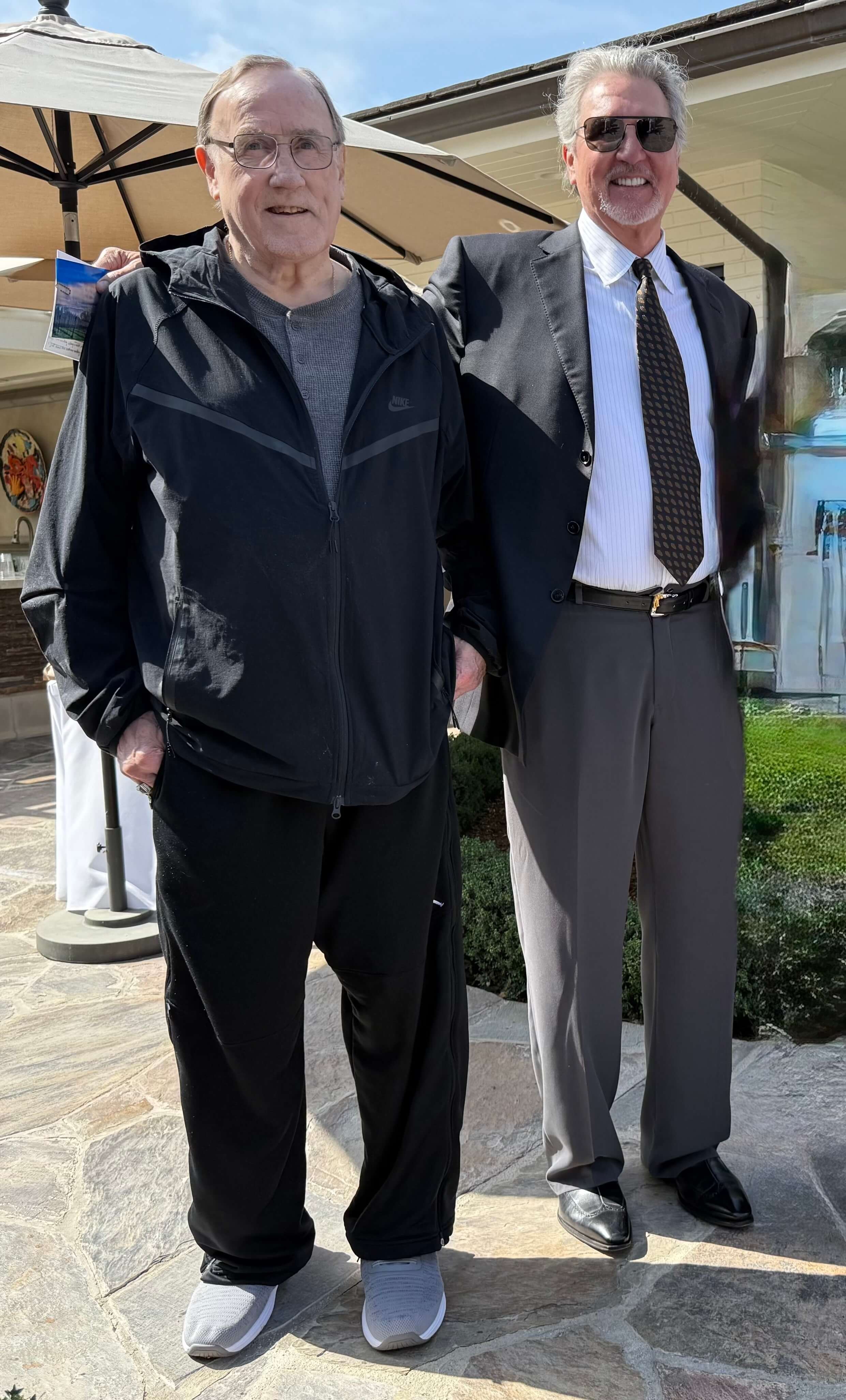
Adelman in recent years with Geoff Petrie, his road roommate and backcourt mate with the original Trail Blazers, and later senior vice president/operations with the club when Rick was head coach (courtesy Geoff Petrie)
Love is right about that. Drexler calls Adelman “a phenomenal coach. His offensive system was great. He gave his players a lot of freedom and got good outcomes. He would put you in the best possible position to succeed. He was great at defining roles for everyone. He was a players’ coach. Everyone loved playing for him.”
Strickland, who played two seasons for Adelman in Portland, told me in a recent profile I wrote on him that his two favorite coaches during a 17-year NBA career were Pat Riley and Adelman. He said he cried when Rick was fired in 1994.
https://www.kerryeggers.com/stories/2026/my-favorite-blazers-the-underrated-rod-strickland
“Rick got the best out of his players,” said Strickland, now coaching at Long Island University. “He put you in positions to succeed, gave you a lot of confidence and let you be a player. He understood you don’t have to coach every play. He put parameters out there and let you play.”
In other words, Adelman didn’t micromanage his players.
“Rick was terrific,” said Wetzel, who served 14 seasons as an Adelman assistant with Portland, Golden State and Sacramento and also worked with Rick on Schuler’s staff with the Blazers. “He treated his assistants with great respect. He let us do our job. We all appreciated that. He always asked for our opinions, and consequently all of us who worked for him were loyal. In that position, the coach is on an island. The ownership, front office, the media and the players — everybody can turn on you. Our main duty to him was loyalty.
“Mike was a bit overbearing at times. Rick was just the opposite. You would meet the next day and talk about it. We didn’t have to meet for three hours after a game and look at the tape. We could do that ourselves the next morning. He was the consummate professional.”
Nobody worked more closely for a longer period of time than Wetzel.
“We were side by side on the bench, in the meeting room, on the bus, on the plane,” Wetzel said. “You get close to people. They are more like family. Rick felt like family.”
During that era, most coaches held practices on most non-game days through the season. Adelman opted for rest on many off days.
“There were days when we would go to the gym, stretch, warm up and shoot for a half-hour or 45 minutes, and that was the extent of it,” said Wetzel, retired and dividing time between homes in Maui and Arizona. “Rick’s attitude was, ‘I want them to be ready for the game. I don’t want to beat them up in practice and tomorrow their legs are tired, or they are tired from all the work we did on an off day.’ The other thing he said was, ‘I want to coach my players like I wanted to be coached when I was a player.’ So many coaches get the power trip and want to show everybody who is boss. He was never like that.”
Wetzel remembers being introduced to former NBA center Joakim Noah.
“He told me everybody talked about wanting to go to Portland to play for Rick,” Wetzel said. “There was respect for him through the league. He was understated. He never did anything to beat on his chest and bring attention to himself. He was self-confident and knew what he wanted to do and what needed to be done. He was the consummate professional.”
Shimensky also worked with Schuler, both in Portland and with the L.A. Clippers. Shimensky, who served the Blazers from 1987-94, said he much preferred the way Adelman handled things.
“Schuler was always paranoid,” said Shimensky, who served 28 years as an NBA trainer with the Clippers, Blazers, Jazz and SuperSonics. “We were flying commercial then. Mike would be sitting up front, and during the flight he would walk down the aisle, give the nod to me, Rick or Jack Schalow like ‘follow me,’ and you would meet in the back of the plane. Then he would unload on the players. I was thinking, ‘I am just the trainer, that’s not my concern,’ but that was Mike. We started to pretend we were asleep when Mike started walking back.
“Rick was totally opposite when he was the head coach. He took losses hard, but he had a great way about him. I would like to think we were close. He was a person you could talk to, and you knew any conversation you had would stay between the two of you.”
Shimensky worked with 10 NBA head coaches. He said Adelman and Jerry Sloan were the best of them.
“Put them in either order, 1 or 1A,” Shimensky said. “They were both terrific.”
Like Strickland, Williams played 17 NBA seasons. Like Strickland, Buck lists Adelman among his favorite coaches alongside Larry Brown, for whom he played with the Nets.
“Larry had a different approach,” Williams said. “Rick coached with very few words. Larry went deeper and tried to get you to understand what he was doing, what the other team was doing. He got down in the weeds to teach us how to play. I don’t think Rick got in the weeds as much. He treated you like a professional. And he was an upstanding guy. When we lost in the Finals (in ’90 and ’92), he stood on the firing lines and took the blame for it.”
“Rick was always protective of his players,” Petrie said. “No matter how upset he might be with a guy, he would never run him down publicly. If he was unhappy with a guy, it would be unusual for that guy to even know it. He was honest and straightforward. I don’t think he ever overplayed his hand.”
“Rick had an easy demeanor about the way he approached the players,” Wetzel said. “In all the years he coached, he never badmouthed a player to the media. He would give them praise, give them credit, but he would never come down on a guy after a bad game. Our players almost to a man loved playing for him.”
Petrie calls Adelman “an offensive genius.” The Blazers led the league more than once in scoring on plays after timeouts. Williams notes the “42” play Rick put in for Buck and Drexler, with Clyde situated on the low post and Buck at the foul line.
“We would throw it in to Clyde, posting up on the block, and I would make the back cut from the high post,” Williams said. “Clyde was such a great passer, he probably got me two to three buckets a game off that one play. Rick came up with that. He was very innovative.
“I was amazed how he would put players in the right position to be successful. He coached who you were as a player. He had an uncanny ability to put players in the right position to help the team achieve success.”
Since leaving Portland in 1995, Lashway has worked in Toronto for 31 years, at first to serve as PR director for the Raptors and eventually as senior VP/communications and community development for seven departments, including the NHL Maple Leafs. He worked with many coaches through the years and holds Adelman in the highest esteem.
“Rick was as grounded and consistent as anyone coaching an NBA team could be,” said Lashway, now running a consulting business in sports, health care, higher education, real estate development, entertainment and the arts in Toronto. “He was the same guy, whether he was coaching a championship contender, hanging out with staff in the office — which he did frequently — or watching his kids play their games.
“I don’t think he ever intended to be a role model or mentor to so many people, but he actually was one. He was a role model and mentor to me in how I did things and lived my life. It’s a cliche, but in Rick’s case it was true — he was a Hall of Famer as a basketball coach, and in life. He was the kind of guy you would run through a wall for, and I always felt he reciprocated that level of loyalty.”
► ◄
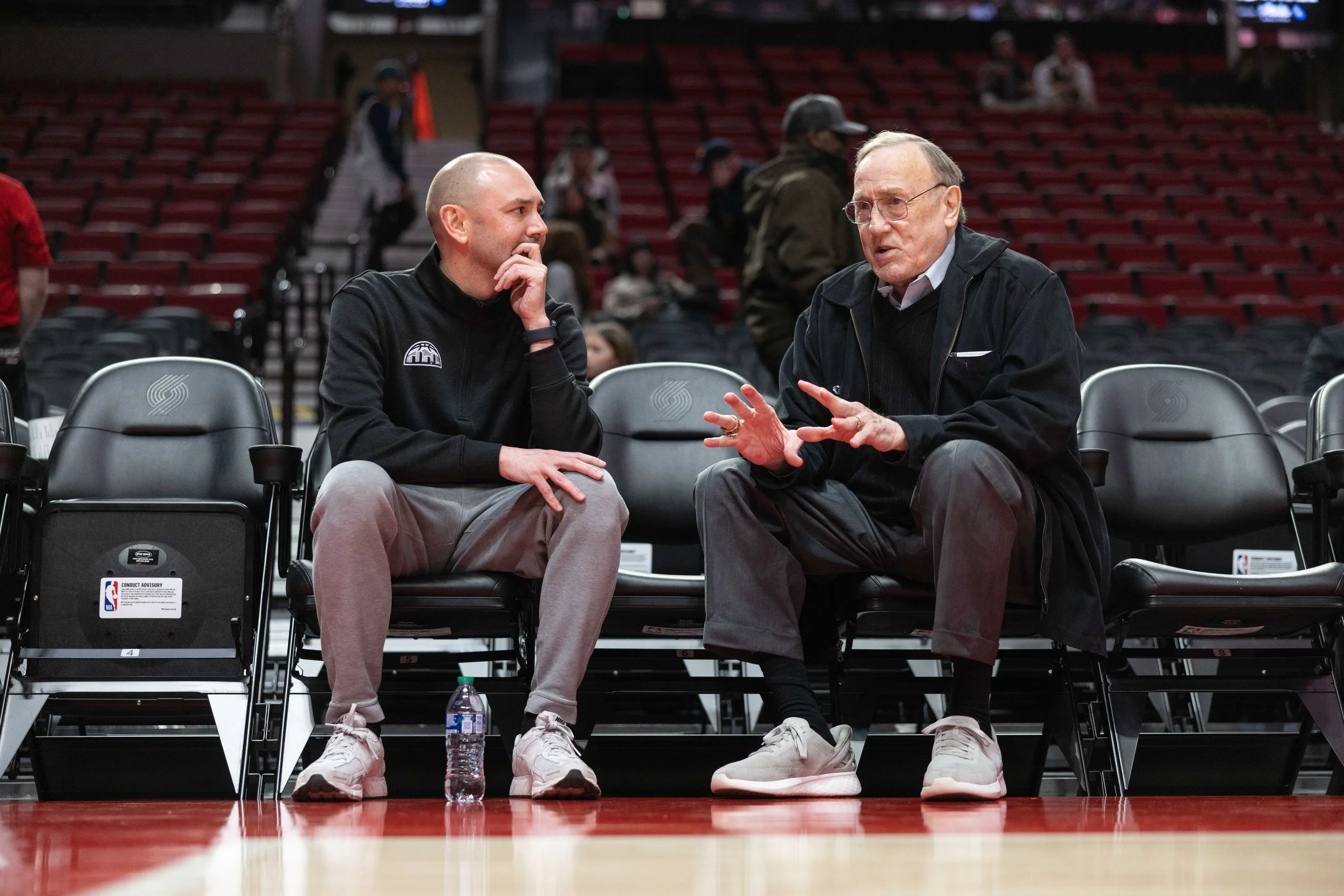
Rick (right) confers with son David, then an assistant coach for the Denver Nuggets, in 2024 (courtesy Bruce Ely)
The unsung hero of the Adelman family was Mary Kay, a wonderful mother and wife who performed behind the scenes to allow Rick to do his job.
“She meant everything to Dad’s career,” David Adelman said. “She was the reason he could do what he did. She was supportive, tough, combative at the right times. She understood the world as it was. My mom is the reason my dad was successful. She is the final answer of our family.”
David is 45, two decades into a coaching career that began at the high school level, then jumped to the NBA. David and wife Jenny have two children. He knows how difficult it is for an NBA coach to juggle the job and family.
“He was a great dad,” David said. “He was measured but loving. Having the job I have now … it’s extremely impressive to me how he handled it. He was present when he could be. I am challenged to try to do it as well as he did it.”
I knew Rick professionally and don’t profess to have been close to him, but I was around him enough to want to mention another attribute of his: He was funny. He made clever observations and liked to poke fun at those around him. I wasn’t normally the object of his verbal jabs, but I witnessed it enough to be thoroughly amused.
“He had a great sense of humor,” Williams said. “Sometimes you wouldn’t realize it. You had to listen close, or you would miss it.”
“He had a dry wit,” Shimensky said. “If you didn’t understand him, it could cut you a bit. Sometimes you had to come back with a crack of your own.”
“He had the needle,” Wetzel said. “He would jab you at the appropriate time. A lot of what he did with the staff was under the radar. It was all in fun.”
“My dad was hilarious,” David Adelman said. “I would be crying laughing, he was so funny. Extremely dry sense of humor. Very Larry David. He saw the world and said exactly what he saw. A lot of people are uncomfortable with that, but he was very comfortable with respecting the world but also making light of it. That speaks to why he knew players so well. He observed. People who observe and shut up are usually the smartest people in the room. That’s exactly who he was.”
There was the other side, too. Rick was always private and understated, but toward the end, he became reclusive. Friends left phone messages and often didn’t hear back.
“I think the loss of R.J. had something to do with it,” Petrie said.
I asked David to describe how he would like his father to be remembered.
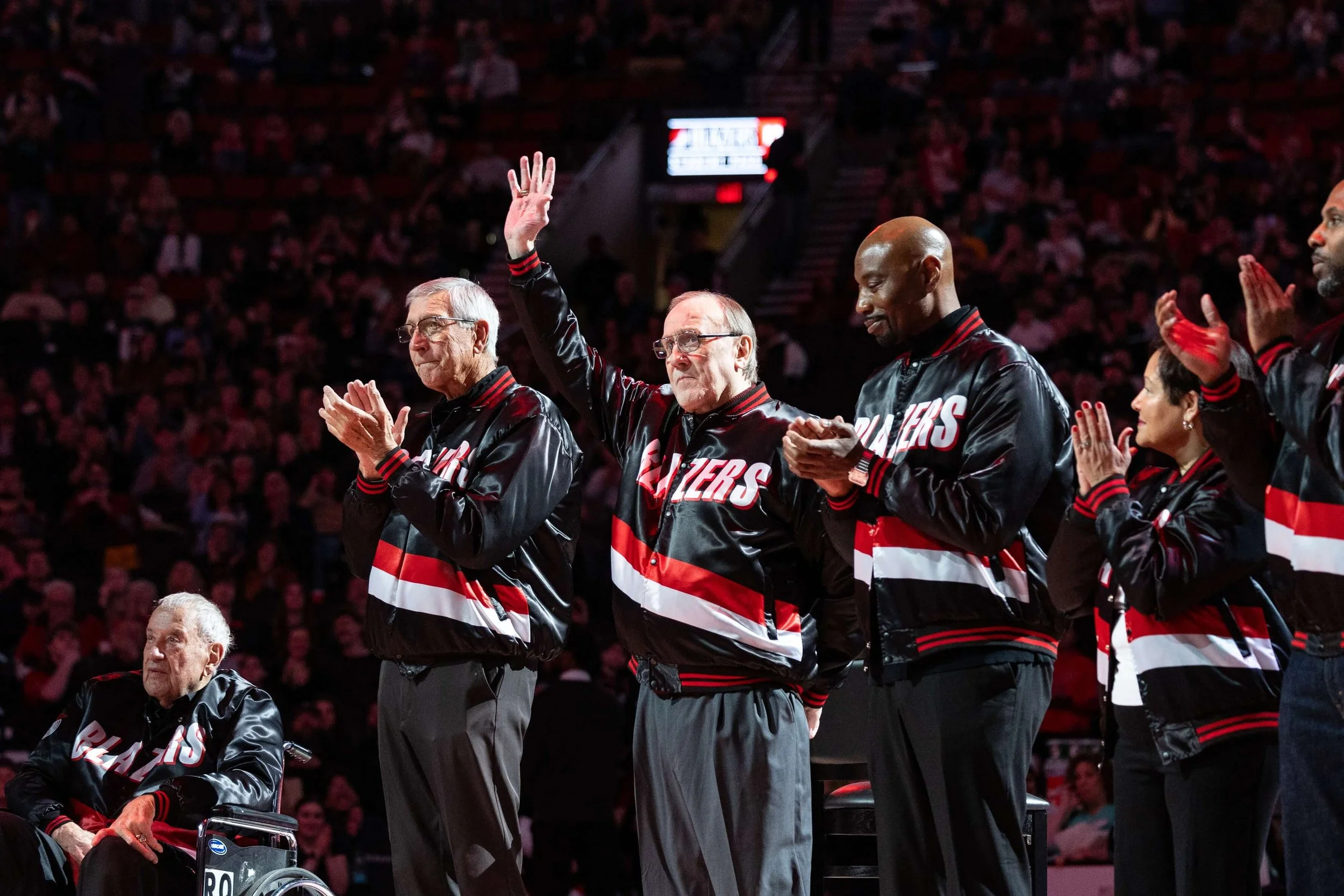
Bucky Buckwalter (in wheelchair), assistant coach John Wetzel, Adelman and guard Byron Irvin during a 2025 celebration of the 1990 and ’92 Portland teams that reached the NBA Finals (courtesy Bruce Ely)
“Humble, for sure,” he said. “He was a person who didn’t care if he was (remembered), but he should be. People are always running toward something to gain attention. He ran toward anything that would help somebody else. That sums him up.
“He liked to put people in the best possible position to succeed. That was true with his coaches and players; same with the kids. It was, ‘Anything I can do to maximize what you are good at, I am going to do it, because I would love to see you succeed.’ That is humble.”
From 1983 on, the Adelmans continued to make their permanent home in Portland, even through coaching stops elsewhere.
“He chose to live in Portland, and chose to die here,” David Adelman said through tears. “He was an LA kid, but this was his home. His love for the basketball community here — high school, college, the Blazers — was deep. He could have lived in Sacramento and just been the man there. He looked at this city as home. His kids grew up here. This is where he wanted to be. It would be a shame if they moved the franchise, because there are people like him who invested their emotions, their lives in this city.”
I will remember Rick with fondness and with admiration. He served the NBA well during his successful career, and he made Portland proud. He was one of us.
► ◄
Readers: what are your thoughts? I would love to hear them in the comments below. On the comments entry screen, only your name is required, your email address and website are optional, and may be left blank.
Follow me on BlueSky.
Follow me on X (formerly Twitter).
Like me on Facebook.
Find me on Instagram.
