My Favorite Blazers: The underrated Rod Strickland
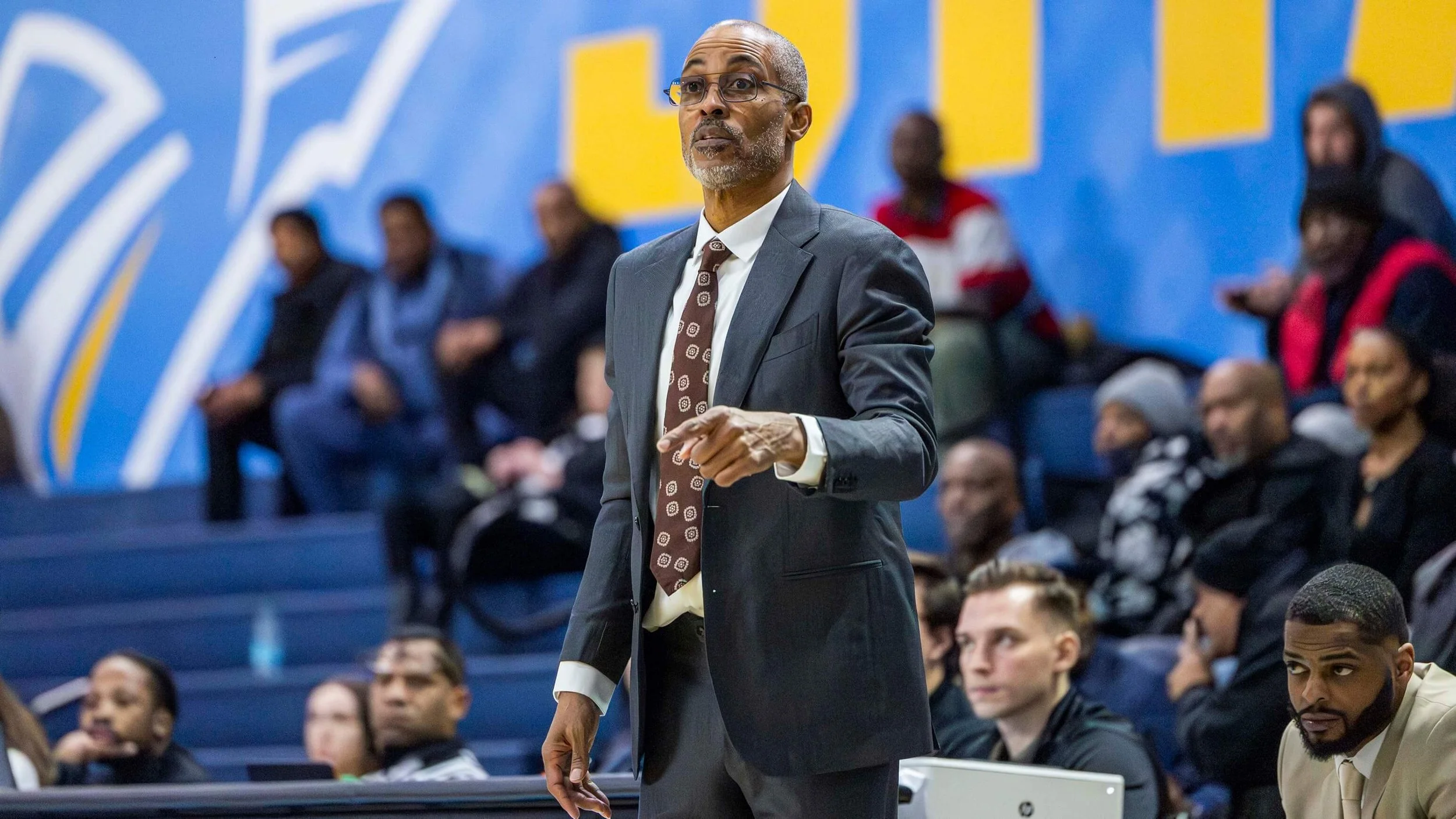
Rod Strickland coached Long Island to a 24-11 record, the Northeast Conference championship and into the NCAA Tournament this past season (courtesy LIU sports communications)
There is a certain irony to Rod Strickland’s success as head basketball coach at Long Island University that even he gets.
In a recent 45-minute phone interview with the former Trail Blazer point guard, I asked if during his playing career he ever envisioned becoming a coach.
“No, not at all,” he said. “That was the last thing on my mind when I was playing. I was busy battling coaches; I wasn’t trying to become one.”
G League commissioner Shareef Abdur-Rahim, who worked closely with Strickland for three years with “Team Ignite,” relays a similar story that was told to him by Stu Jackson when Jackson was coaching and Abdur-Rahim playing for the Vancouver Grizzlies. Jackson had coached Strickland when he was playing for the New York Knicks to begin his 17-year NBA career.
“Stu had run into Rod when he was still playing, and they had a conversation,” Shareef said in a phone call from New York City. “Stu asked Rod if he would ever consider coaching after he retired. Rod shook his head and said, ‘Nah. I would have to deal with a bunch of me’s.’ ”
Strickland had his share of run-ins with coaches through his otherwise splendid 17-year NBA career, including P.J. Carlesimo in Portland, along with assorted tardiness and off-court transgressions that led to a number of arrests, fines and suspensions. Rod was always well-regarded and respected by his peers as a teammate and player, however, and his career numbers — 14,453 points, 7,987 assists and 1,616 steals — bear that out. When he retired in 2005, he ranked sixth in NBA history in assists and 19th in steals (today he I s 14th and 35th, respectively).
A change of heart — and direction — began when John Calipari hired Rod as his director of basketball operations at the University of Memphis in 2006. Fast forward to 2022, when Strickland assumed his first head coaching position at Long Island. After turning over nearly the entire roster from the previous season, the Sharks went 3-26 in 2022-23. From there, they improved to 7-22 in 2023-24, to 17-16 and second in the Northeast Conference in 2024-25 to 24-11 this past season, winning both the NEC regular-season title and its postseason tournament. Strickland was named conference Coach of the Year and took the Sharks to their first NCAA Tournament in eight years.
Rod played four years with the Trail Blazers, from 1992-96, plus an ill-fated 21-game stint at the end of the 2000-01 campaign. He arrived in 1992-93, a season after Portland had reached the NBA Finals for the second time in three years. Rod fit right in with a strong nucleus of players led by Clyde Drexler, Terry Porter, Buck Williams and Cliff Robinson and was immediately one of my favorite players to both watch play basketball and interview.
Through the six years I have operated kerryeggers.com, a number of players have been featured in the “My Favorite Blazers” section on the home page. Among them have been Sergio Rodriguez, Meyers Leonard, assistant coach Elston Turner, Buck Williams and Larry Steele. The last one was Andre Miller under a story headlined, “The underrated Andre Miller.” My newest favorite Blazer is “the underrated Rod Strickland.”
Several of the people I reached out to for this article used the term “underrated” in describing Strickland as a player.
“Rod had a complete game,” says Hall of Famer Clyde Drexler, who played with Strickland for 2 1/2 seasons in Portland. “He was quick and fast and when he got out in the open court, he would get you the ball in a hurry. But if you needed him to score, he could do that. He was a pretty good defender, too, and underrated as a player. He was good for every team he played.”
“A very underrated player,” says Chris Dudley, Strickland’s teammate through three seasons with the Blazers. “One of the greatest finishers ever, especially for his size. We would always kid him for how often he went to the floor, but he went in there and he could finish over anybody. He wasn’t scared to take punishment, either. He had such a great touch, a great feel for the game around the basket. I would have to think hard for a point guard who was a better finisher than Rod Strickland going to the rim.”
During LIU’s 93-58 loss to Arizona in the NCAA Tournament, analyst Stan Van Gundy talked glowingly about Strickland, whom he first saw play at Truman High in the Bronx.
“Rod was the best high school player I ever saw,” said Van Gundy, a head coach for 14 NBA seasons in Orlando, Detroit and New Orleans. “And in college (at DePaul), he was the best finisher below the rim I ever saw. He had every shot in the book.”
Strickland is a member of New York City’s Basketball Hall of Fame. His contemporaries include Kenny Smith, Pearl Washington, Kenny Anderson and Mark Jackson, with whom he was featured in a 2022 documentary called “NYC Point Gods.”
Strickland grew up about a half-hour from LIU’s urban campus in downtown Brooklyn. He played for three schools during his high school years. He attended Rice High as a freshman but left the school “because they didn’t move me up to varsity,” Rod says. He spent his next two seasons at Truman playing for a young Steve Lappas, winning the state Class A his junior year.
“Loved playing for Lap,” Strickland says. “He was a great coach and a good guy. I think we were the only public school to win both the New York City and state titles.”
When Lappas left to become an assistant coach at Villanova, the Rice coach took over at Truman.
“I hold grudges,” Strickland says. “(The new coach) was trying to take over my (college) recruiting. Lap looked for other places for me to go.”
Strickland transferred to Oak Hill Academy, a small private boarding school in Mount of Wilson, Va.
“My mother (Rosetta Strickland) didn’t want me to leave,” Rod says. “But once we left a meeting with the new (Truman) coach, she was like, ‘You do what you need to do.’ ”
Strickland went on scholarship as the first big arrival to the school that became famous for its basketball teams. Among others who played there were Carmelo Anthony, Kevin Durant, Jerry Stackhouse and Rajon Rondo.
Rod played three seasons for Joey Meyer at DePaul, leading the Blue Demons to three straight NCAA Tournament appearances and earning first-team All-America honors as a junior.
“I loved DePaul, I loved Chicago and I loved our style of play,” Strickland says. “Me and Joey had our run-ins. I was a young fella. But it was all good.”
The New York Knicks took Strickland with the 19th pick in the 1988 NBA draft, beginning a peripatetic career that saw him suit up for nine teams. When I ask him for highlights, he has a few ready for me.
“Making All-NBA second team (in 1997-98 with the Wizards) … leading the league in assists (the same season) … playing in D.C. with Chris Webber and Juwan Howard … playing in (Madison Square) Garden … being in the playoffs my first nine years … going against (Utah’s) John Stockton in the playoffs while I was with Portland … playing in San Antonio with the great David Robinson … playing with Kevin Garnett, Clyde Drexler, Vince Carter, Tracy McGrady …”
Two major misses: Strickland played in the playoffs in 11 seasons but won only one playoff series — with the Spurs in 1989-90, his second season. In an era of great guard play, he never played in an All-Star Game.
Rod had some of his peak years in Portland, signing a four-year, $7-million free agent contract in 1992 after the Spurs failed to extend a qualifying offer.
“When Rod became unrestricted, I was immediately interested,” says Geoff Petrie, Portland’s senior vice president/operations at the time. “He had some quirks, but he was a tough cover and a really good point guard overall. He was 6-3, strong, could get to the basket on anybody and he could finish. I got on the phone with his agent and got it worked out quickly.”
Strickland played his first two seasons with the Blazers under coach Rick Adelman.
“Rick had one of the best feels for a free-flowing type of offense,” says Petrie, now retired and living in Granite Bay, Calif. “That was good for Rod. He was a New York City guy with a bit of a street game. You can’t put those guys in a box.”

“Portland is where I got my mojo,” Strickland says. “Rick’s temperament and personality were perfect for me. Rick started to stretch my game. He was the first coach who had me posting up. I believe that started when we played against Muggsy Bogues. Rick had me coming off screens to shoot shots.”
Strickland joined Robinson, Mark Bryant and Mario Elie — the latter a free-agent acquisition who had played for Golden State — as reserves on the ’92-93 Portland team. The starting five from the 1992 Finals team — Drexler, Porter, Williams, Jerome Kersey and Kevin Duckworth — had returned. The Blazers opened the season 8-0 before Drexler began to have knee and hamstring problems that would cause him to miss 33 regular-season games.
“That changed everything,” Rod says. The Blazers finished 51-31 but lost to the Spurs in the first round of the playoffs.
Strickland credits Petrie with helping him with shooting.
“Geoff took a liking to me,” Rod says. “He would get in the gym with me and work on my jump shot. After my first year in Portland, he suggested I play in the Utah Summer League. He said, ‘Don’t worry about making layups and all that, because that is what you do. Go there and work on your jump shot.’ I played a couple of games. I would pull up in transition and work on my jump shot. That was a big help.”
Strickland, a career .282 3-point shooter, had the two best seasons of his career with the Blazers, shooting .374 from beyond the arc in 1994-95 and .343 in ’95-96. He had a career-high 35 points, shooting 15 for 21 from the field, in a 105-99 loss to Knicks in January 1995. Under Adelman, Rod set a franchise single-game record with 20 assists in an April 1994 victory over Phoenix.
By that time, Strickland was an expert shooting the “teardrop,” a floater from inside the key.
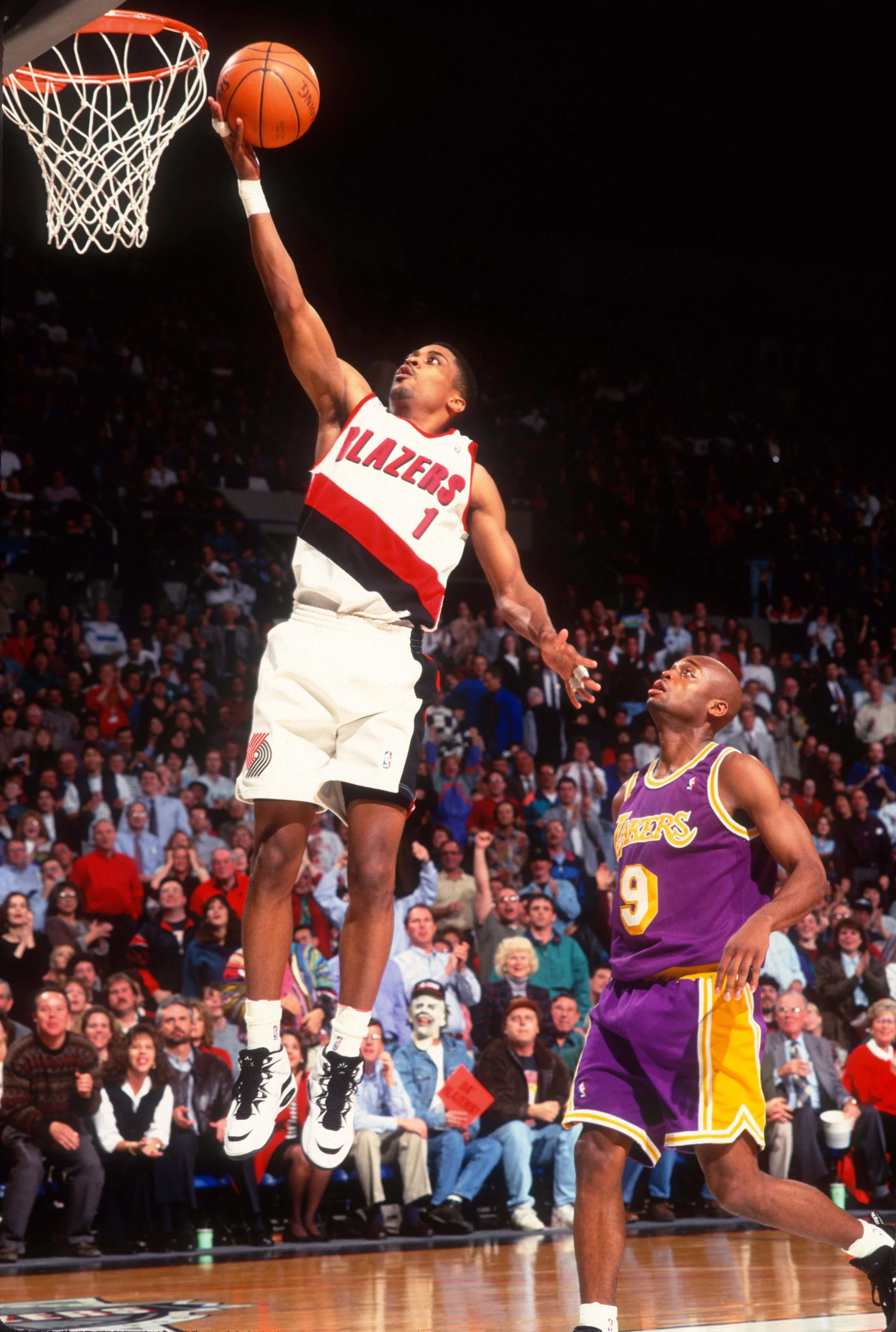
The “teardrop” was Strickland’s signature move to the basket (courtesy Bruce Ely/Trail Blazers)
“People forget about that,” Rod says when I mention it. “I used to watch Dr. J. and George Gervin and Pete Maravich and Isiah Thomas and all them dudes. I also had people to watch around the neighborhood and in the parks. It was just about using my imagination. I always wanted to be different. To this day, I go into the gym and I throw that ball high up in the air, and it will come down and hit nothing but net.”
Petrie laughs with a recollection from those years.
“The only thing players were responsible for when we went on the road was taking their own shoes,” Petrie says. “The equipment guy (Roger Sabrowski) would take everything else. Rod was notorious for forgetting his shoes. I told Roger to just pack four pairs of Rod’s shoes and put them on the plane, and we would never have to worry about that.”
After two seasons of first-round playoff ousters, Petrie resigned and owner Paul Allen fired Adelman.
“When I heard the news about Rick, I cried,” Strickland says. “I actually cried. It was almost like a best friend dying. Playing for Rick was great. I remember struggling at the start of a playoff game, He pulled me over and was like, ‘Listen, I don’t care how many shots you miss; I believe in you. Just keep playing.’ That was big, especially since most coaches are screaming at you. He was so calm.”
In Adelman’s place came Carlesimo, in his first NBA job after a dozen seasons at Seton Hall. Rod and P.J. meshed like oil and water, Rod bristling at what he regarded as unnecessary disciplinary matters. During the second half of the 1995-96 campaign Strickland asked GM Bob Whitsitt to trade him. When the deadline passed with no trade, Rod went AWOL and was suspended without pay for six games. He returned to action after a hefty suspension and finished out the season before being sent to Washington on the deal that brought Rasheed Wallace to Portland.
Strickland came back to Portland in the midst of the “Jail Blazers” era after he had been waived by the Wizards in March 2001. Whitsitt added him to a point guard crew that included Damon Stoudamire, Greg Anthony and, at times, Scottie Pippen. Rod averaged only 4.6 points and 3.4 assists in 16.7 minutes on a team stocked with too many players who needed minutes. The Blazers were swept by the Lakers in the first round of the playoffs, losing all three games by an average of 13 points.
“There was too much talent, absolutely, 100 percent, and I added to the problem,” Strickland told me for my “Jail Blazers” book in 2018. “There were definitely too many people in too many positions. Bringing me in compounded a bad situation. If I knew everything, I may not have walked into that. … I almost went to Indiana.
“The players were great with me, but I don’t think they felt they needed anyone else. They felt they had enough. The environment was polluted … I walked into something I wasn’t expecting, something that was too much.”
Strickland will be remembered by teammates in Portland not for that short stint but for the contributions he made on-court in his first four seasons in Rip City.
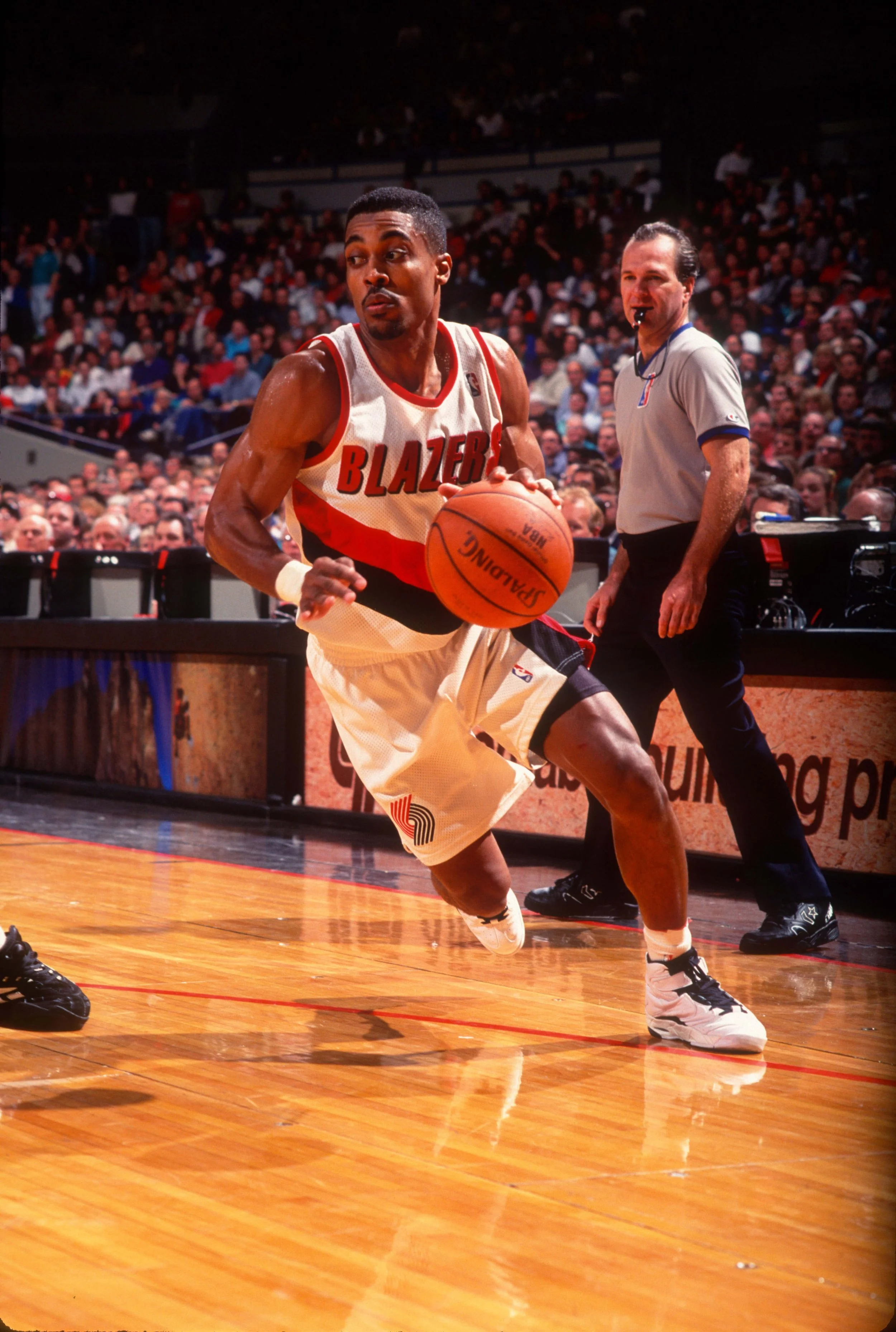
Strickland led the Blazers four straight seasons in assists and three in steals from 1992-96 (courtesy Bruce Ely/Trail Blazers)
“Rod was misunderstood,” Williams says today. “He is one of the nicest guys you will ever meet. Any time a college coach comes to the NBA, you have to leave the college mentality behind you. It took P.J. awhile to make the adjustment. You are dealing with men now. P.J. is a good guy, but as a coach, he had to make the transition.”
Ironically, two of the best statistical seasons of Strickland’s career came under Carlesimo. In 1994-95, Rod averaged 18.9 points and 8.8 assists. The next season, he averaged 18.7 points and 9.6 assists.
Strickland’s teammates during his Portland years appreciated him.
“Rod was an exceptional player,” Williams says. “He mastered the mid-range game over almost any guard who played in the league. Reminds me some of Shai Gilgeous-Alexander, who has a lot of the same traits, with his height and ability to get into the middle and create havoc. Not many guards had the ability to have the kind of impact that Rod did.
“I enjoyed playing with Rod. He was good in the locker room. He worked hard to make his teammates better. He complemented all the bigs he played with because of his passing ability.”
“I have always gotten along well with Rod,” says Dudley, currently a Republican candidate for governor of Oregon. “I saw him last year at a Knicks reunion in New York. He was a great teammate. He had your back. He knew the game. He is a guy you wanted on your team, somebody you wanted to go to battle with.”
► ◄
After leaving the NBA at age 38, Strickland maintained an athlete’s mindset.
“I didn’t think I was going to get any (coaching) opportunities,” he says. “I wasn’t even thinking about that. I still wanted to play.”
Strickland signed a contract to play with Arvydas Sabonis’ pro team in Lithuania, Zalgiris Kaunas.
“The day I was supposed to leave, I backed out of it,” Rod says. “They were probably sitting at the airport waiting for me. I didn’t go. I just didn’t want to. I am not an out-of-the-States guy. I got cold feet.”
Strickland wasn’t sure what was in store for him.
“I didn’t know what to do,” he says. “One day I called a friend of mine and said, ‘I need a job.’ That is when we started the idea of me going to (work in college basketball). There were only one or two NBA guys who were coaching in college. It was too much work, and almost beneath an NBA player. But Cal gave me an opportunity, and I got the bug from there.”
Strickland spent eight years working in primarily an administrative role for Calipari — three at Memphis staff and five at Kentucky from 2009-14. Rod was there when Calipari won the only NCAA championship of his career, leading the Wildcats to the title in 2012. Calipari had him work individually with some players, especially guards. At Memphis, Rod helped develop Derrick Rose and Tyreke Evans.
“I got a chance to ride (Calipari’s) wave,” Strickland says. “Cal is an interesting person. He just has a way about him. When he walks in a door, things change. He is a unique personality, one of a kind.
“A lot of times I watched and observed Cal. I might ask him a question or two about why he made certain decisions, but Cal is one of those guys I have never seen uncomfortable. He is always in control, even when he is not in control. He is a forward thinker. He is always thinking ahead. Cal is just different.”
Strickland became an official coach for the first time when he took a job as an assistant coach at South Florida from 2014-17. Then it was on to a position that helped Rod grow, both in the basketball profession and as a person.
From 2018-22 he worked with the G-League, the last two years as program director of the G-League Ignite, a developmental team for top young talent as an option to college ball.
“My initial job was to recruit talent to get drafted and come into the G-League and make $125,000,” Strickland says. “That transformed into heading Team Ignite — gathering a team of young guys to whom we paid a lot more money.”
Shortly thereafter, Abdur-Rahim became president of the G-League, a position he still holds today.
“Once Shareef came in, we locked in and were able to make things happen,” Strickland says.
Abdur-Rahim hardly knew Strickland before the two began to work together.
“I had played against him but never with him, and I had never spent any time with him,” says Abdur-Rahim, who played for the Blazers from 2003-05 near the end of the Jail Blazers era. “I knew his reputation. He had a swagger, a demeanor about him. He didn’t talk a lot to people. He was all business on the court. We had never spoken more than a few words in passing.
“I found that Rod was unbelievably good to work with. We spent a lot of time together with the Ignite program and all the young kids. He is one of the best basketball minds I have ever met. I put him with people I have been around like Rick Adelman, Geoff Petrie, Mike Bibby. The way Rod sees the game, thinks the game, it is absolute top level.”
Abdur-Rahim has come to consider Strickland a friend.
“He is a great dude — honest, with a really good heart,” Shareef says. “Not a lot of times do you meet people later in life and have a connection like we do.”
Strickland was the key to building the Ignite from scratch, Abdur-Rahim says.
“There wasn’t all the NIL stuff back then, and the NBA was trying to figure out what to do about players like LaMelo Ball, to come up with a solution for young kids,” he says. “Rod was hired to recruit those kids. We developed that together.”
In an early discussion, Strickland told Abdur-Rahim that there were kids still in high school who could make the G League.
“I didn’t see it,” Shareef says. I thought, ‘They are just high school kids.’ ”
“The really good ones have a poise, a confidence that they know they can do it,” Strickland told him.
“Rod was right,” Abdur-Rahim says now. “I learned a lot from him, the way he taught players and saw the game. He would get on the court with these kids, talk them through the ins and outs of being a professional player.”
One of the players was Dyson Daniels, now a starting guard for the Atlanta Hawks.
“Dyson struggled at first,” Abdur-Rahim says. “Rod spent time with him, putting him through drills with dribble routines. He also spent time talking to him and other kids about humility and getting them comfortable with the inevitabilities of success and failure.”
Among the Ignite players Strickland recruited were lottery picks Jalen Green, Jonathan Kuminga and Scoot Henderson.
“It came down to us signing Scoot or this other guy,” Rod says of the Blazers’ third-year guard. “Once I saw (game video) of Scoot, I am like. ‘Wow.’ It was an easy pick, because I saw Scoot’s speed and athleticism. He had a good pull-up jumper, a good mid-range game. We thought he was really good, but once he got there, he was even better than we thought he was. He has all the goods.”
Henderson admits he didn’t know of Strickland’s playing credentials when they first met.
“Then I started watching (video) of him,” Scoot tells me. “He was Kyrie (Irving) before Kyrie.”
Strickland left an impression on Henderson.
“The time we spent together was genuine,” says Scoot, who played 17 games for Team Ignite during the 2021-22 and 2022-23 seasons. “I love the person Rod is. He is a real dude. Ask him anything and he will tell you. He taught me a few point guard things, but it was more just talking than an on-court thing. The situation I was in my first year was a little different than anybody else my age. He was telling me to keep my head up, and whatever I do, stay strong with it, and have my goals.”
► ◄
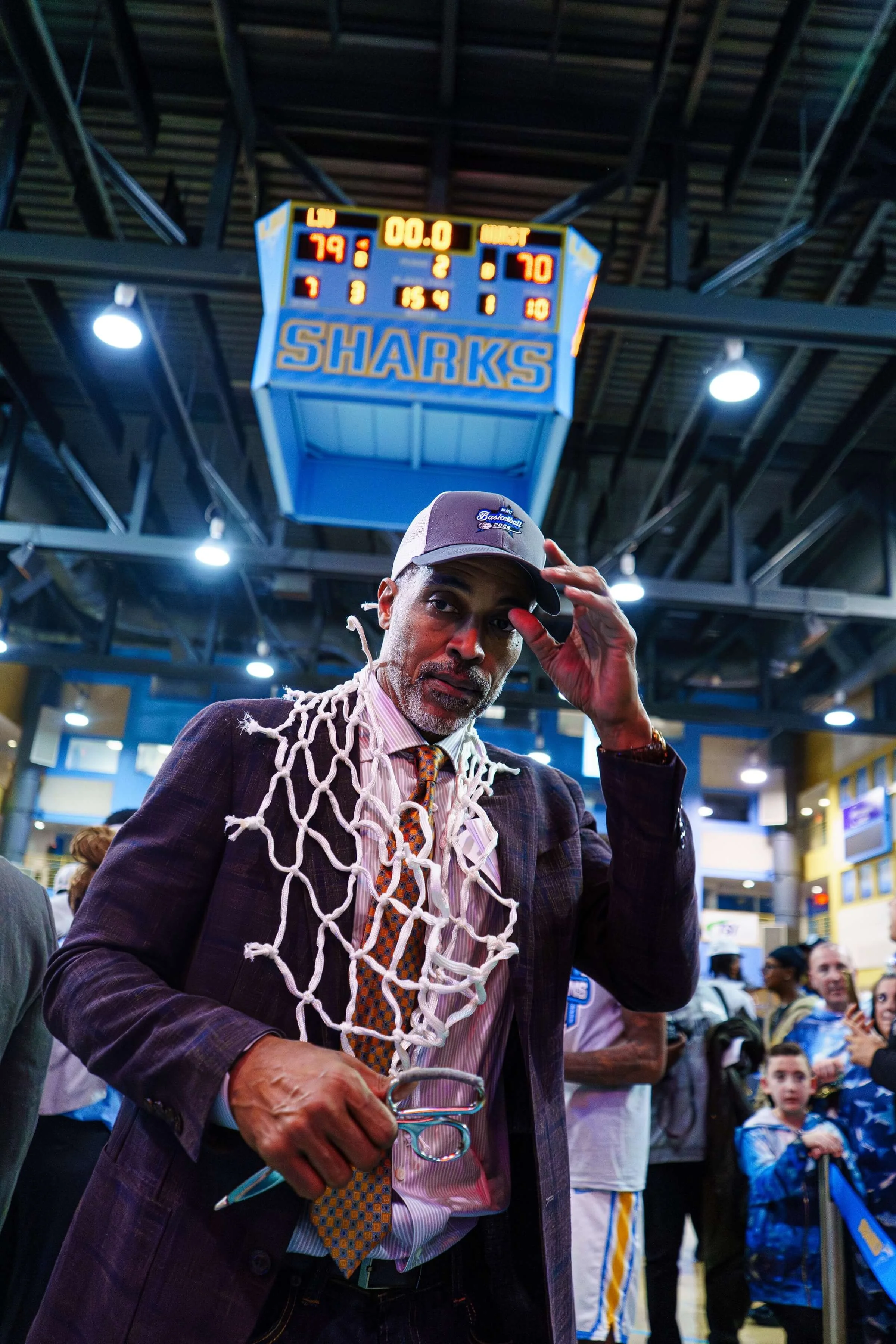
Strickland will go into the 2026-27 season hoping to continue to “put LIU on the map” (courtesy LIU sports communications)
When the Long Island job opened after the 2021-22 season, Rod found the proximity to home appealing.
“That was a big part of why I decided to take the job,” Strickland says. “The opportunity to be a first-time head coach was part of it, too. But for it to be right there in New York City with family, friends and all the history I have here? That is what excited me about it.”
It was the start of the transfer portal era, and Strickland was left with only one starter and three returnees during his first season.
“It was hard,” he says. “I may have panicked a little bit. I had to listen to others more than myself. I don’t know if the others were the best ones to ask. It was a learning curve for me. It was as simple as that.”
The second season, Rod brought in sons Tai and Terell via the portal — Tai a 6-2 senior from Georgia Southern, Terell a 6-foot junior from James Madison. Both were starters, and Terell was the following season, too. They were good players, sure. But beyond that, there was a bonding experience.
“I wish I would have had them for all four years,” Rod says. “Potentially, I could have gotten more out of them. This is probably a father speaking here, but also a coach. It was a pleasure to be able to coach them, and it was great for us as a family to be together on a daily basis. It wasn’t the easiest at times, but it was always interesting. From a family dynamic, for us to be there together, it was a good thing.”
The Sharks’ splendid 2025-26 campaign came to a close against No. 1 seed Arizona, which advanced to the Final Four, so it wasn’t unexpected.
“You knew it was going to be tough, a 16 seed against a team that could have won the national title,” Strickland says. “I wanted us to come out and just compete. The moment may have gotten to our guys a little bit, but understandably. We were playing against a great team with a great coach. We were up against it.”
Rod calls the NCAA Tournament appearance “a great accomplishment for our program.”
“I walked into that place in July of ’22 maybe a little naive,” he says. “I had to put together a roster, and if I knew then what I know now, I would have done a better job. Those first two years were tough. I had to make changes in recruiting, changes in the staff. Once I got the right people around, and I had some experience so I knew the conference and what was in it … after that it got better and better.
“I knew the process. I knew I had to learn. I knew it would be an adjustment. Being in basketball and competition all your life, you are comfortable with the adversity part, with the struggle. I knew it was a matter of getting my feet set and learning the landscape.”
During his NBA career, Strickland played for such coaches as Adelman, Rick Pitino, Larry Brown, Bernie Bickerstaff, Pat Riley, Flip Saunders and Jeff Van Gundy. Which became his biggest mentor?
“I played for some great coaches, but no one really became a mentor,” he says. “I was pretty much to myself. I don’t know how many people were going to get too close to me. I just had that kind of personality.
“I loved playing for Pat Riley. People are like, ‘What?’ But he was the most straightforward coach. You knew where he was coming from. He got on everybody, no matter the best player or the worst. He was all about winning. If you won, he would do everything for you. If you lose, you were a piece of s**t. I was perfectly fine with that, because you knew what was expected of you. There was no guessing with Pat Riley.”
Strickland’s teammates in Portland have noted his coaching success.
“I was thrilled to see (the Sharks) made the tournament,” Dudley says. “I knew Rod had the team going in the right direction. That was a tough first-round matchup, but it was a win just to make the tournament. He had to change the culture, change the mindset, bring in new talent. I can see where he would be a great coach. He was kind of a no-nonsense guy as a player. He doesn’t want to put up with any BS. He is just about the game. As a player, that’s who you want to play for.”
“He has done a great job at Long Island,” Drexler says. “He is building a nice resume there. I think he was the right guy for that job. I am super proud of what Rod is doing there.”
The top three scorers for LIU’s team this past season were seniors. Strickland has lost several of his potential returnees to the portal.
“Most of them are gone, which is fine,” he says. “I am looking forward to having another great year (in 2026-27). I will be able to recruit. We are talking to players now, high-level players. That’s the name of the game. Everyone is going to lose just about everyone. Not many schools are bringing back a bunch of players. At our level, I don’t know if those are the best players. If they are the best, most of them are going to leave. You just retool. Now it is about recruiting again. If I can recruit, then I believe I am going to have a really good team.
“I feel l always will be able to recruit because of my Rolodex and the people I know. People respect me. They know how I am going to deal with young people. We are going to develop young men. We are in New York City. I always felt once you start winning, this thing will grow. I want to put LIU on the map. I want to make people notice who LIU is. I want our program to look like a high mid-major, or a high major. I have to win some games. I have to recruit at a different level. That’s the goal.”
Does Strickland have enough revenue share/NIL funding to attract major talent?
“I don’t know if it is enough,” he says. “but I am going to figure it out.”
When Strickland dipped his toes into college basketball waters two decades ago, “it wasn’t like this,” he says. “The intentions were different. You recruited kids, developed them, get some transfers. Then a few years ago, on came the NIL piece. It is just different. For years, universities and coaches ate off the young people. Now the players are getting a lot of it back. It may not feel good and may imbalance some things, but everyone has to deal with the same thing. I am fine with that. We all gotta figure it out.”
► ◄
Our interview almost over, I wish Strickland a happy 60th birthday in July in advance. He has four children — including daughters Torin and Tanner — and two grandchildren now. How does he feel about his advancing age?
“I have no choice,” he says, laughing softly.
Then he adds, “What I am doing now — coaching, working with kids — has enabled me to grow. That’s the most important thing for me at 59, about to be 60. I have grown from what I was at 20, at 30, at 40, at 50. I am in a super great spot in life. I feel grateful for that.”
► ◄
Readers: what are your thoughts? I would love to hear them in the comments below. On the comments entry screen, only your name is required, your email address and website are optional, and may be left blank.
Follow me on BlueSky.
Follow me on X (formerly Twitter).
Like me on Facebook.
Find me on Instagram.
