Beaver baseball will lose a lot, but key pieces are back and big talent could be on the way
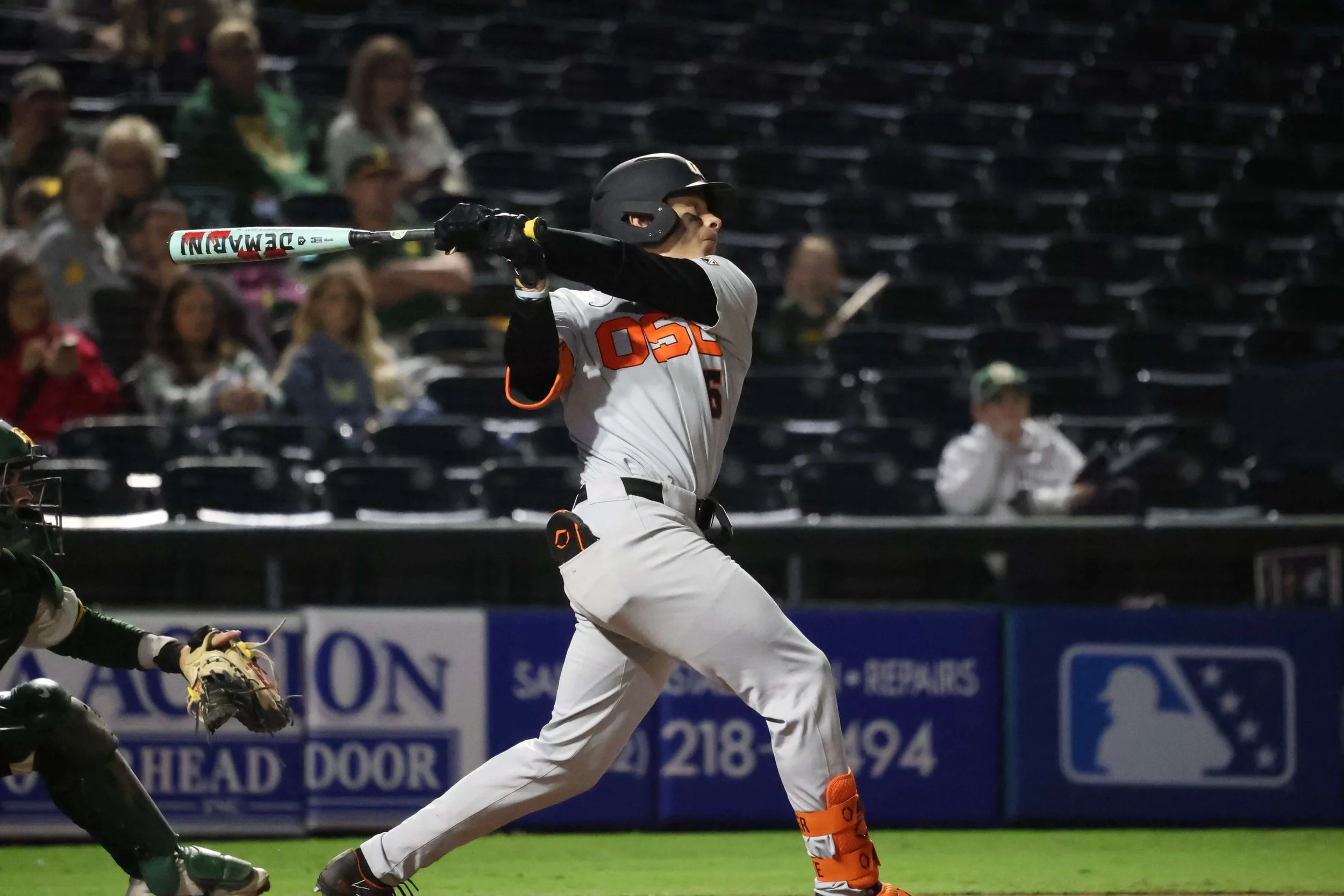
Senior center fielder Easton Talt led the Beavers with 52 runs and 26 stolen bases this season (courtesy OSU sports communications)
Updated 6/8/2026 8:40 AM
Every season that doesn’t end in Omaha, those in Beaver baseball like to say, is a bust.
So yeah, the 2026 campaign won’t be considered suitable for framing by those in the Oregon State program.
The season ended with a thud in, of all places, Eugene, where host Oregon beat the Beavers 4-1 Sunday night to win the Eugene Regional.
Though relief pitching in the seventh inning proved OSU’s downfall in the finale, hitting was the bugaboo that, frankly, kept the Beavers out of the College World Series picture.
In their two victories, 9-2 over Yale and 10-1 over Washington State, the Beavers bashed 15 hits apiece. In their two losses, the first one 3-2 to Wazzu, they combined for 13 safeties and three runs.
In its second and last season (at least for now) as an independent, Oregon State finished with a 45-14 record, its fifth straight 40-win season, with four of them at 45 or more. The Beavers have made the NCAA Tournament nine straight years, with three Super Regionals and one CWS appearance over the past four seasons.
They didn’t get past the Regional this time, but the season shouldn’t be considered a failure. The Beavers won all 11 of their weekend series, sweeping eight of them. One of them was against Cal Poly, which plays at West Virginia in a Super Regional this weekend. Another was vs. a 44-win Mercer team. The Beavers went 15-2 on the road, including a 12-4 romp at Southern Cal, and were ranked among the nation’s top 10 teams most of the season.
There were losses to Quad 4 opponents Air Force, Cal State Northridge (sorry, “CSUN” doesn’t work for me), Texas-Rio Grande Valley (ditto “UTRGV”) and Cal State Fullerton. In the case of three of them, Oregon State still won the series; the Beavs split a pair with Texas-Rio Grande Valley.
In the end, OSU’s portfolio came close but didn’t merit hosting a Regional. In Eugene, the season ended in disappointment. In interviews this week with pitching coach Rich Dorman and assistant coach Ryan Gipson, they both used the same verb to describe the feeling.
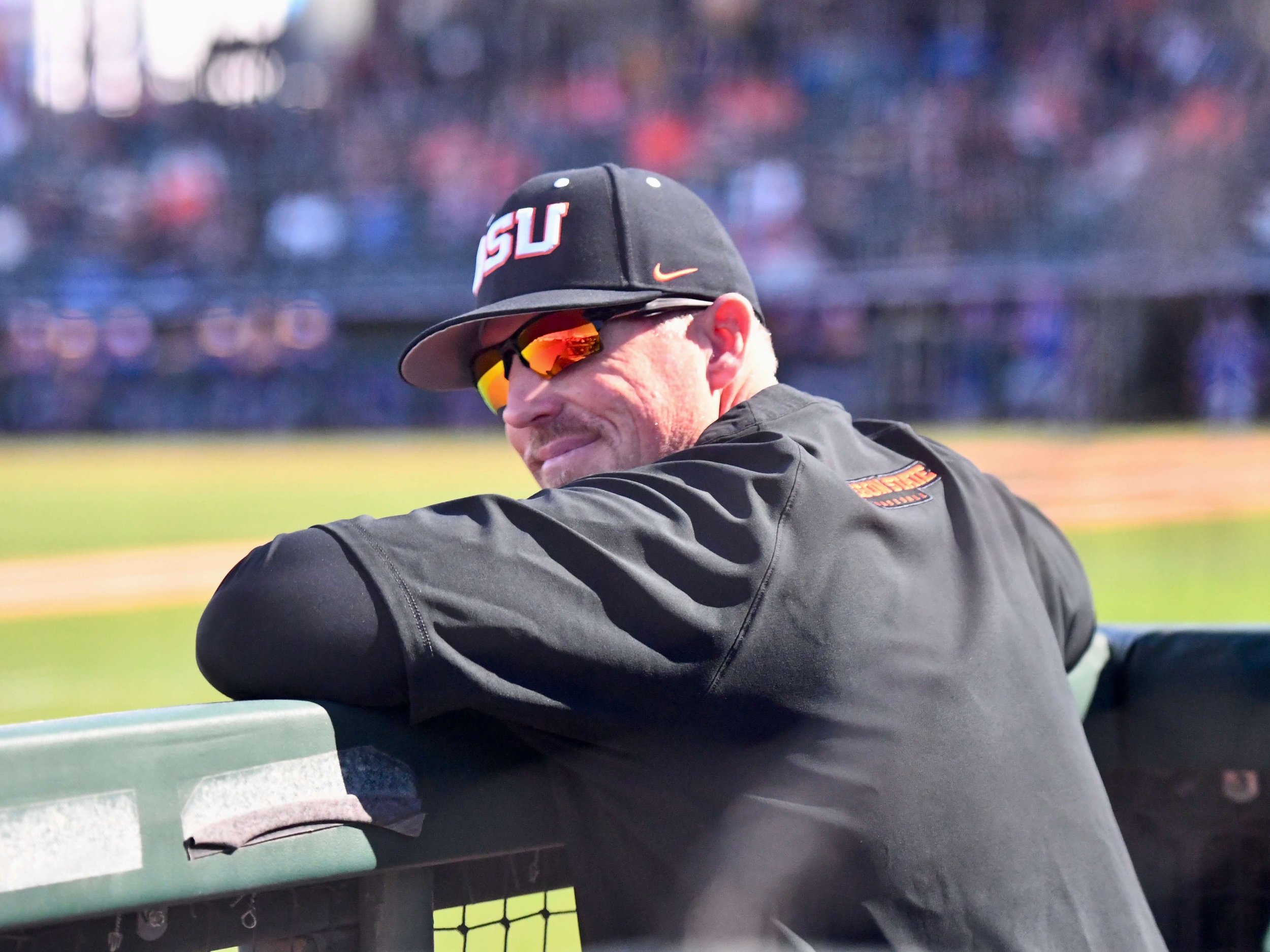
Rich Dorman, who did a marvelous job with the pitching staff this season, says the Beavers’ season was “good, but not good enough” (courtesy Dominic Cusimano)
“It was good, but it wasn’t good enough,” Dorman said. “It sucks how it ended. It is unfortunate. (The Ducks) scored more runs than we did. We gotta get better.”
“There was a lot for our guys to be proud about this season,” Gipson said. “Winning 45 games isn’t easy. It sucks to go down in the Regional, and down to Oregon. Credit to (the Ducks). They had a kick-ass environment and they ended us. Tip of the cap. They moved on and we didn’t.”
Pitching provided many highlights for the Beavers in ’26. Despite losing ace Dax Whitney to injury for the final five weeks, Oregon State led the nation in ERA (3.22), walks/hits per innings pitched, or WHIP (1.14) and strikeouts (699). The latter bettered a school record the Beavers set a year ago in 40 more innings and was an average of nearly 12 K’s a game.
Freshman Trey Morris (1.98 in 59 innings), Whitney (2.00 in 63 innings) and junior Eric Segura (2.22 in 73 innings) rank fourth, fifth and eighth, respectively, in ERA in the country.
“Three arms in the top 10 is pretty cool,” Dorman said.
Oregon State opponents averaged only 3.6 runs a game. That included an 18-2 walloping by Washington at Goss Stadium on March 31.
Dorman is most proud of the performance by his staff after Whitney was lost to Tommy John surgery in late April. Freshman Trey Morris joined juniors Ethan Kleinschmit and Eric Segura in the weekend rotation, and the bullpen, led by seniors Isaac Yeager and Albert Roblez, didn’t skip a beat.
“There wasn’t a lot of drop-off,” Dorman said. “Guys stepped up. Another bright spot for me was how tight our staff was. They had an identity. They wanted to be the best pitching staff in America. They wanted to go out and prove that every day. We took a punch in the mouth (by the Huskies) and the guys responded.”
The starters were superb. In 11 starts, Whitney was 6-1 with a 2.00 ERA. Kleinschmit (9-2, 3.74), Segura (6-2, 2.22) and Morris (7-0, 1.98) carried on and continued as one of the top rotations in the nation.
The bullpen featured Wyatt Queen (1-2, 2.49), Tanner Douglas (0-0, 1.02), Yeager (6-2, 2.04) and Roblez (2-1, 1.03 with 14 saves).
“The guys continued to fight and get better,” Dorman said. “I really loved this group. The coolest thing is that they loved each other.”
The best previous pitching staff during the Mitch Canham era was in 2022, which had a 3.48 ERA and 611 strikeouts in 61 games. That team featured Cooper Hjerpe, Kevin Abel, Jake Pfennigs, Bryant Salgado and Jake Mulholland. How does this year’s staff compare?
“We did it a different way,” Dorman said. “Our bullpen this year was a little more swing-and-miss, a strikeout type of staff. At the end of games, Roblez was really good to have. If we had a lead past the sixth inning, the game was over.
“And (this year’s) starting pitching was so good. Until ‘Whit’ went down, we had four really solid starters. We didn’t have the fifth guy to step up. If you are going to look for a weakness, starting depth might be it. But we had guys who filled roles. They did a tremendous job.”
Oregon State’s defense this season flew under the radar, but it was top-notch. The Beavers committed 33 errors in 59 games — lowest ever by a Canham team — and turned 40 double-plays. The 2025 team turned 43 twin-killings but made 48 errors in 65 games. Second baseman AJ Singer, shortstop Tyler Inge and third baseman Paul Vazquez combined for only 11 errors in 493 chances this season.
Assistant coach Joey Wong was in charge of infield defense; undergrad assistant Brady Kasper handled the outfielders.
“Joey did a great job with the infield,” Gipson said. “He has always been really good about doing extra research, (directing) positioning and how the guys play (opposing hitters). The way they practiced this year was really good. Brady did a great job with the outfielders, too. We had some speed out there with (Easton) Talt, (Adam) Haight and (Nyan) Hayes. And (Josh) Proctor got a ton better as the season wore on.”
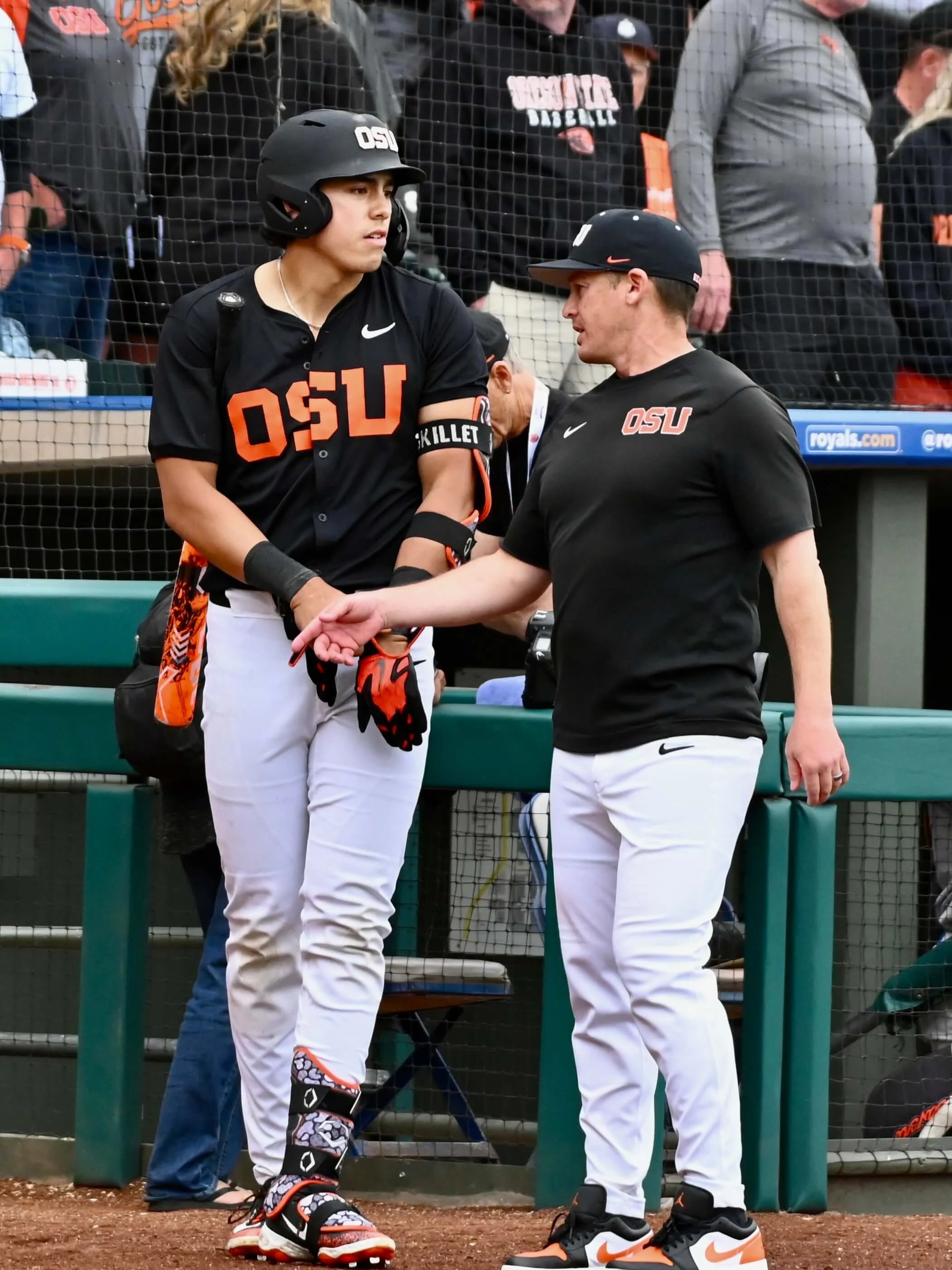
Assistant coach Ryan Gipson (right) says freshman left-fielder Josh Proctor will be part of Oregon State’s “core nucleus” next season (courtesy Dominic Cusimano)
Singer won a national Gold Glove award as a junior; it wouldn’t be a surprise if he repeated this season.
“The position that is going to lead a team in assists is second base, and we have been fortunate to have AJ play that position every game for two years,” Gipson said. “When everything hit that way is an out, that is a really good feeling.
“Inge and (Cooper) Vance both played a very solid shortstop. Paulie (Vazquez) came and got the ball well, and he has a cannon for an arm. He played his tail off all year. We are hoping he wins a Gold Glove at third base this year.”
Oregon State was more challenged on the offensive side, hitting .274, the lowest mark since Canham took over in 2020, with 55 home runs. Last year’s Beavers hit .290 with 107 round-trippers.
Other comparisons: the ’25 Beavers were better in on-base percentage (.405 to .384), slugging percentage (.422 to .405) and free passes (440 to 370). The ’25 club struck out more often, 564 to 427, but scored more runs per game, though it wasn’t a great difference — 7.4 to 6.6.

This year’s team got better through the season and scored seven or more runs in 29 games. The Beavers plated three or fewer runs 15 times, but only twice in the last 17 — both in the Regional.
“We knew it was going to be a different offense than we have had the past few years,” Gipson said. “We knew home runs weren’t going to be our offense. We didn’t have the big slug superstars we have had. We thought Jacob (Krieg, the first baseman) was going to slug a lot, but he never really got going.
“We scored enough runs to win 45 games, but it was a down year in all of our minds — and especially in my mind because I coach the hitters — in terms of how the offense performed overall.”
The Beavers played more small ball, reminiscent of some of Pat Casey’s teams. Lead-off man Talt scored a team-high 52 runs and stole 26 bases, third on the school single-season list behind Travis Bazzana (36 in 2023) and Dave Brundage (29 in 1986).
“We got creative when we needed to,” Gipson said. “You could see glimpses of the offense start to come around when we stayed to the middle, hit the other way, bunted, stole bags, pressed the issue and applied pressure that way.”
Only one Beaver hit better than .300 — catcher Jacob Galloway at .304 — but eight others topped .270. Freshman DH/first baseman Ethan Porter (.293 with a team-high .480 OBA) emerged as a solid No. 3 hitter the second half of the season. Vazquez (.296 with eight homers), Haight (.283 with three homers) and Proctor (.283 with seven homers) were consistent producers. Singer hit .291 with eight four-baggers and led the team in RBIs (56). DH Bryce Hubbard led with nine homers but slumped the second half of the season, hitting his last dinger on May 1.
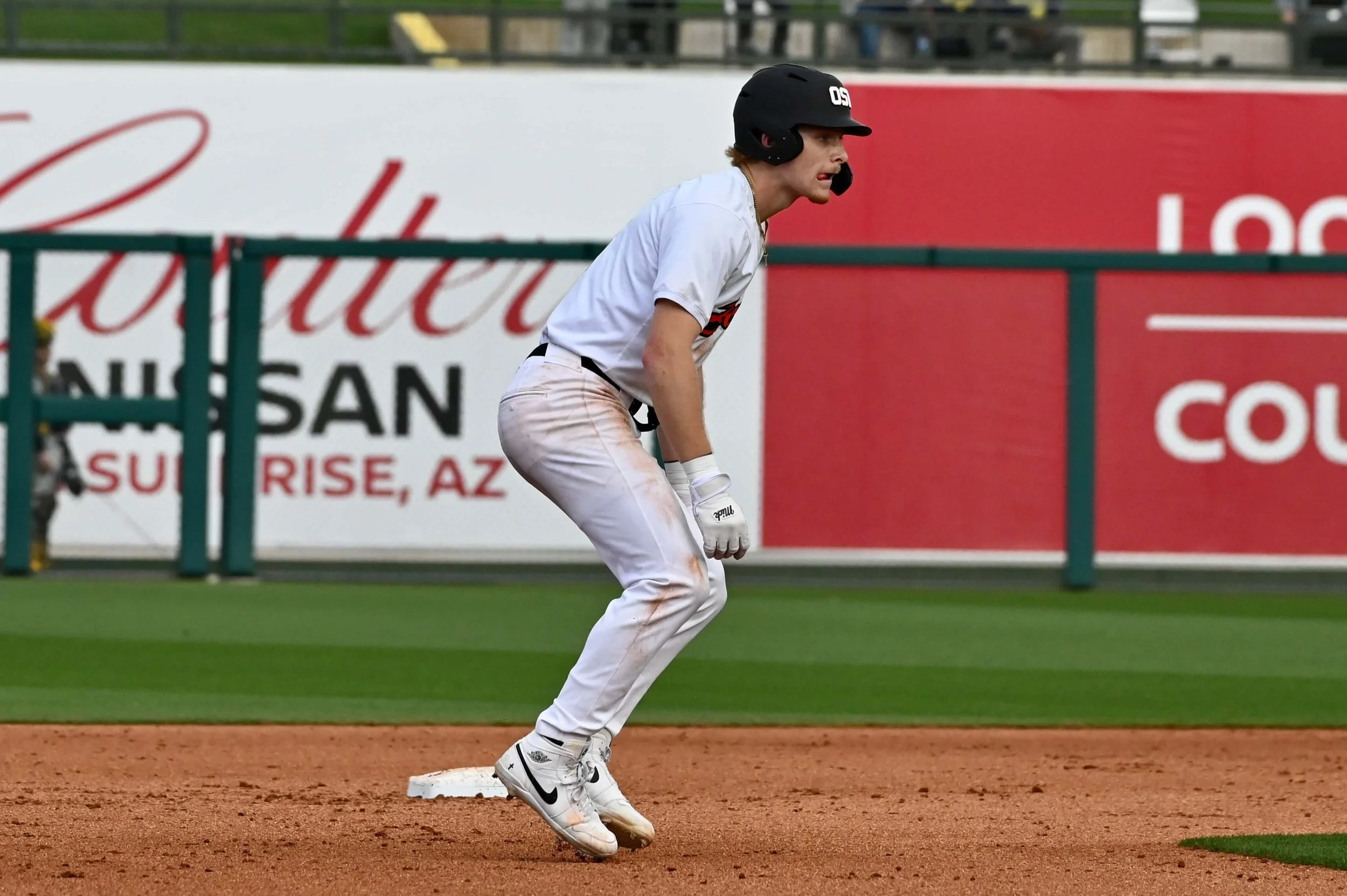
Sophomore right-fielder Adam Haight will be a key component in Oregon State’s plans for 2027 (courtesy Dominic Cusimano)
Oregon State will lose a load of talent from this year’s club. Singer, Galloway, Talt, Hubbard, Krieg, Hayes and Vance are seniors, as are pitchers Roblez, Yeager and AJ Hutcheson. Juniors Kleinschmit and Segura will be lost to the MLB draft, and Queen is likely to go, too. Junior infielder Bryson Glassco — who hit .282 with five homers as a part-time starter — has hit the transfer portal along with redshirt freshman catcher Ryan Vandenbrink, who played sparingly this season.
The biggest on-field loss will be Whitney, who will likely miss the entire 2027 campaign as he rehabs from Tommy John surgery. It seems probable that the No. 1-rated prospect for the ’27 draft has thrown his last pitch as a Beaver.
“Makes me sad to even think about it, but that could be a reality,” Dorman said. “Dax might be just getting ready for the draft. He should be up and ripping by draft time next year.”
Shame of it is, Whitney loves the Oregon State program. In an interview less than a week before his injury, I asked him if he would return for his junior season.
“Absolutely,” he said quickly. “Hey, without a doubt.”
That was good news in Beaver Nation, I told Dax, for there was concern that he might get stolen away by another school in the transfer portal.
“Can’t get stolen if you never enter the portal,” he said. “Not gonna happen.”
Whitney said after the surgery he intends to be back at Oregon State next season, rehabbing and working with the program’s medical staff. He will be around his teammates, and my guess is he will be a great resource for Beaver pitchers, with his experience and knowledge to share.
The ace of next year’s staff is likely to be Morris, the 6-2, 250-pound left-hander who will surely garner Freshman All-America honors. The Easton, Calif., native will not pitch in the Cape Cod League this summer.
“ ‘Boogie’ is ready to take a break,” Dorman said. “I had him ready to pitch a little for the (West Coast League Corvallis) Knights, but he will be in Corvallis all summer, working out and prepping for next year.”
Dorman said Morris reminds him of New York Yankees southpaw Carlos Rodon, a three-time All-Star now in his 12th major league season. Dorman started the year thinking Morris would get some “midweek touches” but be available for bullpen duty on the weekends. He was so good with his midweek starts that, when Whitney went down, he fit seamlessly into the rotation.
“Trey is a bulldog,” Dorman said. “He is aggressive with his fastball command, he is in the zone, he has an advanced pitcher’s mind, and he is just so strong. He has a bright future. He needs to continue to build on this year both physically and as a pitcher. He will keep developing his secondary stuff, because his heater is real.”
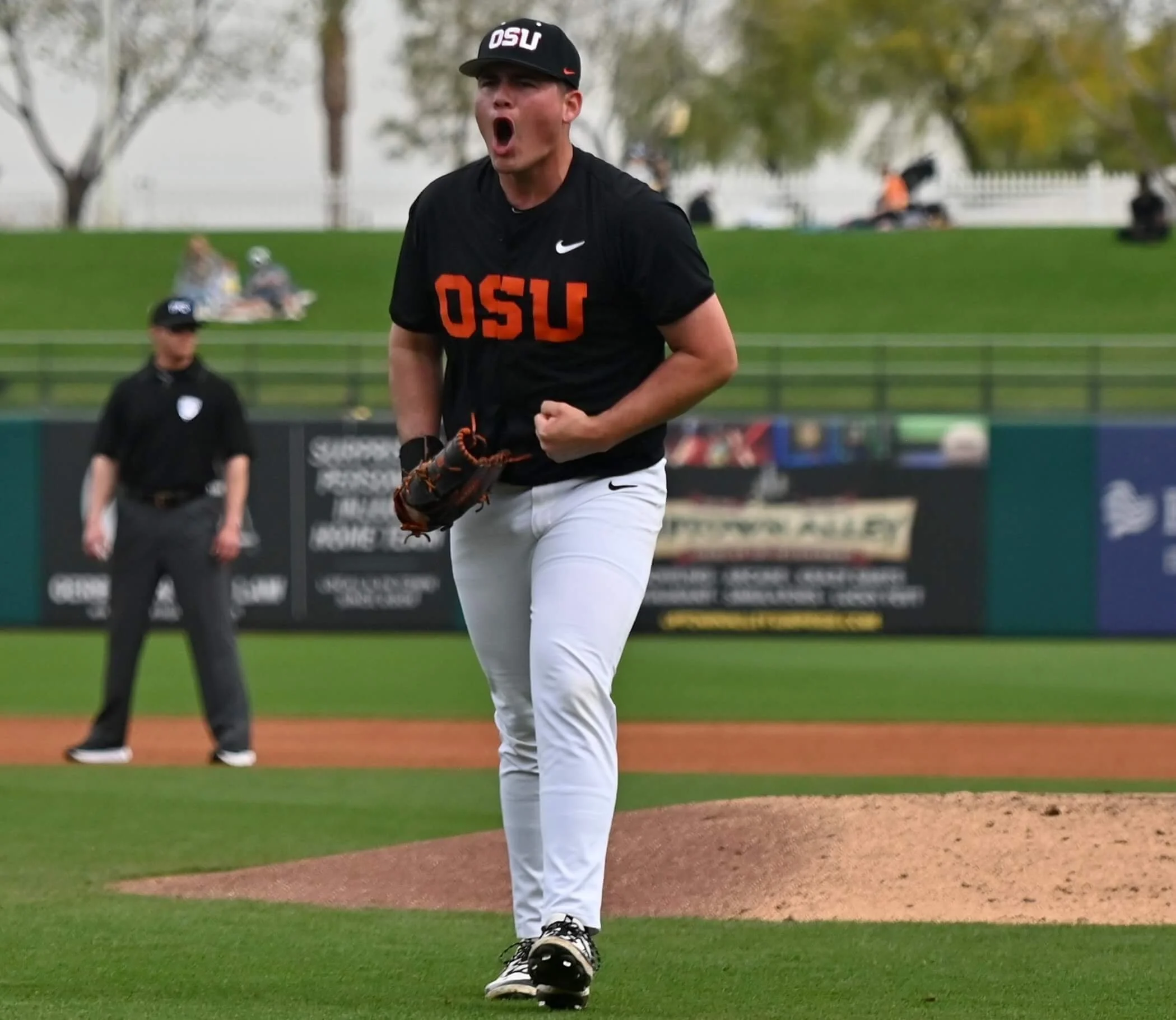
Freshman Trey Morris will likely be the ace of Oregon State’s pitching staff next season (courtesy Dominic Cusimano)
Dorman said Morris’ average fastball is in the low 90’s, and it stays there from the first to last pitch.
“He is coming downhill and has good extension,” Dorman said. “The ball has good vert (vertical drop) and he locates it and hides it a little bit. (The fastball) doesn’t need to get super hot.”
Dorman named four players as candidates to make the kind of jump Segura and Douglas did this season from a year ago — right-handers Zach Edwards, Zach Kmatz, Noah Scott and Jack Giordano. All four are scheduled to pitch in the Cape this summer.
“Those four guys should be on that kind of trajectory,” Dorman said.
Edwards, a 6-2, 230-pound sophomore right-hander, finished with a 2-0 record and a 5.61 ERA with 37 strikeouts and a .224 opponents batting average in 25 2/3 innings. The ERA was under 3 after his first five appearances, when he couldn’t get anybody out.
“Wish we could throw out that first month,” Dorman said. “The way the kid finished was great. ‘Zed’ is a potential weekend starter next season. He is strong as an ox and has a strong three-pitch mix. We have to continue to develop the fastball and generate a little more whiff with the heater. He can handle that.”
Scott a 6-4, 240-pound junior, was 2-1 with a 5.68 ERA in 16 appearances and 23 innings. Dorman believes he could challenge for a rotation spot in ’27.
“It was like he was the younger brother this year” after a transfer from Iowa Western JC, Dorman said. “He is going to be better when he is the older guy next season. I want him to be a little more dominant.”
Kmatz, a 6-3, 235-pound sophomore, was 0-0 with a 5.30 ERA in 14 games and 18 2/3 innings.
“He got off to a slow start, but he made a ton of improvements with his slider,” Dorman said. “I expect a lot of improvement this summer. He should be in prime position to be a guy for us next season. He could handle starting. A lot of it is on his plate.”
Giordano, a 6-1, 200-pound sophomore who converted from catcher after a transfer from San Diego, threw only 6 2/3 innings in nine appearances this season.
“We are going to be patient with Jack,” Dorman said. “Big-time arm. He is going to emerge at some point for us.”
Dorman has eight newcomers who have signed letters of intent, including three from the JC route — Luke Duncan from San Joaquin Delta in Stockton, Calif.; Grayson Riding from College of Southern Idaho and 6-7, 235-pound Creighton Tuzzio of Iowa Western. The five incoming freshmen are Everett Burdett of Albuquerque, Neil Burtis of Maple Valley, Wash., Julian Sabourin of Ancaster, Ontario, Grady Saunders from Springfield’s Thurston High and August Ware from Hillsboro’s Glencoe High. All but Burtis and Ware are right-handers.
“I love our incoming freshmen,” Dorman said. “I feel like there are a couple of draft risks.”
One is the 6-2, 185-pound Saunders, a two-way player (also a third baseman) ranked by Baseball Northwest as the No. 1 prospect in the Northwest.
“I think Grady is coming to school,” Dorman said. “He loves Oregon State. We are looking at him first at pitcher, though he might become a two-way guy for us.”
The Beavers will likely add multiple pitchers from the portal. One has already arrived: Jaxon Baker from Long Beach State, from where Roblez transferred to OSU last season. Baker (0-1, 6.32 in 17 appearances, including four starts) is a 6-5, 200-pound freshman left-hander who allowed 22 walks with 41 strikeouts in 31 1/3 innings this season.
“He came on strong toward the end of the season,” Dorman said. “He has big upside.”
Oregon State is losing three position players who ended the season as starters — Singer, Talt and Galloway. Their presence will be missed. Returning, though, are sophomores Inge at shortstop, Vazquez at third and Haight in right field and freshmen Porter at first and Proctor in left field.
“That is our core nucleus, and I absolutely love that group,” Gipson said. “I am excited about them as players, but even more so as people. They go about things the right way.”
Pencil in redshirt freshman Mason Pike — who missed nearly the entire season after elbow surgery — to replace Singer at second. The 5-11, 210-pound Puyallup native, a switch-hitter who was the Washington Gatorade Player of the Year in 2025, is a two-way player who will focus on being a position player next season.
“Mason will be practicing in the fall, though it may be more of a build-up and progression, but he will be full go next season,” Gipson said. “He has crazy bad speed and strength — big potential as a position player.”
Two other players on the 2026 roster who redshirted as freshmen should make their mark next season — 6-3, 220-pound Josh Nati from Sydney, Australia and 6-2, 240-pound Kameron Beck from South Jordan, Utah. Nati had 11 at-bats in eight games; Beck sat for the season. They project as first basemen, though each could get a look at catcher.
“Josh has raw power and big hitability,” Gipson said. “He already shows signs of zone control — doesn’t swing at balls, will only go at strikes. He is really loud with the bat. And Kameron is going to hit a boat-load for us in his career as a Beav.”
Proctor, Haight and Vazquez will do stints in the Cape this summer. Inge, the son of long-time Detroit Tiger Brandon Inge, will not. After beating out Vance for the starting shortstop job, Inge hit better than .300 the second half of the season to finish at .277.
“Tyler will stay home,” Gipson said. “He is going to live in the weight room and the (batting) cage this summer. His confidence at the plate started to come around, and there is innate hitability there. He has a knack at throwing his hands and finding a barrel. He is going to be a special player. I have already had plenty of scouts talk to me about him and what they expect of him next year as a junior.”
Oregon State has seven position players signed — six high schoolers and shortstop Diego Vazquez (no relation to Paul) from Fullerton (Calif.) JC.
The 6-2, 185-pound Vazquez hit .312 with 14 doubles, four triples and five homers in 49 games at Fullerton this season. He had a .441 OBP and a team-high 53 RBIs.
“Diego has a big-time bat and is more of an offensive infielder,” Gipson said. “We will see once we get to fall where we will use him.”
Three of the high school signees are expected to go in the first 10 rounds of the MLB draft. Outfielder Blake Bowen from Riverside, Calif., is projected to go early in the second round. Shortstop Troy Southisene of Henderson, Nev., and catcher Teagan Scott of South Salem High are picked to be taken in the middle rounds.
Other signees are identical twins Kyson and Kael Barney of Nolensville, Tenn., and catcher Dyson Grant of Mission Viejo, Calif.
The 6-3, 210-pound Bowen was MVP of the 2025 Under Armour All-American Game at Camden Yards. Gipson said the situation reminds him of a year ago when OSU signee Xavier Neyens, the Washington Gatorade Player of the Year in 2025, accepted a $4.1 million signing bonus with the Astros.
“Blake is the best prep outfielder in the country,” Gipson said. “We are going to be fortunate if we have Blake in a Beaver uniform next year. I know it is what he wants to do. With ‘X’ (Neyens), we knew there was a number, and he got that number. Blake is of that caliber. We’ll see what happens.”
The 5-10, 175-pound Southisene is the youngest of four brothers out of Henderson, Nev. Two are playing in the minor leagues, a third is playing at College of South Nevada. An All-State selection as a junior, Troy is batting .349 this season.
“Troy is an absolute little stick of dynamite,” Gipson said. “He has some Nick Madrigal to his game and some built-in power. He can run and is a tough out.”
The 5-11, 210-pound Scott is the Oregon Gatorade Player of the Year. He hit .558 with 11 home runs in 28 games for the Saxons.
“He can help us right away,” Gipson said. “Catcher is a tough position as a freshman, but if anybody is going to be ready to do it, it’s Teagan.”
The 6-2, 210-pound Grant “is a stud,” Gipson said. “He is another catcher who will come in and be ready to roll.”
Kyson Barney is a 6-5, 190-pound shortstop. Kael Barney is a 6-5, 200-pound left-handed first baseman. They are playing for the Salem Marion Berries in the West Coast League this summer.
“They are big, tall, intriguing, good-looking twins,” Gipson said. “They have huge upside.”
Oregon State will be competing in the new Pac-12 next season. The seven-team league for baseball includes Washington State, Fresno State, San Diego State, Texas State, Gonzaga and Dallas Baptist. Each team will have a three-game series against the other six Pac-12 members. That means there will be 18 conference and 38 non-conference games on the Beavers’ schedule, plus the postseason conference tournament.
“The average RPI of the conference schools is going to be good,” Gipson said. “The schedule will have somewhat of an independent feel to it, with just six weekends (for conference play) in the meat of the schedule. It will be great to have a conference tournament, a good thing for our guys.”
Oregon State will open its 2027 schedule with three weeks on the road — the annual opening series in Surprise, Ariz., followed by series in Las Vegas and Texas. The fourth weekend is expected to be the Beavers’ home-opening series.
“For those first four weekends, the schedule is aggressive, which is awesome,” Dorman said. “Our RPI will be in a good spot before we start conference play. There is something to be said for what we were able to do as an independent, but I like that we will be playing in a conference again.”
The Beavers’ pitching should be solid, depending much on the newcomers. If the recruits wind up on campus, the position players could provide the impetus for a better offense in ’27.
“Talent, makeup, attitude — you name it, it is going to be a really fun group next year,” Gipson said. “I see a lot more runs being scored, and the potential for more home runs, but a much more productive group.”
► ◄
Readers: what are your thoughts? I would love to hear them in the comments below. On the comments entry screen, only your name is required, your email address and website are optional, and may be left blank.
Follow me on BlueSky.
Follow me on X (formerly Twitter).
Like me on Facebook.
Find me on Instagram.
