On Griffin’s unveiling, plus OSU President Murthy’s thoughts on the new AD and Jensen Huang
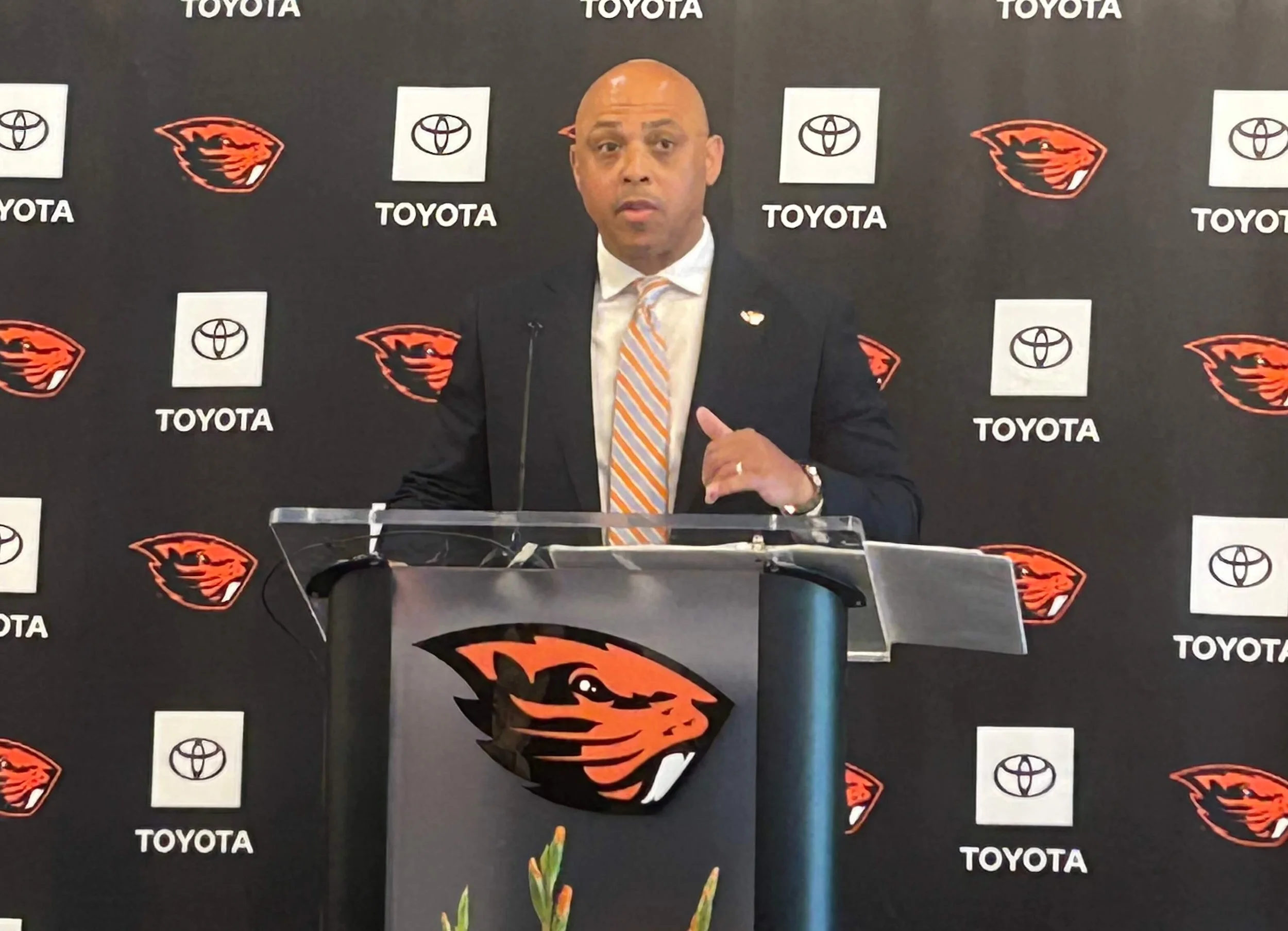
Kevin Griffin set lofty goals during his first media conference as Oregon State’s new athletic director, declaring that they include “that we sit at the top of the Pac-12 mountain in everything we do”
CORVALLIS — Once upon a time, Kevin Griffin was a college football player. At, as Oregon State president Jayathi Murthy referenced Tuesday at Griffin’s introductory press conference as the school’s athletic director, “the Ohio State University.”
Griffin, then 5-10 and 185 pounds, began with the Buckeyes as a cornerback, then switched to receiver. Career totals: four receptions for 37 yards.
But Griffin made his mark on special teams. As a senior, he served as captain for the specialty units. Twice in his career, No. 42 scored touchdowns off of blocked punt plays, including one in his final game as a Buckeye — a memorable 16-yard scamper for a score in the first quarter of Ohio State’s 24-14 win over Texas A&M in the 1999 Sugar Bowl.
When I asked him about it Tuesday, and about how his role as special teams captain helped begin to shape his professional career in sports administration, he offered what amounts to a parable.
Seems that the night before the game, Kevin’s uncle Archie — yes, the only two-time Heisman Trophy winner — was with him in New Orleans. Kevin told him that his coaches had a punt-block play set up for the Aggies.
“Hey, I am going to score a touchdown on this play,” Kevin told his uncle.
And Griffin told me, and the audience at the Coastal Club inside Reser Stadium, “Then it happened, exactly how we had practiced, exactly the way we visioned with our sports psychology team. It all happened. We had practiced, we had done the visualization, and I was prepared. At that moment, it was really easy to pick up that ball and run 16 yards into the end zone.”
It was the culmination, Griffin said, of a lot of things falling into place.
“Our coaches knew how to design the play,” he said. “They had the right players in the right position. Our sports psychology team took us through visualization. I didn’t block the punt (teammate Derek Ross did), but I was ready to pick the ball up and score. It took a team effort. It shows how many people participate and have to do a great job for that one moment to come to life.”
Murthy hopes she has come across a special moment with her decision to hire Griffin as the successor to Scott Barnes, a move that will become official on July 5. For the past four years, Griffin, 50, has served as associate vice president/brand engagement, services and partnerships and associate AD/business strategy at his alma mater. Prior to that, the Redmond, Wash., native had worked for 12 years in the NFL — as director of fan development and community relations with the Seattle Seahawks (2004-13) and VP/marketing media and fan experience with Cleveland Browns (2013-16).
Though much of his work experience has come in pro football, “my first passion was college athletics,” Griffin said. “I Interned in the (Ohio State) sports information department. I wanted to be like Andy Geiger, the long-time athletic director at Ohio State (along with Maryland and Stanford).”
On Tuesday, Griffin assumed his first duties as an AD, speaking to media and a group that included head coaches JaMarcus Shephard (football), Justin Joyner (men’s basketball), Scott Rueck (women’s basketball), Mitch Canham (baseball) and Chris Pendleton (wrestling). In the audience were wife Farrah and their three children, Taylor, Jackson and Kennedy.
Griffin came off as polished, organized and direct. He knows he is taking over an important job at a critical time. A reorganized Pac-12 launches on July 1. New head coaches Shephard and Joyner are in charge of the athletic department’s marquee programs. On a lot of fronts, the Beavers have been fighting a losing battle. Griffin must make sure that turns around.
Griffin was in middle school when he saw former Beaver basketball All-American Gary Payton’s photo on the cover of Sports Illustrated.
“I put that picture on my wall,” he said. “That is how I learned about Oregon State. That is what athletics does for a lot of universities. It opens the door to who and what they are.”
Before the break-up of the old Pac-12 and the advent of the NIL and revenue-sharing age, Oregon State was doing just fine, holding its own on the gridiron against the best of the conference, winning titles in women’s basketball, dominating baseball and even reaching the Elite Eight in men’s basketball.

The last few years have been unsettling to Beaver Nation. The schools left behind, Oregon State and Washington State, have had to pick up the pieces of the conference while the others fled for greener pastures. Griffin intends to make sure the Beavers are positioned to rise as the new conference begins, and he is not shy about sharing it with those relaying the message through the media.
“When I asked (Murthy) the most important objective, she said, ‘Win,’ ” he said. “That’s the bottom line. My job is to equip our coaches and student-athletes to perform at their best. We believe that would mean we sit at the top of the Pac-12 mountain in everything we do. Our rightful place is atop the Pac-12 mountain. Our teams are going to compete for conference and national championships.”
In the next breath, he said a part of his duties will be “making sure everybody believes. Talk is cheap. We have to earn everyone’s trust. That is going to take some time. If we can do just a little bit more and do this thing together, then we are going to be in a really good spot.”
Griffin won out over a small field of finalists, including Kimya Massey, the capable former assistant AD at Oregon State now running the show at the University of San Diego. Several of the coaches were involved with the interview process, including Rueck, who has been a rock star in building and maintaining his program through 16 years at the women’s basketball helm. I asked him what about Griffin impressed him.
“Charisma,” Rueck said. “I love his energy, his vision. He has a passion for progress. That is what makes him an exciting choice. He has a dynamic background, all the way from his time as a student-athlete to spending so many years at the professional level. I am excited to see how it impacts us and where he takes us.”
Murthy formed a local selection committee and hired a national search firm for help, but ultimately Griffin’s hire was her decision.
“We felt we needed a leader and a brand-builder, and that is Kevin,” she said. “He is a change-maker, with a clear vision for OSU athletics.”
After the press conference, I got some one-on-one time with Murthy. I remarked that I had been struck by the energy emanating from Griffin. She nodded and smiled.
“That is so important,” she said. “It is from the energy of our coaches that we all draw energy. I sense an enormous amount of energy from JaMarcus, from Justin, Mitch and Scott, and so many of our coaches. They are all energetic in their own ways. They bring that intensity to their sport. And that culture is really important for OSU across the board, not just in athletics. It is essential to everything that we do.”
Money talks now more than ever in Division I athletics. The best athletic directors today have the skills to communicate, to bring people together and to serve as a de facto CEO of a multi-million-dollar corporation. (Oregon State’s athletic budget for the 2025-26 fiscal year exceeded $100 million). Also, to be a capable, even inspirational leader, and to build strong relationships with coaches. And more than ever, to fund-raise, which has been Griffin’s specialty during his time at Ohio State.
“Revenue generation is going to be deeply important across the board,” Murthy said. “This is not a new revelation. We know college athletics is changing and the focus on money is important. But I will tell you that it is not just money. I have spoken about Kevin’s student-athlete connection. He was a student-athlete, his family are all athletes, and he grew up in the tradition. He comes from a fabled football family. He has really been in that mix all of his life. With that comes a special regard for students and student-athletes that I detected from him right away.
“The other thing is how creative he is. He is just buzzing with ideas. That energy is really important. OSU is doing so many things that are truly creative. I would love to see this cross-pollination between all the ideas that have been generated in athletics and academics, for them to play off of each other to be truly important in both worlds.”
In the NIL world, academics has largely gotten lost in the shuffle. At the richest, most powerful schools, vast amounts of money have been used to buy athletes. Many of them take most if not all of their courses online, meaning they are spending little or no time on campus going through the maturation process that comes with the traditional college experience. With the transfer portal so easy to maneuver, athletes are bouncing from school to school, slowing the developmental process and not allowing for relationships to fully grow.
Griffin said he will emphasize helping student-athletes develop into adulthood along with the athletic experience.
“We are going to be all about supporting our students for their full development,” he declared. “My wife and I were both student-athletes. Our oldest son was a student-athlete. Our daughter is a current student-athlete. We think about the world in terms of student-athlete development. It is truly important to us.
“We will do this better than anyone else, ensuring that our students are healthy, that they are growing and ready for life after college. We also want to make sure they are having a good time while they are here. Those things matter, but it is a heck of a lot better when we are also winning. We have to make sure we are doing both of those at the same time.”
Keeping up with the Joneses in terms of NIL and rev-sharing is part of the equation. Barnes proclaimed that Oregon State would be at the top end of that in the new Pac-12, but some projections say that won’t be the case. The $48 million Valley Challenge, launched last month, could help matters a great deal. But since I had Murthy’s ear, I thought I would float a question that several of my Beaver friends have been asking for some time. Will Jensen Huang ever earmark any contributions to his alma mater for athletics?
Most of those in Beaver Nation recognize the name of the 1983 graduate of the School of Engineering who went on to become founder, president CEO of Nvidia, the technology giant that has become the world’s most valuable company. Forbes estimates Huang’s net worth at more than $200 billion, making him the world’s seventh-wealthiest person.
Huang clearly loves Oregon State. It is where he met his wife, Lori. He has given major grants to the university, including $5 million for cancer research and $50 million for the Collaborative Innovation Complex. The latter is a $213 million facility designed for team-based research that houses the Nvdia supercomputer to address global challenges in climate science, microelectronics, oceanography and artificial intelligence. It is expected to open its doors in December.
I am pretty sure that Huang, as a student at OSU in the early ‘80s, wasn’t much interested in Oregon State’s nationally ranked men’s basketball team under Ralph Miller, or its woefully inept football program under Joe Avezzano. Word is that he is not a sports fan today. But Huang, 63, is a very smart man, and with athletics the window of a major university, he surely knows his school would benefit from any direct contributions he might make to the athletic fund. Better athletic schools draw more students. After its 2001 Fiesta Bowl win over Notre Dame, Oregon State’s on-campus enrollment increased seven percent to nearly 18,000 students, a record high at the time.
Huang could become Oregon State’s Phil Knight, or T. Boone Pickens, on steroids if he so chooses.
Murthy answered my question, sort of.
“Jensen will decide his own priorities,” she said. “He has been incredibly generous to us. I will tell you that everything he has given to the university — all the opportunities that it has opened up for us in artificial intelligence and large-scale computation — these things are very important for the future of the university. “There are interesting connections between athletics and AI and data and where all of that is going to go. Kevin has spoken about that to some degree in terms of athlete performance and health, and there is so much other stuff there. That is what I mean by cross-pollination between athletics and academics. Jensen is in the mix because of all his contributions through AI and high-performance computation.”
Indeed, there is a tie-in between Huang’s business and Oregon State athletics. During Griffin’s remarks to the media, he mentioned that “we will unlock the power of data analytics, leverage the university’s immense research and enhance the university’s health and wealth performance.”
Analytics is becoming a more important part of preparation and decision-making tools in the sports world. Oregon State baseball, in particular, is on the cutting edge of that. Perhaps that could be the key to unlocking the door to Huang’s generosity to an athletics gift that could make a major difference.
For now, a more likely venture is getting passed through Congress what is known as the “Protect College Sports Act,” which would establish desperately needed guardrails for NIL, rev-sharing and the transfer portal. Pac-12 commissioner Teresa Gould testified in last week’s Senate hearings, saying the conference strongly supports the bill.
“I was so proud to see commissioner Gould testifying there,” Murthy said. “She represented us so well. She told the story of schools like OSU and the issues that we face in the new environment. We are deeply in need of some kind of legislative action to contain all the flailing that is happening in collegiate athletics. There is a lot of work to be done. I am so hopeful, particularly as both sides of Congress work together to make this happen. Fingers crossed. It has to move very quickly, and I am very hopeful that something good will come out of it.”
When I asked Griffin about the act, he was in total agreement.
“It is critically important,” he said. “What it does mostly, it sets the framework for conversation. Depending on where you sit in terms of what conference you are in, there are things you like or don’t like in that bill. When you boil it all down, it would be a better environment for our student-athletes and for college sports in general. It sets the framework for folks to get in a room and hash out the conversations that we have been avoiding having over the last four years.”
In the meantime, Griffin will have to get on his horse to create or increase revenue streams at his new school.
“We are going to utilize a robust NIL and sustain revenue-sharing models,” Griffin said. “Some commercial opportunities aren’t fully monetized or optimized. We will work on that. One of the areas we will focus on immediately is, ‘What is our NIL strategy, and what does our NIL staff look like?’ ”
Good question. Oregon State’s NIL program seems to have gone dormant since Kyle Bjornstad sold the “Dam Nation” collective nearly a year ago. Any in-house NIL presence seemed to disappear after the Blueprint Sports fiasco.
Oregon State has traditionally been a blue-collar school with a hard-working approach to fielding a competitive athletic program. Griffin seems willing to roll up his sleeves and get at it.
“My top priorities are, week one, to share with our staff the vision I am starting to lay out,” he said. “We must make sure we are ready for football and ensure that we move right into all of our sports in the fall in a seamless way. This will be a collaborative effort. Everyone’s voice will be heard, and they will participate.
“We have to make sure we are the leaders of the Pac-12. It is going to be a dogfight. I am up for the challenge.”
As Griffin says, talk is cheap, but positive results are priceless. Murthy is going all in on the belief that Griffin is the right one to take the ball into the end zone for Beaver Nation.
► ◄
Readers: what are your thoughts? I would love to hear them in the comments below. On the comments entry screen, only your name is required, your email address and website are optional, and may be left blank.
Follow me on BlueSky.
Follow me on X (formerly Twitter).
Like me on Facebook.
Find me on Instagram.
