Tinkle’s fate at Oregon State: ‘We identify them, we recruit them, we develop them, and then we lose them’
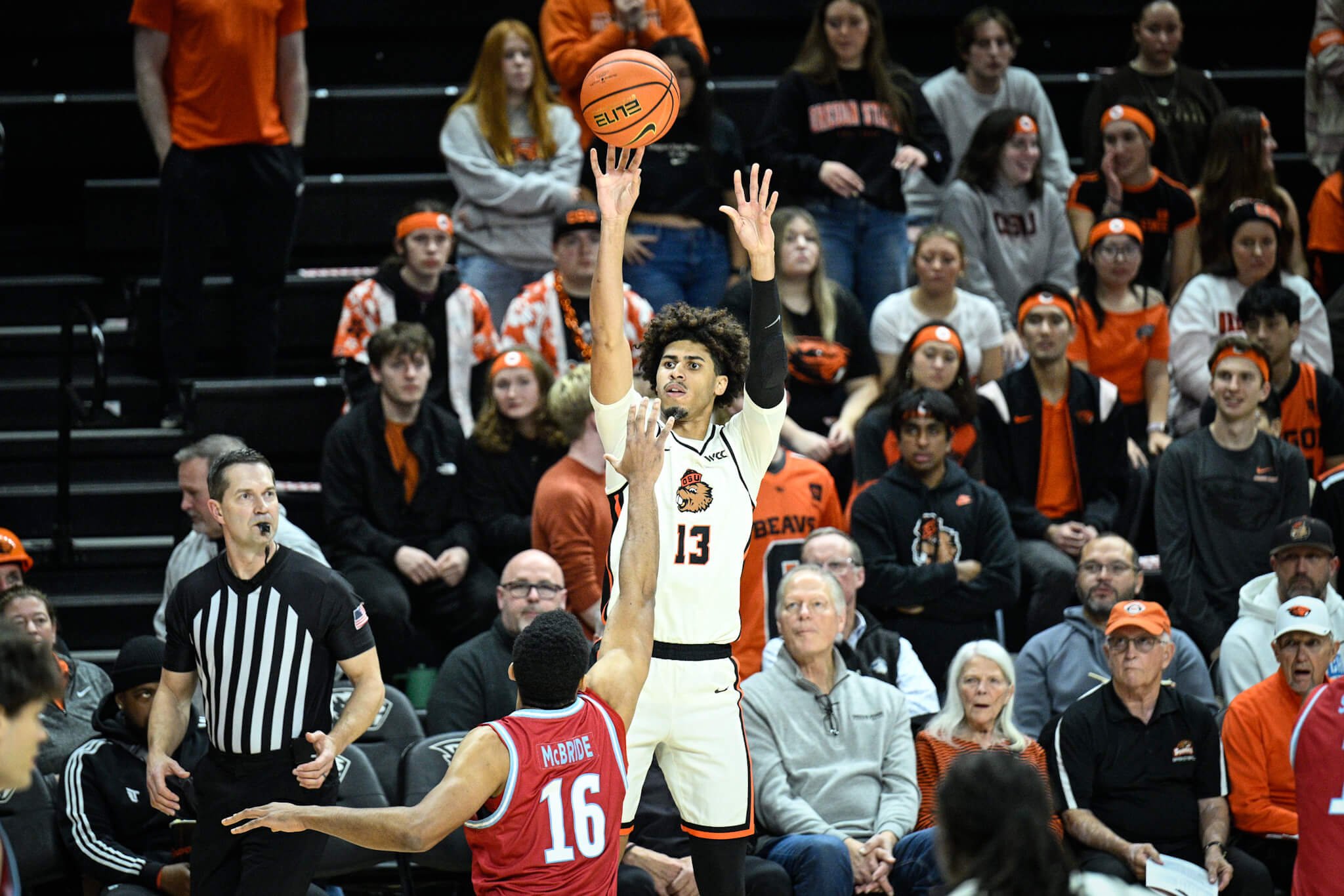
Junior forward Isaiah Sy, coming off career highs of 25 points and 11 rebounds in Wednesday’s win over Loyola Marymount, is a key to the remainder of Oregon State’s season (courtesy Karl Maasdam/OSU sports communications)
Updated 1/17/2026 11:11 AM
CORVALLIS — Wayne Tinkle went into this season with hopes that his Oregon State team could at least duplicate what the Beavers did a year ago, when they gave him only the second 20-win season of his tenure as head coach.
It doesn’t look like that will happen. Oregon State is 10-10 overall and 3-4 in West Coast Conference play going into Saturday’s 3 p.m. matchup at Gill Coliseum at Pacific (12-8, 3-4), which thrashed OSU 84-53 in Stockton on Jan. 2.
The Beavers beat Loyola Marymount 76-70 Wednesday at Gill, giving them a chance for a home sweep by getting revenge against a Pacific team that cleaned their clock just two weeks ago.
“We have mentioned (that outcome) to our guys, for sure,” Tinkle said Friday. “I was watching the game film and had to turn it off after eight minutes. We weren’t very good, and (the Tigers) exploited it.”
Josiah Lake II, Oregon State’s point guard, captain and best player, got two early fouls and contributed nine points and one assist in 18 minutes in that one.
“JoJo being out took the wind out of our sails, nobody stepped up in his absence and it snowballed,” Tinkle says. “I don’t think we need to remind our guys much more about what happened down there.”
In Wednesday’s victory over Loyola Marymount, Oregon State shot poorly from the field (.364) and 3-point range (.300), but was 29 for 31 at the free-throw line (.934). A Lake jump shot with 4:36 left, which pushed the Beavers ahead 63-61, was their last field goal. But they sank 13 of 15 foul shots over the final 3:12 to secure the victory.
For their part, the Tigers sank 24 of 25 gift shots (.960), meaning the teams combined to make 53 of 56 attempts at the charity stripes. I have never seen such a clinic in foul shooting, either at the college or NBA level.
The collegiate record for combined free throw percentage was set a half-century ago, when Purdue (25) and Wisconsin (22) were perfect on 47 attempts at the line in 1976. The NBA record for most gifters without a miss is 45 in a game between Atlanta (29) and Washington (16) in 2021.
The Beavers are shooting .778 from the line this season, not far off the .786 mark that set a school record last season. They have also played a lot of strong defense, holding opponents to .429 shooting from the field and .320 from 3-point range. On Wednesday, they used a season-high 11 steals to create 15 Pacific turnovers.
This is not a particularly good shooting team from the field, however. Lake is terrific, firing at a .500 clip from the field and .382 from beyond the arc and averaging 13.2 points, but he is taking only 7.5 shots per game. Lake, who was 9 for 10 from the foul line against Pacific, is shooting .847 from the line this season. The 6-2 junior from Tualatin leads the Beavers in scoring, rebounds (4.5), assists (3.9) and steals (1.6). He had only one turnover in 37 minutes while running the offense against Pacific.
“When he takes open looks, JoJo shoots at a high clip, and he can get to the rim and finish,” Tinkle says. “I would like to see him do that more often. We are asking him to do so much. He’s our engine. He’s a tough kid. He never backs down.”
Junior forward Isaiah Sy (pronounced “See”) had the game of his career Wednesday with 25 points and 11 rebounds, hitting 5 of 6 3-point attempts.
“We thought that was what he was capable of when we recruited him,” Tinkle says. “He pulled his hamstring in the preseason and missed a month. It takes awhile to get back on stride.”

The Dean of Portland Sports is now on BlueSky.
Sy is shooting .394 on triples but only .369 from the field while averaging 10.2 points.
Guard recruits Dez White and Keziah Ekissi are shooting well from 3-point range but only .360 and .333, respectively, from the field. And promising freshman Matija Samar from Slovenia, a smooth, savvy swing man, has shot poorly from the field (.276) and 3-point territory (.254).
“We are not finishing very well in transition, our guards especially,” Tinkle says. “With Matija, it’s in his head. He is a good shooter. He is getting good looks. We need those guys to get going a little bit.”
Tinkle hasn’t gotten consistent production from his big men, either. Yaak Yaak, a 6-11 junior from Australia; Johan Munch, a 6-11 sophomore from Denmark; Jorge Diaz Graham, a 6-11 senior from Spain, and 6-10 Olavi Suutela, a 6-10 freshman from Finland, have all had their moments. Suutela, for instance, scored 19 points on 8-for-9 shooting — 3 for 4 from 3-point land — in last week’s 82-76 loss to Portland. The next time out against Pacific, he contributed four points and four rebounds in 19 minutes.
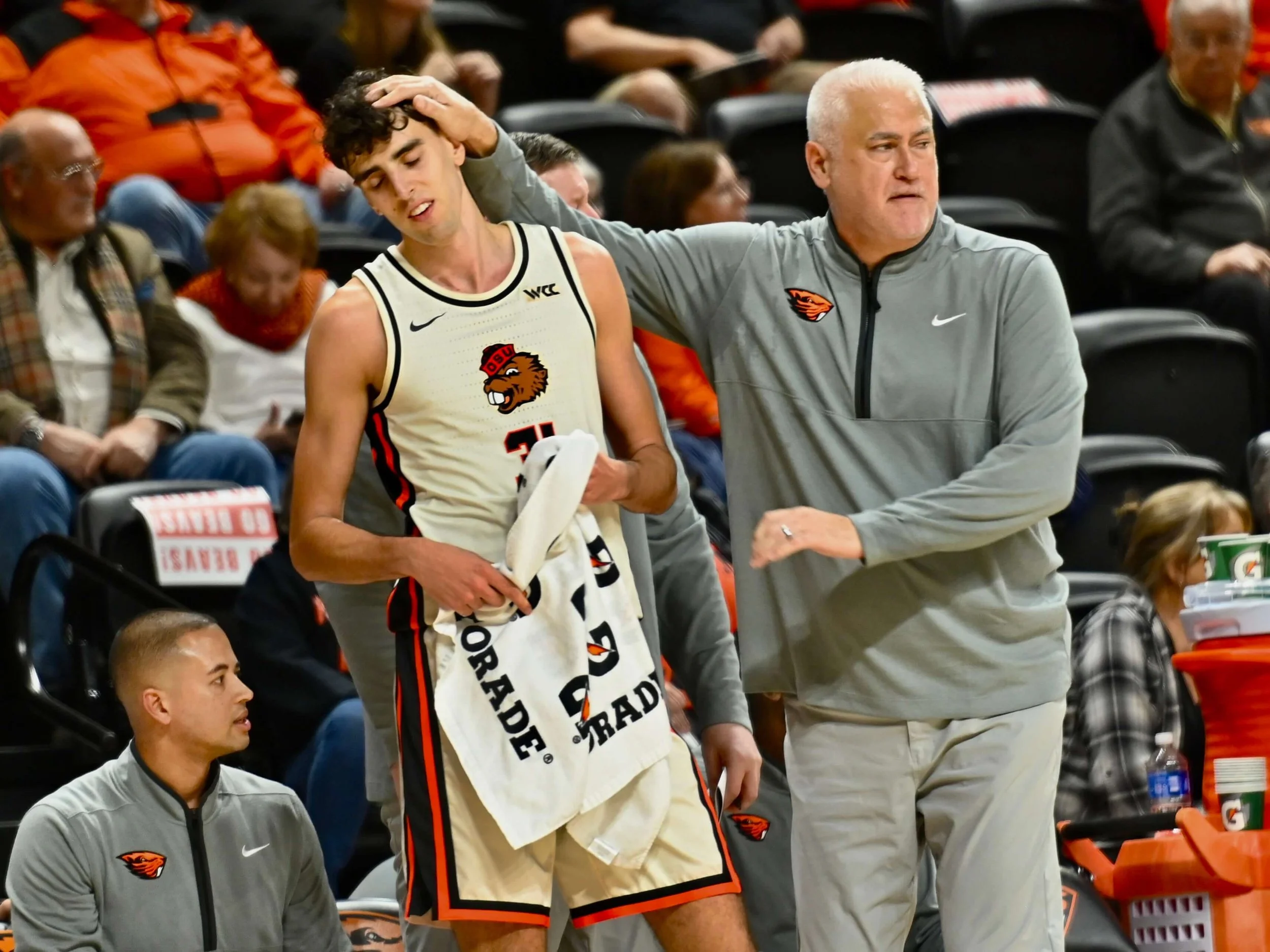
Wayne Tinkle, here positioning senior Jorge Diaz Graham to look like the leaning tower of Pisa, hopes to coach beyond 2026-27, the final year of his contract (courtesy Dominic Cusimano)
Inconsistency has been a team trait, too. The Beavers upset Arizona State 78-75 in Tempe on Dec. 21; a week later, they were drubbed 102-64 at home by Santa Clara. They followed that with a nice 70-62 win over USF; then came the disaster at Pacific. What really hurt was going winless in three close games — including double overtime against Iona — in a tournament in the Virgin Islands before Thanksgiving. Win those and they are 13-7 with a reasonable chance to hit the 20-win spot before season’s end.
Oregon State has 11 games remaining, six on the road, before the WCC post-season tournament at Las Vegas from March 5-10. Chances to repeat a 20-win season are minimal, but Tinkle chooses to be optimistic.
“We think we have everything in front of us,” he says. “We have to make up for a couple of games we let slip. I thought by now we would be a more disciplined team.
“But we have had teams make late runs in past seasons. With 11 league games and the tournament (left), we want to make some hay. Our guys know we haven’t played our best basketball and we have some stuff in the tank.”
This Oregon State team, however, isn’t nearly as talented as last year’s. The Beavers went 20-13 with only one senior, little-used Matthew Marsh. Tinkle then lost five starters to the transfer portal, all because of NIL money. Michael Rataj (Baylor, $2.2 million), Nate Kingz (Syracuse, $700,000), Parsa Fallah (Oklahoma State, $700,000), Liutaurus Lelevicius (TCU, $600,000) and Demarco Minor (Pittsburgh, $550,000) left for the money. That’s a collective $4.75 million. The year before, Oregon State paid them in the range of $700,000, and the entire team about $1 million — total.
The former Beavers are playing well in their new environments. All five are starters.
Fallah is averaging 15.1 points and 6.5 rebounds in 24.5 minutes, shooting .626 from the field. Rataj averages 10.2 points and 6.1 rebounds though, surprisingly, he is shooting only .267 from 3-point range. Minor averages 10.8 points and 3.4 assists in 32.2 minutes, shooting much better than he did last season at OSU — .450 from the field, .397 from 3-point land and .892 from the foul line. Lelevicius is averaging 8.9 points in 24.3 minutes and shooting splendidly — .489, .393 and 1,000 (24 for 24 at the line). Kingz averages 9.4 points and 4.1 boards in 29.7 minutes despite shooting troubles — .441, .310 and .542. At OSU last season, his numbers were .504, .446 and .818.
“They are all contributing to high-major teams and having success,” Tinkle acknowledges. “It’s brutal. We identify them, we recruit them, we develop them and then we lose them. It’s the nature of the game right now. Build a team, have success, and those guys are going to leave you for a lot more money.”
Last season, Oregon State was 20-9 before losing its last four games, including 77-73 to Pepperdine in the first round of the WCC Tournament. Tinkle says agents began calling his players in January and affected their focus down the stretch.
“We control what we can control,” he says. “We will continue to try to get the right kind of kids. If you lose them, you regroup and go with the flow.”
Two years ago, Tinkle lost his two best players — guard Jordan Pope to Texas and forward Tyler Bilodeau to UCLA. Pope has been a two-year starter for the Longhorns and is having a bigger impact this season, averaging 13.1 points and 2.6 assists while shooting .412, .370 and .846. Bilodeau is one of the best players on the West Coast, averaging a team-high 17.5 points and 5.0 rebounds for the Bruins while shooting .523, .395 and .846. Then there is Justin Rochelin, a 6-5 guard who played sparingly his first two seasons at OSU and left after the 2023-24 campaign. OSU fans will see him Saturday as a starter for Pacific. He is averaging 8.2 points and 6.3 rebounds in 25.3 minutes for the Tigers.
This year’s OSU team reaped about double in NIL dollars from the previous season — a little more than $2 million. But funding rose considerably in programs nationwide in a year. In the WCC, Gonzaga was at $5 million and is said to be prepared to double that in the next offseason. Santa Clara and Saint Mary’s are in the $4 million range, and San Francisco has two players raking in $2 million apiece.
Keep in mind, none of these schools have football like Oregon State and Washington State, so they can pour more money into basketball. That doesn’t help Tinkle or Wazzu coach David Riley, whose Cougars are 9-11 and 3-4.
Since the recent Blueprint Sports debacle, the dissolution of Dam Nation and the apparent immersion of the collective into the athletic department last fall, absolutely nothing has been said about what Oregon State is doing about its NIL problem. When I ask Tinkle who is handling such matters, he is vague in response.
“With what has happened the last few months, they are working out some of those kinks,” he says. “It’s still evolving. When we get to where we’re recruiting out of the portal, hopefully we’ll have things in a place where we know what we have to work with.”
Sounds like the coach is covering for athletic director Scott Barnes. Let’s hope there is a plan in place. Any plan.
Other than Josiah Lake, I’m not sure which of the 2025-26 Beavers would be attractive purchases for other major programs. Perhaps Suutela and Munch. There is only one senior — guard Malcolm Christie, who is not in the regular rotation. Tinkle has two recruits signed — Kahu Treacher, a 6-9 forward from Eastern Arizona JC, and Drew Anderson, a 6-10 freshman forward from Rancho Santa Margarita, Calif.
Like other coaches of mid-major programs, Tinkle has had to alter his coaching style in the NIL/transfer portal era. He has had to use a kinder, gentler approach, and to spread minutes to more players to keep them happy.
“Especially a few years ago, when we had a really young group, we had to walk around on eggshells,” he says. “For fear of if you’re too hard on them, they’re going to leave. Or if you’re not playing them enough, they’re going to leave. Or if you’re not paying them enough, they’re going to leave.”
Tinkle says the last two seasons, he has changed his philosophy on that.
“I came to realization that I have to be true to who I am,” he says. “They are going to leave regardless if you don’t have the money. If they are leaving for other reasons, you can probably get better through the portal yourself.
“That has been the hard part. We have been honest with our guys. We are going to be who we are. You have to adjust. We have a group that understands that. But after the last couple of cycles, nothing surprises you. You have to really be prepared.”
Interest in the OSU men’s program seems at an all-time low. The average announced attendance for a dozen home games this season is 2,627. I’m told only about 500 season tickets were sold. Last season’s average was 3,888, which was up from the 3,441 figure the previous season. The high mark during Tinkle’s 12-year tenure was 6,256 in 2015-16, his second season. OSU’s Elite Eight team of 2021 unluckily came along during the Covid year, when there were no spectators.
For decades, Oregon State men’s basketball attendance was consistently high. Through the ’60s and ‘70s, the season averages were between 7,000 and 9,000 per game. In 1979-80, that rose to 10,128 and stayed over 10,000 for six seasons during the Ralph Miller era. It stayed between 8,000 and 9,000 until 1994-95, Jimmy Anderson’s final season, and has never been above 7,000 since. Craig Robinson’s high was 6,084 in 2009-10. Tinkle’s teams have drawn averages of under 4,000 for five straight seasons.
To be fair, it is a different world now. College basketball crowds at all but the top-25 programs are down considerably across the country. Fans are staying home and watching games on TV. The old Pac-12 is gone, and the Beavers are no longer playing the likes of UCLA and Washington and Arizona at home. Power Four programs have raided their program for talent the past two seasons. If they win big, they will draw bigger crowds, but I’m not sure how much bigger.
Tinkle is in the next-to-last year of a contract that calls for him to make $3 million next season. When I ask if he has entered discussions with Barnes about an extension, Tinkle’s answer is brief.
“No,” he says. “Too busy with this group (of players).”
Would he return for a final lame-duck season without an extension?
“That’s all going to take care of itself one way or another,” Tinkle says. “I’m not putting any thought into it.”
Well, of course he is. Tinkle is not oblivious to the apathy among Beaver Nation for his team right now, and that a large number of fans want him fired. He has been dealt a difficult hand, with the Pac-12 falling apart, with the Beavers falling behind in the NIL/transfer portal wars. That doesn’t matter to a lot of people.
Tinkle, who turns 60 on Jan. 26, isn’t ready for retirement. He would like to coach at least a couple of more years. He says the “growth and development piece” of coaching is still fun. Of course, when that has occurred in recent years, he generally loses the player who has grown and developed.
“I got into coaching for a connection through relationship building, and the opportunity to mold players and make them productive young men,” he says. “A lot of it now has become transactional, not transformational. That’s the tough part.”
Barnes may choose to let Tinkle go and bring on a new, younger coach at a much lower salary. I’m not sure anybody can succeed unless Oregon State’s NIL largesse is increased. I can tell you for sure that Tinkle isn’t ready to give it up on his own volition. If he is going to stay, he will need an extension of at least a year — and be willing to accept a significant pay cut. Coaching in a lame-duck season would make recruiting even more difficult than it is now.
“I am blessed with good health,” he says. “I know I have some great years in front of me. We are going to keep grinding with this group. We had a lot thrown at us in recent years. We have been through a ton, and hung in there through it all.
“We are confident we will get it back where we need it to go. I am excited about the Pac-12 being resurrected next season. I certainly hope to be a part of it.”
► ◄
Readers: what are your thoughts? I would love to hear them in the comments below. On the comments entry screen, only your name is required, your email address and website are optional, and may be left blank.
Follow me on X (formerly Twitter).
Like me on Facebook.
Find me on Instagram.
