With Scott Barnes, discussing the state of college sports and the Beavers
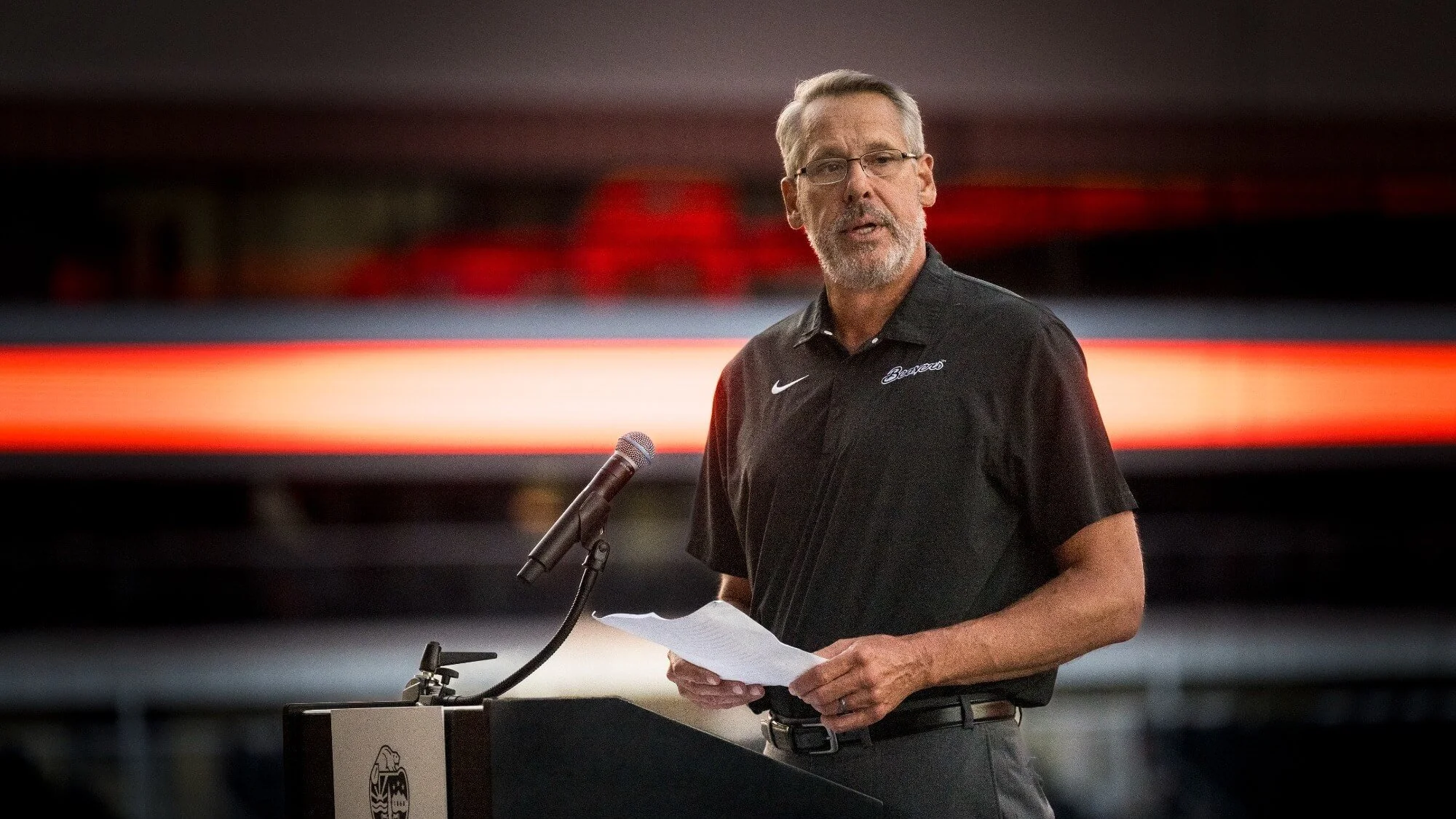
Scott Barnes, Oregon State’s athletic director since 2017, says “the chances are more than not” that he won’t finish a contract that runs through 2030 (courtesy OSU sports communications)
Updated 2/24/2026 9:42 PM
CORVALLIS — It has been a rough last few years for Scott Barnes. A Division-I athletic director’s plate is full regardless of complications, and for Oregon State, there have been plenty of complications — the dissolution of the old Pac-12, creation of the new conference, the emergence of NIL, revenue-sharing and the transfer portal to name a few.
For Barnes, there have been other issues, including the midseason firing of a football coach and the Blueprint Sports fiasco, not to mention Barnes’ heart attack in April 2023.
I sat down with Barnes in his Gill Coliseum office for an interview on Friday. Barnes, 63 and OSU’s AD since 2017, looks trim and fit and says he has had no continuing issues with the heart or his health. I got a half-hour of his busy schedule, which meant there wasn’t time to get around to all of my questions. But we covered a lot of ground, including the school’s current revenue-sharing and NIL operations, a goal to hire what he calls a “Chief Revenue Officer,” the athletic department’s “transition success plan,” a “$30-millionish” decrease in previous Pac-12 Conference distributions and the futures of basketball coach Wayne Tinkle and Barnes himself.
(Barnes’ comments are lightly edited for brevity and clarity.)
KE: You are nearing the 30-year mark as a college athletic director. It seems like the drag on time for that position is exponentially greater than ever before.
SB: I have been in college athletics 37 years, but think about the last 37 months. It is not anything anybody in this business would have thought in terms of where we sit now. It is an entirely different environment, a different world. It is up to us to navigate it, but it is not what any of us signed up for.
KE: On a professional level, how do you deal with it?
SB: It is all about perspective. College athletics is never going to be what it used to be. So (it is about) how you take the hand we have been dealt and turn it into something that is positive, that is meaningful, that your fans can rally around, that delivers a great experience for your student-athletes.
We have to do things differently. We are seeing student-athletes leaving after a year. A lot of what we did in the past was based (on the athlete spending) four or five years in a program. Now we have to think about it differently. How do we deliver a similar experience and do it in a shorter amount of time? It is about adapting to today’s marketplace and still keeping your values and your priorities.
KE: You were a member of the House vs. NCAA Implementation Committee after the $2.8 billion settlement that allowed college athletes to share in revenue beginning last fall. Each school can distribute up to $20.5 million to its athletes. What was that experience like?
SB: The best way to describe it, it was a new frontier. What we tried to do was get our head around what the new norm would be, particularly with the enforcement sub-committee I was on. Frankly, (in the past) the NCAA hadn’t done a good job in enforcement in terms of the time it takes and the actual penalty that is imposed (for rules violations). We tried to develop a program that would allow enforcement to be swifter and the punishments would be great. We hired the chief enforcement officer of MLB (Bryan Seeley) to run it.
KE: How is it working?
SB: We are still waiting to see some of the outcomes. Once people are penalized at a very substantial level, that sends a message and sets a bar, a standard. You are going to see some of that coming. But until that happens, enforcement and real punishment has been in place, you are not going to see a lot of change.
(Editor’s note: Deloitte was supposed to be acting as the clearinghouse for NIL deals more than $600. With the House settlement, NIL has basically transitioned to revenue-sharing for the athletes, which is done in-house by the university. NIL still exists, but outside of the university. All payouts are through “rev share” until the $20.5 million is reached. After that, athletic programs can use outside NIL funding to compensate their athletes.)
KE: How is the process working so far?
SB: Any deal that is $600 and above has to be registered and is vetted. Because of the high volume, the deals that are being vetted are the bigger ones, because that is where you get the problems. Rev share just has to meet the cap of $20.5 million. A lot of schools are at the cap, and they have an outside arrangement with NIL. As long as it is fair-market value and has legitimate activity, they can build that up as high as they want. You hear about some schools that spend $40 million (in NIL). They hit the cap in rev share, and outside they have other deals getting done to bolster their total package.
It used to be that (schools) could do anything they wanted and there wasn’t enforcement. Now there is enforcement, and two things have to happen. NIL activity has to be legitimate, and it has to be within the range of compensation. Deloitte has helped build what that looks like in terms of range of compensation and full-market value. If it doesn’t fit in that box, it is supposed to be denied. There have been a lot of deals that have been denied because of that, which is good.
KE: Have they announced that?
SB: No, they don’t announce it. They keep track of it. Prior to the current system being built, it was said that 70 percent of last year’s deals would not have passed. We are now seeing a tamp-down in the marketplace, some adjustments being made. Last year we saw front-loading. (Schools that) could get the deals done before this new system was in place did it; they knew wouldn’t be accountable. So there was a bunch of front-loading going on that hyper-inflated the market. The market has settled down some — I’m not telling you it’s great, but it has settled down some. What we need next is a federal bill.

The Dean of Portland Sports is now on BlueSky.
KE: So it should go to Congress?
SB: They have tried, with problems from challenges of a bipartisan bill that everyone can agree upon. We thought we had some traction, but it slowed. There is still hope for a federal bill, but it is waning. If we can’t get something done soon, ultimately the next course of action might have to be collective bargaining in say football, to try to bring some sort of accountability and control of the marketplace.
KE: Where is Oregon State at in terms of rev share for the current fiscal year?
SB: We are in the $8 million range.
KE: What about for football?
SB: We are growing it. JaMarcus (Shephard, the new coach) has done a wonderful job of being a steward of the dollars he has, making every dollar stretch, making wise decisions on how much he is spending and on whom. But now we have to grow. We have about $4 million now, and it needs to get to $7 million. We are doing benchmarking (with other Pac-12 schools) right now. We believe our football program should be in the neighborhood of $7 million, and men’s basketball should be in the neighborhood of $3.5 million. With the rest of the sports, it just depends.
KE: Dam Nation collective has been dissolved, your agreement with Blueprint was discontinued soon thereafter, and Kyle Bjornstad resigned as the athletic department’s general manager after a month on the job. Which of your administrators are in charge of your rev-share operation now, and how is it being handled?
SB: We have several. And we have an open position. Once we fill a COO role, that person will be really involved.
KE: That person will replace Brent Blaylock, who resigned after the Blueprint deal was terminated?
SB: Yes. For now, we have (deputy ADs) Jacque Bruns and Sara Elcano, and Hannah Rispler (Barnes’ administrative assistant). Our legal team on campus is involved. For football, we have a GM (Eron Hodges) who will handle it. The other sports use an assistant (AD) or their opps people. With some sports, there is hardly any activity. The sports that have it are mostly football and basketball, and baseball is coming.
KE: What about your NIL operation?
SB: The NIL program is twofold. We have the Woodshop (Exchange). You can go on-line and select a student-athlete and engage with them and they will do an appearance, or sign an autograph, or perform some duty (for compensation). We have Beaver Sports Properties, our multi-media-rights holder, and their suite of activity and things they sell. They are also doing NIL activity, bringing corporations and student-athletes together to do deals. Those two platforms are NIL-specific.
Before rev share, any donors would go through Dam Nation because you couldn’t do it internally. All those dollars are coming through the university now. Dam Nation and Blueprint were membership organizations — $100 here, $100 there, which represented about two percent of our total (purse for athlete compensation). We brought it in-house. We will launch that, and it will be a chance for every donor, for every fan to get involved through a membership for $100. We want to grow that and make it much bigger than it was when it was outside — more members and more dollars there to create a baseline of support for rev share. The roll-out will be this spring.
KE: Seems a bit complicated for people who want to support the various athletic programs at Oregon State.
SB: We will soon begin educating our base on the difference between revenue-sharing and NIL. Our Beaver Nation (a fund-raising arm of the OSU Foundation) will focus on raising money through memberships to support revenue-sharing. Beaver Sport Properties will focus on NIL.
KE: Huron Consulting Group, a company based in Chicago, was in Corvallis recently for a look at the OSU athletic department operation. Was that by directive of President Murthy?
SB: It was my idea. We have three things we are doing. One is benchmarking against all the new Pac-12 members and the bottom quartile of the ACC and Big 12 in everything we do — operations, rev share, coaches’ salaries, all of that. The second piece is an organizational assessment. We are looking at all of our positions. We are looking at today’s marketplace, how we better meet the needs of (revenue) generation and finance and all the things that are going on. We will look at that assessment and make some adjustments to our executive team and other positions. I am really focused on hiring an individual who will be solely responsible for “rev gen,” who will be a “chief revenue officer.” The third bucket is financial modeling — five to seven years, a sophisticated look in terms of every aspect of what we are doing in terms of build-up, to project where we are going to be in expenses and revenues and have that available to make adjustments to on the fly.
KE: How many Huron officials visited Corvallis?
SB: I think we had seven. They were here for two or three days and are going to come back out one more time. They are as good as anybody in the country at mining data. They have done some work for our campus over the years in finance. They do higher ed, too. Bernard Muir, a former Stanford AD, is in their group now. He is a good friend and was part of the group that came out. We think by May we will have the entire project done. We are calling it a “transition success plan,” so that we know a lot better the landscape and where our priorities lie and some of the adjustments we need to make to be ready to succeed in the new conference.
KE: After Kyle Bjornstad resigned as the athletic department’s general manager, you didn’t replace him, explaining that there was no need to have a GM for the overall department. Then new football coach JaMarcus Shephard hired a GM for football only. What changed?
SB: I never said it wasn’t necessary. The GM position is really a misnomer. It’s not like a GM in the NFL, where the coach reports to the GM.
KE: Though at Stanford, with Andrew Luck, they do it that way.
SB: Yes, (at Stanford) the football coach reports to the GM, not the AD, and is much more involved in every-day football operations. Our GM is transactional, all about doing a rev-share deal with the student-athlete, working with the agents and being an intermediary with the coach. It is about chasing those (rev share) deals down, getting them set and ready to go along with our staff. Hannah is also very involved. That is the bulk of what our GM does in football.
JaMarcus stressed the need for somebody for football, and we are on the same page about that. Remember, we had somebody (Bjornstad) before who was mostly football but also did other sports. The difference with this position is it is football-specific. We left (the title) as “GM” because we didn’t have a better name for it.
KE: What is your pool for assistant coaching salaries under Shephard? I read it was $3 million, with $2 million for “support staff.” What does that mean?
SB: We were at the Power Five level for (assistant coaches) the last year under Jonathan (Smith), at (almost) $5 million. When we hired Trent (Bray), we recalibrated the head coach (to a lesser salary, from Smith’s $4.85 million to Bray’s $2 million). Once we moved into the transition to the new league, we recalibrated the assistants pool. We benchmarked and made sure we had enough to be at the top of the assistants pool in the new Pac-12, which we were. Every cycle changes, but we had the dollars available to be at the top. It doesn’t mean we are hiring the most expensive coordinator; it means we had the most dollars based on that analysis.
In our example, JaMarcus added assistants. You can have (a maximum of) 10 assistants to recruit off campus, but you can have as many as you want, so he has added a couple of more assistants, because that is what he needed. Those dollars are still in the program, either helping with additional assistants or going to rev share and other things he needs.
Just because we didn’t have to spend X amount of dollars on coordinators doesn’t mean (assistant coaches) aren’t a priority. It is important to know that. If we didn’t have to spend $600,000 on a coordinator but got the guy we wanted, why wouldn’t we? Those dollars stay in the program. The point is to give JaMarcus the tools he needs to make strategic decisions that he feels are most beneficial to the program.
KE: Shephard’s predecessors, Smith and Bray, were pretty much football-only guys who didn’t show a lot of interest in dealing with the media and the fan base. Early indications are that Shephard seems to embrace those parts of it, too.
SB: He is waking up Beaver Nation with his personality, but he has purpose, too. He is driven by that purpose. The standards are set higher, from the weight room to the classroom to the field. And his ability to connect with the fan base, with the donors, is infectious.
KE: Do you handle the football scheduling?
SB: I do. Having to do an independent schedule for two years was something I will never want to do again in my career. That was brutal. To come back and have seven built-in games with the conference this next season is awesome. Think back to two years ago. One of our philosophies was, we want to play home-and-home with the bottom half of the ACC and Big 12. Texas Tech was the bottom half (of the Big 12) forever, and all of a sudden, $40 million (in rev share and NIL funding) later, (the Red Raiders) are top 10. That is because of the marketplace now and how quickly it can change. Wake Forest was a great get for us, too, but things change quickly. It makes non conference scheduling trickier.
KE: What about baseball scheduling for the 2027 season? There are six Pac-12 schools with programs — Oregon State, Washington State, San Diego State, Fresno State, Texas State and Gonzaga — and Dallas Baptist will become a baseball-only member.
SB: We are working on that. There will be plenty of non-conference opportunities for Mitch (Canham, the coach) to keep that RPI up. Dallas Baptist will be the one affiliate member for next season. We’re continuing to look at affiliates, but for next season, that’s all we have right now. There are others that are interested, and we believe in future years we will add more.
KE: What is your projected overall athletic budget for FY26 (the fiscal year that begins on July 1)?
SB: It is a moving target. We haven’t put it to bed, but it will be in the $100 million range.
KE: I am told there will be a number of cuts across the board. How much will you have to cut?
SB: There are challenges ahead. It is about how much revenue can we generate, and how many cuts do we have to make to get there? We are losing $30-millionish in conference distributions (from the original Pac-12). So how do you make that up, and add rev share to it? You can’t do it in one year. It is going to be a five-to-seven-year plan to get back on target and make these moves. It is not going to happen overnight.
KE: How much will the media rights package be for each Pac-12 school in 2026-27?
SB: We will be at the top of the Group of Six, the non-Power Four. What we are focused on is the total distribution, which includes media rights, conference championship and sponsorship distributions. I am not going to share the numbers, but we are tracking well.
KE: Does Gonzaga get a full share even without a football team?
SB: Yes.
KE: Basketball coach Wayne Tinkle has one more year on his contract. What are your thoughts about his future?
SB: He and I are talking and evaluating. We will make a decision at the end of the year. That is all I can say.
KE: Might you not extend his contract and let him go into a lame-duck 2026-27 season?
SB: I am not going to comment on that other than to say that we are talking and we’ll make a decision on that when the time comes.
KE: Your contract as athletic director runs through 2030. Do you intend to finish out the contract?
SB: We are pushing these boulders up the hill. At some point, I am going to want to hold onto that and let somebody else push it up the rest of the way. I would say the chances are more than not that I won’t finish my contract.
KE: There has been a lot of negativity with Beaver Nation with what has happened with Oregon State athletics over the past couple of years. What would you say to them about that future?
SB: Never in our history have we been in the position to be in the first quartile of the conference we’re playing in. There are opportunities galore there. We are not looking up at USC, Washington and Oregon. We have to sustain ourselves and continue to grow in areas like rev share, but can you imagine the opportunities ahead of us, to have the resources to be in the first quartile of our conference, to have a better path to the CFP than we’ve had in our history? There are incredible opportunities ahead of us. The basketball conference is one of the best in the country. Lots to look forward to, but we have to continue to invest while we strategically make cuts. We also have to be strategic and intentional about our investments and continue to grow in certain areas. Obviously, football is the No. 1 priority.
► ◄
Readers: what are your thoughts? I would love to hear them in the comments below. On the comments entry screen, only your name is required, your email address and website are optional, and may be left blank.
Follow me on X (formerly Twitter).
Like me on Facebook.
Find me on Instagram.
