‘High Five Line’ a tradition with Beaver baseball
(Courtesy of Dominic Cusimano)
(Editor’s note: A condensed version of this article ran in the Fall 2025 Oregon Stater alumni magazine. This update includes the perspective of the originator of the tradition, former Beaver pitching coach Nate Yeskie.)
Over the past two decades, Oregon State has played some great baseball, seven times reaching the College World Series, including the 2025 season.
Good coaching and top talent have been key components. So has esprit de corps.
For some time, Beaver baseball has featured a tradition before each game.
“We called it the ‘high-five line,’ ” says Michael Gretler, a starting third baseman from 2016-18, the latter the season the Beavers won their third national championship.
It goes like this:
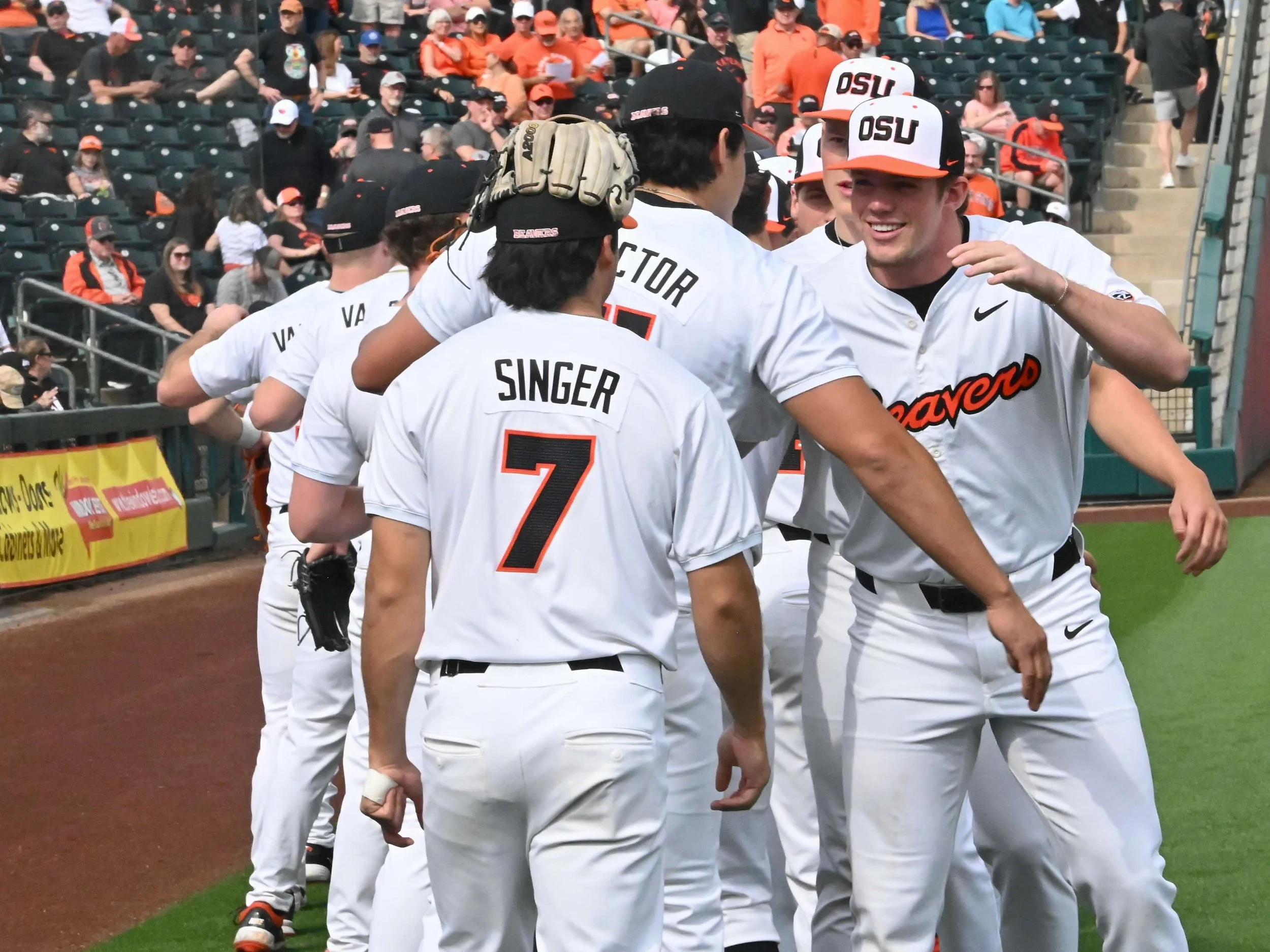
Once the starting pitcher has finished warming up before the game, he leaves the bullpen for the playing field, with the starting catcher trailing him. Waiting in a line on the field are the rest of the pitching staff and the pitching coach. The pitcher and catcher exchange high-fives and hugs with each of them. Once they pass a player, the player flips around and follows them. Everyone exchanges a high-five and hug with the rest. Then they proceed to the dugout, where the position players are in single file, waiting to continue the process.
Moments later, it is “Play ball!”
The ritual has been going for as many as 15 years.
“I assumed it started with Coach (Mitch) Canham,” says Jacob Kmatz, a starting pitcher from 2022-24. “Then I found out they did it in ’17 and ’18, which I didn’t know beforehand.”
“I know they were doing it before I got there as a freshman,” says Andrew Moore, a starting pitcher from 2013-15. “It’s cool that it has continued on all these years.”
“They are still doing that? No way!” says Jake Thompson, who went 14-1 on the mound and was a first-team All-American at OSU in 2017. “I thought with the coaching change, it would fade out.”
Pat Casey doesn’t recall exactly how it got started.
“It was probably initiated by a player who was thinking, ‘Let’s jump out there and get the pitcher going,’ ” says Casey, who coached the Beavers from 1995-2018 and won three College World Series crowns. “We probably won the game, and off it went.”
Jack Anderson agrees.
“I think it was started organically by the players,” says Anderson, a starting outfielder from 2016-18.
Well, not really. It was the brainchild of Nate Yeskie, Oregon State’s pitching coach from 2009-19.
It began with just an interaction between the starting pitcher and catcher, then soon morphed into something much bigger.
“We introduced it in Truax (Indoor Center) one day in 2011 or ’12,” says Yeskie, now in his third season at Louisiana State, with whom he won a College World Series title last June. “In ’13, it was going for sure. Soon it involved the guys in the bullpen. By the time we got to ’17, it had spilled over to the position players. Those guys were waiting out there in front of the dugout. I remember (shortstop Cadyn) Grenier being one of the first guys. Then it became a thing.”
Since then, it has been a fixture as a pre-game ritual at home games at Goss Stadium, though not as much on the road.
“For away games, it wasn’t quite as much of a big deal,” says Wilson Weber, starting catcher on Oregon State’s 2025 College World Series team. “We still tried to do it, but sometimes the first five guys in the batting order were watching (opposing) pitches already. At home, we always did it.”
But why? What is the point?
“I feel like it is the starting pitcher leading the pack, letting his guys know that he is going to compete for them,” says Rich Dorman, who is in his seventh season as Canham’s pitching coach in 2025. “Gonna leave it out there for his brothers. Oregon State baseball is a family. Our guys truly care about one another. It’s the starter telling his teammates, ‘I’m going to go to war for you,’ and the other guys saying, ‘We’ve got your back. Go get ‘em.’ ”
That’s the way Weber sees it, too.
“We were doing it mostly for the starting pitcher, to show him we were all ready, we had his back,” says Weber, who began his pro career with the High-A Beloit Sky Carp in the Miami Marlins organization. “And he was telling us he was ready to go, going to give us his all.”

The Dean of Portland Sports is now on BlueSky.
Dorman always waits at the end of the pitchers’ line, observing the action.
“Typically, everyone flips around, and I am the last guy (in line),” the veteran coach says. “The starter will hit all the relievers, and be the first one to get to the position players. It could be right in front of the dugout or along the baseline, depending on the venue. My favorite part about it is when our pitchers go down to the dugout to meet our position players. It is both parts of our team coming together.
“I have asked our pitchers why they think we do it. I want to make sure they are not just doing it to do it, making sure there is meaning behind it. I have gotten good feedback on that.”
One of those pitchers was Kmatz, who was 20-9 in three years as a starter for Dorman from 2022-24.
“I loved it,” says Kmatz, who is likely ticketed to pitch this season for the Bowling Green (Ky.) Hot Rods, the Tampa Bay Rays’ High-A affiliate. “It is a good moment for everybody to be present and pick up each other. That is what the culture in that program is all about. We are one group, one team, a unit working together. It is a chance to give each other a hug before going out there. To have each other’s backs is huge. You are loose, but in the back of your head, you know what you are planning to do right after that.”
Moore, who was 27-9 with a remarkable 2.10 ERA in his three seasons as a starter at Oregon State, recalls those moments before games with fondness.
“I would get to high-five Ben Wetzler and Max Englebrekt and Matt Boyd and all the guys,” says Moore, now pitching coach for the Columbus Clippers, the Cleveland Guardians’ Triple-A affiliate. “It became a thing. It got me going. It got us going.”
“If I was pitching, it was, ‘I got you guys. Let’s go, let’s go,’ ” Kmatz says. “Or if I wasn’t pitching, it was some words of encouragement for the guy who was.”
All these suppositions are on the right track as far as Yeskie is concerned.
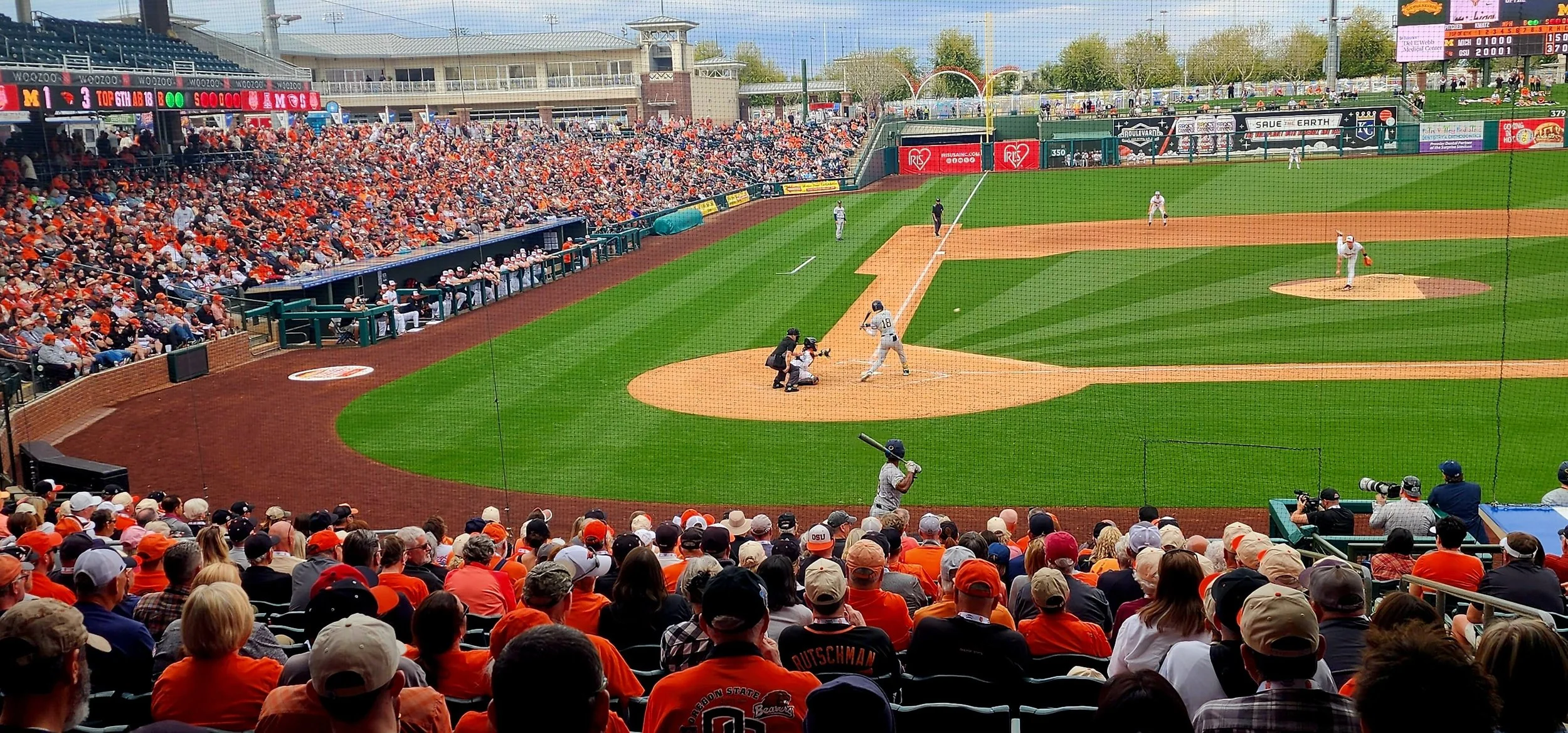
A mostly Oregon State crow of 5,683 was on hand for the Beavers’ season-opening 5-3 loss to Michigan Friday at Surprise Stadium (courtesy Doug Crooks)
“The idea back then was an effort to get closer as a group as well as more engaged,” says Yeskie, who served as pitching coach at Arizona in 2020 and ’21 and at Texas A&M in 2022 and ’23. “I have other reasons, but I have to keep some trade secrets.”
Yeskie laughs, then continues: “It was a way for us to check in with each other. Like, ‘All right, we’re getting ready to go to battle, to compete.’ It was recognition we were in this thing together. ‘I got your back; you’ve got mine.’ And a mental check for some of the guys. Who is ready to go and who is not? Some guys goof around and maybe don’t take it serious enough. You can tell a lot by a person’s engagement level in whatever you’re doing that is relative to your team.”
Through the years, players have taken it upon themselves to add different elements to it.
“When Jake Thompson was pitching, he liked to go full speed on the hug, like he was a fullback,” Anderson says. “He would really go for it.”
Thompson and outfielder Steven Kwan — now an All-Star outfielder for the Guardians — had a special connection.
“I loved being the aggressor,” says Thompson, now pitching coach at Olympic Community College in Bremerton, Wash. “Whenever Kwan and I got matched up, we would give the biggest hug and slam our bodies together. It’s like in football, when guys are getting pumped up, they hit their helmets together.
“It was like, ‘I got your back; let’s go do it.’ That is what made it special. You are walking down from the bullpen, getting mentally ready. Here we go — it’s game time. It was like your ‘on’ switch.”
Some of the players exchange pre-arranged handshakes.
“A lot of the pitchers started to do that (last season),” Weber says. “Guys had different handshakes with other guys. Dax (Whitney) and Nelson (Keljo) had a certain handshake. Dax and (Ethan) Kleinschmit had a different one and a special hug.”
“I had one with Keljo,” Kmatz says with a chuckle, “but he had one with everybody.
“ ‘Dor’ was the one who always gave the biggest hug. Even the grounds crew was in on it. You would give ‘Roseburg Rick,’ our mound guy, some knuckles. Good vibes all around. The fans start cheering. They know what time it has gotten to be.”
The Beavers’ high-five line was unique in college baseball, at least at first. Dorman says in the past few seasons, he has seen other teams try to replicate it.
“I always looked over and thought, ‘I don’t think any other teams do this,’ ” says Anderson, now a Tigard resident who works as a physical therapist in Beaverton. “It is a very cool thing. Every player wanted to do it. It never felt forced. It was super fun. Every time I see (OSU players do) it now, I think about the continuity and the brotherhood that keeps rolling along.”
Thompson pitched six seasons of minor league ball, advancing as high as Triple-A before ending his playing career in 2023.
“Oregon State was the best time of my career,” he says. “Once you get to pro ball, it’s a job. In college, you’re all pulling together to help the team win. The bond I had with my teammates — I don’t think anything could match it.”
The Beavers trotted the ritual out on Friday as they opened the season with a disappointing 5-3 loss to Michigan in Surprise, Ariz. A crowd of about 5,317 — probably 5,000 of them Beaver fans — were in attendance. They bounced back with wins over Arizona (7-6) and Stanford (3-2) the next two days.
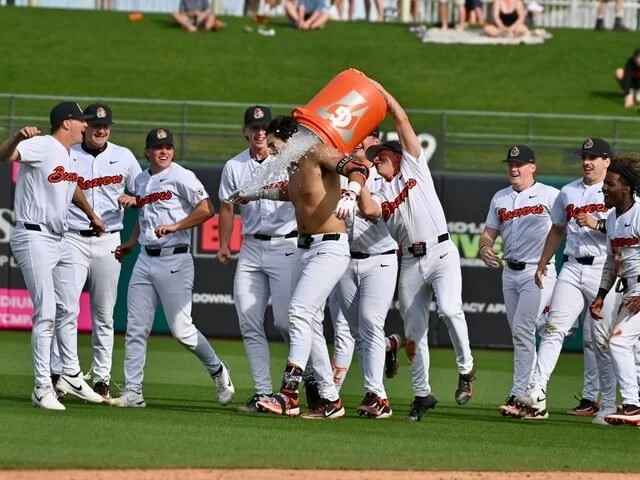
Teammates douse freshman left-fielder Josh Proctor with Gatorade shower after his walk-off single provided Oregon State with a 3-2 win over Stanford Sunday at Surprise Stadium (courtesy Dominic Cusimano)
Yeskie has brought the “High Five Line” tradition from program to program since he left Oregon State.
“It was something I implemented at Arizona,” he says. “The kids are still doing it there. Likewise at A&M, and to some degree (at LSU). It is starting to catch with some of the guys in the dugout. And I am seeing similar things more around college baseball. I laugh thinking where … well, I guess where it began. Maybe somebody had done it before and it died off. Maybe there was a variation of it somewhere. But I can tell you, the places I have done it, it’s still present.
“I am proud to have left the places I have been in good hands and in a place where kids are invested. It’s great, because kids feel like they are involved and invested in something that’s bigger than themselves. Sometimes we lose track of that in sports.”
Yeskie pauses for a few seconds.
“For a moment, maybe 60 seconds before the game, it is something they are all in together,” he says. “They all feel included, that they are in it for the same purpose. It is neat to see that mark still being present at all those places. And it all started in Corvallis.”
► ◄
Readers: what are your thoughts? I would love to hear them in the comments below. On the comments entry screen, only your name is required, your email address and website are optional, and may be left blank.
Follow me on X (formerly Twitter).
Like me on Facebook.
Find me on Instagram.
