With Chris Dudley, discussing Tom Dundon and the Moda Center mess
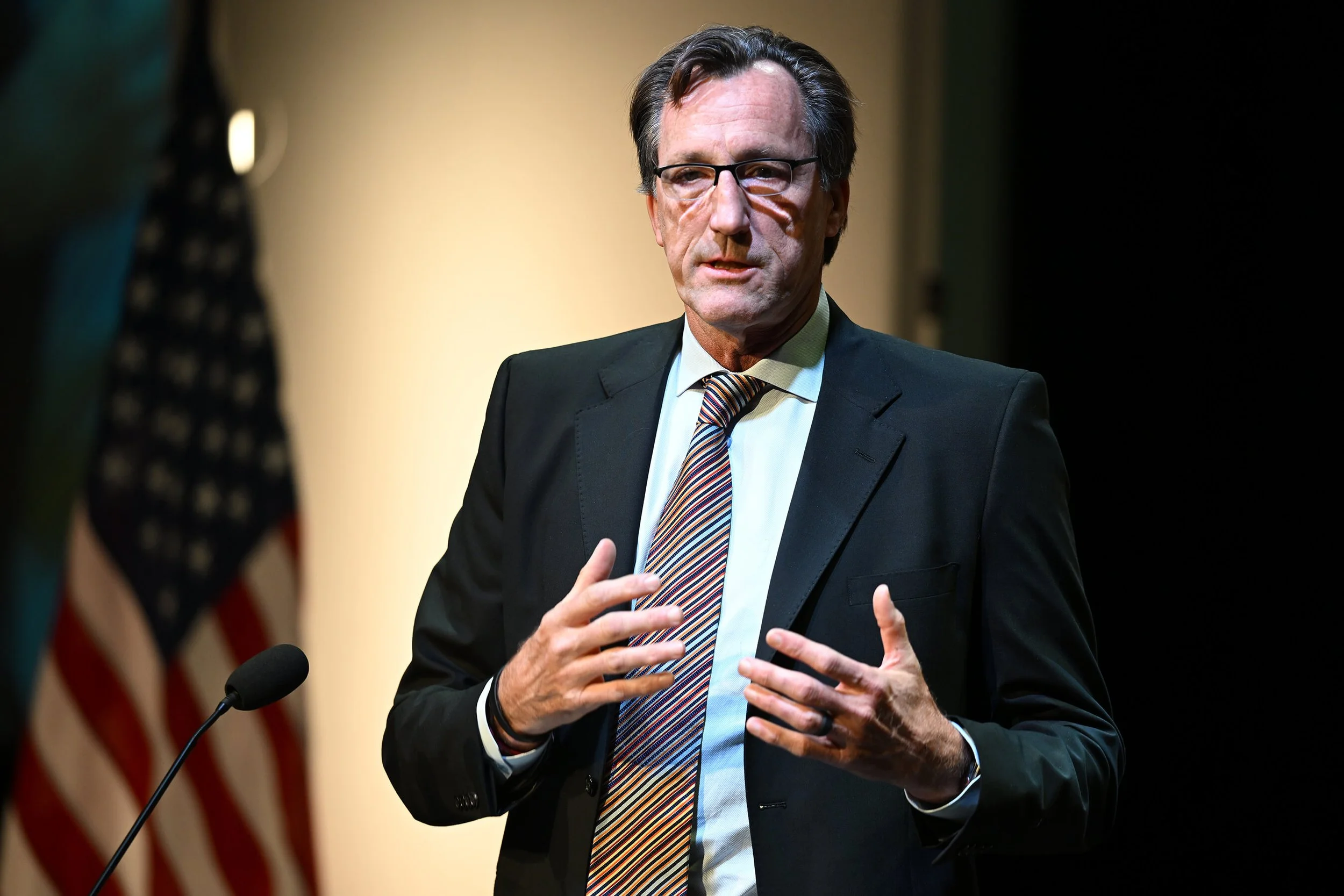
Former Trail Blazer Chris Dudley says he is not surprised with the tack Tom Dundon has taken toward funding Moda Center renovations (courtesy Dudley family)
On Tuesday, during the NBA Board of Governors meeting in New York, NBA commissioner Adam Silver publicly addressed the ownership/Moda Center renovation situation with the Trail Blazers.
“It is my hope and belief that the Trail Blazers can be successful in Portland, Oregon,” Silver began. “It is important at the same time that Tom Dundon reaches a deal with the city and state-elected officials that makes operating in Portland viable for the long-term. That is what we are focused on.
“There are times when it becomes necessary for teams to relocate for various circumstances. I don’t want to make that a point of pride for me. That would be prejudging the situation. I want to be very direct about it. I would see it as a failure if we did not keep the team in Portland. I have spent a lot of time in that community over the years. They have shown amazing support for the Trail Blazers. They are some of the best fans around the league.
“At the same time — now I speak for our WNBA team in the market (the Fire) as well — we need a state-of-the-art arena. The current building there is in the bottom measure of any arena in the league. These are centerpieces of not just mid-sized cities like Portland, but increasingly even some small arenas in communities throughout America.”
Silver said he spent “a significant amount” of time with Dundon during the meetings on Monday and Tuesday.
“It is my hope that we can lower the temperature bit in these negotiations,” Silver said. “We discussed the situation around Portland in one of our committee meetings. He was able to bounce ideas off other owners who have been through similar negotiations in other communities. There are some lessons to be learned there.”
Silver said he and members of the league’s front office would be willing to assist negotiations in any way possible.
“We have had a great track record in Portland,” he said. “No doubt in my mind, it would be a failure if we weren’t able to accomplish a result that makes Portland basketball — NBA and WNBA — viable for the long term.”
Whether it was lip service or said with sincerity — I would like to think it was the latter — Silver’s comments tied in directly to my conversation with Chris Dudley a few hours earlier.
Dudley is well-versed in basketball, politics and negotiations. A 6-11 center who played 16 NBA seasons — including six with the Blazers — he was treasurer of the NBA Players Association and served on the negotiating committee for a collective-bargaining agreement in 1998, which resulted in a lockout that delayed the start of the season until February of ’99.
“I played with the Knicks that year, and we made it to the (NBA) Finals,” Dudley tells me. “Patrick Ewing was the (union) president. I have so much respect for Pat. He had a lump-sum payment that year in his contract. He lost more money than anybody in that lockout ($6.7 million), and he was a very strong leader.”
A Yale graduate and former recipient of the NBA’s prestigious J. Walter Kennedy Citizenship Award, Dudley was the Republican nominee for governor of Oregon in 2010 and also ran this year, losing to Christine Drazan in the Republican primary.
In July 2025, after Paul Allen’s estate put the Blazers franchise up for sale, Dudley formed a group called “Rip City Forever,” with the core purpose to ensure the Blazers remain in Portland. In August, a Dundon-led contingent reached agreement for purchase for $4.25 billion. This March of this year, the NBA Board of Governors approved the sale.
Dundon, who also owns the NHL’s Stanley Cup champion Carolina Hurricanes, has not made many friends in Portland with his actions since then. There has been little communication between Blazer management and local government officials about the term sheet the latter submitted for the upcoming renovation of Moda Center, even after the city of Portland, Multnomah County and the Oregon Legislature have committed nearly $600 million to the project.
With their commitment of $120 million, city commissioners made additional asks of the new ownership group, including a 20-year lease; $3.17 million in annual rent of Moda Center; $3 million in annual property tax offset, which would escalate over time; a user fee on game tickets; caps on project-cost overruns; a commitment to unionized labor and an explanation of how the requested public money will be used.
The response from the ownership group has been mostly “mum’s the word.” On June 24, speaking at the Portland Metro Chamber annual meeting, Dundon said, “It feels like we are making a pretty big investment by staying here and paying these tax rates and agreeing to these fees for dollars that go back into the building.” He added that Portland is beset by a “stagnant business climate, high income taxes and a divisive political environment.”
In August, the city council formally approved the term sheet it presented to the Blazers. The two sides need to reach agreement by December or the state funds of about $365 million go away. If that happens, the Blazers’ lease at Moda Center would expire in 2030 and Dundon would be free to relocate the club elsewhere.
There is grave concern that could happen. In a podcast with former KATU-TV news anchors Steve Dunn and Natali Marmion, Dudley said, “You’ve seen this movie. It’s called ‘Seattle.’ Exact same scenario.”
In 2006, Clay Bennett purchased the Supersonics and said he intended for them to remain in Seattle. Two years later, he moved the franchise to Oklahoma City.
Dudley, 61, and his family live in Sisters and are emotionally invested in the Blazers. I have great respect for Chris’ intellect, integrity and knowledge of what is happening and his opinion on what needs to be done moving forward in negotiations.
Chris was out of commission and could not be reached for reaction to Silver’s comments after we had talked. The following, however, are the results of our question-and-answer session.

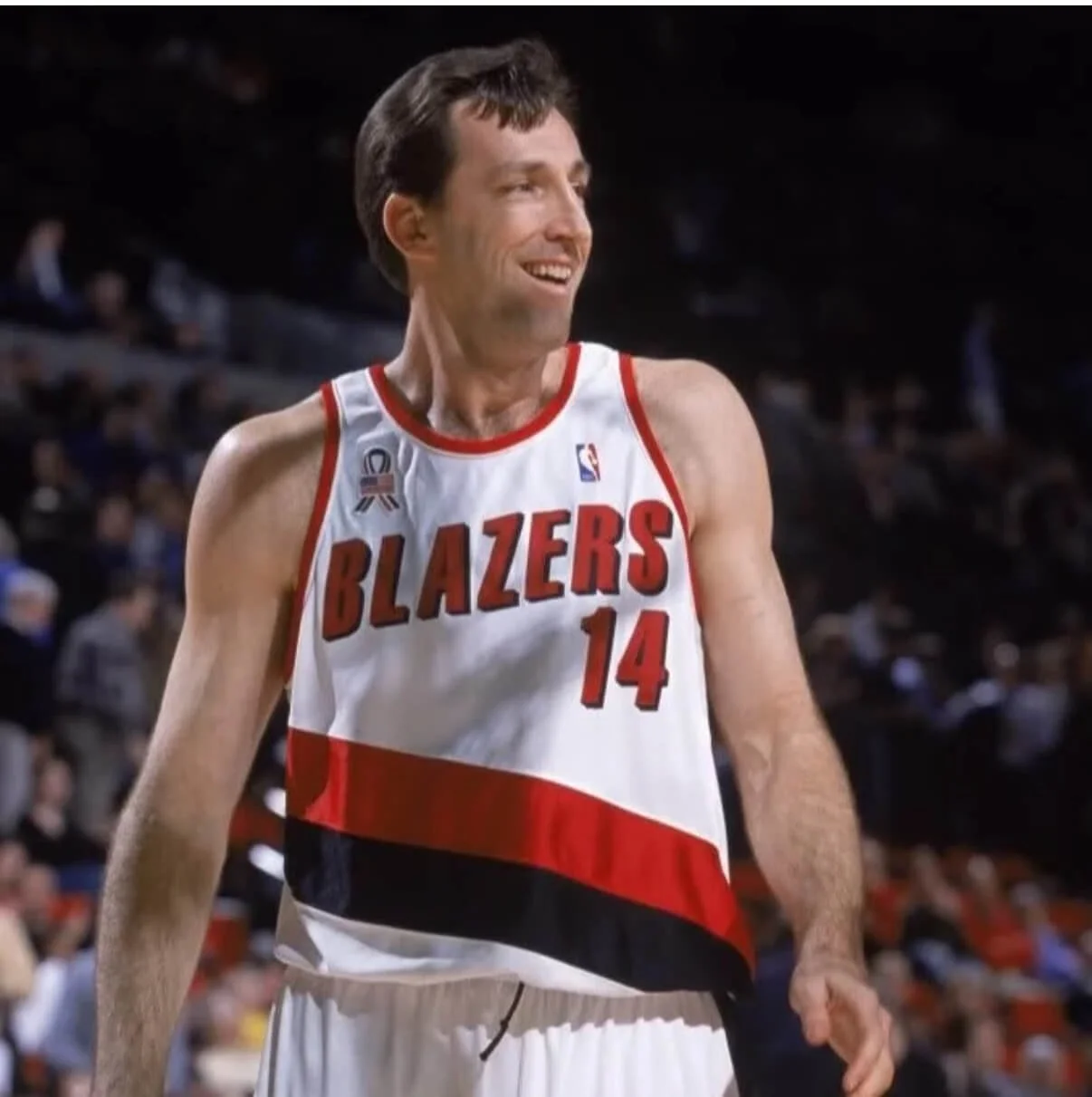
Dudley played 16 seasons in the NBA, including six with the Blazers, and served as treasurer of the NBA Players Association (courtesy Dudley family)
KE: Have you ever met Tom Dundon?
CD: Only on Zoom. It was awhile ago, before he had been approved as owner. He was on a call with some members of “Rip City Forever.” It was pretty introductory. I knew his reputation before the call. He is a businessman. (The Hurricanes) were on their way to winning a Stanley Cup, but with the NBA, he had no background. I met with (minority owner) Sheel Tyle as well.
KE: What are your thoughts about how Dundon has treated negotiations with the governing bodies in Oregon over Moda Center renovation?
CD: I can’t say it is surprising. People have different negotiating styles. His is to get maximum leverage. He uses timing to his advantage. He did that with the state (of Oregon). The state rushed into a deal they shouldn’t have done. They didn’t do a good job of negotiating the deal. They made a mistake by agreeing to everything and ultimately leaving it up to the city. I don’t think it would shock anybody to call (the city council) somewhat dysfunctional and not what you want to have a high-stakes negotiation come down to.
(Dundon) has been smart in how he has played it from a business perspective. He gave as little details as possible and didn’t reveal many of them until two weeks left in the legislative session, and it was basically “sign it or else.” At that time, the governor (Tina Kotek) should have waited, gotten better understanding of the background and called for a special session later to negotiate the deal. But here we are. He has gotten himself into a position where he can be agnostic about the deal. Like, “Hey, if I get this great deal where I put up no money, and the city, state and county pay everything, I’ll stay in Portland if I get that. If I don’t, I’ll go to a better market.” In that regard, it’s a win-win for him. It’s not a win-win publicly for his reputation, but I’m not sure he cares about that.
KE: What did you make of the meeting between Dundon and Portland city administrator Raymond Lee in Texas last week?
CD: That may have been just to say hello, but I think it’s good. If something good is going to happen, you have to have conversations. I have felt like the state and the other entities need to negotiate as if they are negotiating directly with the NBA, and not with Dundon. You have to have a deal on the table that the majority of (franchise) owners would say, “That’s a good deal,” and not approve relocation.
That is the wild card here. Will Adam Silver step in, or at least put his thumb on the scale toward keeping the team here in Portland? Will he say, “If there is a good deal, you need to stay.” That is why I worry about leaving it up to city council. If you start changing the deal at the last minute, throwing in terms that weren’t there originally, it gives him, and the other owners, permission to relocate. That’s the risk we’re running right now.
(Editor’s note: It would seem Silver’s Tuesday comments address this question, but we will see how it plays out.)
KE: On June 24, Dundon spoke at the Portland Metro Chamber annual meeting at Moda Center. The Portland City Council held a separate public work session on Moda Center’s future at the same time as the Metro meeting. The chamber asked City Council president Jamie Dunphy to reschedule the work session so council members could attend the business event, but Dunphy declined. Dundon didn’t even send a representative to the city council meeting, which miffed some of the councilors. Your thoughts?
CD: I don’t know that he needed to go to the city council meeting. In negotiations, you want to know who you are negotiating with. He has had talks with the mayor (Keith Wilson) and the governor. If you really want to get a deal done, yeah, you probably show up. But I think his position is, “We have already come to terms on this deal, the deal is in place, we agreed to it, and everybody said when it was approved that we had the outline for it. So why do I need to go back and renegotiate the major terms? I didn’t agree to this other stuff.”
Right now, he has the best deal in the country. The city council threw in a bunch of terms that weren’t there before. They agreed to too much too early. I wouldn’t blame him for saying he didn’t agree to that when they added on the different fees. That is going to be a sticking point.
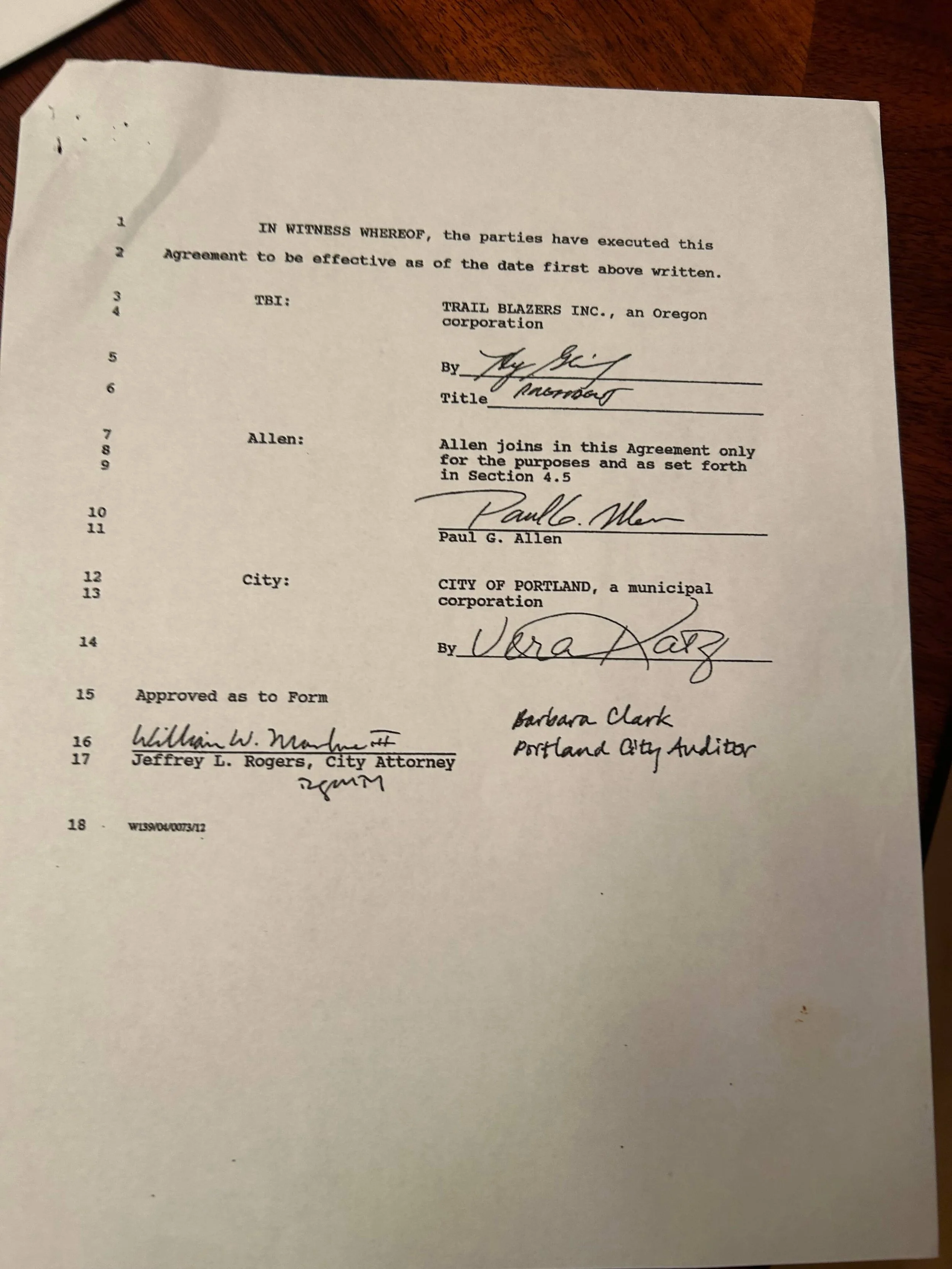
The final page of the Blazers’ exclusive site agreement with the city in 1993, signed by owner Paul Allen and mayor Vera Katz and verified by city auditor Barbara Clark
KE: I would seem that Dundon has all the leverage, except the fact that a move to another city will cost some money. On the other hand, he surely figures he would get it back eventually by making more money in a city where there is more corporate support.
CD: He has the leverage, other than he has to get it approved by the NBA.
KE: That would require a simple majority of the league’s 29 other owners — 15 yes votes.
CD: That is why Adam Silver and the league office are such an important piece. It’s not like moving a store or some kind of business from one city to another. He has to get approval. That’s the big wild card. From an economic perspective, the value of a franchise is skyrocketing. The Lakers sold for $10 billion, then (Mark Walter) flipped it a year later and picked up $2 1/2 billion in the $12 1/2-billion sale. The math is pretty simple. If (Dundon) buys it for $4.25 billion in Portland but it is worth $8 billion somewhere else, those relocation costs don’t matter as much.
But it really comes down to whether he would be able to get that approval. If the city and state came through with the deal that was agreed to in the first place, it would be pretty hard for the other owners to approve relocation.
KE: But won’t the owners be inclined to vote for relocation, knowing that they might be in position to request such a thing in the future?
CD: The owners might be hesitant to disapprove, because they might want something approved for them down the line. That’s the flip side of it. But Adam Silver knows it wouldn’t be a good look for the league. That’s why the extras the city has thrown in (to a proposed renovation deal) -- I’m not going to say in the 11th hour, but at least the 10th — clouds the issue and provides more of an out (for Dundon). This is where you want the commissioner to work toward the best interests of the NBA. It’s a bad look if a city, county and state step up and put forward the money that is asked, and the team leaves, anyway.
KE: Moda Center is the oldest arena in the league to have not had a major renovation. Costs from most of the renovations in other arenas have been shared by the owner and public entities. This case is unusual, though, since Dundon is coming in as a new owner and can say, “It’s not my fault the arena needs a major renovation.”
CD: I would say he has done the other owners a great favor. This is the first deal I know of in a public/private partnership where the private side isn’t putting any dollars into the equation.
KE: Should the Blazers at least pay some rent for use of the arena?
CD: Yes, I would say so. But Portland is in a bad situation now from a negotiating perspective. You can’t have Moda Center lose its major tenant. What do you do then? There’s no understating the importance the Blazers are to the city and the state of Oregon. We need them. It’s our one team of the Big Four pro sports. There is so much history here. Sports are so important in how they bring people together. Our community needs them for its psyche, not to mention the revenues and the attractions and the stamp that, if you are a major league city, it’s a big deal.
KE: What else have negotiators for the public side missed on?
CD: One thing is they need to do a better job of having one voice, somebody who is an expert in these areas. At times, they haven’t had that. It has been disorganized and plays into the national reputation of Portland’s dysfunction, which is not good. You want to have a unified, organized front and an expert who is well-versed with arenas, understands the business, understands pro sports monetarily and how these deals work. Otherwise, you will get what we are seeing now.
KE: Who might the point person be? Raymond Lee?
CD: I don’t know at this point. It could be the mayor. To their defense, it is hard when the other side is not coming to the table. I think there will be pressure on Dundon from the league office with, “Don’t tell us things aren’t working out if you are not even going to the table.” He has to show up and make a good-faith effort.
KE: Expansion was on the agenda at the NBA Board of Governors meeting, with Seattle and Las Vegas the expected locations. Reports are that Dundon intended to lobby other owners against it, with the ulterior motive of leaving open more options for relocation if it comes to that.
CD: It is in Portland’s best interest that expansion is approved, for obvious reasons. They are talking $8-10 billion in expansion fees — lower end for Seattle, higher end for Vegas. If an NBA franchise is worth that, it would be a lot better for the Blazers if they approved those expansion franchises and take those cities off the table (for possible relocation).
KE: If the term sheet is approved by both sides, should the Blazers not be able to move under any circumstances?
CD: Relocation has to be off the table for the duration of the deal. That is not what the state agreed to. They agreed to a break-up fee, and that was naive. If your franchise is worth a couple of billion dollars more in another city, and you have to pay a break-up fee of a couple of million, that’s nothing, pennies on the dollar.
KE: In 1993, just before the Blazers moved from Memorial Coliseum to what was then called the Rose Garden, owner Paul Allen signed a 30-year “exclusive site agreement” with the city.
CD: A no-move agreement has to be in place this time, too. I might complain that the deal was one-sided and the city/state gave too much money, but the most important piece is that they can’t move it for 20 — I’d have liked 30 — years.
KE: Do you think Silver steps in if necessary?
CD: I would think so. If the (public entities) are organized and offer a deal that makes sense with a franchise that has had more than 50 years of success and for most of its history was considered a model franchise — and for awhile, the model franchise in the NBA … The way things happened in Seattle was seen as negative reputationally for the NBA. Oklahoma City has had great success, but it has been nearly 20 years and Seattle still doesn’t have a team. I don’t think it’s something (league officials) take lightly.
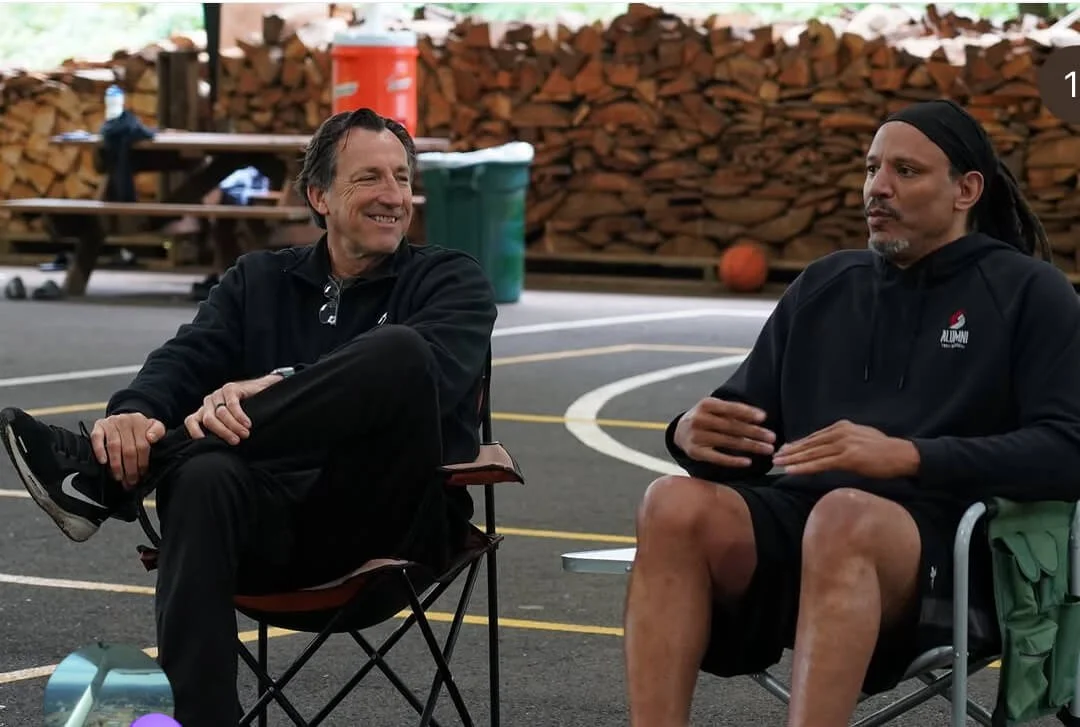
Dudley, shown here with ex-Blazer forward Brian Grant, says he is optimistic a deal will get done between Dundon and the city, county and state (courtesy Dudley family)
KE: Do you think the deal gets done?
CD: I am an optimist. I think it gets done. My biggest deal point, if we are going to do all this, (Dundon) cannot move the franchise. He has to be committed to Portland for at least the next 20 years. You want both sides to have that commitment. You don’t want to have these conversations every five years. That’s what bad franchises do. You don’t want anything but, “We are here to stay.”
► ◄
Readers: what are your thoughts? I would love to hear them in the comments below. On the comments entry screen, only your name is required, your email address and website are optional, and may be left blank.
Follow me on BlueSky.
Follow me on X (formerly Twitter).
Like me on Facebook.
Find me on Instagram.
