After four pro seasons, Justin Boyd says, ‘I’m done’
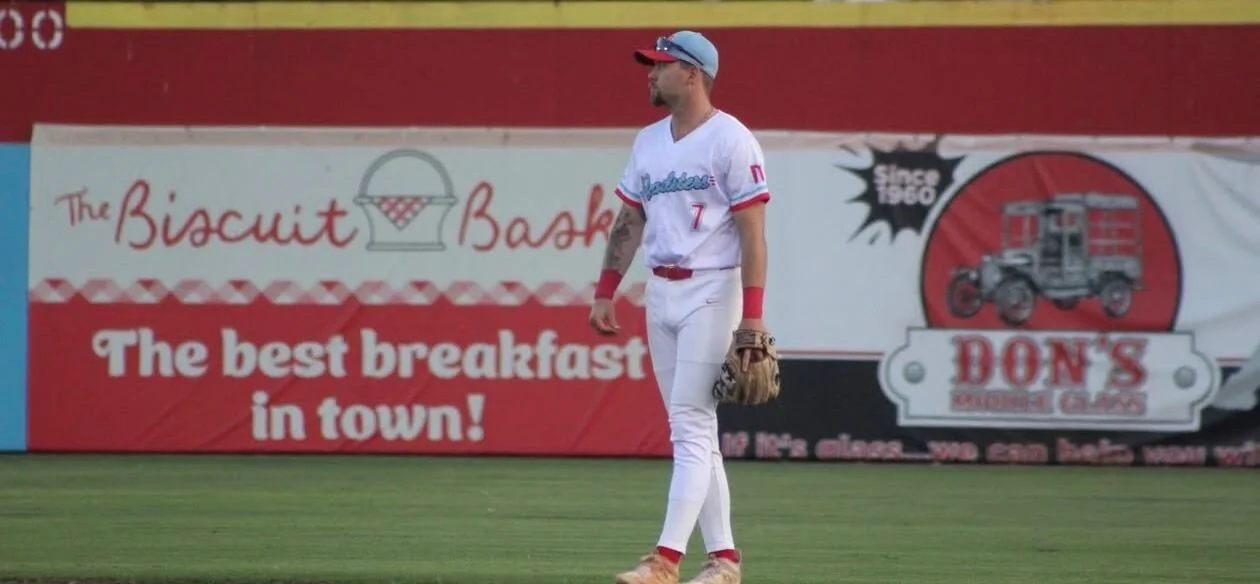
Former Oregon State outfielder Justin Boyd ended his pro career with the Modesto (Calif.) Roadsters in the independent Pioneer League this season (courtesy Justin Boyd)
The Boyd family had everything in order. Flights were scheduled, hotel rooms reserved, game tickets purchased. An entourage of 10 was going to watch Justin Boyd play the final professional baseball series of his career last week for the Modesto (Calif.) Roadsters of the independent Pioneer League.
“We had made some T-shirts and all kind of cool things,” says Scott Boyd, Justin’s father. “Then Justin told me, ‘I’m not going to play, Dad. I can’t do it anymore. I can hardly walk.”
The Boyds knew that Justin’s injury-riddled career was nearing an end. They just didn’t know it was over.
“It was tough on the family,” Scott Boyd says. “We didn’t get a chance to see him play his last game, which was difficult, for sure.”
The Boyds changed their flights, heading instead to Phoenix, where they spent time with Justin at his Mesa home.
“We hung out as a family and reminisced a lot about his days in baseball from age six through high school, to Oregon State, to being drafted,” Justin’s father says. “He had some good times in there when he was playing, but the injuries got the best of him.”
At age 25, before he had even reached his physical prime, Justin Boyd’s career was history.
“I’m done,” Boyd told me in a phone interview last week. “I’m a little sad, but kind of relieved. I couldn’t play the way I wanted to for so long. The injury battle took such a mental toll that it was hard to keep going.”
It wasn’t supposed to be that way. Not after the way he played as a redshirt sophomore for Oregon State in 2022, when he was part of a dream outfield that included Pac-12 Player of the Year Jacob Melton and Wade Meckler. Melton and Meckler have reached the major leagues. Boyd was supposed to get there as well.
“That was my thought, too,” he says. “But the Lord had different plans for me. I am taking that as it is and looking to keep following my path.”
Boyd grew up in Parker, Colo., in suburban Denver, the fourth of six children to Scott and Karen Boyd. He was a star football player at Legend High, a cornerback and receiver who was all-league and second-team all-state as a senior.
“Nebraska and BYU wanted him to play football,” says Scott Boyd, who coached Justin in baseball at Legend. “Baseball was his first love, though, and playing at Oregon State was his dream.”
Pat Bailey first saw Justin play baseball the summer after his freshman year of high school in 2016, scouting him in a Denver-area tournament.
“I was looking for white rhinos among elephants — guys who are really athletic,” says Bailey, then an OSU assistant coach under Pat Casey. “They might not be great baseball players, but great athletes. When I watched Travis Bazzana for the first time, I was also looking at a teammate of his. I saw Travis and thought, ‘I like the other guy, a good baseball player.’ But their best athlete — and it wasn’t even close — was Travis. I felt the same way about Justin. I watched him play three or four games and liked what I saw — how hard he played and how athletic he was.
“Besides his abilities, he was a great young man. I got to know his dad when we were recruiting him and we became good friends. Justin is a great person because of his family.”
Boyd was Colorado’s No. 2-ranked prep player as a senior in 2019, hitting .487 well after he had decided on Beaver baseball as his destination.
“Oregon State was one of the schools I loved to watch play growing up,” Justin says. “I loved talking to Coach Bailey. I went out for a visit and felt like (Corvallis) was home. The family environment that Casey and Bailey built and (Mitch) Canham continues to build was one of the main reasons.”
Boyd wasn’t an immediate hit after he arrived on campus. He sat out the 2020 Covid season in which the Beavers played only 14 games, and he didn’t break into the starting lineup until late in his redshirt freshman 2021 campaign. Manning the outfield that season were the likes of Melton, Meckler, Joe Casey, Preston Jones and Micah McDowell.
“They were all great players,” Boyd says. “I still needed to grow as a ballplayer and get the coaches to trust me a little bit more.”
Boyd hit .301 with a .395 on-base percentage, with 19 starts in 27 games and 88 plate appearances that season. He made the All-Regional team at Fort Worth, Texas, where the Beavers were ousted by Dallas Baptist. Boyd’s ninth-inning single scored the winning run in OSU’s 3-2 win over Texas Christian.

But he came of age as a 6-foot, 200-pound redshirt sophomore in 2022, a splendid mixture of speed, power and athleticism. Melton was spectacular in center field but Boyd was dynamite in right, too, leading the Pac-12 in batting average (.373), on-base percentage (.490) and stolen bases (24). He scored 72 runs and had 53 RBIs, 12 doubles, four triples and nine home runs in 62 games, and had six hits in a 10-inning, 25-22 loss to UCLA in the Pac-12 Tournament. Boyd was a second-team All-American, made the All-Pac-12 Tournament and was on the All-Pac-12 Defensive team.
Scott Boyd’s fondest memory of watching his son play at OSU was his final game, a 4-3 loss to Auburn in the Corvallis Super Regional, which kept the Beavers from reaching the College World Series. Justin had three hits, including a two-run homer to draw OSU to within 4-3 in the seventh inning.
“I thought that was his greatest moment,” the senior Boyd says. “Being there in that atmosphere in (Goss) Stadium and watching him do that — it was amazing.”
Justin admits he didn’t see it all coming.
“I didn’t know that season was going to happen, honestly,” he says. “It was surreal. That was a fun time. It was a matter of finding the confidence in myself and then being surrounded by a great group of players. Being around Mel (Melton) and Meck (Meckler) … they are great players. We would be the first to show up, last to leave. We would always find extra work and talk to each other, help each other if we were struggling.
“It helped to be able to go against our pitching in the fall, too. You get to find out what you are made of. Facing our pitching staff was tougher than facing any other staff in the country that year.”
It may have been the finest collective outfield in Oregon State history.
“Melton was the Pac-12 Player of the Year and the highest-drafted of the three, with tools galore,” Oregon State assistant coach Ryan Gipson says. “Meckler made it to the big leagues before all of them and is still up there. We had plenty of scouts, though, who thought Justin was the best (prospect) of the three.”
Boyd was what they call a five-tool player.
“He was balanced as a hitter,” Gipson says. “He had the full skill set. He could run, and he ended up hitting for some power his draft year. He could drag (bunt), he could push (bunt), he could steal bases. He played a remarkable right field, had great arm strength as well as the ability to cover ground out there. He turned into a really complete outfielder for us.”
► ◄
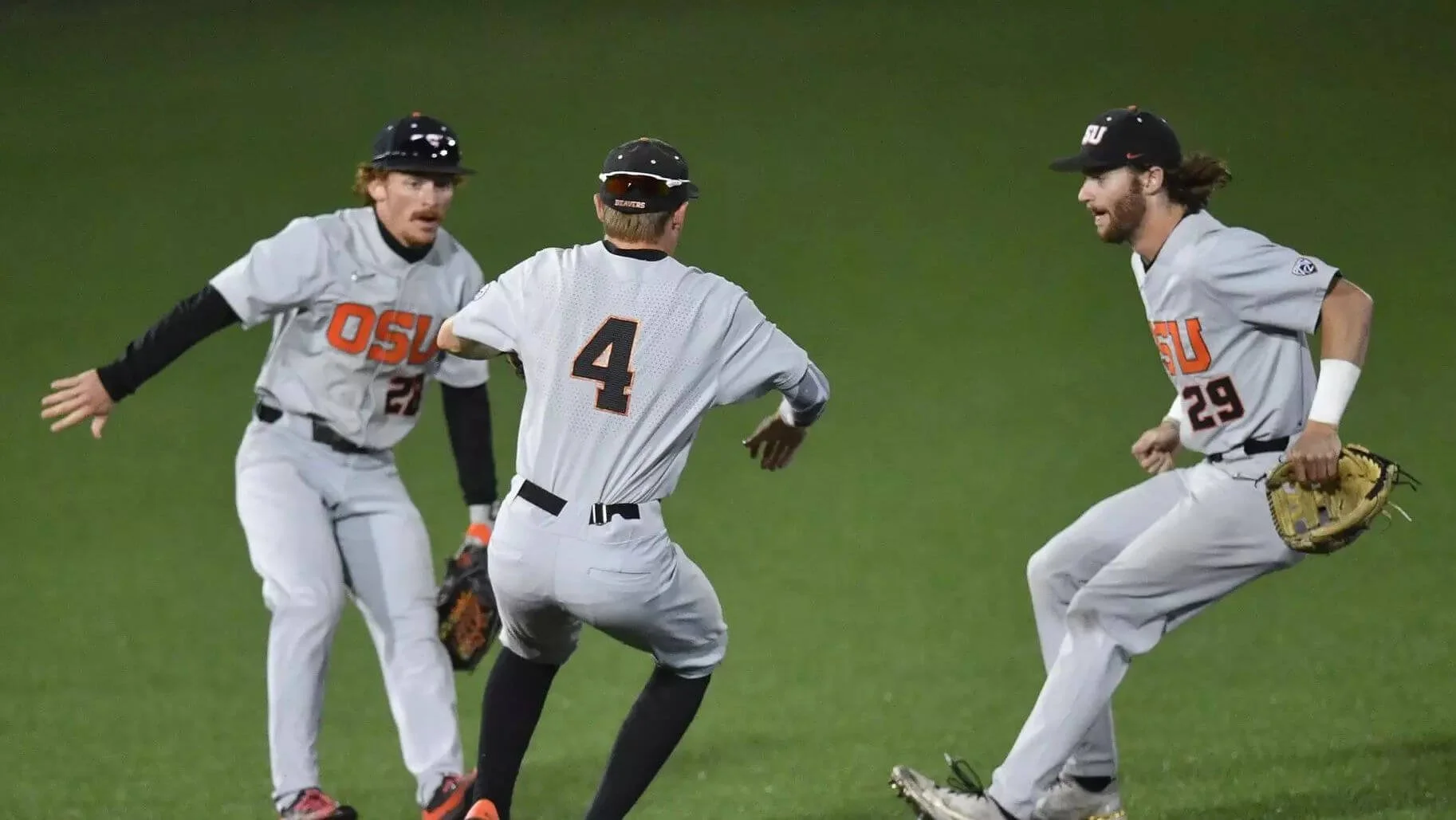
Boyd was part of a dream outfield at OSU that included Wade Meckler (left) and Jacob Melton (right) (courtesy OSU sports communications)
Melton went to the Houston Astros in the second round with the 64th overall pick in the 2022 MLB draft. Boyd was taken by the Cincinnati Reds nine picks later, at No. 73 in the special phase after the second round. Meckler was chosen in the eighth round by the San Francisco Giants.
Boyd began his pro career in early August 2022 in A ball with Daytona (Fla.), hitting .183 in 21 games.
“I was dealing with a little bit of arm issues,” he says. “It had been a long (college) season. I had never played that many games before. There was a little bit of fatigue.”
In February 2023, the Reds traded Boyd to the Cleveland Guardians. It seemed odd for a team to trade a second-round selection so quickly. Boyd was in Corvallis, taking classes and working out with Melton and Meckler.
“I was confused,” Boyd says. “They both had report dates for spring training. I was thinking, ‘I don’t have one. I don’t know what’s going on.’ A couple of days later, Mel and I were hitting at Linn-Benton and talking to Juco kids about baseball. I picked up my phone and had like 12 missed calls from my dad, my agent and other people. I called back and found out I had been traded. I was like, ‘All right, well, I’ll show up and be ready to go.’ ”
But then the injury parade began. Boyd tore his hamstring in spring training. After he worked his way back into good health, he suffered a dislocated shoulder and torn labrum. Boyd wound up batting .140 and playing only 15 games for Lake County (Ohio) in High-A ball. In 2024, he hit .165 in 42 games for Lake County.
“I kept pulling my hamstring,” Boyd says. “I would work my way back, play for a week or two, and same thing.”
In 2025, Boyd got what appeared to be his best opportunity, going to spring training with the Guardians.
“I was there at the beginning of spring training with all the big leaguers,” he says. “I practiced with them and would play the back half of some of the spring training games.”
Boyd got into three of the Guardians’ games, going 1 for 5 with a double and two walks. He was assigned to Triple-A Columbus to start the season.
“I had dislocated my shoulder again that spring and was still recovering from it when they sent me to Columbus,” he says. “I thought I played some good outfield there, but I didn’t really get a chance to play very much.”
He played in nine games for the Clippers, going 2 for 24 at the plate. On April 28, he was sent down to Double-A Akron.
“I think that was the original plan,” Boyd says, “but they weren’t very communicative about it.”
The shoulder injury acted up again, and he wound up hitting .208 in 15 games before going on the injured list in June. The Rubber Ducks activated him three days after the season ended in September, then released him 11 days later.
“I get it,” Boyd says. “It’s a business. It’s how things are run. (The Guardians) just didn’t want to deal with the injuries and take any more chances. But I was frustrated. I knew that I could be a lot better than I was. I wasn’t given the time to settle in. Each time I would get injured, I would come back and try to settle in. But it was, ‘You have to perform now.’ I didn’t quite do that. They weren’t willing to keep it going.”
Boyd had played with Travis Bazzana at Oregon State in 2022, when Bazzana was a freshman. They played together twice in the Guardians farm system, at Lake County and Akron. Bazzana went on to earning the starting second base job and an All-Star Game berth as a rookie with Cleveland this season.
“It was cool to be around Travis again,” Boyd says. “I’m not surprised what he has done, not at all. He has always had it in him. We all knew it from Day One.”
Boyd also has gotten to know ex-Beaver Steven Kwan, the Guardians’ All-Star and Gold Glove left-fielder.
“I worked out with Kwan (during the offseason) at Oregon State,” Boyd says. “I always talked to him when he was there. We also talked during spring training, and when he did a rehab assignment at Lake County. I got to see him quite a few times. He is an awesome human being.”
► ◄
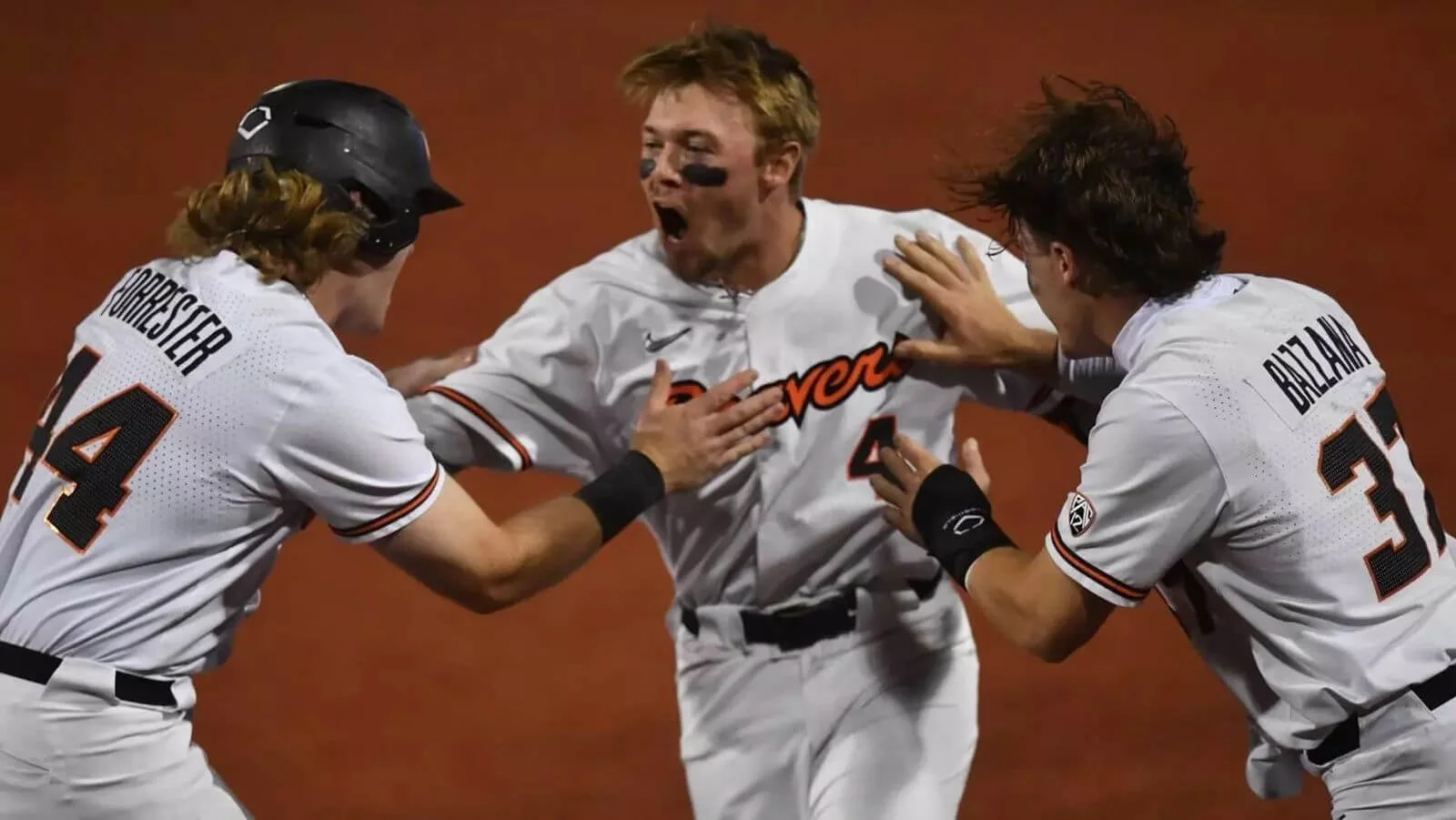
Boyd, here celebrating with teammates Garret Forrester (left) and Travis Bazzana, had a sensational final season at OSU in 2022 (courtesy OSU sports communications)
After his release by the Guardians, Boyd didn’t get hooked up with any MLB-affiliated minor league team. He turned to the Pioneer League, an official independent MLB partner league but not an affiliate.
“I was just looking to play somewhere, have a little bit of fun and see what came of it,” Boyd says.
The quality of play in the Pioneer League “is better than people think,” Boyd says. It is a hitters’ league. Modesto’s team batting average for the regular season was .309.
The Roadsters were a good team, with an overall record of 57-38 that placed them fourth in the 12-team league and into the playoffs. Boyd says he enjoyed his teammates.
“It was a great group of guys,” he says. “They were really fun to be around. It was more relaxing, less pressure in a way (than with an affiliated team). There was still pressure to perform, but it is hard to get picked up (by an MLB team) out of those leagues, no matter how good you are doing. And most teams pick up pitchers more than position players.”
Boyd got off to a great start, hitting up to .380 during the first half of the season.
“Then his shoulder started bothering him,” his father says. “That is when his average went down. He started getting healthy, hit a couple of bombs and was hot again, then his knee started bothering him. He dove for a ball, (suffered) a meniscus strain and some cartilage damage. And finally, (a week before the end of the regular season), he just said, ‘I’m done.’ ”
Boyd finished with a .302 batting average — eighth-best on the team — and .428 on-base percentage in 62 games, scoring 58 runs with 43 RBIs, a team-high five triples, nine homers and 16 stolen bases. He struck out 63 times in 265 plate appearances.
In 103 games and 376 minor-league plate appearances over four seasons, Boyd hit .170 with two home runs and 20 RBIs.
“Justin had some struggles even when he was healthy,” Gipson says. “And the injuries really made things hard for him.”
“Most of my favorite baseball memories are from my time at Oregon State,” Boyd says. “After that, it was kind of downhill.”
So Boyd’s baseball career is over, with most of his adult life ahead of him. What next?
“That’s the question that everyone is asking,” he says. “I have some ideas. I have been looking into some jobs in the finance field. I grew up working underground infrastructure in the summers and whenever I could. That has always been interesting to me. Working for a construction company and being a project manager is also a possible path.”
Another possibility is following his father into the coaching profession.
“I have thought about it, but I’m not too sure about it,” he says. “It would be fun, but right now I need a little mental break from baseball and time to relax.”
Boyd plans to reside in Mesa, not far from the home of his sister, Brooke Bursa, who lives in the San Tan Valley/Queen Creek area of suburban Phoenix.
Baseball wasn’t supposed to end this way for Boyd. But for those who make it big — as have former teammates such as Bazzana, Meckler and pitcher Cooper Hjerpe — there are more stories about those who don’t. Some simply don’t possess the talent to make it to the top. In Boyd’s case, injuries as much as performance proved his undoing.
► ◄
Readers: what are your thoughts? I would love to hear them in the comments below. On the comments entry screen, only your name is required, your email address and website are optional, and may be left blank.
Follow me on BlueSky.
Follow me on X (formerly Twitter).
Like me on Facebook.
Find me on Instagram.
