Through a career in hoops, Spo has made big things go
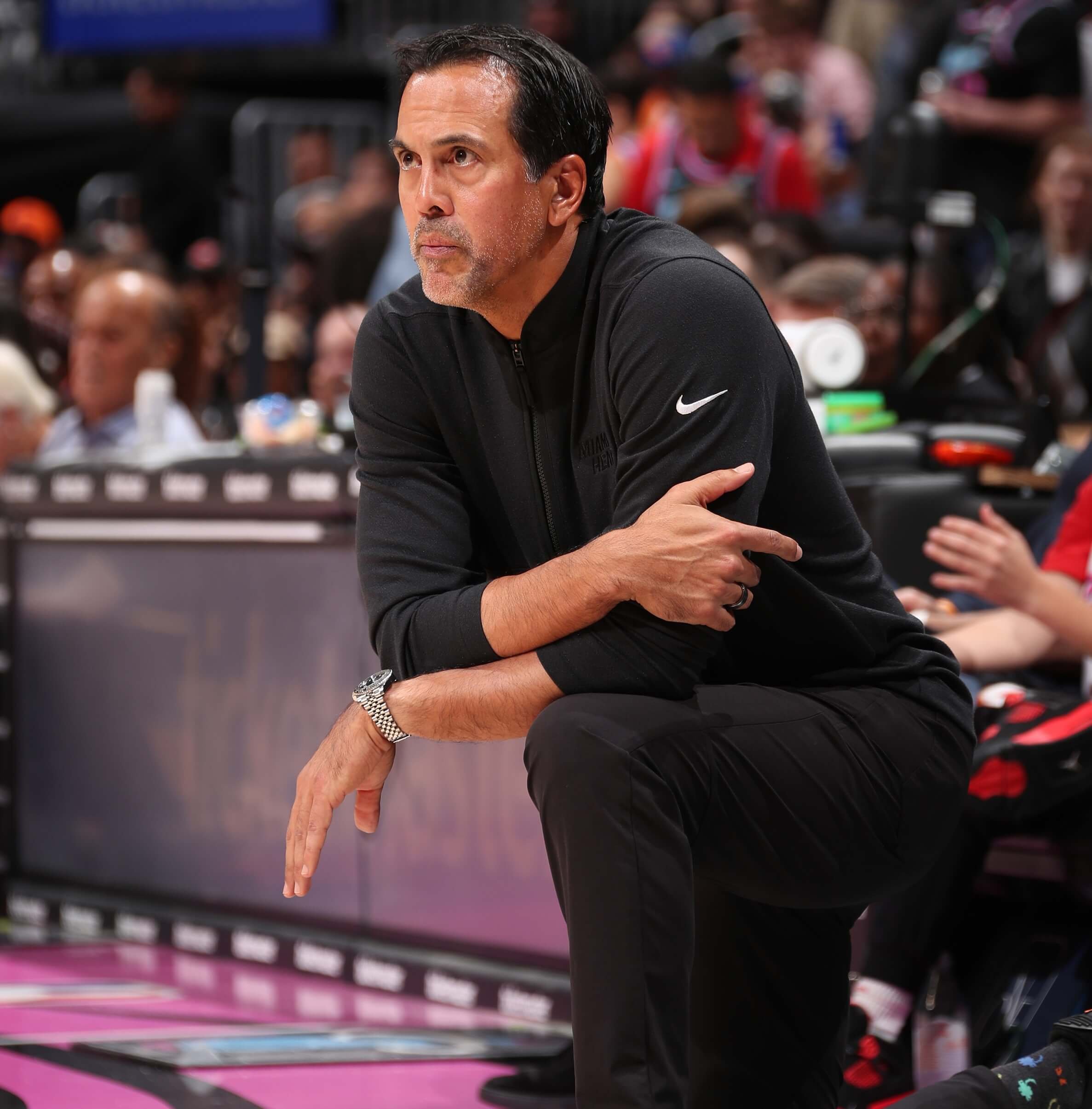
Portland native Erik Spoelstra is in his 18th season as head coach and 30th season in various capacities with the Miami Heat (courtesy Miami Heat)
During his 35 years as a pro basketball player and coach, Erik Spoelstra has seen the world. As head coach of the Miami Heat, he regularly visits all of the major cities in the U.S.
The Heat’s annual trip to Portland, however, is still circled on the calendar.
That is where Spoelstra calls home. That is where he spent his formative years, the son of former Trail Blazers executive Jon Spoelstra, lapping up basketball by the bucket full.
It is where parents Jon and Elisa have lived since 1981, not long after they moved from Buffalo to Portland. The basket where Erik shot “a zillion shots” in his youth, according to his dad, still stands on the property. If the Heat have a day off in the City of Roses, Erik gets a home-cooked meal and a visit with family.
That is what happened last week. On the Wednesday between a 130-117 win at Sacramento and a 127-110 loss to the Blazers, the Spoelstra household was a bustle of activity.
Erik’s older sister, Monica Spoelstra, flew in from her home in Miami and was there. (She was making a side trip to Spokane, where her son, Alonzo Metz, is a 5-11 walk-on freshman guard at Gonzaga). Erik brought along several Heat staff members, including associate head coach Chris Quinn, VP/basketball operations Adam Simon, senior adviser/basketball operations Chet Kammerer and shooting/player development coach Scott Gurka.
“Mom made a feast,” Erik says.
“Salmon, brats and sliders,” says Randy Neu, a boyhood chum who was there along with sons Lucas and Ramsay. (One guess for whom they were named.) “It was great.”
“We had a fun time telling old stories,” Erik says. “It is always special to be able to come back, go to the house, bring people with me and have a great night.”
For a night, Spoelstra was able to get away from the rat race, from the pressures of being an NBA head coach. It is special when he can do it where it all started, where his love for the game was nurtured, where opportunities were first created to help take him to the top of his profession.
Spoelstra, 55, is in his 18th season as Miami’s head coach, longer than any current head coach or manager with one franchise in any of the four major pro sports leagues in North America. Through Tuesday’s games, Spoelstra’s career regular-season record was 812-594, ranking him 17th on the all-time list for coaching wins. He is closing in on No. 16 Cotton Fitzsimmons (832) and one of his boyhood heroes, former Blazer coach Jack Ramsay (864). Spoelstra is one of three coaches to gain 800 victories with one franchise, joining Gregg Popovich and Jerry Sloan.
Spoelstra’s career playoff record is 110-83, placing him fifth for career wins behind only Phil Jackson (220), Erik’s boss, mentor and predecessor Pat Riley (171), Popovich (170) and Doc Rivers (114). In 2022, in honor of the NBA’s 75th birthday, Spoelstra was named as one of the top 15 coaches in league history. Under his watch, the Heat have won two NBA championships and reached the NBA Finals six times. There is little doubt that one day he will join many of the aforementioned in the Naismith Basketball Hall of Fame.
In 2023, Spoelstra served as an assistant coach to Steve Kerr on Team USA for the World Cup. In ’24, he assisted Kerr with the United States team that won gold in the Olympic Games at Paris. In ’25, he was named as head coach of the team that will represent the U.S. in the 2028 Olympics at Los Angeles. He will also coach the U.S. in the 2027 World Cup in Doha, Qatar.
Spoelstra is currently in the second year of an eight-year, $120-million contract with the Heat. Not bad for a kid from Portland who began his career with the Heat as a video coordinator in 1995, not sure if he would even get through his first season.
Erik was born in Evanston, Ill., then moved to Buffalo when his father was hired as an executive with the NBA Braves. In 1979, when Erik was nine, the Spoelstras moved to Portland, Jon taking a position as vice president of marketing.
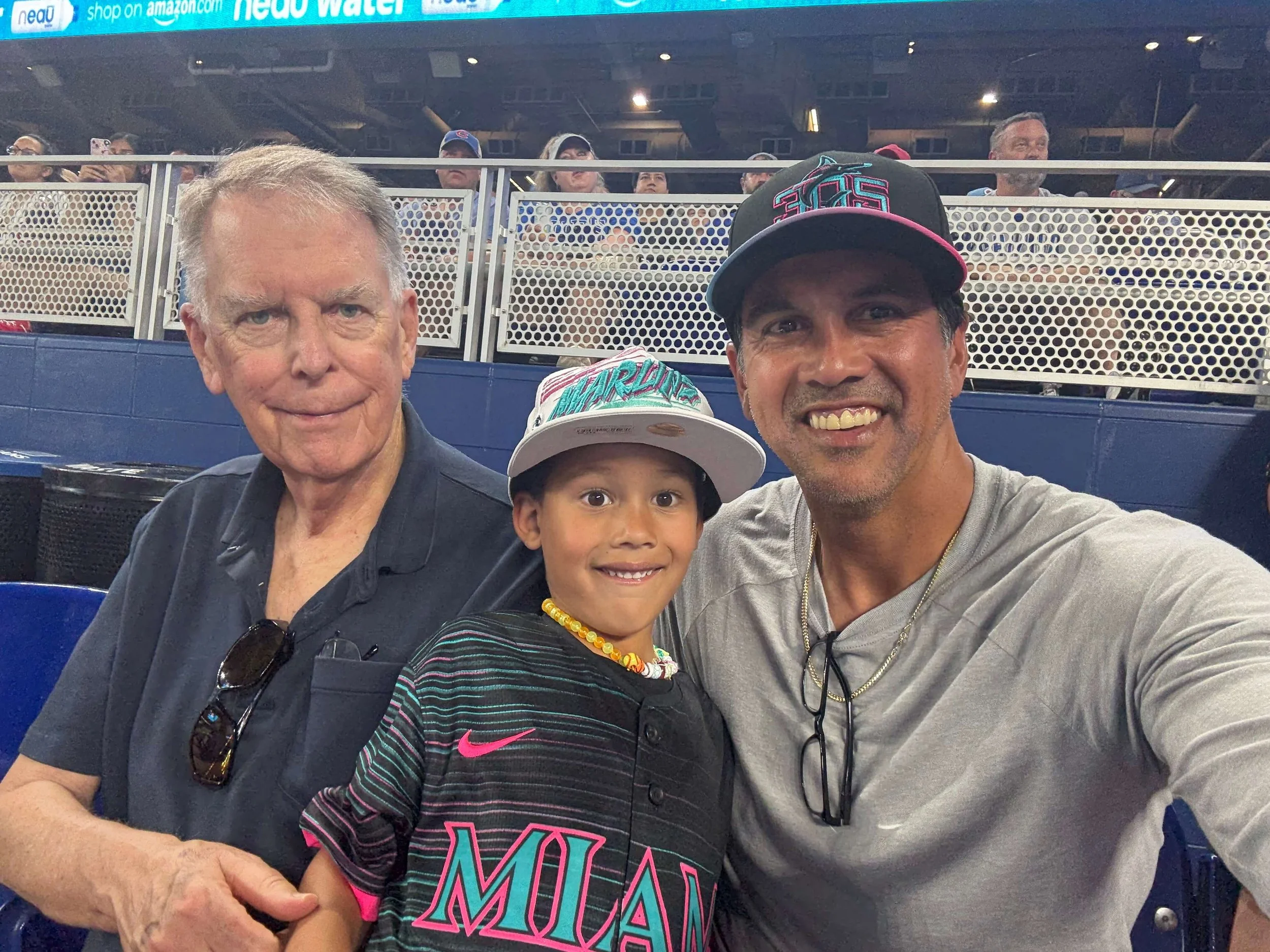
From left, Jon, Dante and Erik Spoelstra at a Marlins game in Miami last summer (courtesy Jon Spoelstra)
The senior Spoelstra ran the business side of the Blazers for a decade, helped develop Blazer Broadcasting and took the franchise’s marketing operations to another level. Sports Business Journal recently named Spoelstra, now 79 and retired, as one of 75 people “who grew the NBA’s business.” (Rick Adelman is three days older than Spoelstra. Both turn 80 in June.)
“Erik’s upbringing has a lot to do with how he views the league,” says Ira Winderman, Heat beat writer for the South Florida Sun Sentinel since the inception of the franchise in 1988. “He is a basketball lifer from a basketball family. You can’t have much better pedigree starting out than that.
“He has great respect for (former) Portland coaches. He talks often about Jack Ramsay. He talks often about Rick Adelman. It would almost be unfair not to include those two when you mention his growth as a coach. They both were very influential.”
During his years at Raleigh Hills Elementary, Whitford Junior High and Jesuit High, Erik drove with his father to and from Memorial Coliseum for nearly every home game of the Blazers.
“Pat (Riley) has been the biggest mentor and influence for me as a professional,” Erik says. “Rick was my role model. He is the reason why I got into coaching. The passion and the love for the game of basketball started with a father and a son going to all the Blazer games.”
Erik says it was about more than just a lift to a game.
“It was an opportunity for us to bond and share in a game that we loved,” he says. “We would talk about the game in anticipation and then catch up on things that were going on in my life. On the way home, we would dissect and talk about the game that just happened.
“We both reflect on and treasure all those special moments in the car to the games. My dad was really busy, but I am always so grateful that he made that time we would spend driving to the games, just the two of us. That was the spark for my love and passion for the game.”
Jon shares his son’s fond memories of those times.
“I looked at it as a father bonding with his son,” he says. “The traffic was less then. I would come home from the office, have dinner and then we would head to the Coliseum. It was fun, and a way we had something we could talk about, a teenage boy and his father. Sometimes there are things you can’t talk about. The one thing we always could talk about was basketball.”
Erik and Neu met in fifth grade at Raleigh Hills. “We both liked to shoot baskets,” Randy says. Soon there was a group of about five boys who ran together.
“We were kind of like the movie ‘Stand By Me’ back in the day,” Randy says. “We played basketball and baseball together for four years.”
Jon coached their seventh-grade team at Whitford. Randy, now chief marketing officer for Cook Solutions Group in Portland, was on the team. So was Brian Cook, chief executive officer for CSG, which is the primary sponsor for kerryeggers.com.
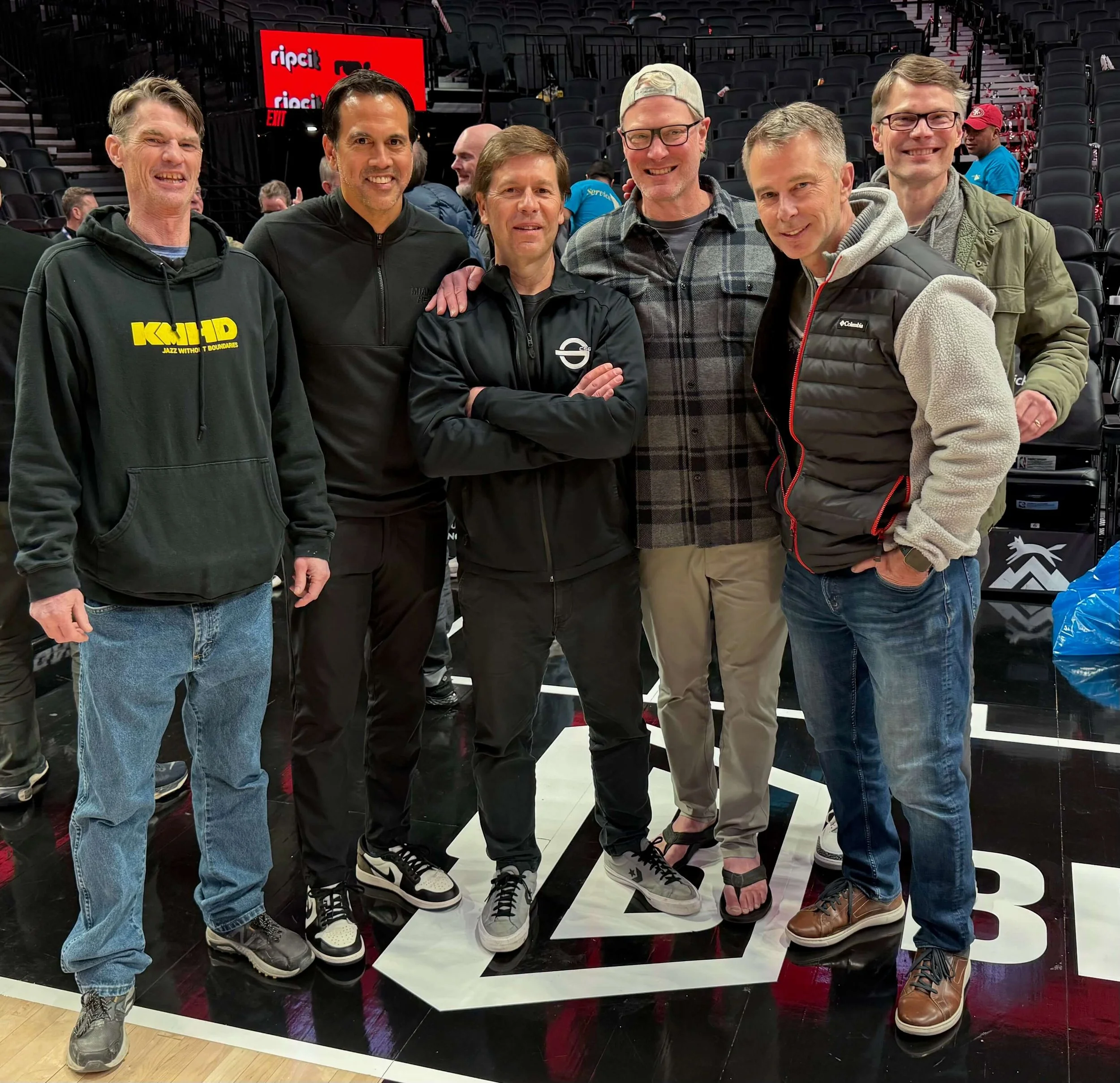
Spoelstra with his gang of boyhood friends after the Heat’s game at Moda Center last Thursday (courtesy Randy Neu)
“We were the ‘B’ team,” Randy says. “We had only eight players, but we were run and gun. Think Loyola Marymount, but we were before them, back in 1982. Erik was our point guard, pushing us. We averaged 100 points and beat the ‘A’ team.”
“The goal was to get up 100 shots in a 32-minute game,” Jon says. “We weren’t allowed to full-court press, so we used a half-court press to force turnovers. We needed to get offensive rebounds all the time and we needed to get 35 steals a game. I wanted every parent to be pleased that their kid got enough shots.”
The senior Spoelsta says during practice sessions, he would time how long it took to get the ball upcourt and get off a shot. The goal was seven seconds.
“We ran a lot of fast breaks,” he says. “We beat the ‘A’ team pretty badly, and then we beat the other ‘A’ team, too.”
Is Erik the same guy today he was during their boyhood years together?
“Absolutely the same guy,” Neu says. “Always driven, but also a prankster. He always liked to have fun. He could flip a switch between having fun and getting serious, which carries over to the way he is today. He was extremely disciplined, but lighthearted. That is a rare combo.”

The Dean of Portland Sports is now on BlueSky.
Through middle school and high school, Erik was a hoops junkie.
“He lived and breathed basketball,” sister Monica says. “He was consumed by it at an early age. In the days of VHS tapes, he would watch game footage over and over — stop it, rewind it, analyze plays. Other kids were watching TV shows; he didn’t do any of that.”
Erik’s work ethic emerged right away.
“Between his sophomore and junior year, he took 30,000 3-point shots during the summer,” his father says. “This was before they had the bounce-back machines. He had to retrieve the ball after every shot. The gym wasn’t air-conditioned. He went over there every day to shoot shots. He kept a chart of where he shot them and what he made.
“He was undersized, a decent ballhandler but not that strong physically. He had to develop an outside shot. He worked hard on his ballhandling. I had a VCR where you could (slow down) the speed. He would dial it up and see how Isiah Thomas moved his hands when he went between his legs. Then he would go down to the garage and try it until he got it. He always had the determination to get better.”
Spoelstra was a standout point guard at Jesuit and moved on to four years as a starter at the University of Portland from 1988-92, earning the WCC Freshman of the Year his first season with the Pilots. By that time, Erik had become a regular visitor to the Adelman residence on Bull Mountain Road. Rick had been an assistant coach with the Blazers under Ramsay and took over the head position in 1989. He coached Portland to the NBA Finals in both 1990 and ’92.
Erik became close friends with R.J. Adelman, Rick’s oldest son, and Kathy Adelman, Rick’s oldest child. Erik was a grade ahead of Kathy and three grades ahead of R.J., who would go on to become director of basketball operations for the Minnesota Timberwolves and work for several other NBA clubs before his death at age 45 in 2018. A much younger brother was David Adelman, who is in his first full season as head coach of the Denver Nuggets after a long career as an assistant coach in the league. David, now 44, is 11 years younger than Spoelstra.
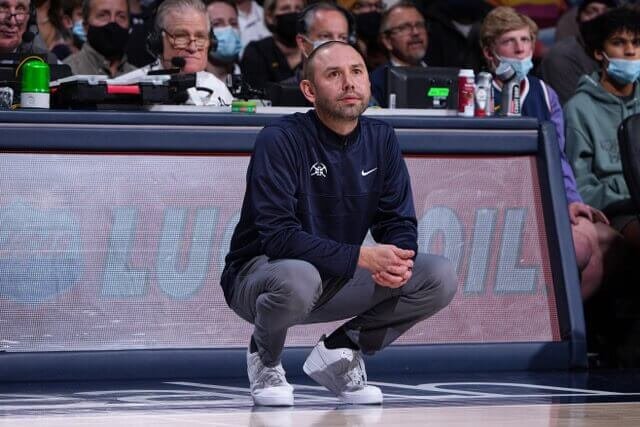
Nuggets coach David Adelman had coaching in mind when he was 10 years old, according to Spoelstra
The Adelmans had a full-court basketball court with night lighting on their property. R.J. organized pickleball and three-on-three basketball games, in which Erik often took part. There were several other regulars, including Nico Harrison, who would ascend to the general manager position of the Dallas Mavericks.
“I didn’t even know what pickleball was when we started,” Erik says with a laugh. “R.J. would organize tournaments. He would have a board, with winners and losers.”
Speaking from his home in Denver on Monday night after a nightmarish road trip to Memphis in which the Sunday game was cancelled, David recalled the scene on Bull Mountain.
“I learned what competition actually means,” he says. “Those guys went at it late night. Dunk hoops, 3-on-3, pickleball — it was so fun to watch.”
Did they let David, just a young kid at the time, participate in the games?
“Oh, hell no they didn’t,” he says with a laugh. “But it was a cool thing to watch. Every now and then I got to play H-O-R-S-E with them. Those guys took care of me.
“There were a lot of really competitive, smart people who played, but Erik stood out. He was a unique guy. He was driven. He had a spirit about him.”
Often when they were done playing games, R.J. would take Spoelstra into Rick’s home office, with David tagging along. They would check out the coach’s VHS game tapes and scouting reports.
“At that time, I was still in college, still just a fan of the game,” Erik says. “I wasn’t thinking the game like a coach. R.J. and David were way advanced.
“R.J. was the one who would bring out the tapes. David would always be in the room. He was much younger, yet he would be able to say, ‘This is what they’re working on; this is what they’re struggling with.’ It was crazy for a 10-year old to talk like that. David just knew he was going to get into coaching, even at that young age.”
In some ways, David was a coach-in-training during the era when his father coached Portland teams from 1989-94.
“I was into what the Blazers were doing,” he says. “I spent a lot of time talking about it, even though half the time I probably had no idea what I was saying. It was so cool to throw on tapes. It was a product of watching my dad do it late at night, in a very different scenario.”
Rick Adelman got to know Erik during those years and noticed that he and R.J. talked a lot of basketball.
“I knew they were playing in those games at the house,” Rick says with a chuckle, “but I didn’t know they were going into my office and looking at stuff.”
Kathy also played point guard for four seasons at UP, a year behind Erik. After her playing career, Kathy launched into an outstanding career coaching high school girls basketball. She twice took Jesuit to the state 4A finals and won a 6A title with Beaverton in 2022. During her years at UP, she had worked several summer basketball camps alongside Spoelstra.
“Kathy was an absolute stud as a coach,” he says. “She was incredible. She had a great passion for coaching and knowledge and an uncommon way of communicating and inspiring kids.”
After Erik had become employed by the Heat, he would meet her for lunch and sometimes come across David, by that time a member of the basketball team at Jesuit.
“Usually the thoughts of a high school player are like, ‘All right, how am I fitting in? How am I gonna score? How am I gonna earn this role on the team?’ ” Erik says. “His view was always about what scheme the coach was doing that he thought was really good; how they were going to beat certain teams in the league; how certain players were going to be successful because of X, Y or Z.
“I just thought it was very deep-level thinking. I certainly did not think like that as a high school player. At a young age, we all just felt David would be the best of us. He had a different level of maturity and understanding of his game. David was dissecting it at a deeper level.”
Much later, after Erik was a head coach and David was an assistant coach in the NBA, they would get together for coffee or dinner during Las Vegas Summer League. Dan Burke, a Portland native who began his 35-year career as an NBA assistant with Rick Adelman and the Blazers, would often join them.
“If you want to talk about two genuinely cool people to hang out with, Dan and Erik are near the top,” David Adelman says. “There is a reason why longevity has been there for both. They coach the game to try to make people better — two awesome role models for a young coach like me. I was lucky to get to know both of those guys. They have had tremendous careers.”
David and Erik were among the coaches who traveled to South Africa in 2017 on a Basketball Without Borders trip. Spoelstra and then-Nuggets coach Michael Malone were head coaches of two of the teams. It was on that trip that Adelman got to know Malone, who would hire David as an assistant that summer. When Malone was fired late last season, David took over as coach.
“The South Africa trip was a cool experience,” he says. “Besides the chance to spread word about the game, I actually got to hang out with Erik in a loose environment. It was a chance to rekindle a relationship that started when I was a kid, and now I am an adult.”
All these years later after the days at “Adelman Arena,” the Jesuit High grads are members of an exclusive fraternity — two of the 30 head coaches in the NBA.
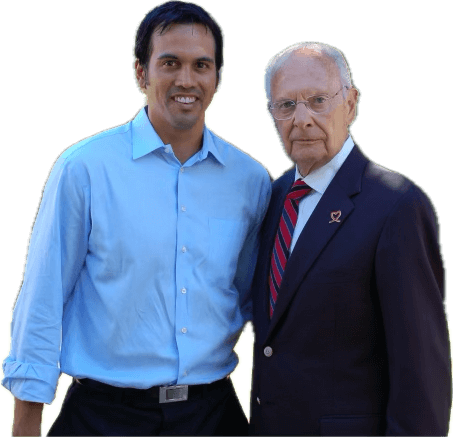
Spoelstra with the late Bill Schonely at the induction ceremony for Erik into the Jesuit High Sports Hall of Fame in 2023 (courtesy Jon Spoelstra)
“Who would have thunk it, right?” Spoelstra says with a smile. “None of us were thinking about such things at that time.”
“It really is amazing,” Rick Adelman says. “They have a lot of the same traits. David gets along with his guys well and he makes good adjustments, which he has had to do this year. Erik has done that also. He has been able to take different types of teams and they have always been successful. He gets the best out of them.”
► ◄
After his college career ended, Spoelstra played two years of pro ball in Germany.
“He had a lot of fun over there,” his father says. “I flew over a couple of times to watch him play. At Portland, he was a facilitator. In Germany, he was a scorer. He averaged 25, 26 points a game and could hit the 3.”
In 1995, Erik came home and applied for a number of entry-level jobs in the NBA. Chris Wallace, who had broken into the NBA as a scout with the Blazers, was Miami’s director of player personnel and hired Spoelstra to do video work. Later that summer, Pat Riley was hired as head coach and team president.
“Erik was terrified,” Neu says. “When Riley came in, Erik thought he was going to get booted. But he was in the office at 4:30 a.m. every day and proved to Riley he was a worker.”
Two familiar faces were in Miami when Spoelstra arrived. Jack Ramsay was retired from coaching and working as TV analyst for the Heat in addition to some ESPN assignments. Ron Culp, who had served 13 years as the Blazers’ trainer, had been with the Heat for eight seasons.
“They made me feel at home 3,000 miles away,” Spoelstra says. “Ron was the one who picked me up for my interview and, after I was hired, showed me around all the neighborhoods to figure out where I would want to live.”
Ramsay was head coach of the Blazers from the time Erik moved to Portland until he turned 16.
“I was terrified of him early on,” says Erik, who got over the fear after attending the Jack Ramsay basketball camps.
“I would go every week — four weeks in the summers,” Spoelstra recalls. There was a benefit to Ramsay knowing and working with his father.
“I always remember that Coach Ramsay would take the time to wake up early to take a few of us through a workout at 6 a.m. before the camp started each day,” Erik says. “That is really unheard of for an NBA coach. I was part of that group. He would coach us hard, teach us everything, and he also always made time to watch at least three or four of my games during the week and have critiques about my game. I always think about that and if I would do that at this time (as an NBA head coach) for someone. It was serendipitous when I got the opportunity with the Heat that he was doing the telecasts.”
Years later, when Spoelstra had graduated from assistant coach to Riley to head coach, Ramsay would occasionally offer advice.
“Coach Ramsay would scribble down plays for me during our championship-run seasons,” Spoelstra says.
Erik used one of them during Game 7 of the NBA Championship Series against San Antonio in 2013. A Dwyane Wade layup off the play with 2:56 remaining gave the Heat a 90-85 lead in what would be a 95-88 victory.
“To this day, I have that ATO (after timeout) play written down as ‘Ramsay’ on my card,” Spoelstra says. “And my current staff all still refer to the play as ‘Ramsay’ all these years later.”
It didn’t take Spoelstra long to gain Riley’s trust.
“His second year as video coordinator, I noticed he was becoming far more sophisticated in understanding the game,” his father says. “I realized his depth of knowledge of the game had really grown. It was like, ‘Are you watching the same game as me?’ ”
Rick Adelman watched Spoelstra’s rise through the Heat organization with interest. Adelman and Riley had been teammates on the San Diego Rockets from 1968-70.
“It said a lot when Pat picked him to be his successor,” says Adelman, retired and living in Portland. “That told me everything. Pat was pretty astute and observant. He thought Erik was going to do a good job. He was patient with Erik, and it paid off.”
One of Adelman’s strengths was the way he worked with his players. Spoelstra has the same attribute.
“What Erik does best is he gets the guys in the right spot, which is always a key,” Adelman says. “You coach to your guys’ strength. You put them in a spot where they can succeed. He has done that. It’s easy to do with LeBron (James) and Wade, but it’s not that easy with most players. They all have egos, too.
“Erik is good with relationships, for sure. I admire the way he has risen to the challenge inside of Pat’s system. They are very happy with him. You just don’t stay in one spot that long. I don’t care who you’re friends with, it doesn’t happen.”
David Adelman echoes his father’s thoughts.
“The words that come to mind with Erik are innovator and consistency,” he says. “He has found a way to recreate himself with different rosters, whether with LeBron or a different roster. If you want to talk about one of the best coaches I have seen all-time, it is Erik.
“He has done it in so many different ways, and he has done it with humility. That is why the respect is so high for him, and so deserved. He is a very easy person to look up to. He is an example that you can do it the right way. It is uniquely cool that he’s from Portland. He has been really impressive.”
Kathy Adelman phrases it in a slightly different way.
“Erik accomplishes so much by valuing all facets of the game,” says Kathy, working this season as a special assistant to brother David with the Nuggets. “He has such a high intelligence about the game, how people work, and how important it is to put the whole puzzle together. You need to value all involved. It doesn’t surprise me he gets the most out of his players, gets them to be better than even they thought they would be. That’s how he has always approached things.”
► ◄
Through his 18 years as Miami’s head coach, Spoelstra has had only three losing seasons and has missed the playoffs three times. The Heat went 37-45 last season in the first year of his new contract.
“The biggest blessing through my professional career has been the opportunity to work for Pat Riley and (owner) Micky Arison because of the stability and consistency that has allowed all of these other things to happen,” Spoelstra says. “It likely would not have happened if I had ended up somewhere else. I would have bounced around six, seven, eight times. That is the natural course of the business in this league.
“For myself and my staff, our biggest breakthroughs have been after disappointing seasons where you would have been fired in other places. Instead, we all got back to work and improved where it is relevant in that organization and that culture. You don’t have to rebuild it and do it all over again. And that makes you work even harder with your heart and soul to do your best for an organization, because you know they have your back.”
Such patience by Arison and Riley “has been extremely important for Spo’s career,” says Udonis Haslem, a legendary player and figure in Heat annals.”Now you see why he is patient with his players. It started up top. They gave him grace. They allowed him to make mistakes, to learn.”
In 2011, Spoelstra got to the NBA Finals for the first time as head coach, losing in six games to Dallas after leading the series 2-1. Thinking outside the box and seeking a change that might benefit a lineup led by James, Wade and Chris Bosh, Spoelstra chose to twice visit with Chip Kelly, Oregon’s football coach, during the NBA offseason — the second time bringing along members of his coaching staff. The Ducks had gotten to the BCS Championship Game the previous season using Kelly’s innovative no-huddle spread offense.
“Erik always liked the speed in sports and wanted to find out more about it,” his father says. “He wanted to know how Chip was running the speed practices, and how that was transferrable to basketball practice.”
Kelly’s mantra, Spoelstra learned, was “pace and space.” Using a more up-tempo offensive philosophy in a lockout-shortened season, he coached the Heat to a championship in 2012 and repeated in ’13.
“After we lost in the Finals, ‘Spo’ was the first to come out and be honest that Rick Carlisle had out-coached him in certain situations,” says Haslem, a power forward on those Miami teams. “That takes a lot for a coach. What he didn’t do was hang his head. He went straight to the lab and got better. All of us got better. LeBron got better. Dwyane got better. Sometimes the coach doesn’t feel he needs to get better. Spo dove into the bunker and got with it. He spent time with Chip Kelly in Oregon and came back with a new offense for us. That is the evolution of Spo, man. We could go on and on.”
A similar philosophy is in place with this season’s Heat team, which leads the NBA in pace.
“Erik is a life-long learner,” says sister Monica, who works as a public relations consultant in Miami. “He is constantly learning. In the offseason, he is constantly meeting with coaches in other sports. He is a student of mindset. Health and wellness longevity is a big piece for him. He has grown so much as a coach, but also as a human being.”
Haslem, now Miami’s vice president/player development, spent his entire 20-year career with the Heat before retiring in 2023. He joins Dirk Nowitzki and Kobe Bryant as the only players to play 20 years with one team. Haslem, 45, was the oldest player ever to appear in an NBA Finals game two days short of his 43rd birthday in 2023. The Heat retired his No. 40 jersey in 2024. Lofty accomplishments for a player who came into the league undrafted out of Florida.
“I came in a little rough around the edges, and the only thing I understood was how to play hard and fight like hell for the things I wanted,” Haslem tells me. “But I wasn’t always received that way sometimes. I have always admired Spo for being willing to get out of his comfort zone and meet players where they are at. With other coaches when you come into their organization, to their locker room, they want you to meet them where they are at, to come up to their level and be a professional and understand things immediately.
“Spo met me where I was. So did Pat, but Pat retired and Spo gave me grace, continued to believe in me and walked me along to the leader and the player I became. It didn’t happen overnight. It took awhile to get to that point. It was through a lot of work and progression and conversations in Spo’s office. He had an open-door policy. I always respected that. We didn’t always have to agree, but his door was always open.”
Spoelstra served 11 seasons as an assistant to Riley before succeeding him after the 2007-08 season. He spent a great deal of time working out the team’s players, including Haslem.
“A lot of times, assistants worked with specific guys,” Haslem says. “Spo worked with everybody. If he worked an hour with Dwyane and I needed a half-hour, he would gladly give me 30 minutes after that. It would be rebounding or whatever I needed to do — play defense, pass. He never had an ego about anything.
“The great thing about that is, once he moved over to head coach, he carried that same mentality. A lot of coaches ask players to not have egos, but the coaches have egos. I don’t think that’s right. I learned the right way from Spo as well.”
In his latter years as a player, Haslem played sparingly and was a de facto on-bench assistant for Spoelstra.
“Spo’s best trait as a coach is figuring things out in times of adversity,” he says. “When times get tight, when your backs are to the wall, that is when he is at his best. That is his biggest asset. When things get murky, he is calm.”
And prepared to meet any challenge.
“He is as prepared as anyone, as committed as anyone to his craft, probably having a lot to do with growing up in a basketball family,” Winderman says. “And from seeing what it takes and then growing up under Pat Riley and seeing what excellence means.”
When I ask Haslem about Spoelstra off the court, he has a quick answer.
“Love him as a person,” he says. “I watched him come out of his comfort zone. He wasn’t the most social person at first. He was quiet, kept to himself. Extremely smart, but you could tell he was not always comfortable revealing his personality right away. It takes him a little time to trust you. But once you get to know him, to know him is to love him. He is smart as hell, he is compassionate, he is authentic. You learn to appreciate people like that in your life.”
► ◄
Spoelstra is a father to three young children — Santiago, 7; Dante, 5, and Ruby, 3 — from a seven-year marriage that ended in 2023. Ex-wife Nikki and Erik are co-parenting the children.
“When Erik is in town, he gets the kids,” Jon Spoelstra says. “When he is out of town, she gets the kids. And they have a pair of nannies who work at both homes. He spends a lot of time with those kids. That is a great release for him. When he comes home, he is with them.”
“I never overstate knowing someone like Erik as a person, because 99 percent of the time I am around him it has been in basketball circumstances,” Winderman says. “But you see him around his children and there is the love of a father. You see his sister here, and hear him talk about his dad, and you can feel how much his family means to him, and his family trips. He speaks very much about empathy, and I think he is an empathetic person.”
The family trips come in the summers and involve his parents.
“We usually go to the Oregon Coast every summer, and then we go to Maui or the big island,” his father says.
The Spoelstra family got disrupted on Dec. 12 when a fire, evidently caused by some faulty wiring, destroyed Erik’s house in Miami. He arrived home in early morning from a flight from Denver to see the house engulfed in flames. Fortunately, nobody was at home. Erik and the kids moved in with his sister for about a month after it happened.
“Erik needed to have his family around him during a time like that,” Monica says. “He is such a committed father. Immediately that day, he came over and got things set up for the kids. He has such a strong community surrounding him. By the time the kids were picked up from school, he had things dialed in at the house. Friends were dropping off extra clothes and toys, and the kids got their favorite foods. He was committed to making things normal for them and as comfortable as possible even after such a terrible event.”
Spoelstra is now renting a house that he considered buying a couple of years ago. He is planning to rebuild on the same spot where he lived before the fire. “We’re good,” he told me.
“Erik lost all of his memorabilia except his rings,” his father says. “But he is young enough to get more of them.”
► ◄
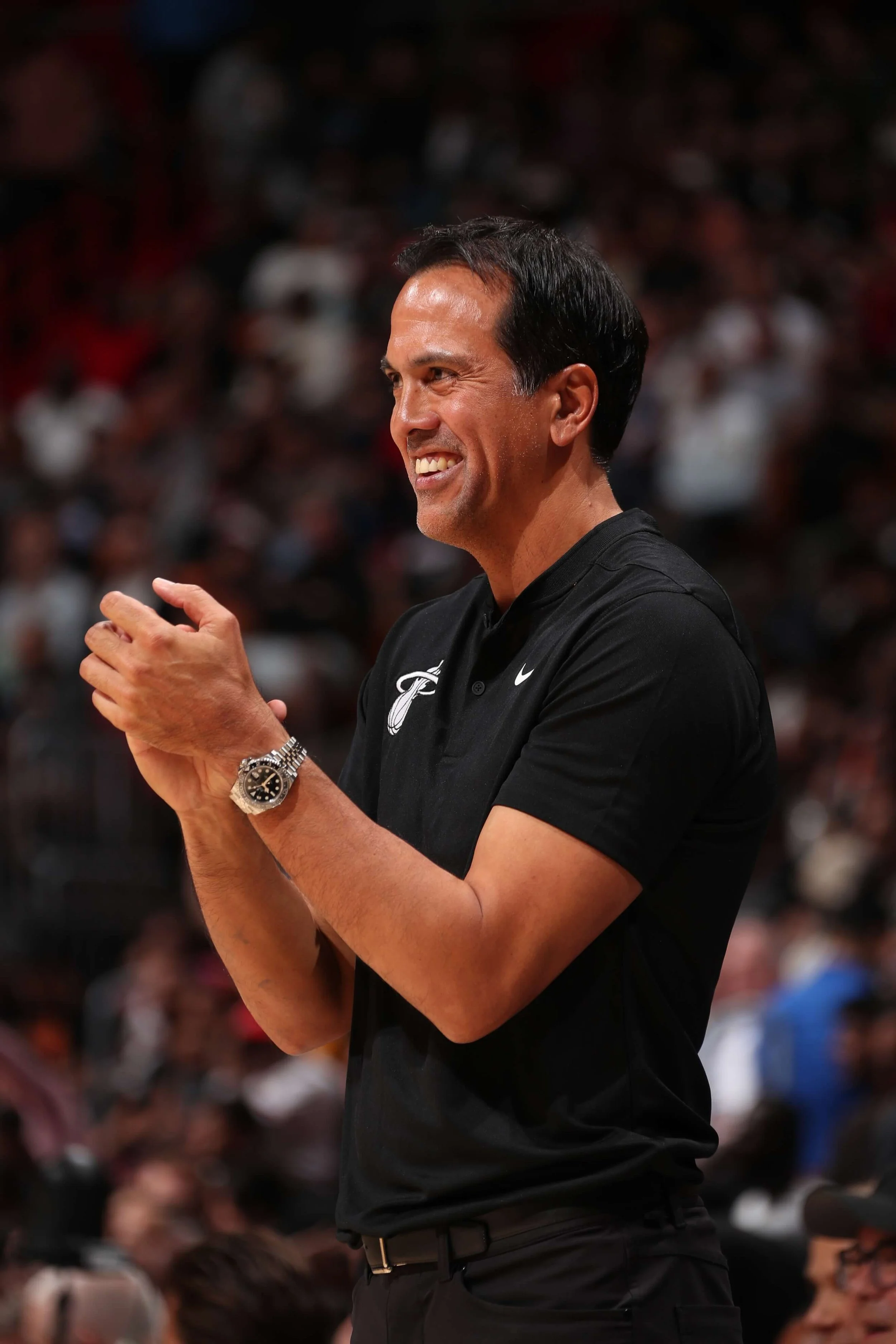
Steve Kerr says Spoelstra is “the perfect choice” as head coach for Team USA in the 2028 Olympic Games at Los Angeles (courtesy Miami Heat)
Erik’s total professional focus right now is getting the Heat, 25-22 and in seventh place in the Eastern Conference standings, into the top six to avoid the play-in round. In the back of his mind is the challenge ahead with Team USA.
“It is the greatest honor of my lifetime,” Spoelstra tells me. “I never thought I would be in this position. Earlier in my career, I would have done anything to be a part of USA Basketball even as a volunteer assistant.
“There is such a history, legacy and responsibility to the USA program. We all feel it. I am glad I had that opportunity to work the last two tours as an assistant. You could feel the expectations and the difference in the game. FIBA is different. You have to first understand that to embrace it. There is a legacy and history that is amazing, beautiful. I am honored to be a part of it.
“I think of all of the things that have led up to it. … it could have been a lot of different people (as head coach). I am honored and grateful to be at the helm to lead the charge to that next chapter.”
Kerr knows he has passed the torch on to good hands.
“Just watching Erik the last two summers and getting to know him up close rather than just from afar, where I have admired him for so long, I got a first-hand glimpse of what a great coach he is,” Kerr told reporters last week. “I think the (Team USA) assistant coaching job is almost a prerequisite for being the head coach. He is a perfect choice. He is going to be great.”
► ◄
Readers: what are your thoughts? I would love to hear them in the comments below. On the comments entry screen, only your name is required, your email address and website are optional, and may be left blank.
Follow me on X (formerly Twitter).
Like me on Facebook.
Find me on Instagram.
