
June Jones was a family man, and there was plenty of family. He and wife Diane had four children and nine grandchildren. This photo was taken at the wedding of granddaughter Lilybelle Holmes, the daughter of June’s daughter, Kelli Moir (courtesy Kelli Moir)
There was nothing common about him, right down to that delightfully esoteric name — June Sheldon Jones III.
Jones, who died Thursday of esophageal cancer at age 73, was an extraordinary athlete, coach and person.
Jones coached football for more than 40 years, including a marvelously successful nine-year run at the University of Hawaii and stints as a head coach with the Atlanta Falcons and San Diego Chargers. His name is synonymous with the run-and-shoot offense first made popular during the Mouse Davis era at Portland State.
He loved football, he loved coaching and he loved people. In his latter years, he took a high school job in Hawaii volunteered his time to help coach quarterbacks there. It was about giving back to what had given so much to him.
June kept things private as his health deteriorated. His wife, Diane, and their four children provided support in his final few weeks at his home in Gresham. June had a home in Honolulu, too, and spent more time there than in Oregon. “He was in Hawaii a lot, but he would come home for six weeks at a time at least a couple of times a year,” says Kelli Moir, one of his three daughters.
I wrote a number of stories on Jones during his coaching career, including during his Hawaii stint and after he took the head coaching job at Southern Methodist. Through the years, June would shoot me texts and emails about things that were happening that he thought would interest me. We talked occasionally on the phone and got together a few times for coffee or lunch in the Portland area. He attended a retirement party my brother put together for me in 2022.
Jones was mild-mannered and even-keeled as both a coach and person.
“That’s how he was,” Moir says. “What you see is what you get.”
I last saw June at a tribute event for Davis at Portland State a year ago. We last talked a month ago, when I called him for comment on ex-Viking QB Davis Alexander, now with the Montreal Alouettes and the favorite to claim the CFL’s Most Outstanding Player Award. He said good things about Alexander and never let on about his own illness.
“He didn’t want a lot of people to know,” Moir says. “And in the end, he didn’t want to do chemo or any treatments. He was going to do what he wanted to do.”
If Mouse Davis was the father of the run-and-shoot offense, Jones was the older brother, pushing the pass-happy, no-tight-ends, four-or-five wideouts attack to great heights wherever he went during a 40-year coaching career.
He coached damn near everywhere, but his heart was with Portland State, and there was no greater ambassador for Viking football. Jones stayed in touch with the program through the years, attending practices and games when he could. It was an extension of his time as the team’s quarterback in 1975 and ’76, leading the Vikings to successive 8-3 seasons in the first two years of the Davis era.
“Without Mouse and June, that program would have died in the ‘70s,” says Neil Lomax, whose passing records at Portland State may never be broken. “Everybody says, ‘Neil, you made that thing happen.’ But no — I tell them, ‘You should have been there in ’75 and ’76 with June.’
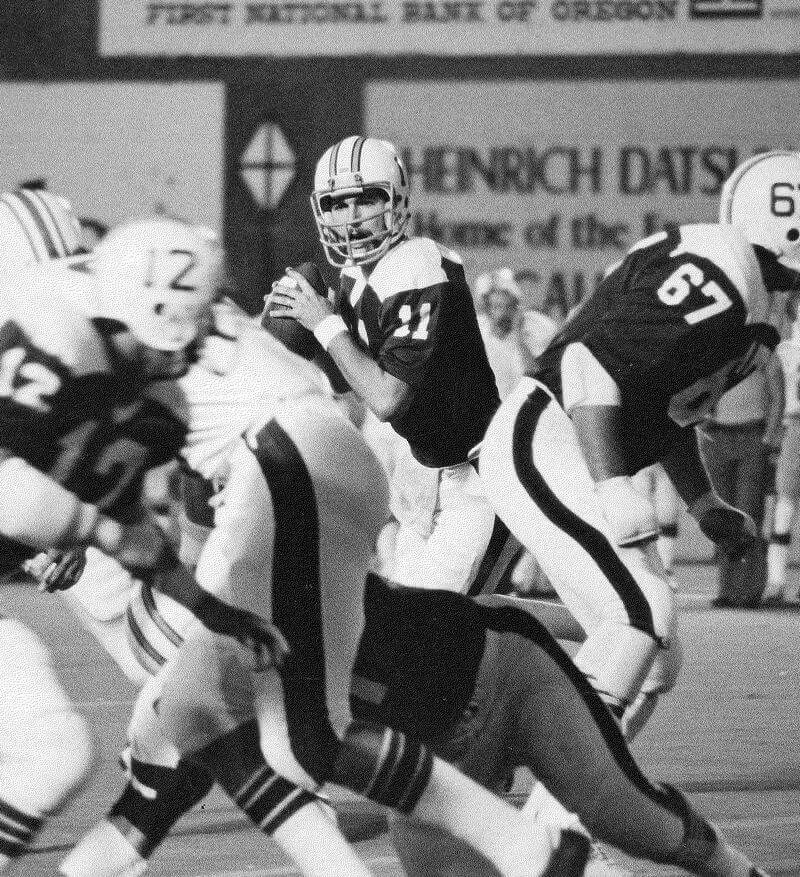
Jones was a Division II All-America quarterback at Portland State (courtesy Portland State athletics)
“That was the match that struck the box and started that fire, and it was contagious. Because that program was going down without those two to save it.”
Jones was a three-sport star at Grant High, then began his college football career at Oregon. When that didn’t work out, he transferred to Hawaii. That didn’t go well, either, and Jones wound up at Portland State, where Davis had to nudge him a little to get him in a Viking uniform.
“At first, he didn’t know if he wanted to play,” Davis, now 94 and living in Houston, told me on Thursday. “He’d had his time at Hawaii, and it was like he’d had his share of football. Then he got back into it with us, and he really took over. He became the guy.”
Jones was never better than on Sept. 25, 1976, during his senior year at Portland State. He threw for 459 yards, including a two-yard touchdown to Dave Stief as time expired, in a 50-49 victory over Montana before a crowd of 16,395 at Civic Stadium. “The greatest game in the history of Portland State football,” says Larry Sellers, the school’s sports information director during that era.
June threw for an NCAA Division II-record 3,518 yards and had 25 TD passes in 11 games while earning first-team All-America honors as a senior in 1976.
“June was an ideal quarterback in my system,” Davis says. “He was in charge, and he wanted to be. He wanted to be the guy who made things go, who had the ball when the game was on the line. He did that. I think he really enjoyed it. He did a great job for us.”
The 6-4, 200-pound Jones went undrafted but made it to the NFL, though his playing career was relatively brief and undistinguished. In four seasons with the Atlanta Falcons, he played in 17 games with five starts, completing 45.2 percent of his passes for 923 yards, with three TDs and seven interceptions. Jones played one more season of pro football as third-string QB for Toronto behind the CFL’s Most Outstanding Player, Condredge Holloway. The Argonauts lost to Edmonton in the 1982 Grey Cup.
By that time, Lomax had finished a remarkable career at Portland State, breaking not only Jones’ school records but NCAA passing marks. Jones visited the Vikings’ training camp before Lomax’s senior campaign.
“I had the most tremendous respect for June,” says Lomax, now retired and living in Lake Oswego. “He talked to me about what it was going to be like in the pros. He said, ‘Keep your head on straight, stay humble, work hard, get in the weight room, and most important is your faith. Don’t ever lose sight of where you came from. You say you believe in God. Well you’re going to be tested when you get to the pros.’ And he was right.”

Jones started his coaching career as quarterbacks coach at Hawaii for a year. He then followed Davis to the USFL — first as quarterbacks coach when Davis was offensive coordinator of the Houston Gamblers in 1984, then as O-coordinator when Davis served as head coach of the Denver Gold in ’85. After a year in the CFL in Ottawa, Jones coached in the NFL for the first time, spending two seasons as quarterbacks coach of the Houston Oilers. In 1989, he rejoined Davis for two years as quarterbacks coach with the Detroit Lions, with Mouse as O-coordinator.
In 1991, Jones began a six-year run with the Falcons — the first three as O-coordinator, the last three as head coach. Receiver J.J. Birden played the last two of his seven NFL seasons for Jones in Atlanta.
“I thoroughly enjoyed playing for June,” says the Lakeridge High and Oregon grad, now retired and living in Scottsdale, Ariz. “He was one of the nicest, coolest coaches I ever played for, and he was incredibly knowledgeable and creative offensively.
“I always responded best to coaches like June. Just tell me what I needed to do, and I’d do it. He respected that. He stayed calm and collected, never feeling the need to scream and shout at players. He told you what he expected, and he trusted you to get it done. I never had a problem with him — never even a disagreement. It was easy to play for him.”
Atlanta improved from 6-10 to 7-9 to 9-7 and a playoff appearance in Jones’ first three seasons as head coach, but after a 3-13 record in 1996, he was fired. After a year away, he spent the last 10 games of the 1998 season as interim head coach in San Diego. The Chargers let him go and hired Mike Riley, who had just finished his second season as head coach at Oregon State.
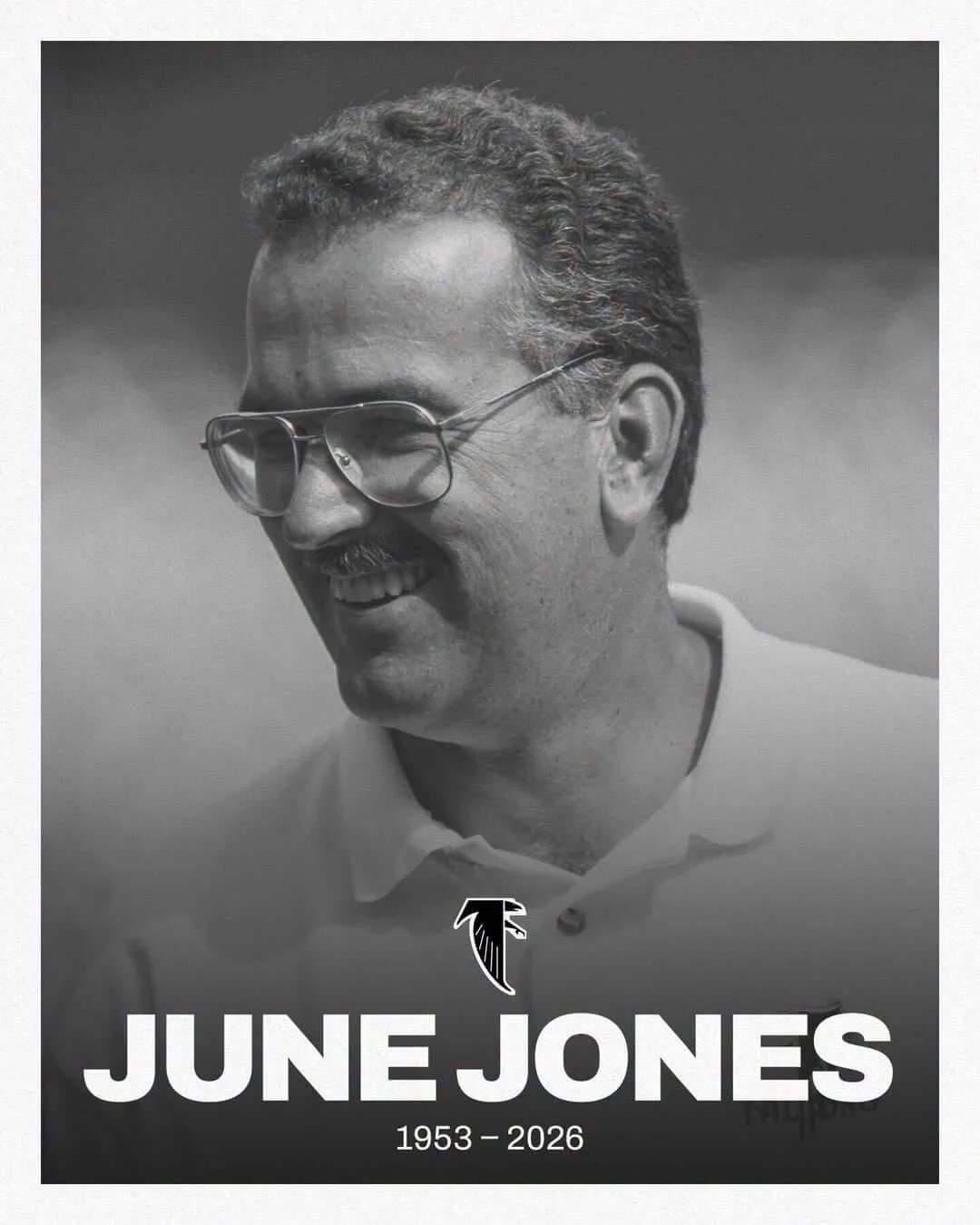
Jones played for five years and was head coach for three years in Atlanta. On Thursday, the Falcons paid tribute after his passing (courtesy Atlanta Falcons)
“I called June (for his opinion) when the Chargers offered me the job,” says Riley, now retired and living in Corvallis. “He didn’t say too much, but he did say, ‘There are only 32 of these jobs, and they don’t come around often. So if you ever want to do it, you might want to do it now.’ ”
Through the years, Riley and Jones became friendly.
“Our paths crossed in a lot of ways,” Riley says. “I liked him. He was an easy guy to know and talk to. You always felt like if you had something you needed to ask him, he was a straight shooter. A real good guy to be around, a good guy in our profession and legendary in our state.
“He was a great coach. He was innovative, he knew his system, coached it and then threw some stuff in there from time to time that was creative. He took the system and made some twists and turns with it. His teams were fun to watch, but not so fun to play against.”
After he left San Diego, Jones enjoyed a bountiful nine-year run as head coach at Hawaii, becoming what the Honolulu Star-Advertiser described in an article Thursday as “one of the most influential figures in Hawaii sport history.”
Jones took over a program that had gone 0-12 in 1998 and coached the Warriors to a 9-4 record in 1999, then the biggest single-season turnaround in FBS history. He went on to win a school-record 76 games and two Western Athletic Conference championships. In 2007, with Colt Brennan at quarterback, Hawaii was 12-0 through the regular season before losing to Georgia in the 2008 Sugar Bowl.
Near the end of his career, Davis spent three seasons on Jones’ Hawaii staff, coaching running backs and special teams.
“By that time, he was the big guy, and I was just a guy,” Davis says with a cackle. “But I would do anything to help him. He was the right kind of person. He built that thing in Hawaii. He really put a program together.
“June was low-key as a coach, just like he was as a person. He was very thorough, and always had the best interest of the player at heart.”
Oregon State visited Hawaii for its regular-season finale in 2006, winning 35-32 before an Aloha Stadium crowd estimated at 50,000. The Beavers, who employed a balanced pro-style offense, finished that season 9-4. The Warriors, who passed on nearly every down, were 11-3.
“That was one of the best games I have been involved with,” Riley says. “Two diverse styles, but a shootout. We made just enough plays to win, but boy were they good, and well-coached. June had it going there. He packed that stadium for several years.”
Current Hawaii coach Timmy Chang, who set NCAA career passing and total offense records there under Jones, considers him his mentor.
“He meant a lot to people in our community,” Chang told the Star-Advertiser. “He impacted a lot of people in our football community with his words, his kindness, his love, his patience with us. I owe so much to him.”
After conflicts with the administration, Jones left Hawaii for SMU, which had gone 1-11 in 2008. The turnaround was quick there, too, with an 8-5 mark and a victory in the Hawaii Bowl the first year. The Mustangs went to four straight bowl games but slid to 5-7 in 2013, and he stepped down after an 0-2 start the next year.
Jones wasn’t done as a coach. He spent most of two seasons as head coach of the CFL Hamilton Tiger-Cats and took the Houston Roughnecks to a 5-0 start before the XFL folded in 2020. His final coaching stint was as offensive coordinator for the XFL’s Seattle Sea Dragons in 2023. The Sea Dragons went 7-3 and lost in the division finals.
“Wherever June went, he took all that knowledge and experience from what Mouse taught him,” Lomax says. “He wasn’t afraid to use (the run-and-shoot). Everybody said, ‘You can’t do that here,’ but he proved them wrong.”
Though Davis was his mentor, Jones also borrowed from Bill Walsh’s West Coast offense.
“The last 10 years or so of Bill’s life, he visited Hawaii every year,” Jones told me for a story I wrote on him in 2022. “We would play golf, go to dinner almost every night for a couple of months. Bill kept telling me, ‘June, you have to keep tweaking what you do or the defenses will catch up to you.’ We would sit there for hours, and he would give me ideas on how to improve the stuff I was doing.”
► ◄
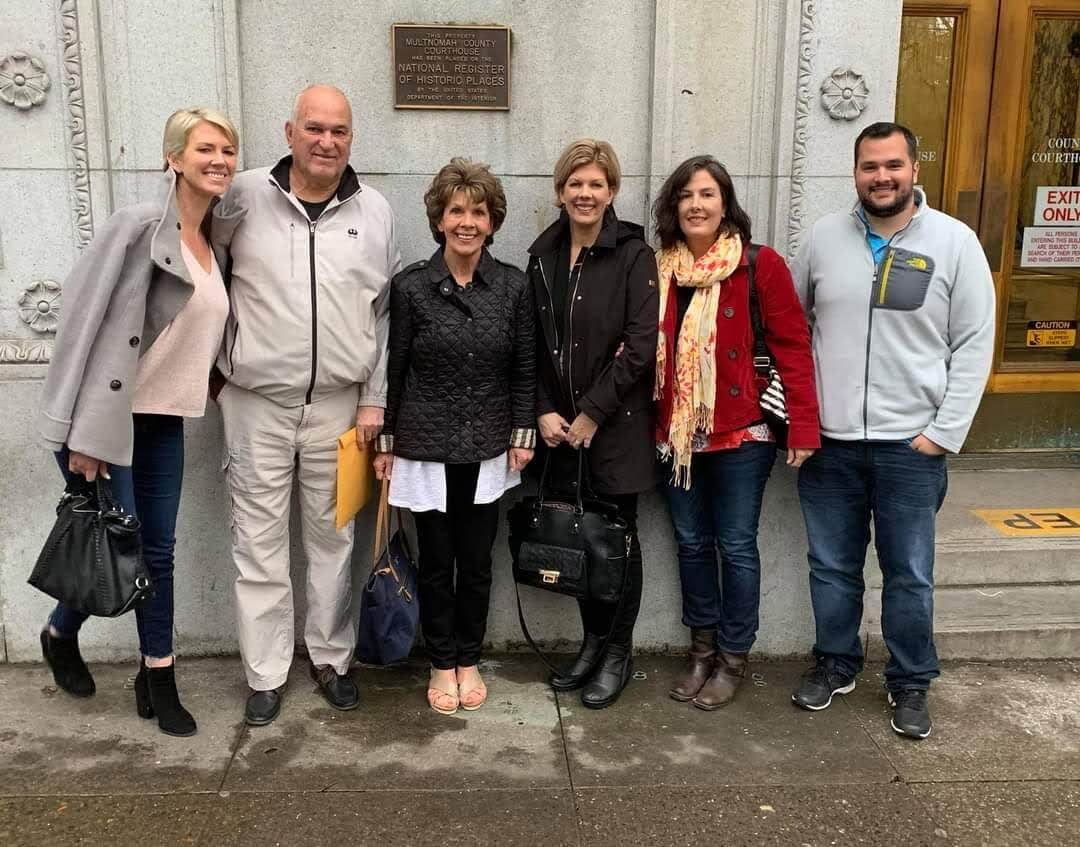
The Jones gang — daughter Niki Jones, June, Diane, Kelli Moir, Jenni Meskel and June Jones IV (courtesy Kelli Moir)
Coaching was June’s profession, but family was the core of his life. Moir and another daughter, Jenni Meskel, are hairdressers in the Portland area. Daughter Niki Jones is an event planner in San Diego. June Jones IV is a private pilot who lives in Bentonville, Ark. Together, they gave June and Diane nine grandchildren — six girls, three boys.
The children were together for June’s final days in Gresham.
“I loved my dad so much,” Kelli says through tears. “He was a football coach, so it wasn’t a normal 9-to-5 job. It was my mom and us. She went to all my basketball games in high school. Dad couldn’t always be at the beginning of games, but I’d look up and I’d see him at some point. And then he’d have to leave for a meeting, but he always made an effort. When I played tennis, the same thing. He might not have been there for the entire game, but he showed up when he could.
“My dad and I are alike in a lot of ways. Everybody says that. He was a wonderful dad. He loved all of his kids. It might not have been the traditional way, but we didn’t have a normal life. I know if there was ever something (that came up), I could count on him to come in and save us. It’s weird to think I don’t have him to bounce questions off anymore. It’s hard. I know where my dad is. He’s not suffering anymore. He acted so strong until the end.”
Kelli pauses, takes a deep breath, and continues.
“He was a football coach, and I sometimes laugh thinking about him,” she says. “He said some things to me growing up that might be horrifying to some people. I’d get hurt or something and he’d say, ‘Suck it up. You’re OK. There’s no crying.’ ”
We share a laugh. I may have done that with my kids, too.
“There was no secret side,” Kelli offers. “He was loyal to whatever he thought was the right way, and there was no changing his opinion. But there was a caring side. He would do anything for us, for a friend, for some player who needed something.”
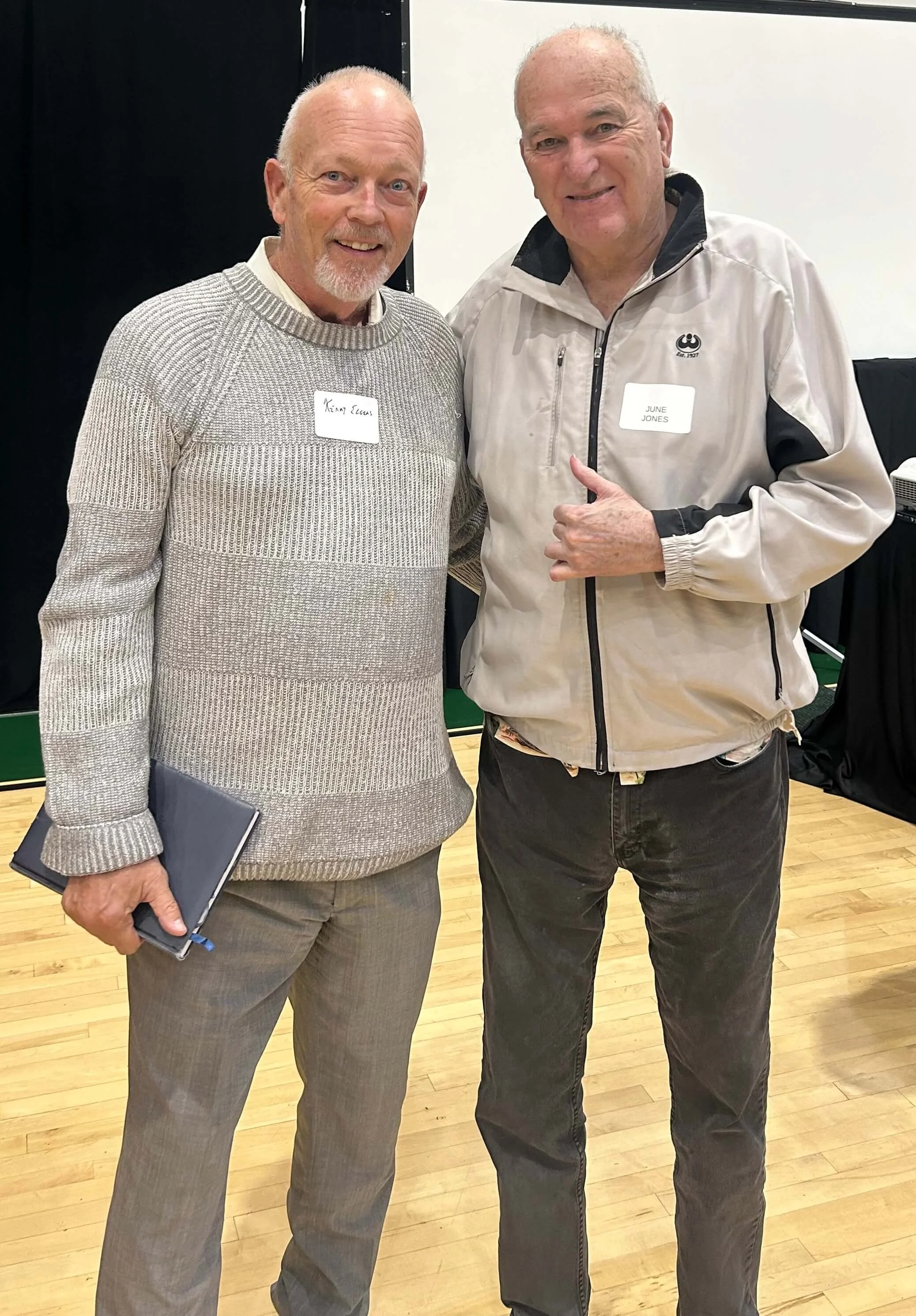
I posed with June during a Mouse Davis tribute event at Portland State last year
If there is an epitaph for June Jones, that’s part of it. He touched a lot of people, both professionally and personally. For those of us in his orbit, we can all be thankful for that.
► ◄
Readers: what are your thoughts? I would love to hear them in the comments below. On the comments entry screen, only your name is required, your email address and website are optional, and may be left blank.
Follow me on BlueSky.
Follow me on X (formerly Twitter).
Like me on Facebook.
Find me on Instagram.
