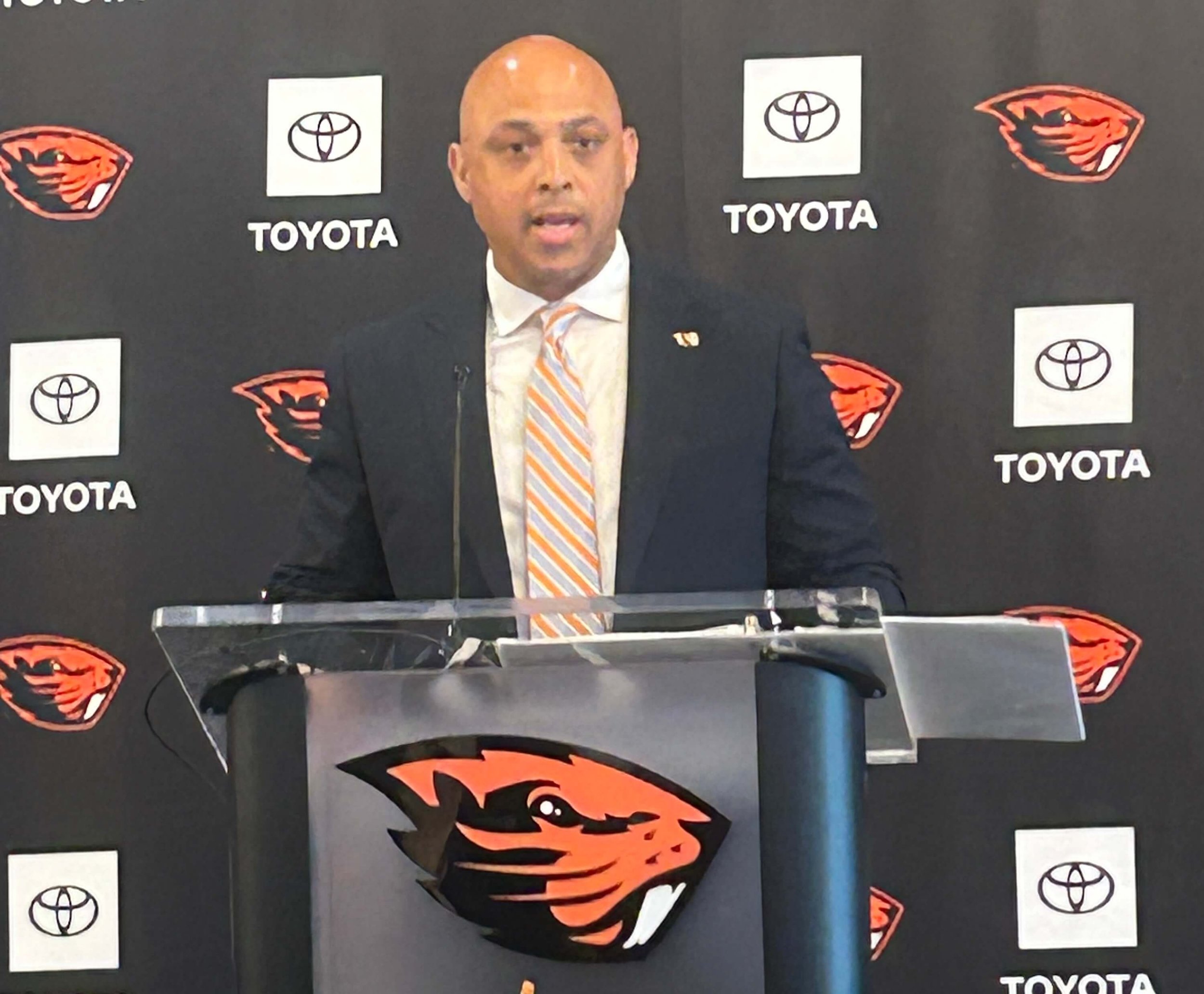
Less than four months into his position as Oregon State’s athletic director, Kevin Griffin is wheeling, dealing and sealing deals
Oregon State athletic director Kevin Griffin met with the Portland media on Tuesday at the Portland Hilton, covering a wide range of topics about much that is happening with Beaver athletics.
The following day, Griffin was good enough to engage in a 30-minute phone interview with me, hitting on some other matters on which Beaver Nation will be interested in hearing his take.
The interview took place prior to Friday’s announcement that freshman receiver and Heisman Trophy candidate Jesse Legree has signed a contract ensuring he will be back with Oregon State in 2027.
“I fell in love with the culture,” Legree told ESPN. “We’ve built a great culture, and it is only going to get bigger from here. This is going to become the start of a national powerhouse.”
A few items from Tuesday’s media availability are intertwined with my questions in this Q&A:
KE: You are closing in on four months on the job at Oregon State. How do you feel like it’s gone for you?
KG: It’s gone great. We have had really good alignment with our campus leadership, with our president (Jayathi) Murthy. Our coaches have been outstanding. Our student-athletes have been receptive to the way we talk about competing and wanting to sit atop the Pac-12. I’m really proud of everyone. Change is not easy. I expected a little bit of friction and pushback, but we haven’t had any at all. It certainly helps that our football team is playing well, that our men’s soccer team is 21st in the country, that volleyball is sitting in the top half of the conference.
KE: What are the most important things you have accomplished since you came onto the job?
KG: It has been a short period of time, but we have reorganized our executive staff. We hired Ragean Hill as our chief sports performance and operations officer. We have reassigned Jacque Bruns to our chief of staff/women’s sports administrator. They both report to me. Ragean’s job is to make sure all of our teams and coaches have what they need to win, to perform both on the field and in academics. Jacque oversees the areas of culture and finances.
KE: You are also looking to make another hire for an executive associate AD of “brand and commercial operations.” How soon will that happen?
KG: We are down to four finalists. We have to finish up interviews this week. We will have a couple of people on campus at the end of October and beginning of November, and hopefully have that person hired by November 15.
We have established what the Beaver way is from a cultural standpoint with our coaches and most of our student-athletes. Folks are beginning to understand a new and different type of pace. We have begun to build trust with campus. And that matters, so they understand what is taking place in athletics. So when there is (an) ask for financial support or some adjustments on how we are doing processes from an academic standpoint, there is clarity around how and why we are asking. More importantly, there is a partnership. It is not like athletics is on one side of the tracks and campus and academics are on the other. We are doing this together.
The other thing is, when coaches ask me to speak to recruits and their families, the message is resonating with them. You are starting to see us land four-star recruits in basketball and gymnastics and other sports because of the way we are putting our words to action. Those things do matter.
KE: One fan said he was walking on campus and you said hello and chatted for a minute as you passed. Another told me you came over to visit for a few minutes at his tailgate on football game day. Is that your idea?
KG: It is just something I do. I have done it throughout my career. I am so appreciative of our fans and community and want to say hi to as many people as possible. I am a people-first person. It is not for show. It is to say thank you, to say hello, to get to know them. And quite frankly, the chance for me to learn. There might be feedback people give you. It might be, “Hey, I didn’t like how this experience has gone.” Or, “I really enjoyed” something else. It is an opportunity to learn how things are going from the folks who really do matter, which are our fans and customers.

KE: How much of your job has been fund-raising?
KG: I don’t have a percentage. It is all day, but I wouldn’t necessarily say it is always fund-raising. That is a mindset that I want to change here. It is really (about) building our commercial business — for instance, finishing up meetings with our partners like Pepsi. How are we driving that business, for them and for us? Sponsorship conversations. Ticket sales conversations. How are we getting better at building our commercial apparatus, and in the fund-raising part? But it is not just fund-raising. It is also story-telling, because our biggest financial supporter is the university. We have to be partners with them. They need to know what is going on. It is great to have individual donors and supporters and families like the Resers, who support us so well. But the campus has to be able to support us as well. They have to believe in what we are doing. I spend a lot of time with our campus leadership, our deans, our provost, our president, our trustees and others.
KE: At your introductory press conference in June, you said one of your areas of focus would be NIL strategies and creating an NIL staff. What have you done with that so far?
KG: (Senior associate AD) Sara Elcano is leading that work force. We have our processes down for both revenue share and our NIL strategy. Revenue share is our financial commitment as a university to the student-athletes. With NIL, it is (helping arrange) endorsement deals for our student-athletes. Sara is leading those conversations and working in partnership with our multi-media-right partner as well.
KE: But you are involved as well?
KG: Of course. As an example, today I was sitting with a big brand and sharing with them the story about some of our student-athletes who we think they should be partnering with, and how that can be done. I gotta tell you, (potential sponsors) get excited when they get this opportunity, because it hasn’t been pitched to them in that way. We are doing a phenomenal job getting everyone in line so we can now move faster. When I got here, what I found was we weren’t able to move quickly. We need to be able to do that. I feel good about where we are. Sara is doing a great job. And we are just getting started.
KE: The current NCAA limit for revenue sharing per school is $20.5 million per year. What is Oregon State at?
KG: We keep that to ourselves. It’s not 20 and a half. We are not to the cap, but we are in really good shape.
KE: In really good shape to be able to keep the likes of Braden Atkinson and Jesse Legree? Because that is what everyone wants to know.
KG: Of course. Yeah, absolutely. And it’s not just them. If we want to be a really great organization going forward, you have to attract talent first, and then you have to keep them. That’s not the same for everyone. Some folks want to make sure they are taken care of one way and some want to make sure they are taken care of in a different way. The answer to your question is, absolutely, we’re working toward that. We will have some good things to share with everyone soon.
KE: Then there is the subject of JaMarcus Shephard. There is little doubt he will receive interest from Power Four schools after this season.
KG: I am fortunate to have a good relationship with all my coaches. JaMarcus is near the top of that list. We have had candid conversations. We have talked about a lot of things. I think we are in pretty good shape. JaMarcus has shared with you all that he wants to be here. If there is one thing all of you have learned about JaMarcus is, he is very honest.
KE: Another thing everyone wants to know: Have you had any conversations with Oregon State grad Jensen Huang? The CEO of Nvidia has donated generously to his alma mater, but not yet in the area of athletics.
KG: No.
KE: Would you like to?
KG: Jensen is an important person to the entire university. I will follow president Murthy’s lead. His name comes up on a daily basis. But we have to make sure that we are having conversations with the folks who make sense for Nvidia and their business. President Murthy and others on campus are having conversations with Nvidia and Jensen about the super computer. That is important to us from both an academic and state-of-Oregon standpoint, in terms of the type of work and research that we will be doing that will impact not only Oregon but this country and the whole world. We will figure out the right time to have the conversation about athletics, but that is down the road. Right now it is about the university and academics.
KE: Another prominent and wealthy alum is Wes Edens, co-owner of the Milwaukee Bucks. Have you had any conversations with Wes?
KG: No. I don’t have a relationship with him. I would suggest that the first conversation with Wes, or with Jensen, won’t be about, “Hey, give us money to support athletics.” You have to have a relationship first, and understand what their needs are, what their interests are in supporting Oregon State in a more holistic or broad way, and hope that part of that would be athletics.
KE: In May, the Wayne and Gladys Valley Foundation committed $24 million — $8 million per year for three years — if donors collectively match it. The goal would be to create $48 million total in support of Beaver athletics. How is the “Valley Challenge” going?
KG: Exceptionally well. We have had a lot of engagement with donors, folks who have given large and medium-sized financial support, and our development team has been doing a great job. Appreciate the work that everyone has been doing.
KE: How much have you raised so far?
KG: We will announce that all at one time. I’ll just say we are doing well. The goal is to get all of this done in one year.
KE: Another vehicle for revenue comes through the university-wide “Believe It” fund-raising and engagement campaign, which was launched in 2022 with the goal of raising $1.75 billion for the school. Donors can earmark where exactly they would like their money to go. Do you know how much has been raised for athletics to date?
KG: I do, but I would rather introduce that to the public in a more professional way.
KE: I won’t take that personally. There has been a serious loss of media rights revenue with the breakup of the original Pac-12. Are any sports at Oregon State in danger of elimination?
KG: We have not had that conversation, but you are right about the media rights from the old Pac-12 to the new, reimagined Pac-12. This athletic department took a 22 percent financial cut 2 1/2 years ago. We are very lean at the moment. We have had no conversations about reducing teams or any of that.
KE: Oregon State’s total athletics budget for the past fiscal year was about $100 million. What is it projected to be for the 2026-27 fiscal year?
KG: We have a board meeting coming up. I want to present that information to our board first before I reveal that to everyone else. Happy to do that at the appropriate time. We are just like most every university right now. We are not in the black.
KE: You have several athletics building projects going, including the new $25 million, 15,000-square-foot Tammy Anne Valley Field Sports Building, which will house softball, soccer, cross country and track and field. How is construction going with that?
KG: It is right on time. Looking forward to the building opening in September of 2027.
KE: You are putting together a feasibility study regarding Gill Coliseum.
KG: We have walked the building. The work is in action. Once we get the feasibility study done, we will be able to present that to president Murthy and others who will be part of the decision-making. It is absolutely on our list of things to review. It is a 77-year-old building. We don’t have any premium suites. It has run its course for what we need to do in terms of a modern-day athletic venue. We are doing a master plan for all of our facilities, with Gill near the top of the list.
KE: So would that mean a major renovation of Gill, or is it possible you will build a new arena?
KG: We are going to study the whole thing and come up with as many possibilities as we can and ultimately make a decision for this campus. We need to be informed by the financials and the facts on what we can and can’t do with the current building. Look, it is a great building. When I walked in this morning, our volleyball team was practicing. When I left for one of our board meetings and I came back a few hours later, our basketball team was set up for practice.
It is such a good building for certain things. But when it comes to the overall fan experience, it is limiting. As an example, our concession stands are (inadequate). We can’t sell anything from a merchandise standpoint. The bathrooms are a real throwback. They are uncomfortable, quite frankly. It really does need an overhaul. There is a lot of nostalgia in the building, but anyone who is in and out of there a lot will tell you there is a lot of room to improve.
KE: There seems to be plenty of interest in the upcoming men’s and women’s basketball seasons, with Justin Joyner taking over the head coaching role with the men and Scott Rueck beginning his 17th campaign with the women.
KG: What I have observed after watching multiple practices, Scott and Justin are incredible teachers. Every practice I have been to, I have never heard Scott raise his voice. He communicates, and the language he uses and the way he connects with our student-athletes is absolutely phenomenal. One of the best teachers I have ever seen. If you go to a men’s basketball practice, the intensity is through the roof. I couldn’t believe it. It was almost like game day intensity at every single practice. The details around that — the way (Joyner) talks about techniques and the things he does to implement not only plays but efficiency. I have been really impressed with that. Most importantly, not only are they both teachers, they have a great relationship with (their players).
KE: After you were hired, you proclaimed your goal was to sit at the top of the Pac-12 mountain in everything you do. It remains to be seen how that will play out, but at this point in the season, that is exactly where your football team sits. Does it surprise you to see that happen so quickly?
KG: When you have good character and good people, you can get a lot done, particularly when you have a lot of belief. The football team is a little bit ahead of schedule, but trending toward exactly where we want to be. The rest of the teams are coming along well. Our goal is to win the Pac-12 in all 16 of our sports. I think at some point in time, we can do that. Most importantly, we have to be known as the dominant and preeminent school in the Pac-12 based on our collective work. I am confident we will get there knowing the people I get a chance to work with every day. I have incredible colleagues. I have never worked with a more dedicated group of people.
KE: The College Football Playoffs grant automatic bids to the champions of the Big Four conferences, the highest-ranked team in the Group of Six and Notre Dame if it is ranked among the nation’s top 12. If Oregon State is not highest-ranked among the Group of Six, you would have to be ranked among the top 12 teams in the CFP rankings to qualify this year, correct?
KG: Correct. Our path forward is winning the Pac-12. If we do that, then we have to be the highest ranked Group of Six school, which most likely means being higher-ranked than James Madison.
KE: When you met with the media on Tuesday, you said, “Where it gets interesting is when we think about the economics of conferences, and distribution of CFP dollars, and how they are reinvested into your program.” What did you mean by that?
KG: In 2027, there will be 24 teams that quality for the CFP. From a conference standpoint, we will still only get one (automatic) spot out of 24, though the field will have doubled. That assumes that the Group of Six is left out of the rankings. So there is more money created to go to the Power Four conferences as opposed to distributing dollars to everyone playing in the FBS. That becomes a challenge. You put more money into the pockets of the Power Four. Everyone in the Group of Six is scratching, clawing and fighting for our lives here. There should be a different way to reimagine and distribute some of the dollars that could support the Group of Six teams.
KE: How do you mitigate that?
KG: A lot of it is good relationships with the commissioners, with other athletic directors, with presidents who play an important role. But really, we have to keep putting a good product on the field and earn the respect. When you have a season like we are having, more people are willing to answer your calls and take you more seriously. You have to operate as a serious organization, which oftentimes means showing up professionally and winning games. That gives you the credibility to set the standard for them to listen to your ideas. If you are not taking care of home, you usually don’t get listened to.
KE: Let’s clarify the bowl game situation. Beyond CFP qualification, the legacy Pac-12 schools — the 10 that left, plus Oregon State and Washington State — are eligible for consideration for participation in the Alamo Bowl, Holiday Bowl, Vegas Bowl, Sun Bowl and Poinsettia Bowl. With the Poinsettia, it will match a former Pac-12 school against a new one, and OSU and Wazzu will be considered new ones. For all the bowls, the Beavers and Cougars get no priority of consideration from the departed schools. Is that correct?
KG: Correct. We just get to be considered for the legacy bowls that were part of the old Pac-12.
KE: I am curious your take on the “Protect College Sports Act,” which passed the Senate and is awaiting a vote in the House of Representatives. As approved by the Senate, it allows one penalty-free transfer for each athlete, caps agents fees at five percent, limits conference to 20 schools and raises athlete eligibility from four to five years.
KG: Here is the good stuff about the act, should it pass. We are fine with the five years of eligibility. That protects us through a number of lawsuits around eligibility that we have had. That has been an issue since Covid. The amount of billable hours of litigation is really quite ridiculous, frankly.
The most important part of the act is helping protect us through some of the antitrust issues. Conferences can’t really work together developing rules that would make sense because of antitrust laws. That would be collusion. This would allow us to work together as an industry in a way that we haven’t had the opportunity in the past. It would also limit the amount of lawsuits that have been coming our way around eligibility.
The other thing, the antitrust provision allows to not have different rules from different states. As an example, last week the Ohio governor (Mike DeWine) signed an executive order that gave athletes a fifth year (of competition) in the state of Ohio (from the high school class of ’22, defying NCAA eligibility rules). It doesn’t make sense to have that in Ohio and nowhere else. Right now, because of antitrust, we can’t manage this whole industry state by state. We need to support them from a national standpoint.
KE: One thing that shocked me was the raise in the cap for revenue sharing, from $20.5 million to $49 million, with $5 million designated for Olympic and women’s sports, in 2027.
KG: That quite frankly to me is …
KE: Ridiculous.
KG: Exactly right. To your point earlier, if you think about media rights in the Big Ten, if you are getting a $100 million check for your media rights, and it is going to be more for some of the bigger brands in that conference, then you can make the argument, “We can pay $49 million.” That makes it really difficult for folks like us.
KE: In your media session Thursday, you said this: “There has to be a new standard for Oregon State athletics. That is not just a commitment for a year or two. How do we win at a consistent clip for 25, 30 years? What’s the new standard for Oregon State athletics? How do we stay at the top of what we’re trying to do? All of that comes down to people. It’s always about people. Whether coaches or student-athletes or administrators — the folks who keep this thing going. The conversation we are having is one we are very serious about. We’re having those conversations. I hope we will have something we can share with everybody soon.” Can you expound?
KG: I would challenge all of us to think about, what does a commitment look like long range? You think about schools like Boise State, which has been consistent for decades. There are other programs that have been consistent. We are trying to establish a foundation so that we can win all the time, for the next 25, 30 years. I am hoping we can have conversations soon about retention of staff and student-athletes, so there is less uncertainty in the market as we go about fortifying our roster and our coaches. Every day I am asked those questions. I can’t wait to give everybody an answer.
► ◄
Readers: what are your thoughts? I would love to hear them in the comments below. On the comments entry screen, only your name is required, your email address and website are optional, and may be left blank.
Follow me on BlueSky.
Follow me on X (formerly Twitter).
Like me on Facebook.
Find me on Instagram.
