From the Court of Common Sense, some reasonable boundaries for D-1 athletics

Former Oregon athletic director Bill Moos finds the current situation in Division-1 college athletics “appalling” (courtesy Bill Moos)
Updated 3/9/2026 6:50 PM
(To make it easy for you to buy Bill Moos’ book if you are interested, I made the image linked to buying the book right on bookshop.org. I do get a commission if you use the links in this post.)
It’s not just you and me — Scram Scribe and Joe Fan — who are turned off about what has happened to college athletics the past few years.
Transfer portal? NIL? Revenue-sharing? And on a regional level, the break-up of the old Pac-12?
Many coaches and administrators are as disgusted about the state of major college sports in the country -- and in the Northwest — as we are.
Bill Moos spent 40 years in sports administration and 28 years as a Division 1 athletic director, including stints at Oregon (1995-2007), Washington State (2010-17) and Nebraska (2017-21). Moos is 75 and retired now, building a home next to his family’s Angus cattle ranch outside of Spokane. He recently released a 600-page autobiography titled “Crab Creek Chronicles,” the story of his life from the wheat fields of eastern Washington to the playing fields of college athletics across the Western U.S.
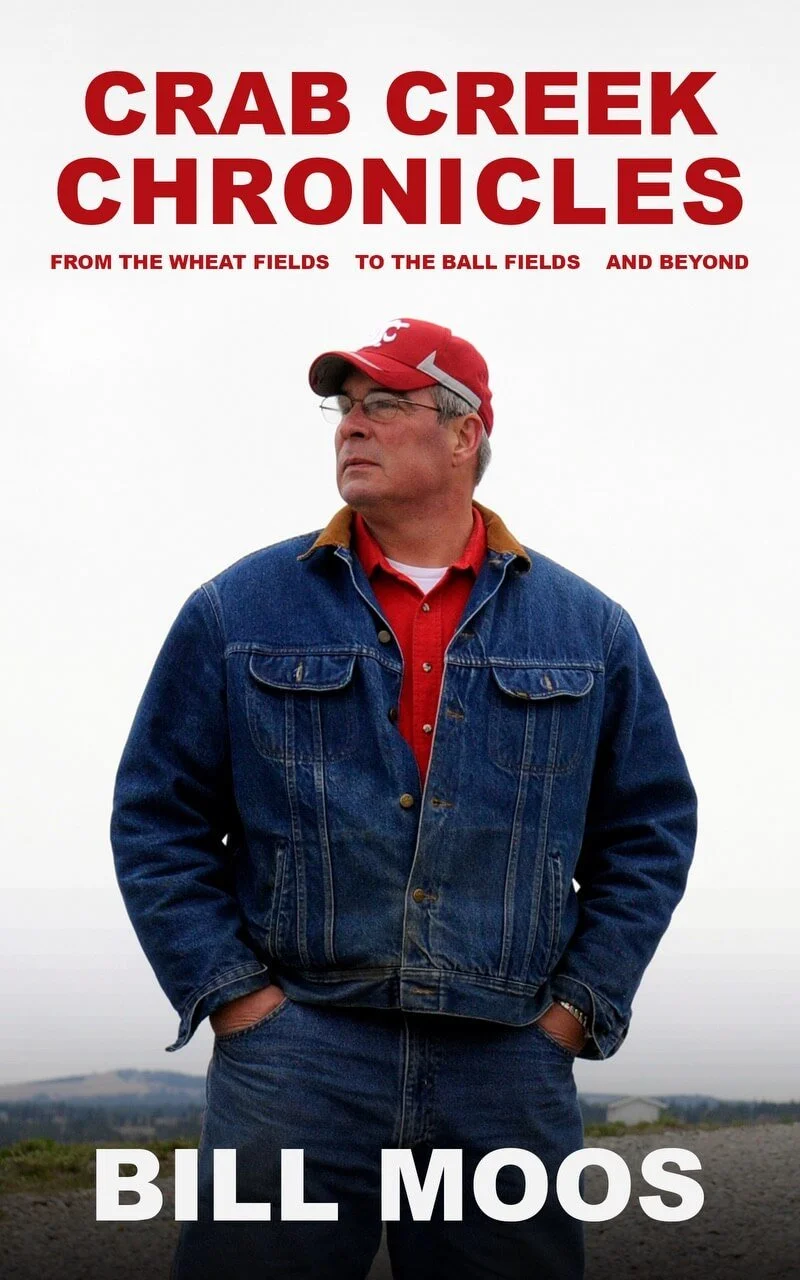
The cover of Bill Moos’ new autobiography, “Crab Creek Chronicles”
The former first-team All-Pac-8 offensive tackle and co-captain on Washington State’s 1972 team — Moos played for Dee Andros in the East-West Shrine Game — took my recent phone call and was more than willing to express his opinions about the state of D-1 athletics today.
“I am appalled with it,” Moos told me. “I always embraced two qualities from the time I was a college athlete all the way through my career in the industry: The opportunity to get an education and a college degree, and the camaraderie you had with your teammates. That may still have some merit, but it is far down the list in today’s world.”
No longer are the terms “student-athlete” and “amateur” appropriate.
“There is a place for athletes to get paid in college sports,” Moos believes, and I do, too — to a point. The chance to make reasonable amounts of money from such things as the player likeness on jersey sales, game tickets or programs is welcome. Pay for endorsement activities, autograph parties and the likes to augment compensation delivered through already existing scholarships, monthly stipends, training table and health benefits makes sense. To hand a football quarterback $5 million or a basketball star $3 million in NIL funds for doing nothing other than playing a sport does not.
Moos brings up the disparity between NIL and rev-share disbursements.
“Beware of a divided locker room,” he says. “It will eventually show on the scoreboard. When some individuals are being paid and getting endorsements and some aren’t, it is not a healthy environment.
“In the old days, when you sat in the locker room, the guy next to you had the same scholarship you had, and walk-ons had a chance to get one. You were brothers, together for four or five years. When you put your hand down on third-and-three, you were fighting for the guy next to you and for your university. I am not sure that is there anymore.”
Moos grew up in rural eastern Washington during the early years of the Pac-8. He was a college administrator during the time of the Pac-10 and Pac-12. He feels the pain of the conference’s demise.
“The sad thing about it, the two true college towns — Corvallis and Pullman — were left in the dust,” Moos says. “When the NIL first arrived, I said to my peers, ‘Here is this Washington State kid who is blossoming. He has a $10,000 deal with Cougar Country Drive-in. And then UCLA sweeps in and offers three-quarters of a million with John Jensen Chevrolet in Pasadena. What’s he gonna do?’
“The NIL got approved just as I was wrapping up my career at Nebraska in 2021. I looked myself in the mirror and said, ‘This isn’t me. I am not going to do this.’ I look at the new-wave ADs, and it is about a whole different strategy and mindset than it was just a few years ago.”
When I speak to people about the travesty of what has happened to D-1 athletics, there is a common refrain. Everyone blames the NCAA. NCAA employees answer to their president, Charlie Baker, but Baker ultimately answers to the NCAA Board of Governors, composed of university presidents, chancellors and athletics directors. I point the blame at them.
“It is about greed,” Moos says. “I have been in the Big Ten (with Nebraska). That was a nice (conference distribution) paycheck — like $53 or $54 million a year. But then it became about getting the footprint large. Gotta get to the East Coast, and then coming out West … it is about greed and prestige. It is going to keep (hauling) the have-nots down the ladder and resisting those who want to climb it from getting in there. It is going to be a handful of big-time large brands, huge-budget universities that are going to be running the show.”
Indeed, a super football conference featuring the nation’s top 30 or 40 programs seems inevitable. It may not happen for a few years, but it is where everything is leading. Even so, it makes sense to have a few rules to follow.
I wrote a story recently with Oregon State athletic director Scott Barnes. He was a member of the enforcement sub-committee of the House vs. NCAA Implementation Committee, which oversaw the installation of revenue-sharing in D-1 athletics. Barnes indicated that penalties for violations of admittedly loose guidelines are coming, and that those rules will create some badly needed guard rails. So far, there is little evidence of that happening.

The Dean of Portland Sports is now on BlueSky.
“It is a loose cannon,” Moos says. “(Schools) can do what you want. It is, ‘Dip your hand in the cookie jar, get your hand slapped, and eat the cookie, anyway.’ ”
Conference championships and bowl appearances used to be the main goal for football programs.
“The big thing now is get in the (College Football Playoffs),” Moos says. “You don’t have to win the conference; just get in the CFP. That is where you are going to get your attention; that is where you are going to get your money; that is where you are going to get your players.”
Our university poo-bahs seem incapable of putting together a system that regulates rev-share and the transfer portal. Will it take an act of Congress?
“There has to be a national body take over, and it is probably Congress,” Moos says, adding he is not sure how that might transpire.
We talk for a few more minutes, and he sighs.
“Any time you can get back some goodness to the game, it is a positive,” Moos says. “Because there is very little goodness to the game anymore.”
Then he laughs.
“If they are not drunk right now (in heaven),” Moos says, “Jim Sweeney and Dee Andros are rolling over in their graves.”
Following are some bullet points of what I think should be enacted to help preserve some sanity and order to the D-1 experience. Some of them wouldn’t — and haven’t — survived a court challenge. In this case, we are operating in the Court of Common Sense.
• The cap for revenue-sharing per program is currently at $20.5 million. Let’s keep that bar for Power Four teams and establish a max of half of that — $10.25 million — for Group of Six programs. There is currently no cap for NIL funding. Let’s create one at $20 million for Power Four, giving each big-time school a total of more than $40 million to distribute to its athletes. No need for one for Group of Six; most of those schools can’t even reach the rev-share max.
• A cap for individual athletes in both rev-share and NIL. Moos proposes for football to cap each position. OK — a quarterback can make $3 million per year, running back $2 million and down the line.
• Every single scholarship athletes gets a piece of the rev-share pie. No, they won’t all be the same amount. But if there are 105 players on scholarship, they all get something.
• Some players are now signing rev-share contracts, a protection for both the athlete and the school. Make it mandatory, and each contract must be for at least two years. No transferring allowed unless the program’s coach leaves.
One former college administrator suggests to me a return to former penalties — sit out a year for a transfer, two years for an in-conference transfer. The courts would never allow it, of course.
But athletes can transfer only once during a college career and must complete their eligibility within a five-year period, unless there is a medical exemption.
And junior-college seasons count. Why not? The recent change to negate that is nonsensical. College is college. For now, it’s “grow bigger, get better and then go play four more years of college ball.” Not on my watch.
• If there is a family or personal issue, an appeal process is available through the NCAA.
• The change from two windows of the football transfer portal to one this year — Jan. 2-16 — was good. Oregon coach Dan Lanning proposes to get the season over by Jan 1, which makes too darn much sense, right? Administrators have already set the next CFP championship game for Jan. 25 (sigh).
So let’s set the portal window from May 15 to June 15. That will avoid the mayhem of coaches switching schools late in the regular season and coaches and players skipping bowl games. Players can go through spring ball and make a change at the end of the school year, which actually helps things along academically — remember when that used to matter? Coaches may have to recalibrate their rosters, but everyone will be doing it at the same time, which is still two to three months before August training camp begins.
• Switch the football redshirt limit back to four games from the nine games FBS coaches unanimously voted for at their January convention. I understand the argument that some players were leaving programs at midseason to protect their eligibility and potential NIL payouts. But nine games (plus any postseason contests, which are allowed) is simply not a redshirt year — it is a full season. No way someone should play that many games and restore a year of eligibility.
• Establish a certification process by which agents representing players must adhere. Since the advent of NIL, many without certification and trying to make a buck off athletes have stepped in and created havoc in the lives of coaches. Their advice is always to transfer, because they can make coin from it. Agents cannot reach out to players until a season ends. Some unscrupulous con guys will still work behind the scenes, but if there is a policy and a penalty established, it is worth regulating.
Also, some of the “agents” are commanding as much as 35 percent of a player’s bounty. The percentage is to be capped at five percent, in the range at what an NFL or NBA agent would top out.
In a recent podcast, host Clay Travis lamented what we are losing in this day and age of big-time college sports.
“The value is about the relationships you build with the school, inside the athletic department, the boosters you meet, people who can one day give you a job and a career when your athletic dreams are over,” Travis said. “If they transfer, they have no alumni network. If you are there for one year, you are not even developing much of a relationship with teammates. If you stay at one school, the people you go through challenging experiences with become friends the rest of your life.”
I was in Corvallis last month for a 10-year reunion weekend of Oregon State’s Women’s Final Four team of 2016. Most of the players from that beloved team returned for three days of celebration, enjoying a return to campus and reliving fond memories. That group grabbed the hearts of Beaver fans who supported them through their college careers. They received a long standing ovation when they were introduced at halftime of a game.
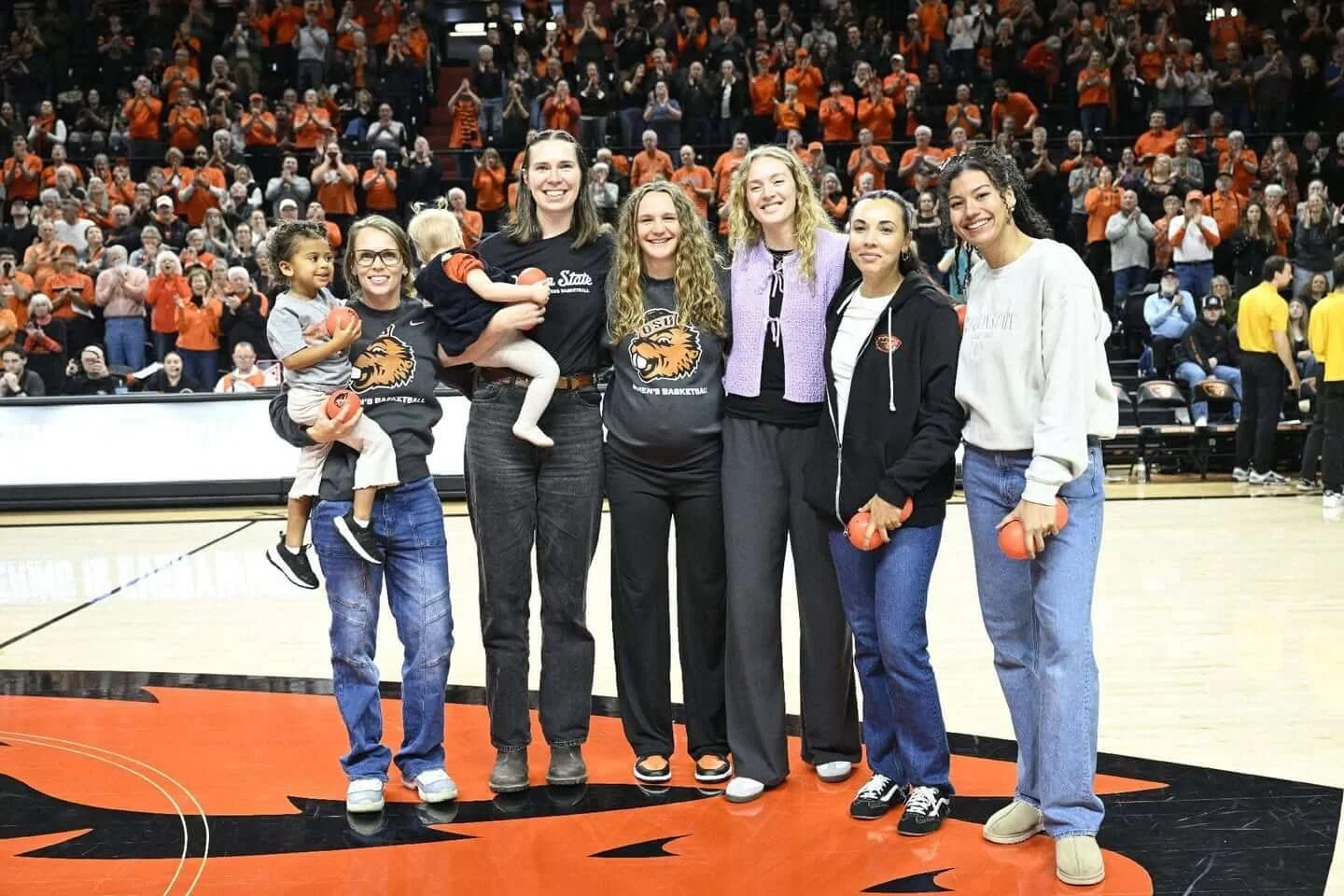
Oregon State recently celebrated the return of several members of the 2016 Women’s Final Four team on the event’s 10-year anniversary. The ’24 Elite Eight team may not get the same treatment (courtesy Nick McWilliams)
Scott Rueck’s 2023-24 OSU team reached the Elite Eight with nary a senior. It was a talented group that would have been in position for a strong run at the Final Four the following season. But with the breakup of the old Pac-12, and for the chance to earn more NIL money, the top six scorers transferred out. In 2034, do you suppose the school will hold a 10-year reunion for that team? I would think not. And if so, if I were a Beaver fan, I would not support it.
A recent conversation with a former Pac-12 administrator — who asked to be unidentified — sums up the current D-1 college athletics situation like this:
“It has not even slowly degraded the experience for fans, alumni and donors. It has been fast. We are losing what everybody loved forever about college sports. It was about life lessons. What lessons are we teaching these kids? When they are done playing their sports, something gets hard and you don’t get what you want, so you just pull up and go to the next stop? That isn’t how it works, or should work, in life.”
I couldn’t have said it better.
► ◄
Readers: what are your thoughts? I would love to hear them in the comments below. On the comments entry screen, only your name is required, your email address and website are optional, and may be left blank.
Follow me on X (formerly Twitter).
Like me on Facebook.
Find me on Instagram.
