For Joey Crawford, a Hall of Fame nod is ‘strange, but it’s cool strange’
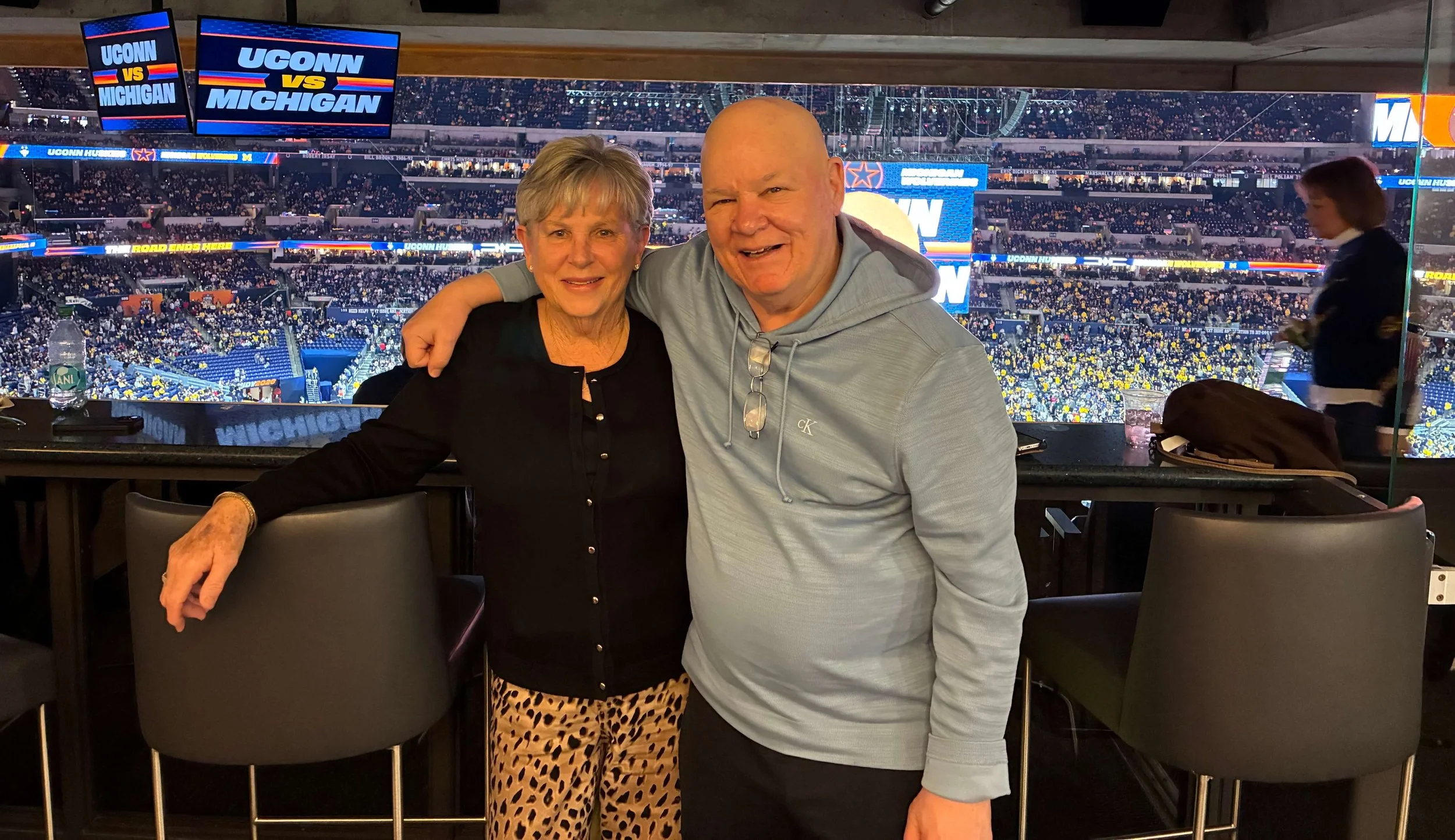
Joey Crawford, shown here with wife Mary at the NCAA Championship game in Indianapolis in April, will be inducted into the Naismith Basketball Hall of Fame in August (courtesy Joey Crawford)
It has been nearly two months since John Doleva, president and CEO of the Naismith Basketball Hall of Fame, made the phone call to deliver the news that brought Joey Crawford to tears — happy tears.
“Congratulations, Joey. Welcome to the class of 2026.”
In a phone conversation this week from his home in Newtown Square, Pa., Crawford’s emotions about the honor come across as palpable.
“Even today, I am still blown away but it all,” Crawford tells a reporter he has known for more than 35 years. “It’s strange, but it’s cool strange.”
Coincidentally, an independent group was doing a documentary on the life of the long-time NBA referee. Joey knew he was going to receive a call from the Hall of Fame, but only to tell him that he made it, or that he didn’t. The film crew was there to record the phone conversation. Also on hand was Mary Crawford, Joey’s wife of 55 years, and his older brother Jerry Crawford, a Major League umpire from 1977-2011.
“Jerry was there because he was interviewed for the documentary,” Joey says. “(Hall of Fame officials) said I would be getting a call between 12 and 2. So the phone rings, and it’s John. And after he said it, I just lost it. I don’t know what he said after that. I started crying like a freaking blubbering idiot.
“It means something to me. I didn’t think it would mean as much as it did until he said those words.”
Crawford has been besieged by well-wishes since news of his impending induction was released.
“I went to the gym this morning and as soon as I walked in, somebody said, ‘There’s the Hall of Famer,’ ” Crawford says. “It’s amazing … last night, I am watching the pre-game show for the playoff game, and they introduce the broadcasters as ‘Hall of Famers.’ I never noticed that until I actually got in.
“I don’t know what that means, or the significance of it, but you don’t even think of it. Then when it happens, you go, ‘Oh my God!’ It’s a strange feeling, it really is.”
Crawford, 74, will be only the ninth NBA referee to enter the Hall. Five of the nine are contemporaries: Earl Strom, Darell Garretson, Dick Bavetta, Hugh Evans and Danny Crawford. Danny and Rod Thorn, the latter a long-time NBA executive, will serve as presenters for Joey at the induction ceremony on August 15 at Springfield, Mass.
“Rod was my boss for 15 years,” Joey says. “A lot of funny stuff happened behind the scenes. I’ll tell the stories about Rod in my (induction) speech. He was great to work with. Rod called me one time and said, ‘Hey Joe, everybody thinks you’re this great referee. All you do is call technical fouls.’ And he hung up. It was awesome.”
Over the past weekend, veteran NBA referee Jack Madden died. He was 90. Crawford called Madden’s son with condolences.
“He told me that Jack had heard the news about me and was very happy for me,” Joey says. “That made me feel good. I told him I thought Jack should have been in, too.”
Crawford worked for 39 years as an NBA referee, from 1977-2016, equalling Bavetta’s record for longest tenure in the profession. Joey officiated 2,561 regular-season games — behind only Bavetta on the all-time list — a record 374 playoff games and a record 50 NBA Finals games. Knee issues ended Crawford’s officiating career at age 64.
“I was trying to get 40 (years),” Joey says. “I could have hung on, but I knew I was dead in the water. It just wouldn’t go. I wound up getting both knees replaced.”
Since 2016, Crawford has served as the NBA’s director of referee operations, working under Monty McCutchen, senior VP/referee development and training with the league. Among Joey’s duties are reviewing game footage to help referees improve decision-making and mechanics. He works with officials from the NBA, the G-League and the WNBA.

Joey and Monty McCutchen, now the NBA’s senior vp/referee management and development, in their younger days as fellow referees
“It has been really good,” Crawford says. “I have enjoyed it. To work for Monty is fabulous. It’s a job — don’t get me wrong — but it keeps you fresh when you are talking refereeing all the time. It is like nonstop. You watch games, and in the summertime you’re in Vegas (for NBA Summer League). I have been all over the world teaching refereeing through our ‘Basketball Without Borders’ program. It has been phenomenal.”
Crawford hasn’t just been teaching refereeing around the globe. He has been doing it in his own backyard, too.
“There isn’t a more deserving official (to make the Hall of Fame) than Joe Crawford,” says Steve Javie, an NBA referee from 1986-2011 and now an officiating and rules analyst for ABC and ESPN. “I say it not because he was my main mentor when I got into the league and is still a dear friend. But I don’t think I have come across an official who has helped so many other officials when he was working, and continues to do it to this day.
“And not just with NBA officials. There are guys in his neighborhood and the area, high school or college referees, who knock on his door and have a video and say like, ‘Would you mind watching this with me?’ He welcomes them. ‘Come on in.’ Joey is a referee junkie, there is no doubt about it. He cares so much about the craft and the profession.”
“Joey watches (video) with anyone who wants to watch it with him,” confirms McCutchen, who worked 24 years as an NBA referee before assuming his current position in 2017. “If you put the time in, Joey will show up to mentor you. That is a beautiful thing, and I don’t use the word ‘beautiful’ lightly.”
► ◄
Crawford was born in Philadelphia but grew up in Havertown, a suburb about 25 miles north of Philly. His father, Henry “Shag” Crawford, was a National League umpire for 20 years. That played a part in his sons’ interest in the profession. Joey umpired for a short time, but baseball wasn’t his calling.
“Basketball was my bag,” he says. “The neighborhood (in which) I grew up was basketball, basketball, basketball. I did both (baseball and basketball) for one year or so. Then I said to myself, ‘I like basketball. I’m not going to get any better if I keep doing both. Screw it. I’m going to concentrate just on basketball.’ ”
Joey didn’t play hoops, however, at Cardinal O’Hara High.
“I didn’t play any sports in high school,” he says. “I wasn’t good enough. There were thousands of kids in my school, and I couldn’t make a team.”
Crawford’s first game as a referee came at age 18, working a CYO game. He briefly enrolled at a junior college in Santa Fe, N.M., but lasted only one semester, deciding that his career was going to be in officiating.
(An aside: While working full-time in officiating, Joey wound up getting a degree online from Newman University in Aston, Pa., at age 58 in 2009. “I didn’t do anything in high school,” he says. “I was portrayed as a dummy. Over the years, I thought, ‘I want to do that (earn a degree).’ It was hard, but the people there showed me something. They worked with me, helped me get the degree. It took me 3 1/2 years to finish. I studied in the hotels and on the airplanes. It was work, but it was one of the greatest things I have ever done. I am very proud of it.” Last year, Newman honored Joey at halftime of a basketball game. Joey and Mary have subsequently donated funds for an annual scholarship to the school’s basketball program.)
At 18, Joey dived headfirst into life as a referee.
“I worked everywhere, all around Philly,” he says. “I went from gym to gym to gym. It was constant.”
Joey began also calling games in the Baker League, a Philadelphia summer league in which many top-level players on the East Coast participated to stay in shape. Soon he was hired by the Eastern League, a forerunner of the Continental Basketball Association.
“There was zero question that Joey was NBA material,” says Steve Kauffman, the Eastern League commissioner at the time. “He was really young, but you could just tell.”
Kauffman, who would go on to become an NBA player agent, recalls an Eastern League game played in a high school gym in Allentown, Pa.

“There was one bathroom in the whole place,” says Kauffman, now retired and living in Malibu, Calif.
“At halftime, Joey, the other ref and I wound up in there at the same time. And then some fans come in, and they see (the referees), and they are yelling and screaming at them. It was insane. Joey just shrugs and says, ‘That’s what we deal with. You gotta go with the flow.’ ”
(I laugh at “go with the flow.” What a great ad lib. “He has a quick wit,” Kauffman says.)
In 1977, a representative from the office of NBA commissioner Larry O’Brien called Kauffman.
“They were looking for NBA officials, and asked me to recommend three of our guys,” says Kauffman, who offered three names: the 26-year-old Crawford, Bavetta and Jack Nies. The latter wound up working 31 years in the NBA.
“They were all very good,” Kauffman says. “Nothing against the other two, but Joey was far and away our best referee. He was confident. He was a little authoritative, but we needed that. Everybody respected Joey. His good traits far outweighed the bad ones.”
Kauffman’s reference to “authoritative” is reflective of Crawford’s officiating style throughout his career.
“Joey came up in the era of big-name lead officials like Strom, Evans, Madden and Jake O’Donnell,” says Bill Spooner, an NBA referee from 1989-2021. “Those guys were bigger than life. Joey was able to work under them and learn from them. He was a hard-ass referee, but back in the two-man days, it was either kill or be killed.”
Spooner, incidentally, worked with Strom, Evans, Bavetta, Garretson and both Crawfords (no relation) during his long career.
“I am the common denominator,” Spooner says with a laugh. “I obviously got them to the Hall of Fame.”
Records aren’t kept, but it is believed that Crawford called more technical fouls than any other referee in NBA history. His most famous ejection came in April 2007, when he twice called technicals on San Antonio’s Tim Duncan. Duncan had been on the bench laughing sarcastically at what he thought were incorrect calls, but not saying anything. He claimed Joey challenged him to a fight during the game.
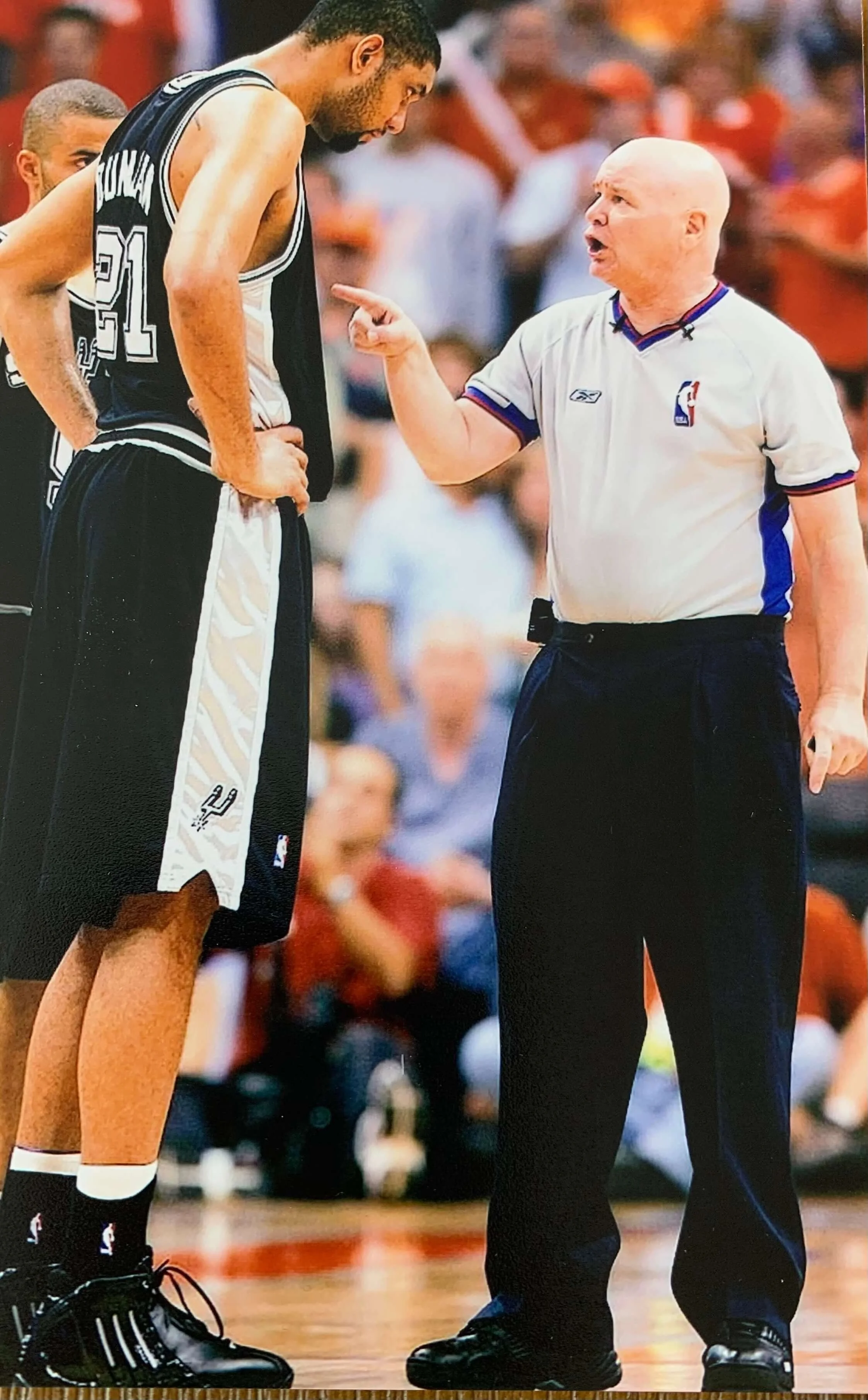
Crawford was suspended for the final week of the regular season and all of the playoffs that year. It was the only time he didn’t call a Finals game from 1986-2015.
“I completely overreacted that day, and it cost me,” Crawford says. “It wasn’t his fault; it was my fault. I shouldn’t have tossed him for just laughing.”
Crawford’s reputation suffered because of the incident. Does that bother him?
“When I look back on it, it does,” he says. “That’s all anybody ever remembers. People are always saying, ‘He’s the ref who threw Duncan out.’ I say to myself, ‘Not all I did was call technical fouls.’ But it’s good and bad. Dick Bavetta was the complete opposite of me. Complete opposite. What works for one may not work for another.”
While under suspension, Crawford sought counseling with a sports psychologist named Joe Fisher.
“The last 10 years of my career were better than my first 29 all because I was able to deal with things better on the court,” Joey says. “That was because of Joe Fisher.
“Joe was a godsend. I still talk to him. He is an awesome human being. He helped me. He explained, ‘Joe, they are not hollering at you; they are just hollering at the shirt.’ In reality, that is exactly what it was.”
In a sense, Joey was following the example of his father.
“He was a very aggressive umpire,” Joey says. “That played into it. Don’t get me wrong. Those last 10 years in the league, I was still an aggressive (referee), but not to the degree I was in my first 29. Today, NBA referees can go to a sports psychologist. They can see someone. Back in the day, we didn’t have that.”
It wasn’t the only time Crawford got himself into hot water.
“Joey had a little temper,” says Thorn, now retired and living in Naples, Fla. “From time to time, we had a tough conversation or two. I would tell him, ‘Joe, you are such a good official, you don’t need to call all these techs.’ As he went along and got further in his career, that part became a sidelight rather than a highlight.”
► ◄
Javie is quick to defend Crawford, saying he policed a game better than anyone during an era where keeping the players in line was a priority.
“Nowadays, officiating is so different,” says Javie, who lives in Newtown, Pa. “That goes from the top down. (Commissioner) David Stern wanted the league run a certain way. They have other people in positions now who want it run their way. They are the boss.
“Joey knew the rules well and how to apply them. He had common sense when it came to officiating. One thing Joey would always say: ‘I would rather leave the arena being 85 percent right on my calls and both teams knowing they got a fair shake instead of being 95 percent correct and people just want to kill you.’ It is the old common sense of controlling a game, and that is the old style of refereeing.”
Today’s referees must deal with the “two-minute report,” a release from the league that makes public a play-by-play post-game assessment of calls made in the final two minutes of close games.
“Wait a minute,” Javie says. “Officiating is a lot more than just putting a quarter in a machine and saying they got the play right or wrong. This is where Joey’s referee sense and knowledge of how to do it properly comes into play. That is a part of the game that I miss, the mental part of the game. You are supposed to get calls right as an NBA referee. It’s the other stuff — knowing the players, the matchups, controlling the benches — that comes into it. That is the part of the officiating that Joey taught me.”
Crawford was a veteran of nearly a decade of NBA wars when Javie came in as a rookie.
“He was one of the best partners for the young guys,” Javie says. “He would always try to take the attention off of you. If I messed up a call, he would divert the attention (from coaches and players) onto him, because he could handle it. Joey did it for me, and I tried to pass that along to guys I worked with as I got to be more of a veteran in my career. You want to make them feel secure, that they know the crew chief is going to be there for them the whole game and not desert them.”
“Joey was extremely loyal to the officials he was working with,” Thorn says. “Some officials would take aside a coach (complaining about calls) and say something like, ‘I don’t know what’s wrong with my partner tonight. He is having a bad day.’ If the coach would (cast aspersions) about other officials, Joey wouldn’t allow it. It would be like, ‘Don’t be talking about Jess Kersey,’ or whoever he was working with that night.”
Crawford took his cue from those who were veteran officials when he was young, referees such as Strom, O’Donnell, Joe Gushue, Lee Jones and Eddie Rush.
“I was always taught the lead official, or the crew chief in a three-man crew, should be the disciplinarian,” Joey says. “If he is, the other two can just go referee. My first five years in the league, those guys would go over to a coach and say, ‘Listen, stay off that kid’s ass. You holler at me. Don’t holler at him.’ They were worried about you losing your concentration. I learned an awful lot from those guys. I probably took it to a different level.”
There was a bit of an intimidation factor to Crawford.
“He had the coaches’ respect; he had the players scared,” Spooner says. “And he was feared by some of his partners, too.”
Spooner recalls a game at Golden State during his third season in the league. Don Nelson was the Warriors’ coach.
“I made this god-awful rebound foul call (against the Warriors) off a free throw with four seconds left — a horrendous call,” says Spooner, now retired and living in Oak Park, Calif. “Nellie was pretty good about it, but I knew right away. As we were going off the floor, a fan leans over the railing and spits at me and hits Joey in the cheek. Joey goes bastard-crazy. He is trying to get into the stands to go after this guy. I am pulling him by his referee’s jacket. ‘Joey, don’t do it.’ Finally security guys break it up.
“We get into the locker room, and Joey goes off on me. ‘What are you doing, making that f-ing call at that time in the game?’ He stops his tirade after about a minute, and I say, ‘Joey, I know. I can’t believe I made that call.’ Then after 10 or 15 seconds of silence, he says, ‘OK. What do we do for dinner? You wanna go to Francesco’s?’ It was over with.”
Spooner pauses, then adds, “What a pleasure it was to work with Joey. He had a great feel for the game, and for what the game needed.”
In a lot of ways, Spooner emphasizes, Crawford was just one of the guys.
“Joey can’t go anywhere without being recognized,” Spooner says. “If you are with him, you are constantly being interrupted. But he has remained humble, and a good guy to be around. He is a great guy to have a beer with. He is a big-time guy, but he doesn’t big-time you.”
As a referee, Crawford had leadership qualities along with a strong work ethic. Kauffman recalls running into him as a game ended a few years into Joey’s NBA career.
“He grabs me and says, ‘Hang with us for awhile,’ ” Kauffman says. “He takes me back to the referees dressing room. Soon they are watching film of the game they had just worked. He would occasionally chastise the other referees — ‘Look at this, look at that’ — but he criticized himself, too. The others listened with rapt attention. What I learned was these guys really cared about doing their job, especially Joey.”
“He absolutely loved his job and went about it that way,” Thorn says. “He came to referee every game. I don’t care who was playing, where it was, he always gave you a great effort. He loved the game. He was always a Finals ref, someone you could depend on, a referee who got a lot of calls right.
“No official is liked by everybody. By and large, Joey was well-respected. I know I had a world of respect for him.”
Crawford had the respect, too, of Buck Williams, calling games through Buck’s entire career from 1981-98, including seven seasons with the Trail Blazers.
“Joey was one of the best, among the top three or four officials who worked my games,” Williams says. “He was fair. He didn’t play to the home crowd. Joey had a lot of my games playing against Karl Malone. He didn’t give the call to Karl because he was a superstar. He gave me a chance to play him.
“I enjoyed a referee you could have a short, respectful conversation with. Joey was one of those guys you could have a dialogue with, the kind most of the players appreciated. I loved that about Joey.”
President of the Joey Crawford Appreciation Society might be McCutchen, who speaks for a group of officials who came up after Crawford and learned from him.
“For us who grew up under Joey’s wing, there aren’t many opportunities to be recognized like this,” McCutchen says. “There is a sense of excitement that our group is being represented. That doesn’t mean others who have gotten in (the Hall of Fame) haven’t represented us. But every team has a soul, a member who embodies the group. At his core, Joey represents the desire to get things right, to live on the high wire of refereeing that this level is.
“When we take on this profession, we make a conscious choice to live on in the historical record. One of the great joys of Joey’s recognition is that he lived a rare life. He is one of the few people who has lived an uncalculated life, in which he is not maneuvering, he is just experiencing and delivering on what is asked of him. That honesty and authenticity to live out on the edge as Joey did — he worked 50 Finals games. That’s a whole season.”
(Not quite, but it is a record amount.)
McCutchen offers a metaphor.
“In rock-climbing, they call the lead person the ‘sharp end of the rope,’ ” he says. “When you climb up 10 feet from the last piece of protection and you are about to put in another piece, if you fall there, you don’t fall 10 feet, you fall 20 feet. For Joey to live on the sharp end of the rope, by being a crew chief for 46 of his Finals games, to do so with such an authentic, honest approach … Yes, there were mistakes made. But our group is deeply connected to the core values that Joey represents. With that, there is a great sense of pride. We are all happy for his recognition. I certainly am on a personal level. He was a great mentor and continues to be.”
► ◄
What was it that appealed to Crawford about officiating in the NBA?
“It wasn’t the money,” he says. “I never even asked the boss what the salary was when he called to hire me. The money never factored into it. I knew that I loved it, and that I could make a living doing it, and I just loved the sport. A little bit of ego was there, that you could say you refereed the best players and coaches in the world. That’s a part of it. People ask me about the money aspect, but no. Most of the time, I didn’t know what I made. My wife handled the money.”
In some ways, refereeing in the league today is much different than it was during Crawford’s career. In other ways, not so much.
“I try to explain it this way: I understand the physicality of the game when we were calling for guys like Bill Laimbeer and Rick Mahorn and Jeff Ruland,” Joey says. “The game has changed, with so many 3’s (taken) today. But refs don’t look at it that way. When they walk onto the floor, it’s the rules and making sure the participants adhere to them.”
Crawford’s current gig as the NBA’s director of referee operations “has been eye-opening,” he says. “I didn’t think it was going to be as good as it has been.”
It has given him the opportunity to teach those up-and-coming in his profession. For years, Tim Grgurich, once an assistant coach with the Trail Blazers, ran a summer camp for coaches. Crawford would have some of his young referees there.
“We used video,” he says. “We would break down what we are looking at when you talk about screening action, for instance. In that kind of venue, you can sit there and watch what coaches do and how they teach it, and it helps refereeing. I came to the conclusion that if we could learn more from the coaches of what they are trying to accomplish, it would help us refereeing. They might not want that, though. Their job is, if they can get over on the rules, they will do it. I mean, they gotta win. Our job is assuring that they adhere to the rules.”
Referees allow players to engage with them much more frequently than in Crawford’s days, and they hand out far fewer technicals than during that era. The Suns’ Dillon Brooks led the league with only 17 technicals during the regular season. Portland’s Rasheed Wallace picked up 41 T’s in 2000-01 and 108 in a three-year period. Are today’s officials being told by the league to take more guff from players than was previously permitted?
“Referees today communicate better than we ever did,” Joey says. “Is that a good thing? If that’s what the powers-that-be believe the game should be, I have no problem with it. What I try to explain to referees is this: Do not put the game in a position where you are listening to stuff that screws up your concentration. If you do, then you are screwing up plays because you are pissed at a player, and someone is shooting a technical foul here or there. And that doesn’t help you or the game.”
McCutchen admires how Crawford has taken to his current role.
“One of Joey’s great attributes is that he is constantly curious and willing to learn,” McCutchen says. “When I suggested to (a number of former officials who went on to work for the league in other capacities) that it was important they learn how to manage people, I got zero pushback. Joey embraced (the idea). He wanted to find a voice for his expertise that lived outside his current skill set.”
Crawford underwent many hours of management training.
“I am deeply proud of Joey’s response to that,” McCutchen says. “We love this profession so much that learning how to hand it down was important to us all. You can teach an old dog new tricks. His embracement suggests why he was so good as a referee.
“As you gain success in refereeing, it is easy to just show up and understand people will accept you, even with your mistakes. That is a dangerous honey pot for a referee. It can mean you don’t continue to grow. Joey continued wanting to get better. Late in his career, he would be reading rulebooks and casebooks in the airport.”
Some NBA referees resent the challenge system that has been implemented in recent years, feeling that it magnifies any errors they may have made.
“I actually like it,” Crawford says. “You get the call right, which is the most important thing. Plus, I watch the referees when they go to the monitor (after a review). It is a chance for us to educate the masses. Explaining why it was a flagrant one or two, for instance, or what you do with the shot clock makes it a big deal. How referees come across when they do that presentation is a way for them to show they are professional, that they know the rules.”
In his work with G League referees, Joey emphasizes that.
“Do not shortchange that stuff,” he tells them. “When you are in a hotel room, look in the mirror and practice your presentations.”
Crawford watched the recent WNBA game between the Indiana Fever and Portland Fire and afterward texted a compliment to a referee for her explanation of a play that was ruled a flagrant foul.
“She was tremendous in her presentation,” he says. “I wrote, ‘Amy, awesome job. This is your opportunity to educate not only the fans and viewers but the coaches and players, too. They are hearing it, also.’ ”
► ◄
Crawford says retirement from his current position with the NBA is nearing.
“I am at the end,” he says. “I am thinking about (retirement). I am very happy doing what I’m doing, but I think it is time. Mary and I have 10 grandkids. I have been doing this basketball thing for 50 years. Monty is awesome and says, ‘Joe, you have given a lot to this profession. Whenever you want to go, you go.’ ”
What will Crawford do with the rest of his life? He is healthy for a man of his age.
“I am trying to get to the gym every day,” he says. “I feel great, thank God. Life is good. I know I will do something. I just don’t know what it is.”
A job such as Javie’s — explaining calls during NBA games — is appealing. Perhaps, he says, he will get involved with something like ESPN’s “30 for 30,” tackling subjects such as “how sport affects society.”
“That interests me,” he says. “A buddy of mine is a professor at Villanova, and another is a TV producer. I ran it by them, and they liked the idea.”
Crawford pauses for a second, then laughs.
“Hey, do you think I’m just a pretty face?” he says. “I gotta do something.”
► ◄
Readers: what are your thoughts? I would love to hear them in the comments below. On the comments entry screen, only your name is required, your email address and website are optional, and may be left blank.
Follow me on BlueSky.
Follow me on X (formerly Twitter).
Like me on Facebook.
Find me on Instagram.
