AJ Singer belts out a big senior season for Beavers
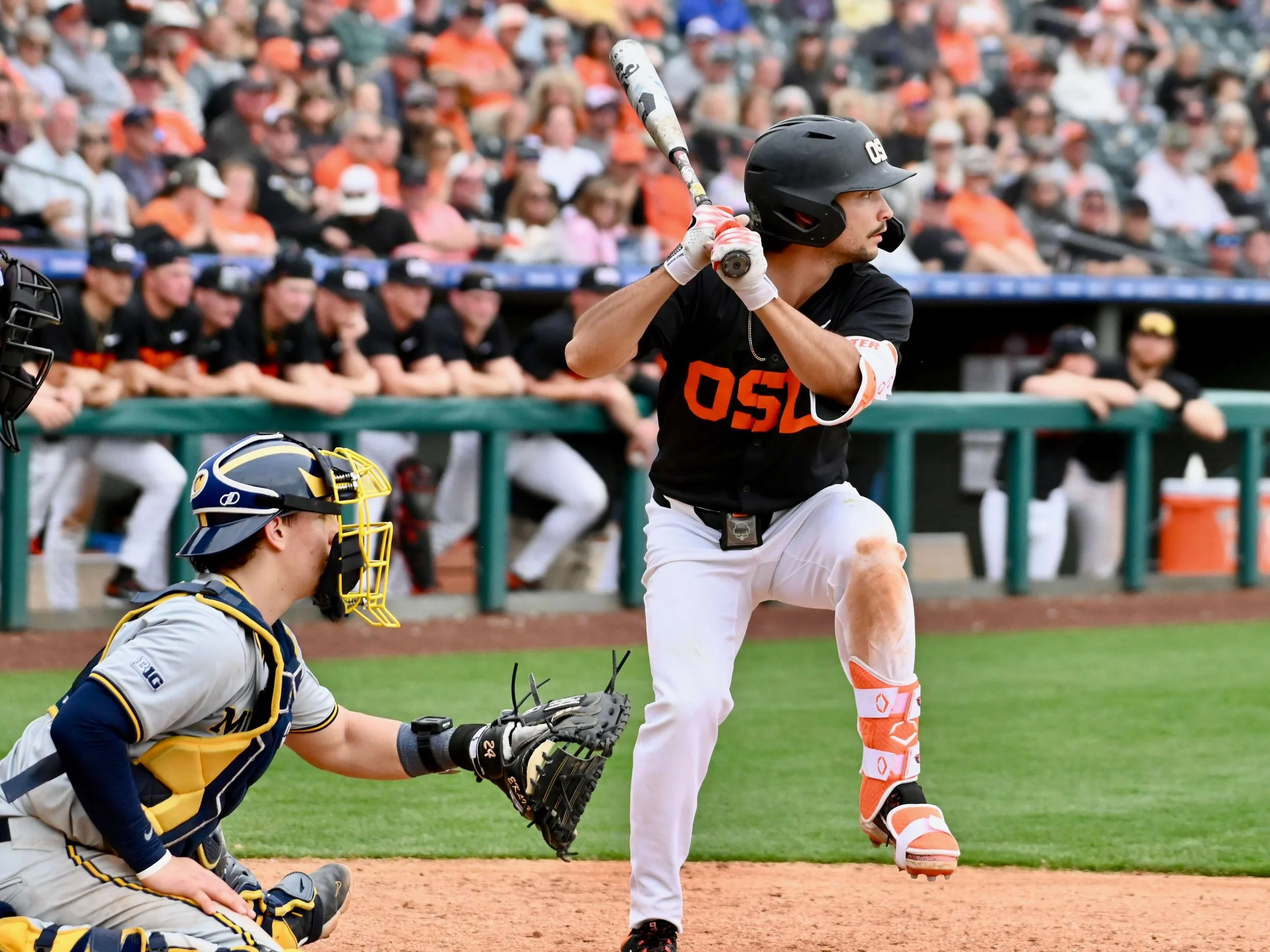
AJ Singer has had a big senior season at the plate, hitting .290 and leading Oregon State in several statistical categories (courtesy Dominic Cusimano)
Updated 5/26/2026 9:25 PM, 5/27/2026 8:23 PM
CORVALLIS — There are reasons to believe that Oregon State got hosed by the NCAA Tournament selection committee, which not only denied the Beavers a chance to host a Regional but placed them in one against their rival 40 miles down I-5. But you won’t find AJ Singer singing the blues.
“I don’t know how that stuff works,” Oregon State’s senior second baseman said Tuesday. “We are just happy to play in late May and June. That’s all we really care about. We get to play postseason baseball in Oregon, and we are excited about that.”
In reality, the Beavers — the No. 2 seed in the Eugene Regional — are beyond disappointed with what they believe was the selection committee’s snub. There are other programs that feel the same way. Oregon State (43-12) swept a three-game home series with Mercer in late March, but the Southern Conference Bears finished the season with a 44-15 record and a No. 28 RPI. Then they were left out of the 64-team NCAA Tournament field.
“There are a lot of things happened that have people scratching their heads,” Singer said. “It’s supposedly the first time a top-30 RPI team didn’t make it. I feel for them. We made it, so we have nothing to complain about.”
Singer will focus on what he can control, so he is gearing up for Friday’s noon matchup with No. 3 seed Washington State in the Regional opener at PK Park. The Glendale, Ariz., native, who will likely be batting in the two-hole against the Cougars, has been a two-way force of nature for Oregon State in his second season after a transfer from Iowa Western JC.
The 5-10, 180-pound Singer, one of three Beavers to play in all 55 games, leads them with 60 hits, 64 RBIs and 99 total bases. He is second on the team in doubles (15), home runs (eight), walks (35) and runs (48) and third with a .290 batting average. Except for the average, his numbers are better than they were a year ago, when he hit .312 with 10 doubles, three homers and 39 RBIs and was honored as a College Baseball Foundation first-team All-American.
Singer has been a human Hoover in the field, committing two errors in 218 chances, duplicating the consistency he showed as a junior when he claimed the Rawlings national Gold Glove award for second basemen. Singer joined second baseman Nick Madrigal (2017) and catcher Adley Rutschman (2019) as the only Beavers to gain the award.
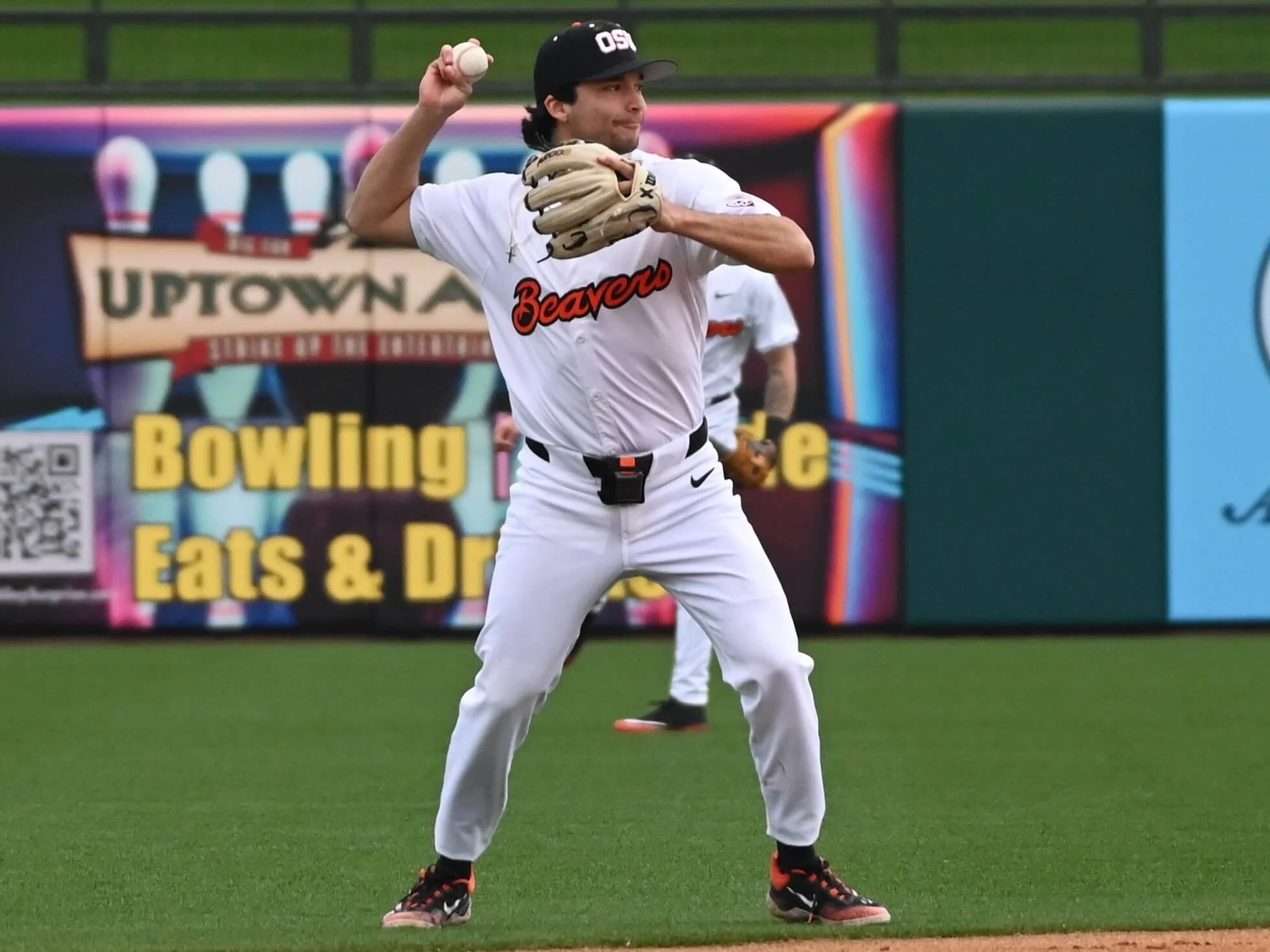
Singer, a national Gold Glove winner as a junior, has made only two errors in 218 chances this season (courtesy Dominic Cusimano)
“AJ is right up there with Madrigal, (Chris) Kunda, (Cadyn) Grenier and (Darwin) Barney among the great infielders we have had playing defense here,” assistant coach Joey Wong said. “I don’t think anyone has been better than he has been at defending his position his two years here. A Gold Glove his first year, and we’ll see about this year after it is over as far as awards go.”
(Wong is too modest to place himself in the same category as the middle infielders he mentioned, but he deserves his place here. Check out this legendary play he made at second base for the Beavers against Cal State Fullerton in the 2007 College World Series:)

Singer was out of sorts at the plate early this season, going 1 for 25 in one stretch and hitting .160 with no home runs over the first 15 games. He then ran off an 11-game hit streak in which he batted .375. Over Oregon State’s last 40 games, Singer hit .331 with eight round-trippers.
“I don’t really know what happened,” he said. “Last year, I started a little slow, and this year it was doubly worse than that. It was just about staying true to myself and deep down knowing I am a pretty good hitter. I just had to stay with the same routine, to stay consistent, loving on the guys around me. That makes me a better ballplayer. Eventually, I came through.”
Singer grew up an Arizona State fan. His father, Jason Singer, is an alum.
“I loved watching (the Sun Devils) as a kid,” AJ said. “They recruited me out of high school and a little bit out of Juco. My original plan (at Iowa Western) was to go back home and play somewhere in Arizona. Then the opportunity arose here.”
Wong was dispatched to Council Bluffs, Iowa, on a recruiting assignment during the 2024 season. He came back with a positive scouting report on Singer, who batted .396 with 81 RBIs in 61 games and was second-team Juco All-American as a sophomore shortstop at Iowa Western.
“I could tell he was an outstanding overall player,” Wong said.
Head coach Mitch Canham got Singer out on a visit to Corvallis, where he was reunited with OSU center fielder Easton Talt, who had moved to Arizona with his family as a 15-year-old. Talt attended Sunrise Mountain High in Peoria; Singer graduated from Mountain Ridge High in Glendale, less than five miles away. They played together for two summers with “T-Rex,” a select team run by Rex Gonzalez, brother of former Major League outfielder Luis Gonzalez’s brother.
“I didn’t know AJ was getting recruited by us until he came out on his visit,” Talt said. “He went to lunch with (assistant coach) Ryan Gipson and me. After that, we talked on the phone. He had questions for me. I loved to be part of that process.”
Singer thought about Arizona State, “but it just wasn’t the right fit for me, and that’s OK,” he said.
What tipped the scale Oregon State’s way?
“The history behind this program, the guys they produce year in and year out,” Singer said. “There is no better place to play, in my opinion. I still love ASU. Not going to talk bad about my dad’s alma mater. But this place has treated me great. I love this place.”
With Aiva Arquette at shortstop last season, there was no room at that position.
“We had a big need at second base,” Wong said. “AJ got to work right away and took to it quickly.”
Wong pinpoints versatility as Singer’s greatest strength.
“He can play anywhere in the infield if you need him to,” Wong said. “He has quick hands in the (batter’s) box. If he gets one on the barrel, it’s going to go. He has some pop for a guy his size. He is a really tough out, works at-bats and uses the whole field. He has had some big hits for us, including last year in the postseason.
“I really like AJ. He is soft-spoken and humble. The guys all get along with him well. He is a great teammate and human being.”
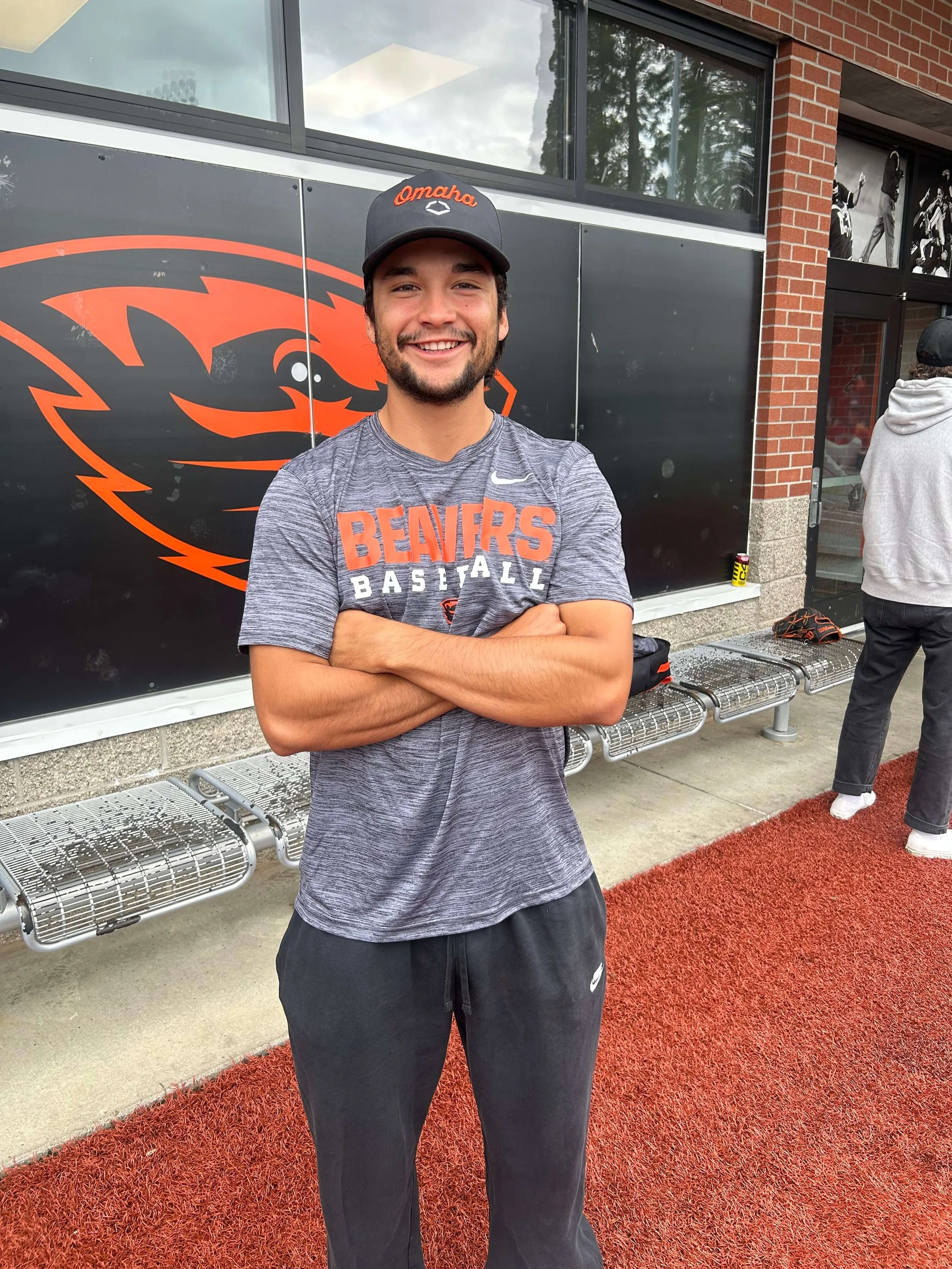
Singer’s role is to “produce offensively, be great defensively” and provide leadership with this Beaver team
Singer and Talt were roommates a year ago.
“We were close in high school, but in college, we have gotten even closer,” Talt said. “One day we might even coach together.
“I can go on and on about AJ. He is one of the best teammates, period. On top of that, he is a Gold Glover at second base and he would be at shortstop if he played there. He has been great offensively. I don’t think we would be who we are if he wasn’t on this team. You can’t replace a guy like that, team morale-wise and with his leadership.”
Singer might be the most important player on this Oregon State team.
“My role is to produce offensively and play great defense,” he said. “But behind the scenes, it is also to make sure all the guys are doing OK, that they know what the standards are here and they know how to do it. It is about paving the way for the younger guys. We have 19 news guys this year. It is about teaching them what we do here, how we run it and why this place is so successful. I learned it from Easton last year, and I’m able to do that this year, teaching (the newcomers) the ropes so they can do it for their new teammates next year.”
Singer said he has enjoyed playing for Canham.
“Mitch is awesome,” Singer said. “He is a player-first coach, and that is where the game is leading now. He makes sure every guy is doing what they need to do, and he lets us lead our own team.”
Surprisingly, Singer wasn’t chosen in the 2025 MLB draft after a junior year in which he was one of the best players on a College World Series team.
“It’s a business,” said Singer, who turns 22 on June 10. “I am not going to dwell on it. I got the opportunity to play here again, and that is a great thing. Getting my education and finishing my degree was also important to me.”
Singer is completing two classes this term and will graduate next month in psychology.
“Getting my degree is something I take pride in,” he said. “Did it hurt not getting drafted? Sure it did. But I don’t care too much because I got to come back to a place I love. I love the guys around me. I love the game of baseball. Every day that I have the chance to play baseball is a good day.”
Singer likes Oregon State’s chances in this weekend’s Regional. Before advancing to an expected Saturday matchup with Oregon, the Beavers must defeat Washington State and sophomore pitcher Nick Lewis. The 6-1, 195-pound sophomore left-hander is 9-2 with a 3.07 ERA.
“We are feeling really confident,” Singer said. “We are going to prepare for Wazoo. They have a good guy on the mound. He has had a good year. We are excited to face (the Cougars), and whatever comes after that, we can handle.”
► ◄
There are legitimate reasons to question the NCAA Tournament selection committee’s decision to not award Oregon State a Regional. The Beavers won 43 games, a figure eclipsed by only eight teams. They were ranked in the top 10 nearly the entire season, finishing seventh, seventh, eighth and ninth in the four recognized polls. Oregon (40-16) was 11th, 12th, 14th and 18th. (The Beavers and Ducks split a pair of games this season.)
The Beavers won all 11 of their weekend series. Their road record was 15-2, second-best to only UCLA’s 18-1. Oregon was 13-9.
While navigating the second of two seasons as an independent, Oregon State’s strength of schedule was ranked 62nd by Warren Nolan and 61st by NCAA/D1 Baseball. Oregon was 29th and 22nd. (Washington State, incidentally, was 85th and 96th).
D1 Baseball has an additional metric called “Diamond Sports Ranking” (DSR), taking into account a team’s record, strength of schedule, its best win and worst loss and something called the “pythagorean record.” Oregon State’s ranking was 13th. Oregon’s was 18th.
The Beavers’ finished 18th in both RPIs; Oregon was 15th. The other snafu was the record against the four “quads.” Oregon State played only five games against Quad 1 opponents, going 2-3. The Beavers were 10-3 in Quad 2 games and 17-2 against Quad 3 foes. They were 14-4 vs. Quad 4 teams, but were evidently penalized for losses to Cal State Fullerton, Cal State Northridge, Texas-Rio Grande Valley and Air Force even though they won series with all four.
“We have to be able to (sweep) those,” OSU pitcher Eric Segura told me. “We have known from the beginning of the year that we would have to win a lot of games, and we didn’t have much room to mess up. Losing those games was completely our fault. We can’t blame anyone else.”
In general, Oregon State had too many Quad 4 games on the schedule, getting a bit unlucky in that some historically strong programs experienced down seasons. Canham declined to cancel games against any of them to protect his team’s RPI ranking as did Oregon with two games against Quad 4 Grand Canyon.
“A system is broken when you are winning games and your RPI is going down,” Oregon coach Mark Wasikowski observed this week, and he is absolutely right. Also, when a team’s RPI goes up with a loss to a highly ranked team.
Oregon State assistant coach Ryan Gipson was surprisingly candid when asked about the situation Tuesday by Mike Parker on his “Joe Radio” program.
“Oregon is the No. 11 seed, and I am told we were between 21 and 24,” Gipson said. “That, to me, is disrespectful … with our body of work. (Selection committee members) didn’t look at the full resume like they said they were going to. They based most everything off of RPI, which is pretty disrespectful in the scheme of things.”
How much, Parker asked, did Gipson think national rankings impacted the committee’s decision?
“Not much,” he said. “They are human rankings. I guess they don’t use that metric at all. They said they were going to evaluate RPI less because teams have been manipulating their RPI. We were a team that didn’t. Still, nothing changed. … There is still some bias in how this thing works, and it’s too bad.”
Gipson said OSU coaches will use the perceived slight “to ignite the fire” with their players.
“It was a bit of a slap in the face when you look at what these guys did, that road stretch and how they competed, and everything they have done all year,” he said. “They are going to be fired up in the right kind of way to go out and prove it, and potentially play with a chip on their shoulder, which I really enjoy. This group thrives when we push them in that way. That is going to be the goal the next few days.”
► ◄
Readers: what are your thoughts? I would love to hear them in the comments below. On the comments entry screen, only your name is required, your email address and website are optional, and may be left blank.
Follow me on BlueSky.
Follow me on X (formerly Twitter).
Like me on Facebook.
Find me on Instagram.
