With Les Gutches, ‘You knew he was going to be a superstar’
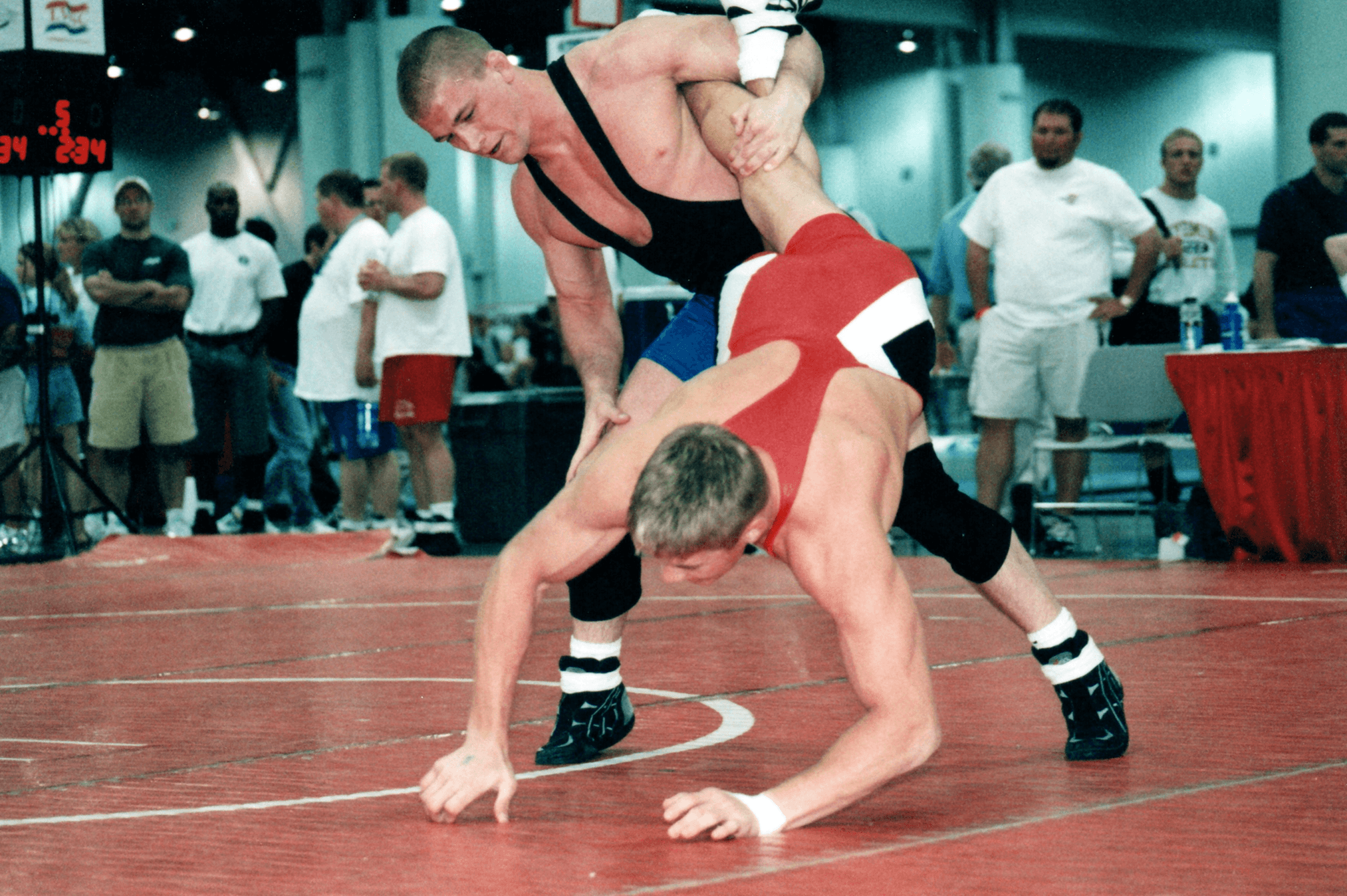
Les Gutches, here winning his fifth straight U.S. Open championship in 2000, was Oregon State’s last NCAA champion 30 years ago (courtesy Les Gutches)
Updated 3/19/2026 9:05 AM
CORVALLIS — Six Oregon State wrestlers are with their coaches in Cleveland in preparation for the NCAA Championships, which run Thursday through Saturday at Rocket Mortgage FieldHouse.
Two of them — senior Maximo Renteria at 125 pounds and sophomore Justin Rademacher at 197 — have legitimate shots at a top-eight finish and All-America acclaim. Rademacher, the reigning U20 World Champion but only a No. 9 national seed, has aspirations to be the national champion in his weight class.
It has been 30 years since Les Gutches earned the second of back-to-back NCAA titles at 177 in 1996.
“Oregon State hasn’t had a national champion since I did it,” Gutches tells me in a recent sit-down at Timberhill Athletic Club, where he is co-owner. I don’t like that. I don’t like my name to be last on that list.”
Gutches is 53 now, still a potent mass of humanity in middle age, with a Mack truck frame and bowling ball calves. He carries 230 pounds on a 5-10 frame and looks like he could still take down an opponent and twist him into a pretzel. A few years ago, Gutches was the North American Masters bodybuilding heavyweight champion.
“I like the preparation aspect of that,” he says. “There is a cerebral component to it. You figure out what works for your body and how you respond to tweaking the calories and prioritizing the muscle group, to trying to put some tissue here and overcoming poor genetics in other areas.”
The 1996 Olympian and 1997 World champion moved back to Corvallis last July with wife Jennifer and the youngest of their two children, Logan. The former Jennifer Busen played basketball at OSU; their son took after her, earning All-Mid-Willamette Conference hoop honors as a senior at Corvallis High this winter. (Their other child, Lexi, is a student at Portland State.)
Les spent most of his adult years living in Corvallis until 2010, when the Gutches moved to Colorado Springs, where he spent 13 years working administrative positions with USA Wrestling. Ever a businessman, he diversified. In recent years, he has purchased interest in a pair of liquor stores in Colorado Springs. Over time, he also attained ownership in both Timberhill and G3 Athletic Club in Corvallis and acquired some commercial real estate holdings in the area. Les had resigned his USA Wrestling post in 2023, so a move back to Corvallis seemed a good idea.
“It was a better spot for my family,” Gutches says. “Lexi was going to school out here. The gyms were out here. I didn’t have anything tying me down to Colorado Springs. The side hustles became more than the lead hustle. It just made sense. I have a couple of full-time jobs here, and I am better focusing on the businesses. The investment in those is an investment in yourself and longer-term returns.”
With Timberhill and G3, Gutches handles a variety of duties.
“I do the stuff that nobody else wants to do,” he says. “I make sure the insurance renewals are done and timely and that we have the right kind of coverages. I make sure we have financials and accounting set up. I do all the big-picture, behind-the scenes processes.”
Gutches was 134-10 during his time wrestling at Oregon State — 69-0 over his final two seasons. It is probably a coin flip whether he or Jess Lewis (76-1) is the greatest wrestler in school history. Both won a pair of NCAA crowns — Lewis at heavyweight — and were Olympians. Gutches became a World champion and also has a World bronze, so his resume is thicker. For sure, he was the most decorated Beaver wrestler ever. You can’t go wrong with either pick.
Life seems good these days for Gutches, even without wrestling as a central part of it. He doesn’t follow wrestling as closely as he once did, but he doesn’t mind reliving it with a sportswriter. He was inducted into the Oregon State Sports Hall of Fame 2003, the National Wrestling Hall of Fame in 2009 and the state of Oregon Sports Hall of Fame 2011.
For sure, it has been a hell of a ride.
Les Gutches grew up the oldest of three brothers to Linda and Les Gutches Sr. The elder Gutches — a fireman during his early adult years, then a construction worker — had been a wrestler of some renown. One summer, when Les Jr. was seven or eight, he came across his father’s wrestling medals. When the senior Gutches got home from work, Les Jr. asked him about it.
“We put the couch cushions down, he showed me a few techniques, and before I knew it, I was wrestling at the local youth club,” Gutches says.
His father played a part in his physical development, too.
“I started lifting weights when I was about 12,” Les says. “Dad would take me to the YMCA. Those are some of my fondest memories as a kid — lifting with my dad.”
All three boys became accomplished wrestlers. Middle brother Jason, three years Les’ junior, was a state champion at 168 at South Medford High and wrestled two seasons at Oregon State. Chad wound up at Corvallis High after his mother was too ill to look after him. Les became legal guardian of him for his three years at CHS.
“Chad is scarred from Les’ discipline during that time,” Jason says with a chuckle. “Like the 5 a.m. wake-ups. ‘It’s time to run!’ ”
Gutches was a prodigy who became the first competitor in USA Wrestling history to win national titles in all five age groups, beginning with U16 and continuing through the senior, or open, division.
Jason recalls Les attending an intensive wrestling camp in Ashland conducted by Minnesota coach Jay Robinson the summer before his freshman year of high school.
“It was a couple-of-weeks-long deal,” Jason says. “There were World and Olympic champs there as coaches. They talked about goal-setting. Les absorbed it like a sponge. He came back after the camp and knew how to set goals. He wrote them down, and followed them. He came back really changed. That is when things really took off.”
Gutches was a 220-pound middle linebacker/fullback in football at South Medford. “I played, but I was looking forward to the beginning of wrestling each season,” he says. “That was No. 1 for me.”
A three-time state 4A champion — at 171 as a sophomore, 178 as a junior and 191 as a senior — Gutches was highly sought-after by college coaches. He didn’t give up an offensive point his last three years with the Panthers.
“Everybody was recruiting him,” says Mark Johnson, the Oregon State coach at the time. “Big talent.”
Gutches signed a letter of intent to Oklahoma State, which finished second to Iowa at the 1991 NCAA Championships. It just never reached the office of Cyclones head coach Joe Seay.
“They had a good thing going and I decided I was going to sign,” Gutches says. “I told Joe, ‘I’m coming.’ I gave (the letter) to my mom and asked her to send it to him the next day. I slept on it, got up in the morning and knew it wasn’t the right choice.
“I went downstairs and asked her if she had mailed it yet. (She hadn’t). I got it and threw it in the trash. That ended up being good for a few reasons. One, shortly thereafter they had some NCAA sanctions for violations. We didn’t know it at the time. Also, I was an Oregon kid, and my support system was here.”
Johnson had been an assistant at Iowa for 11 years before taking the OSU job prior to the 1991-92 season. His first recruiting class featured Gutches, who would win Junior World titles in Greco-Roman and freestyle at 198 in ’91 and ’92. After two seasons in Corvallis, Johnson was head coach at Illinois for 17 years before retiring in 2009 with a career dual-meet record of 223-48-5.
“I had a lot of great wrestlers in my time,” says Johnson, now retired and living in Champaign, Ill. “Les is, if not the most, one of the most athletic kids I ever recruited. Right away, as a high school kid, you knew there were great things coming.
“I had just gotten the (OSU) job. There was a lot of pressure on me to get an in-state kid with that kind of talent. I bonded with Les right away. One of the hardest things I had to do as a coach was look him in the eye and tell him I was leaving for Illinois. I brought him into my office by himself to tell him. He was so mature. He was disappointed, maybe a little mad, but he understood.”
Johnson grew up in Illinois.

The Dean of Portland Sports is now on BlueSky.
“It is in the Big Ten, an easier place to win,” he says. “But it was a difficult choice. We had it going right away at Oregon State. I liked it out there, but it wasn’t home. I had spent my whole life in the Midwest.
“Les was as good a kid as I ever recruited. He was very technical. He studied the sport. He lived the sport. Then you add the athleticism with the good technique he had, you knew he was going to be very good. Some guys you don’t know about. With Les Gutches, you knew he was going to be a superstar.”
Ironically, Gutches never won a match for Johnson, redshirting his first season in 1991-92, when the Beavers went 11-1-1 in dual meets and won the Pac-10 title. And then Johnson was gone. The new coach was Joe Wells, who had been an assistant for 13 years at Michigan.
“Mark was great, but so was Joe,” says Gutches, who considered leaving OSU after Johnson departed. “I really liked Joe as a person and a coach. He would wrestle with the guys. He was one of a kind.”
Gutches says the main reason he stayed was Wells’ hire of Randy Couture as an assistant coach. Couture, who had been a two-time NCAA runner-up at 190 at Oklahoma State, would go on to become a six-time UFC champion.
“Randy was wrestling a lot of Greco at the world level at the time, and had won a few national titles,” Gutches says. “For me, it was perfect. He was a good guy, a good wrestler, a training partner, good at pummeling and hand-fighting, which is really important when you get to nationals. That hire was instrumental in my success.”
As a redshirt freshman in 1992-93, Gutches was 28-8 at 190 but did not place at the NCAA meet.
“That didn’t go so well,” he says. “I wasn’t quite big enough for the weight class. Most of the guys were coming down to that weight, and were taller. It wasn’t the right weight for me that year. I decided if I wanted to be a national champion, I needed to get down to the right weight.”
Gutches cut to 177 as a sophomore. His natural weight was between 190 and 195, but he would taper through the week to get down to 177 on meet day.
“I liked my international weight (187 1/2), which was much better,” he says. “It was hard to get down (to 177), but you change your body. You do what you have to do.”
Wells — who died in 2015 — picked up where Johnson left off. During Gutches’ final three seasons, with a stable of wrestlers that included Babek Mohammadi, Trent Flack, Chad Renner, Oscar Wood, Dan Alar and Dave Nieradka, the Beavers finished fourth, second and eighth in succession at nationals.
“We weren’t a great dual-meet team, But when we got to the nationals, we had some guys who were going to go deep,” Gutches says. “We had a pretty tough group, most of them Oregon kids. It was fun.”
Gutches was a three-time All-American, finishing fifth as a sophomore before claiming successive national titles as a junior and senior.
“It could have been a little better,” he says now. “I could have been a three-time national champion, but everybody wishes they’d have gotten one more.”
Gutches still hasn’t forgiven himself for not winning as a sophomore. He entered the 1994 NCAA Championships as the top seed, unbeaten and ranked No. 1 all season. Gutches was pinned 1:39 into his quarterfinals match against unseeded Andy Reese of Wyoming. Reese would go on to lose 3-2 to West Virginia’s Dean Morrison in the finals. Gutches won twice in consolation but lost the third-place match 8-5 to Minnesota’s Brad Gibson.
Gutches went untouched his final two seasons, going 36-0 as a junior and 33-0 as a senior. He yielded one takedown during that time. He still hasn’t forgotten the circumstances.
“I wrestled at 190 for the first half of my senior season, which was fine,” he says. “I think I could have won the nationals at that weight. We were at Wisconsin and got into a funky situation, and (the opponent) got a takedown.”
At the 1996 NCAA Championships in Minneapolis, Gutches won the Most Outstanding Wrestler Award, replicating what OSU’s Greg Strobel had done 22 years earlier. Strobel, a two-time NCAA champion at 190 with a career record of 124-5-1, is right next to Gutches and Strobel among the best OSU wrestlers ever.
“Greg was one of the coaches on the U.S. team at the 1996 Olympics,” Gutches says. “I ended up working with him quite a bit. He was an inspiration to me — an Oregon kid (from Scappoose) whose career mirrored mine in a lot of ways.”
Even more meaningful to Gutches than the MOW award was being recipient of the second Dan Hodge Trophy in 1996, given to the nation’s outstanding collegiate wrestler. It is wrestling’s equivalent to the Heisman. “That was really cool,” he says.
During his time at Oregon State, Gutches continued to shine internationally. He claimed Junior World Freestyle championships at 198 in 1992 and at 180 1/2 in ’93 and ’94. The decision to stay in Corvallis turned out to be a good one.
“Looking back, I don’t know that I would have done anything different,” he says. “It was great being close to home. Oregon State was a great place to be. Everything that happened to me, whether it was wrestling or when I went back to get a business degree, the chances everybody gave me — it was a great experience.”
•
What was it like growing up as the younger brother to Les Gutches?
“It was a double-edged sword,” says Jason Gutches, now a chiropractor in Medford. “Awesome to be around someone so successful like that, but he also cast a large shadow. But I loved it. We wrestled a lot together, especially in the summers. A lot of times I was a primary drill partner for him. We would be trying things out. I drilled with him a lot, even when he was competing internationally. I knew the looks he wanted.”
Jason accompanied Les to most of his national tournaments and some of his international events, including the 1998 World Championships in Tehran, Iran.
“Les is the most disciplined person I have ever known,” Jason says. “He is analytical, very Spock-like. He definitely has some OCD as far as that goes. He makes a plan and it is getting done.
“When we were kids, Chad and I would mess with him. He would have his shirts color-coded in his closet, spaced just so. We would go in and shift some of those around. He would come in and notice it right away and flip his lid.”
The discipline bore Les well in wrestling.
“I was pretty disciplined and stayed in good position most of the time,” he says. “I understood head position, hand position … If I were wrestling a guy who was fast and if he split his stance and had heavy, big legs, I could pick and attack that a little bit. My tactical and basic positioning was pretty good. That is why I didn’t get scored on that much. I probably didn’t take enough chances offensively, but I had a really good defense because I had great base and was disciplined.”
Strategy was a huge factor, too.
“A lot of it was about staying in situations where you want to be, and not being (influenced) to wrestle somebody else’s match,” Les says. “I was good at that. I knew where I wanted to be and I would fight for five minutes and 50 seconds to get there if I had to for that ideal 10 seconds.”
Work ethic played a part. He spent time alleviating his weaknesses.
“Wrestle in positions where you are not good,” he says, “and the next thing you know, it’s a strength.”
Then there was that innate ability.
“I was strong for my weight.” Gutches says. “I had a good ability to change levels. I had a pretty good straightforward penetration. I always wished I had been a little better laterally, but I had good hips. Probably a good aptitude to start with, too.”
•
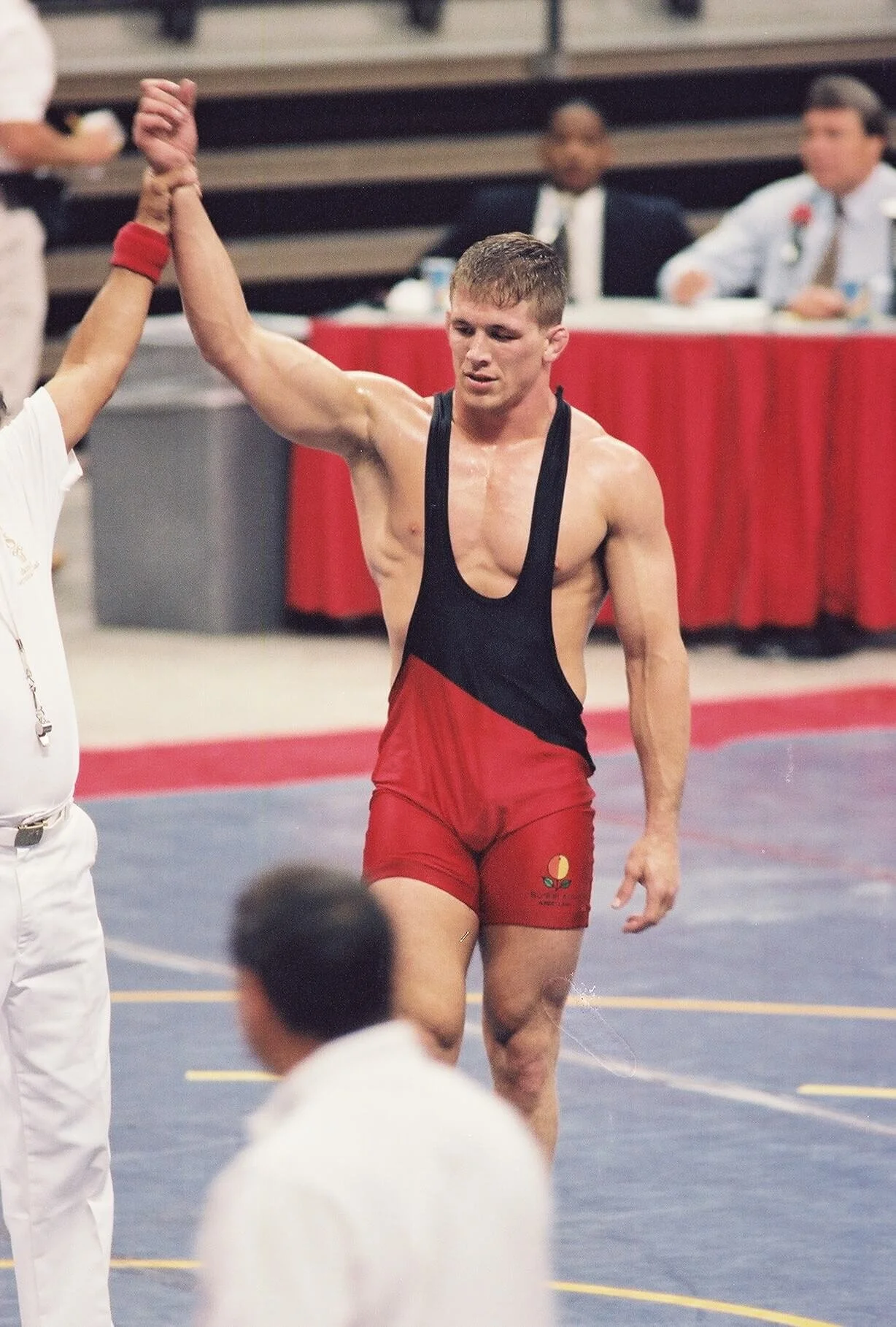
Les Gutches won the 187 1/2-pound class at the World Championships in Russia In 1997 (courtesy Les Gutches)
Gutches was entering his prime in 1996 and ’97. There was the NCAA championship. There were victories over three-time World and defending Olympic champion Kevin Jackson from Iowa State three times. Including twice in the wrestle-off at the Olympic trials in Spokane to claim an Olympic team berth. One account of the final Jackson match had Gutches doing a back flip when it was over.
“I don’t know,” he says coyly when I ask about it. “I might have. I could do them.”
At the trials, Gutches beat high-schooler Cael Sanderson, who would go on to Iowa State to forge a collegiate record of 159-0 and become the first four-time NCAA D-I champion.
“He surprised me a little bit,” Gutches says. “He was long. Usually you get a good feel for range. I remember having to adjust my range in that match because he had long arms.”
Gutches came into the Olympic freestyle competition in Atlanta with unsure expectations. He won his first two matches, then lost 2-1 to Elmadi Zhabrailov of Kazakhstan. In his next match, Gutches fell 3-2 to Magomed Ibrakgimov of Azerbaijan, which took him out of medal contention. He closed his competition with a 3-0 win over Cuba’s Ariel Ramos to finish seventh. Zhabrailov placed fifth and Ibrakgimov sixth.
“It is strange when your biggest accolades are also your biggest disappointments,” Gutches says today. “The goal was NCAA title, World Championship and Olympic championship. That is what I set out to do. I got two of the three.
“I really would have liked to have gotten at least an Olympic medal. I was probably more in the mix than I thought I was. I went into every tournament thinking I could win, but it is a pretty big jump from the NCAAs to the Olympics in a relatively compressed timeline.”
Shortly after the Games, Gutches injured his back. He underwent surgery in January 1997.
“I was able to come back,” he says. “I was never 100 percent again, but maybe 95 percent.”
That was good enough to gain Gutches the 187-1/2-pound freestyle title at the World Championships in Krasnoyarsk, Russia, that August. He beat Eldar Assanov of Ukraine in the finals, reigning as the only U.S. champion at any weight class in either freestyle or Greco-Roman that year.
“That was an interesting experience,” Gutches says. “We were in Siberia, the heart of Russian wrestling country. It is a hard place to win. At the time, I don’t know I thought it was any harder, but it was a really cool place to win. Not many Americans can say they won a World Championship gold medal in Russia. It was a great feeling.”
During that year, he also beat Olympic champion Khadzimurad Magomedov of Russia and runner-up Yang Hyun-mo of South Korea. In 1998, he took care of Magomedov again at the Goodwill Games in New York. He would go on to win bronze at the 1999 World Championships in Ankara, Turkey. He won his fifth straight national freestyle crown in 2000 and had high aspirations for the 2000 Olympic Games in Sydney.
“That was probably my year,” Gutches says. “I went back and forth with Yoel Romero from Cuba, who won the silver (in 2000) and was the 1999 World champion. On a good day, I could beat him. I felt like that year, ‘If I have a good Olympics, I am going to win. If I have a bad Olympics, I am going to get bronze.’ That’s how I was looking at it.”
But in April, prior to the Olympic trials, he injured his back again, basically ending his career.
“It was terrible on a couple of levels,” Gutches says, frowning at the memory. “I just couldn’t wrestle. I tried. To get hurt and not have a shot at an Olympic medal … going out like that … I was 60 percent at the end.”
► ◄
From 1996 through 2006, Gutches worked most seasons as an assistant coach for Wells at his alma mater. He also served as club coach for the Orange Crush Wrestling Club in Corvallis. The first part of that time, he was still wrestling competitively.
“That was tough, because competing is inherently selfish, and coaching is selfless,” he says. “But that is why Joe had me there. He wanted me working out with the guys.
“When I came back after 2000, it was a different experience. I had a little more time. I went back and got my Masters in business. I liked coaching; I can’t say I loved it. I sometimes wonder how coaches do it. You are essentially putting your well-being in the hands of 18-to-22-year-olds and the decisions they make. I didn’t like recruiting at all. I am not a car salesman.
“I really liked the kids. I liked working with the wrestlers. But I made the decision when Joe left (in 2006) that I wasn’t going to pursue the job. That was a tough decision, but in retrospect a good one for me.”
Gutches — who had married Jennifer in 1999 — opted for an office job as a commercial loan officer for Citizens Bank.
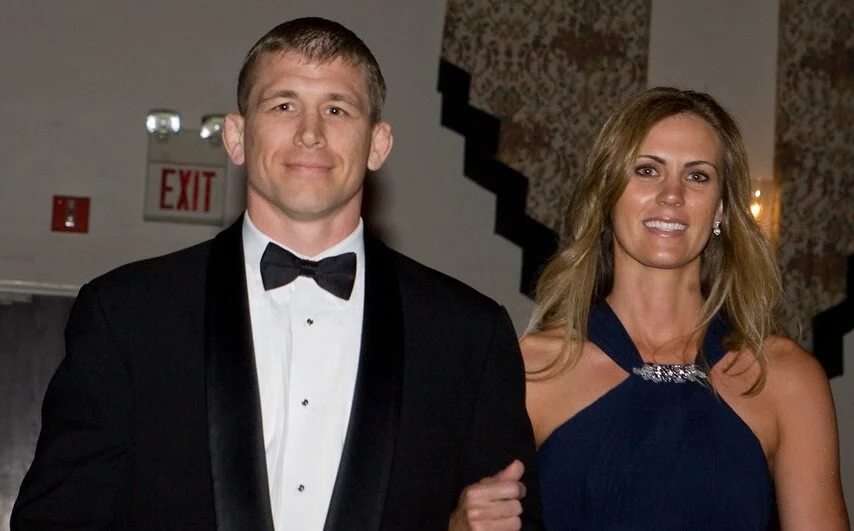
“I knew wrestling,” he says. “I was in my sweet spot there, and this was my first real job. But man, it was great. I liked the folks down there. I made some good friends. The best part about it, I was a credit analyst. I went through financial statements and tax returns all day every day. I started to figure out what works in business and what doesn’t, how people build wealth and lose it — by divorce, most of the time. I learned how companies grow, and what a strong balance sheet looks like, what is good leverage and bad leverage and lending terms. I got to do a ton of that.”
The practical experience was great, but commercial banking also wasn’t Gutches’ dream job.
“In some ways, I didn’t like it,” he says. “I was hunched over a desk a lot. My eyes were straining. You are getting spread sheet blindness looking at numbers all day. But man, it led to everything I have done since then.”
The first part of that came in 2010, when he joined USA Wrestling as director of program development. In 2012, he was promoted to associate executive director for programs and strategy in 2012. Les and his family spent 13 years in Colorado Springs.
“I had gotten just about everything I was going to get (out of Citizens Bank), and I missed wrestling,” he says. “It was a great opportunity. It was an administrative position — like an athletic director — and an opportunity to use my business experience with the knowledge I gained at the bank and my wrestling experience and marry the two.
“I wasn’t coaching, but I was working for an organization that I loved, and I had a skill set that helped me and USA Wrestling be successful. I learned a lot about big insurance claims, contract negotiations and that sort of thing. All those things have helped me since.”
► ◄
When he was still teaching at wrestling camps and clinics — he hasn’t had time for that in years — Gutches was fond of philosophical phrases about his sport. Such as:
“Wrestling taught me life lessons — the value of hard work, how to set goals, how to compete. Sum it in one word, the one thing wrestling has given me is confidence.”
I ask, how so? He quotes the great Dan Gable:
“Once you have wrestled, everything else is easy.”
“Wrestling is tough,” Gutches says. “They turn off all the lights but one, and put a spotlight down on the mat, and you are either going to win or get beat up. That builds a certain skill set and mental attitude. I look at confidence maybe different than some people do.
“You are confident when you know you have done everything possible to prepare for the moment. Nothing guarantees success, but wrestling taught me that when I prepare, when I work hard, I am putting myself in the best possible position to succeed. That has carried over into life for me. Looking at a business deal, I may not be the smartest, but I am going to work the hardest to figure it out.”
As a businessman, he says he thinks like a coach with his employees.
“I like the coaching aspect,” he says. “I like to help people to get better. My grandpa had a saying, ‘Leave it better than you found it.’ I like having that approach with people.
“Businesses are a different opportunity to coach. Maybe I don’t have direct contact with all the employees here, but we are doing our best to create an environment to succeed. That is a cool piece of owning businesses.”
Another Gutches quote, this one from his wrestling career: “There are some positions, in that I’m a bit of a sadist on the wrestling mat, that I want to take my time and make them suffer a little bit.”
I ask, were you kidding?
“That was probably the wrong term to use,” he clarifies. “In some cases, wrestling is a war of attrition. I am willing to work hard if I can make you work harder. It is not like you go out to injure someone, but you try to make that match as hard as you can (for the opponent). Snap ‘em down, make them get up 50 times, get an angle, make ‘em square up, shoot, make ‘em sprawl. If you are on top, make them work hard. Sometimes the last one to get up is the one who comes out on top.”
Though he hung out with such standouts as Couture, Chael Sonnen, Matt Lindland and Randy Henderson, Gutches never competed in mixed-martial arts.
“Those guys were all getting into it from about 1995-98 and also had one foot in the wrestling world,” he says. “We would all get together and train. We would wrestle 20 minutes of Greco, 20 minutes of freestyle and then a half-hour of jujitsu. I got to do a little bit of it, but in a way I am glad I didn’t. It is a tough road. You get a lot of respect and notoriety and potentially make some money, but I am glad I went the route I did.”
I ask Gutches about his legacy in wrestling. I can tell he is uncomfortable with the question.
“I didn’t do it for legacy,” he says. “I did it for me. The guys like Strobel and Lewis and Larry Bielenberg and Howard Harris, they inspired me. Also Rick Sanders. If those Oregon boys can do it, why can’t a kid from Medford do it?”
He pauses and then has an answer.
“The next kid who looked at me as the same type of inspiration as I did to others — maybe a kid from Oregon can compete at the highest level?” He asks rhetorically. “If so, that is pretty cool. If you are an inspiration to anybody who goes on to try to achieve their goals and dreams, that is cool, too. But my real legacy is as a husband and father to my kids.”
► ◄
Readers: what are your thoughts? I would love to hear them in the comments below. On the comments entry screen, only your name is required, your email address and website are optional, and may be left blank.
Follow me on X (formerly Twitter).
Like me on Facebook.
Find me on Instagram.
