Who’s the dummy now? Not Terry Fator
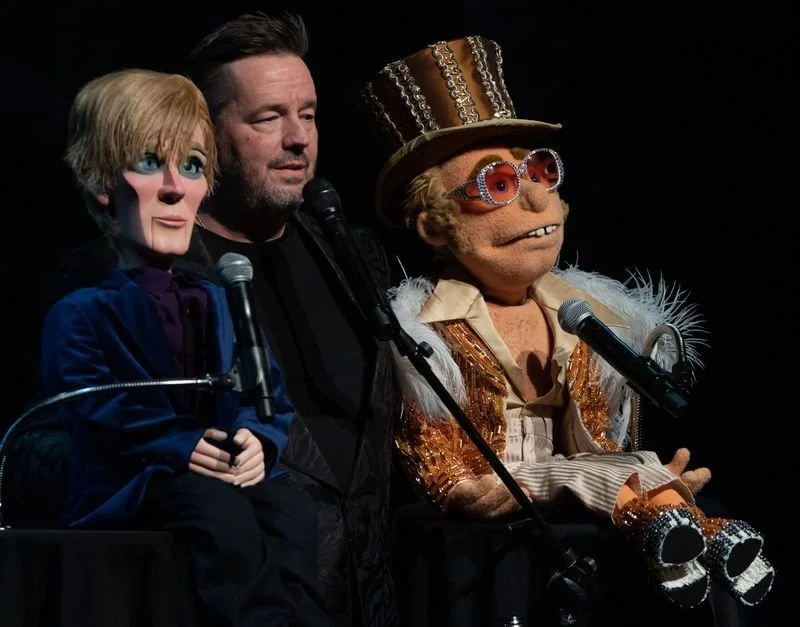
Terry Fator, with David Bowie and Elton John, says it has taken “hundreds of thousands of hours” of practice to hone his act (courtesy Caprio Media Design)
Updated 2/7/2026 8:15 PM
If you consider Terry Fator a “unicorn,” you are not wrong. The Texas native and Las Vegas resident is a one-of-a-kind entertainer, both for his versatility and his mastery of a unique craft.
Fator, 60, is a singer, comedian, ventriloquist and impressionist all in one. The legendary Vegas Strip entertainer is making two stops in Oregon on his current “Pure Imagination” North American tour — for a pair of Valentine’s Day shows at Wildhorse Resort & Casino and on March 7 at Chinook Winds Casino Resort in Lincoln City.
Terry began singing in front of audiences at age three, doing impressions when he was six and got his start in ventriloquism at 10. He began his professional career in 1987 as lead singer of a band called “Freedom Jam,” which played shows at middle schools and high schools throughout the country. Soon he was performing a solo act of singing, comedy and ventriloquism that reaped mixed results. There was one show in a 1,000-seat theater that drew one spectator.
Fator was discouraged in his late 30s and considered pursuing a different career, but then expanded his repertoire to include impersonations of singers through his puppets.
His big break came in 2007 when he earned $1 million as winner of Season 2 of “America’s Got Talent.” Judge Simon Cowell called Fator’s act “the best of the best.”
That resulted in appearances on every national talk show imaginable, a four-month gig at the Las Vegas Hilton for $1.5 million and soon landed him a five-year, $100-million contract with the Mirage — the biggest deal in Vegas show-business history up to that point.
I have not seen Terry’s show live, but I have watched quite a bit of video, and I am truly blown away by his talent. Here is a guy who paid his dues, tinkered with his act and became one of the biggest successes in show business. He has a great speaking voice, a great singing voice, and he seems like a very good dude.
Fator ended his legendary 16 1/2-year residency in Vegas in September, but it doesn’t mean his career is winding down. Terry and I spoke via telephone from Las Vegas, which he and wife Angie have made their home since 2009.
KE: You are performing in Lincoln City in March and in Pendleton next weekend. Have you ever done shows in Oregon before?
TF: I played Pendleton years ago when I was on the little stage. I wasn’t the headliner. I was coming in to do three to five shows a day on the small stage. I told my wife how much fun it was (in Pendleton), that I couldn’t wait to take her back. We are so excited about coming back to that area.
KE: You were a performer almost from the time you could walk, starting with singing.
TF: My first memories are of me standing up and singing to an audience of clapping and cheering adults. Man, that little brain of mine said, “I like this.” Those endorphins went nuts in that little kid. I fell in love with being in front of people and entertaining.
KE: You got interested in ventriloquism by a library book you read in fifth grade?
TF: That’s exactly true. I was going in to do a book report on Valentine’s Day. I over-flipped the card catalog from “Va” to “Ve” and it landed on a book titled “Ventriloquism for Fun and Profit.” I thought that sounded like fun. With my little ADD brain, I checked out the ventriloquism book and forgot about my Valentine’s Day project.
KE: I read two different accounts of the first puppet you owned. Did you get a “Willie Talk Dummy” from Sears at age 10, or did your mother help you get your first dummy at 18?
TF: Both are true. My first little puppet wasn’t a professional puppet. I got it when I was 10 with babysitting money. We lived in apartments and my next-door neighbor had very young children.
KE: Babysitting, at 10?
TF: I was a very responsible 10-year-old. It was the apartment next to ours. She would put them to bed, and she had a VCR, and I would basically sit there and watch Mary Poppins. Never had any issues or problems. She gave me $5 every time I did it, and I used $10 and bought my first little puppet.
It took me eight years to save enough money, with my mom’s help, to buy a real professional puppet. That’s where “Walter T. Airdale” came in. When I do my shows in Oregon, I will tell that story and talk about the fact that Walter was my very first professional puppet. All these years later, he is still in my act. He is my sentimental favorite. “Winston the impersonating Turtle” is my very favorite.
KE: Do you still have that Willie Talk dummy?
TF: I do. He is in a shadow box along with my very first little suitcase my mother put together. It says “Terry and Josh” on it.
KE: So throughout your childhood, you entertained family and friends with your ventriloquism and impersonations of singers and actors.
TF: I was always able to do impressions of singers. I was that incredibly super-annoying kid who was always impersonating everything. If I heard an announcement on the loudspeaker, I would try to repeat what they had said and sound just like what the speaker said. It was a way of honing what I do.
I have an ear where I can hear something and recreate it. I don’t do speaking impressions much. I do a few cartoon voices. But for some reason, I can hear a vocalist and recreate the tones and sounds and the way they say their words of almost anyone that I decide to do that with. It is quite an interesting gift. I was able to do that from the time I was a child.
When I was 22, I started a band. I would bring out my cowboy puppet, Walter T. Airdale. He would do (a singing) impression of Garth Brooks or Dwight Yoakam or Hank (Williams) Sr. It never really occurred to me to make my show an impressionist show with puppets until about 2005, when I saw a vocal impressionist at the Mirage (in Las Vegas) doing impressions of singers.

The Dean of Portland Sports is now on BlueSky.
KE: The great Danny Gans, whom you would replace as headliner at the Mirage a few years later.
TF: I was so overwhelmed by how talented this guy was. I fell in love with him as an artist. But I thought, “Man, I can do all those impressions, but I really didn’t want to be known as Danny Gans-like.” I could do the same type of show he was doing, but everybody was going to say, “Yeah, well, the original is Danny Gans.” So I thought, hey, I will just have my puppets do the impressions. It was that flippant.
I had no idea that I was creating a new genre that had never existed, and that I was doing something that nobody else in the world can do. It was quite overwhelming and surprising to me how it resonated with the world. Everybody fell in love with it. I played Rome recently, and the audience (members) were gobsmacked watching these puppets singing like the artists. I did Elton John, Michael Jackson and David Bowie. (Spectators’) jaws were hanging. It is a lot of fun to be able to do this. It really resonates with people everywhere. There is no language barrier.
KE: Backtracking for a moment: I laughed out loud at a comment you made in an article about your beginnings in show business as a ventriloquist, when you were doing fairs and they classified you as a kids’ performer. You said, “They would stick me over at the petting zoo.”
TF: It’s literally true. I would play at the petting zoo. The worst part of it was, in the petting zoo/children’s entertainment tents, they had clowns running around entertaining the audience while I am trying to do a frickin’ show. Not that I have anything against clowns. I don’t mind clowns. But it was like, “Oh God, this is so terrible.”
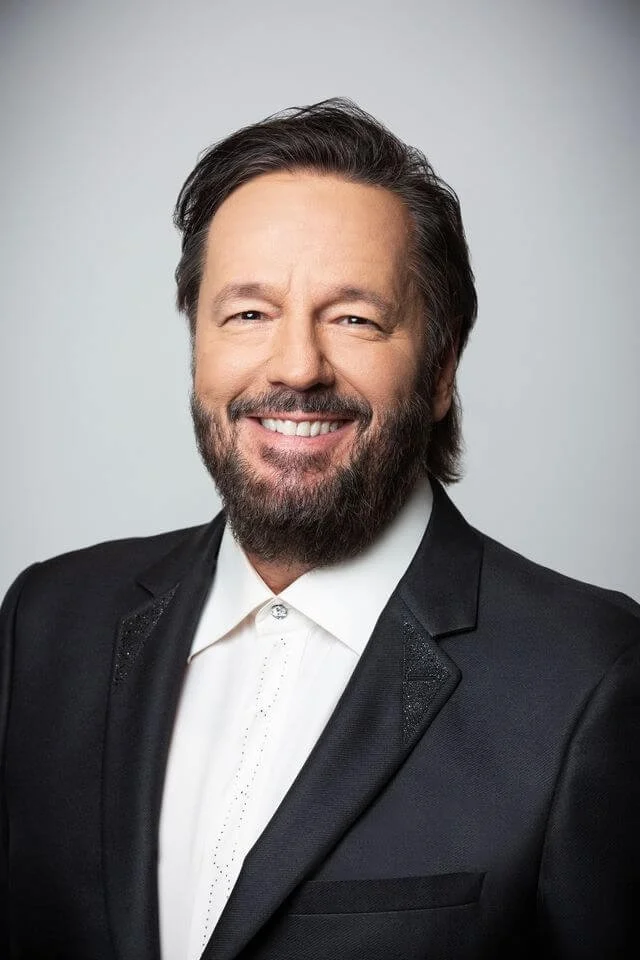
Terry Fator is the only entertainer offering audiences his brand of singing ventriloquism (courtesy Caprio Media Design)
KE: Did you resent being classified as a kids performer?
TF: I am not a kids entertainer. Don’t get me wrong, I love children. I am actually working on creating a show for children and people with Down’s Syndrome and people on the spectrum. What I do has such a profound effect on children and people with disabilities. I love that. But I have never considered myself a children’s entertainer. I never do dirty material, but I have always had more sophisticated, for-the-adult-intellect type of material.
But hey, it was a paycheck. It was better than being an insurance salesman. I was a waiter for a year, and by the way, I loved it. If I were not doing (his act), I probably would be a server or a waiter in a high-class restaurant. I was good. I used to have voices coming from under steaks or out of the coffee cup. I would entertain and sing. People loved me. I made unbelievable tips. I gave customers a dinner and a show, too.
KE: So it wasn’t until you were 40, after watching Gans but deciding to go in a different direction, that you began incorporating impersonations of singers into your act through your puppets? Did that jet-stream your career?
TF: In 2005, I decided I was going to make my show all about the puppets doing their impressions of singers. Man, it took off.
KE: And two years later, you were on top of the world as the second-ever winner of “America’s Got Talent.”
TF: I had no idea I was going to win. Almost to a person, everyone who talks to me about that says, “I knew you were going to win that from the moment you did the first audition (with puppet Emma Taylor) singing Etta James’ “At Last.” That is amazing to me. I was the last person who thought I was going to win that show.
KE: Even after you won, right?
TF: If you watch (the video), I gave a trepidatious response. I wasn’t 100 percent sure it was me. I didn’t want to be like (Ben Stiller in) “Zoolander,” where they say the other guy’s name and (Stiller) walks up and starts giving his acceptance speech, and it was the other guy who won (for “Male Model of the Year”). The last thing I wanted to do was humiliate myself and start celebrating because, like, what if I heard that wrong? I was absolutely convinced Cas Haley, the guy who came in second, was going to win. I was happily wrong. It turned into something unbelievable, beyond my wildest imagination of success.
KE: During the “America’s Got Talent” competition, I loved your turtle as a frog and you as Louis Armstrong together singing “What a Wonderful World.”
TF: (Panelist) David Hasselhoff said, “It is so genius that you had the turtle doing an impression of a frog.” But I have to tell you, necessity is the mother of invention. That genius was because the Muppets refused to allow me to use “Kermit the Frog” on television.
I had a Kermit puppet and wanted to do that. They said no. They said, “We don’t care if you do the voice; you just can’t do the frog.” I am panicking. I want to do it the next show after I had gotten through the third round. I am clamoring to figure out some sort of a reptilian or amphibian figure I can use. I find this little turtle puppet in a toy store online and have it shipped overnight to me. “Winston the Impersonating Turtle” was born.
Once I won the show and got my big headlining gig, I didn’t want to use a puppet I had bought at a toy store. I was contacted by “Puppet Heap,” one of the greatest puppet makers in the world. They actually work on the Muppets. I had them help me create this iconic cuteness that is Winston. That is how he came about.
KE: How did you learn to talk without moving your lips? Just trial and error?
TF: I started to practice in fifth grade after reading that book, which gave you the ABCs. But I have always been a perfectionist. Anything I set my mind to, I want to do it as well as I possibly can. I wasn’t satisfied with substituting “D” for “B” and “T for “P,” which is what they tell you to do. I would experiment with different ways of using my tongue to save those letters and try to figure out if there was a better way to make it sound like a “P”or a “B.” Without any kind of training with anyone else … I found later that all of us in the upper echelon of the ventriloquism world use the same technique that I discovered on my own by trial and error.
My puppets do not sound garbled. They are not hard to understand. Their voices are clear. When they say something, you don’t have to try to figure out what they are saying. It sounds just like I am saying it with my lips. That has come from lots of hard work. They say it takes 10,000 hours to become perfect at something. I have spent hundreds of thousands of hours working on my craft.
KE: It must be even harder, then, to have the puppets not just talk, but sing without moving your lips.
TF: It is so much harder when I am doing it with my mouth closed — 10 times harder. It takes a lot more work. It is so much easier to sing with my mouth open. It had been a dream of mine to do a symphony show. I did one with a 60-piece orchestra at the Smith Center in Las Vegas. I gotta tell you, it was amazing. I did about 80 percent me singing and 20 percent puppets. It was so much fun for me to do that.
But my music director kept saying, “Terry, open your mouth. You don’t have to have your mouth closed (when singing).” I would forget, because I had been doing it for so long (with puppets). But I have more fun doing it with the puppets. I have people tell me, “Terry, you are such a good singer, you could do a show with no puppets. Why do you do it with them?”
Really great singers are truly a dime a dozen. There are thousands of us out there. There is only one who can do impressions of singers with their mouth closed, and that is me. And it is so much more fun for the audience. I can get up and sing a Frank Sinatra song, but when I have a Sinatra puppet sing it, there is something more joyous and fun about it than just having me sing it. That is really why I do it.
KE: How do you throw your voice so that it sounds like the words are coming from the dummy’s lips?
TF: That is just a lot of practice and misdirection. If I convince you a voice is coming from a certain area, your brain is going to trick you into thinking it is. I can’t literally throw my voice, but I can convince your brain it is coming from the particular area.
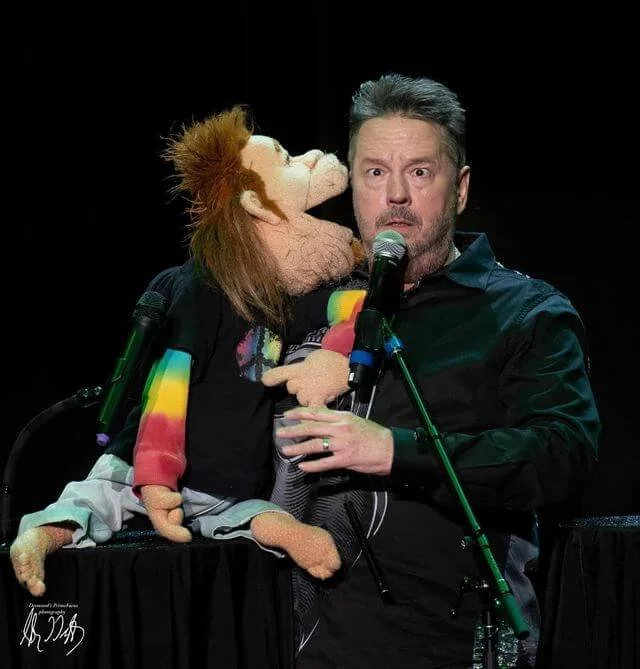
Duggie the Annoying Neighbor is one of about 30 puppets Fator uses in his current act (courtesy Caprio Media Design)
A story about that: When I first learned how to throw my voice, I was working on what is called the “distant voice.” You ease the voice out and do an impression of a voice from far away.
When I was 14, I wrote this routine for a show at a church. There was supposed to be somebody in the janitor closet off stage. You could see the door. I had my puppet interacting with the person in the closet. We were going back and forth. Throughout the show, the person in the closet was yelling things. I would interact with this. It was the first time I had done a show using that distant voice. I was thinking, “This is a disaster. No way they are believing there is something in that closet.” I was sweating through the whole show. But the audience loved it. And after I finished, I looked over, and I’ll be doggoned if people weren’t coming from the audience and opening that door to see who was in there. And I am like, “It worked!”
I realized it is about how I have to make you believe there is something there. If I do that, your brain is going to make you think you are hearing it from inside that closet. It works every time. I will be sitting there right across from them, and they will say, “Oh my gosh, I heard it from the other room.” It is misdirection — a lot like a magic trick.
KE: I was going to ask about that. Do you do magic? Are you an illusionist?
TF: Ventriloquism is considered part of the magic and illusion genre, and it really is. The whole thing is an illusion. I will be performing at a black magic convention and hosting an evening. I am doing that in 2027. I performed there in early 2025.
KE: Besides all you do with the singing and the voices, you also have to synchronize it with working to operate the pull string of the puppet, its mouth, its eyes, its movement. How long did it take you to get the hang of all that?
TF: I literally have ADD (attention deficit disorder). I have never gone on medication for it. I honestly believe the reason I am able to do all of these things at once is because my brain is fractured in many ways. My wife says it is the most astounding thing she has ever seen. I can be watching a movie, reading a book and working on something else all at the same time, and I usually have the (audiobook) on triple speed. I am hearing every single word of it while I am watching a movie or playing a video game. She is like, “I don’t get it.” I say, “Honey, that’s just how my brain works.”
I need a lot of stimulation. An overload of stimulation for an ADD brain is necessary to be able to do all the things at once. I refuse to go on medication for it. I don’t want to do anything that is going to dull or change that. I might get annoying sometimes, but it is crucial to my career. I drive people nuts because I am always jabbering and I talk too much. Hey, it is much better for my career that I allow people to be annoyed by me but am able to do what I do.
KE: When you are working the dummy, you really have to take on two personalities — your own and the puppet, right?
TF: I do. That is something that started when I was maybe 12. I told my family, “I am really having trouble relating to my puppet and pretending and feeling like my puppet is real, so here is what I am going to do. When I am home and we are doing anything as a family, I am going to make the puppet a part of that group. I want you to ask the puppet questions and treat it as if it is part of the family. I need to learn to treat this puppet as if it is a real person.”
They happily agreed. They would ask the puppet, “How was your day?” And I would have to come up with this whole scenario where the puppet did this or that. I did that for about six months, and it really helped me to develop that rapport with the puppet that I did not have before.
KE My wife says she doesn’t really want to know how all that you do is done. She says that is what makes it fun — the pleasure of believing something you can’t believe.
TF: That’s right! Most of us don’t want to know how a magic trick is done. It is fun to believe that a person can float in the air or fly or disappear. It is fun to believe that these inanimate objects are real and carry on a conversation and make you laugh.
KE: Among the singers you impersonate are, as you mentioned, Etta James, and also Karen Carpenter and Meghan Trainor. Is it harder to impersonate a woman?
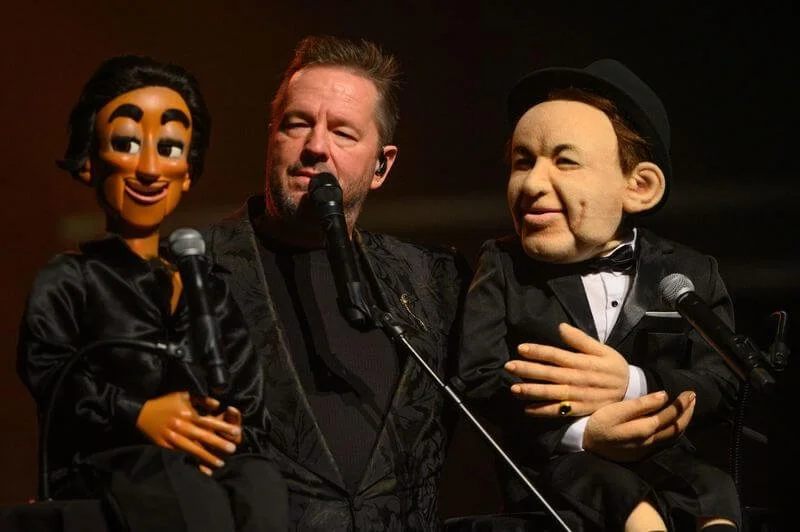
Terry Fator with Fernando V. Francisco (left) and Frank Sinatra, staples of the act he brings to Lincoln City and Pendleton in the coming weeks (courtesy Caprio Media Design)
TF: It depends on if they are in my (vocal) range. Karen Carpenter is very easy. So is Etta James. Some women are much more difficult. Taylor Swift is hard because she has a higher vocal range. I can do her; I just have to lower the key. I don’t have to change the key at all for Karen Carpenter. She has a lower resonance. Then it is a matter of learning how to say the words the same way she says them and use the same inflections. For some reason, Etta James is right there in the sweet spot of my vocals. Sometimes it is harder to do a really low voice than it is to do a high one.
KE: Is there a singer or celebrity that you have done that has just been so difficult, you don’t feel like you’ve got it right?
TF: Not yet. I may not feel I am perfect at it, but I do a decent enough impression to where I can entertain the people. That is what really matters. I am a perfectionist. I want to make impressions as good as possible, but I can pretty much do anyone I set my mind to.
KE: How many impersonations do you now have in your voice library?
TF: We started counting two or three years ago. I stopped counting at 200. I think if I wanted to do an impression of any singing voice, I could. I may not be able to hit notes. I can’t do Mariah Carey when she is doing those squeaky things that only dogs can hear. I can do some of the basic ones she does, like (he breaks out singing) “I don’t want a lot for Christmas.” I will get into my key and can do her lower range. It is a wonderful gift God has given me. I give him the glory for giving me the gift. I give myself the credit for working hard and perfecting those gifts.
KE: When you are doing your singing impressions, is it more important to be funny than to sound like the person you are imitating?
TF: It depends on what I am trying to accomplish. If it is a comedy routine, it is more important to be funny. But I pride myself on trying to do as close to the original artist as I possibly can. That is my goal, unless I am specifically trying to be funny with it.
KE: How many puppets do you work with these days?
TF: You are probably going to see about 30 different characters in Pendleton and Lincoln City. I do “We are the World” with 19 puppets and impressions. I have about 10 puppet characters you will see throughout the show and then 19 at the end of the show.
KE: You ended your 16 1/2-year, 3,500-show residency in Vegas clubs in September. Was that your decision? If so, why?
TF: The best decision I ever made. Don’t get me wrong, I loved it. It was a dream come true. It was a dream until it became a drudgery, and I was, “Oh my gosh, I just can’t extend my wings as an artist.” I finally stopped it.
I don’t have to do 200 shows anymore. My wife and I are able to go on a vacation and stay an extra week if we want. I have one chapter left of a novel I am writing. I have been able to do that because I don’t have a show every single day. It has been such a breath of fresh air.
I never felt it was a drudgery when I got on stage. Once I got on stage, I was in heaven. But it was, “I’ve got another show tonight. I’ve got to leave the house at 3, get there, do my vocal warmups and do my show.” It was day after day.
Now I have enough days off where I can’t wait for the next show. Now I am excited again to perform. I get giddy. I get that adrenaline rush. I brought back the joy. Trust me, Vegas begged me to stay, and I said, “No, enough is enough.” I want to play enough shows in Vegas where I keep my presence, but I am loving this new-found freedom.
KE: Looks like you have 32 dates scheduled for your current tour of North America.
TF: And we are just getting started. We are probably going to double that number by the end of the year. They are booking me like crazy and I am loving every minute of it.
KE: Does Angie travel with you?
TF: My wonderful, incredible wife and I never go anywhere without each other. She tours with me. She runs my teleprompter on the road. She has a little job there. We are inseparable. It is amazing.
KE: What is it about entertaining that moves you?
TF: I do everything I do for my audience. It is one of the reasons why I have been so successful. The fame, the fortune, the accolades — all that is white noise. All that matters is to see the smiles on the faces of people watching, the laughter.
I get wonderful letters and emails from people. They say things like, “My father was dying of cancer, and you gave us laughter in his last few months.” I got a letter from a lady who told me her son had been going through a deep depression and was on the verge of suicide until he found my videos online. It brought him out of that and saved his life.
I am so grateful for the success, for the money I have made, a lot of which goes to my foundation. But I am only about the people, the audience. That is what keeps me going. That is going to keep me going until my dying day.
► ◄
Readers: what are your thoughts? I would love to hear them in the comments below. On the comments entry screen, only your name is required, your email address and website are optional, and may be left blank.
Follow me on X (formerly Twitter).
Like me on Facebook.
Find me on Instagram.
