They’re slinging it, they’re bringing it and they’re singing the praises for Slingball
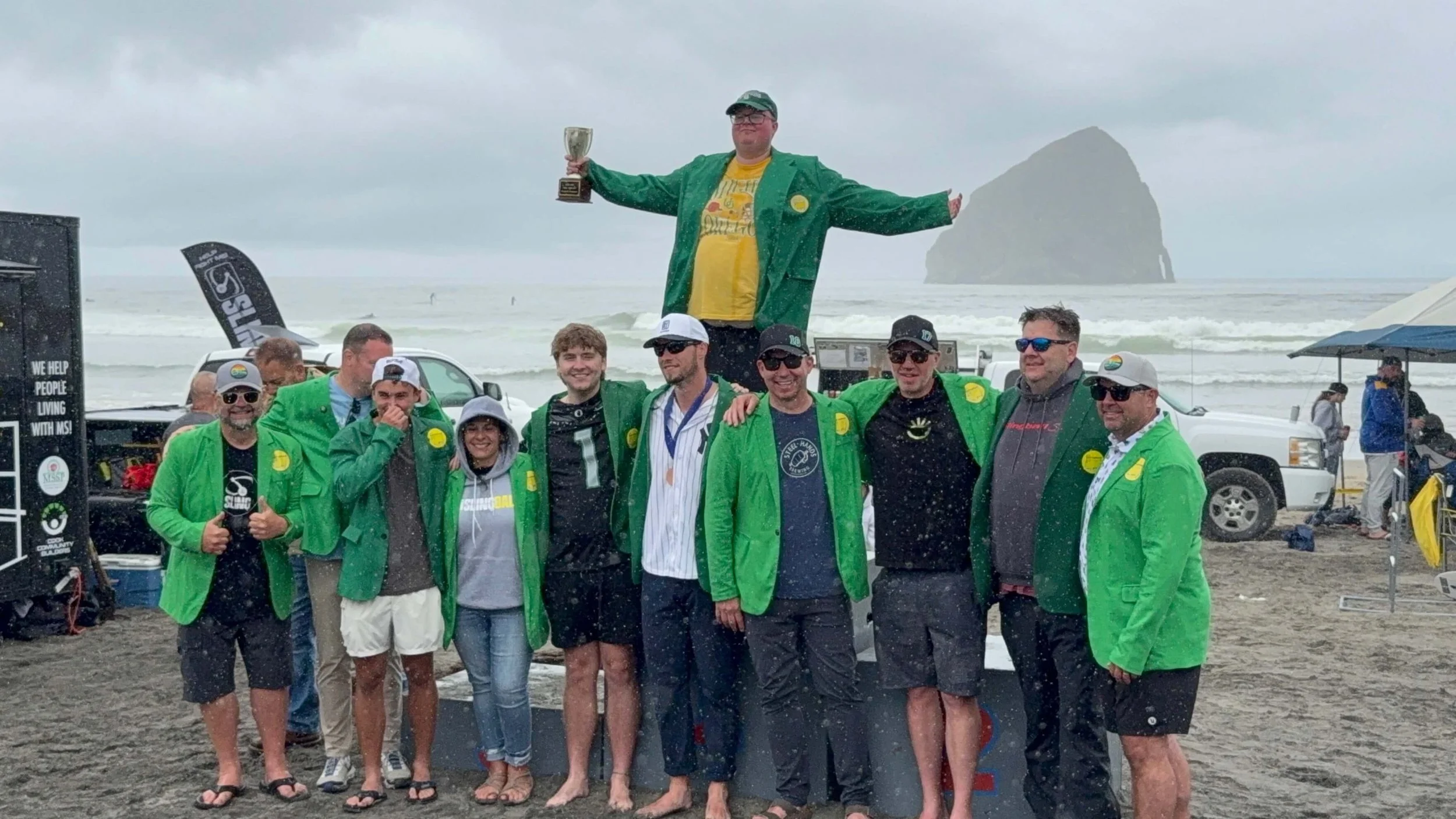
Beaverton’s Payton Haskins, the Sling 2026 champion, spreads his wings across a group of green-jacketed former champs (courtesy Randy Neu)
PACIFIC CITY — It was one of those all-weather weekends at the Oregon Coast. Some sunshine, but some rain and wind, too, which slowed the operation but did nothing to dim the atmosphere at Slingball 2026, the 19th running of one of the state’s unique annual summer events.
Randy Neu was beaming, and why not? The president of the non-profit Slingball, Inc., was looking out at a crowd of more than 200 participants in a fund-raising — and fun-raising — activity that benefits the Multiple Sclerosis Society of Portland.
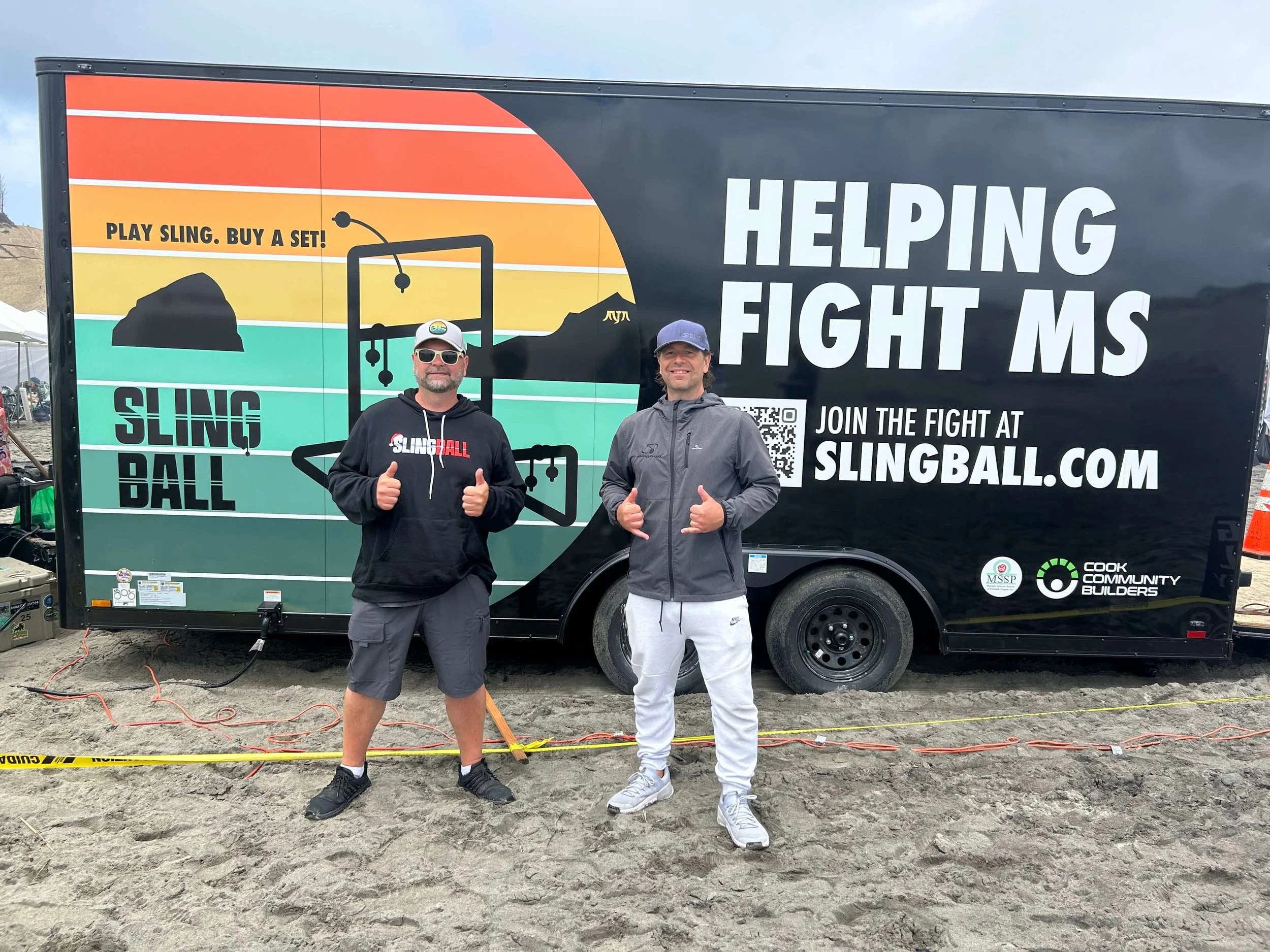
Brothers Carter (left) and Randy Neu began the annual Slingball charity event in memory of their mother Marilyn, who died of Multiple Sclerosis in 2005
“This is our largest group of players in five or six years,” Neu says, speaking on the beach that looks out to Chief Kiawanda Rock. “We may have lost a few (participants) because of the weather — we got hit by a few squalls — but everybody anticipated it. Weather is something you can’t control. Everybody puts up with it. They love the event, love giving to charity and helping people living with MS.”
I wrote about the event in 2022 here.
The champions this year were Beaverton’s Payton Haskins in the adult division and Dusty Anderson, 12, in the kids division.
Neu and brother Carter Neu staged the inaugural Slingball tournament in 2007 in memory of their late mother, Marilyn Neu, who died in 2005 from complications of MS at age 63.
Randy and wife Tracy and Carter and wife Wendy are members of the board of directors for MSSP, with proceeds directed toward those living with the autoimmune disease.
“We still help out with the cure (by way of the National Multiple Sclerosis Society/Oregon chapter), but we try to fill the gap for folks living with MS who don’t normally get (treatment) covered by insurance,” Randy says. “Families of those living with MS often get forgotten.”
Over the years, the Slingball event has raised more than $400,000 to fight MS. The tiller rang out at more than $33,000 for this year’s event.
“We are creeping toward the half-million mark,” Randy says. “We are looking forward to a big 20th (anniversary event) next year.”
Randy serves as MSSP president. Tracy — a teacher at Beaverton’s Barnes Elementary — is the executive director, and also emcees the annual Slingball event, directing competitors with a microphone and keeping chaos to a minimum.
“Her voice is miraculous,” Randy says. “It pierces through the crowd. She controls the whole event and is awesome at it.”
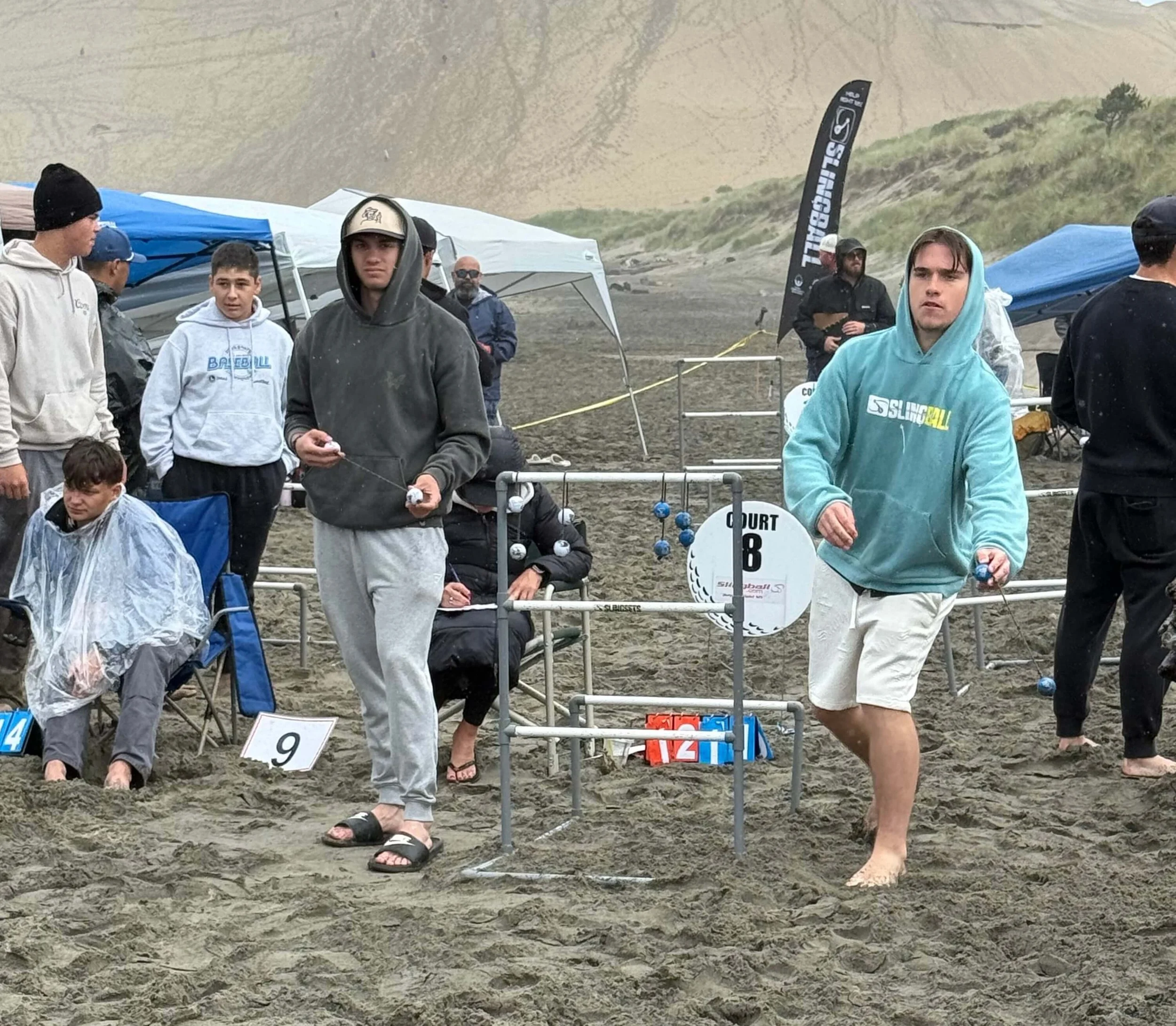
Ramsay Neu slings it during Sling 2026 (courtesy Randy Neu)
Carter and wife Wendy are also members of the MSSP board. Randy and Carter are both administrators for Portland’s Cook Solutions Group, lead sponsor through its Cook Community Builders program.
“I am happy to support this event,” says Brian Cook, founder, president and CEO of Cook Solutions Group. “It is a great way to kick the summer off. It’s good to know your money is going to a good cause.
“Really, it’s about the gathering — everybody getting together and having a fun time. Just a bunch of good people with positive vibes in a fun environment. And we’re at the beach — you can’t beat that.”
Slingball is a yard game that has a bit of horseshoes, of cornhole, of bocce ball to it. Two people play against each other by tossing a foot-long piece of rope tied to a pair of golf balls at each end, and landing the implement on a tower made of PVC pipe with four crossbars some 25 feet away. First to 21 points wins.

The origin of the game is uncertain. Variations have been called “hillbilly golf” and “cowboy golf.” Carter Neu discovered the game years ago while attending a Lincoln City Elks Club annual picnic. Carter made his own playing set, played in his backyard for awhile and came to call it “Hangball.” Eventually that morphed into “Slingball.”
“You kind of sling it like a gunslinger,” Randy says. “So we named it that.”
There is some skill involved in putting the implement in the right places to score points, but not a lot of athleticism is necessary.
“Some of the ‘athletes’ who are friends of ours lose,” Cook says with a grin. “They don’t like the game, because grandma beat them.”
The two-day Pacific City event features 12 courts set up for competition in the adult and children’s (12-and-under) divisions.
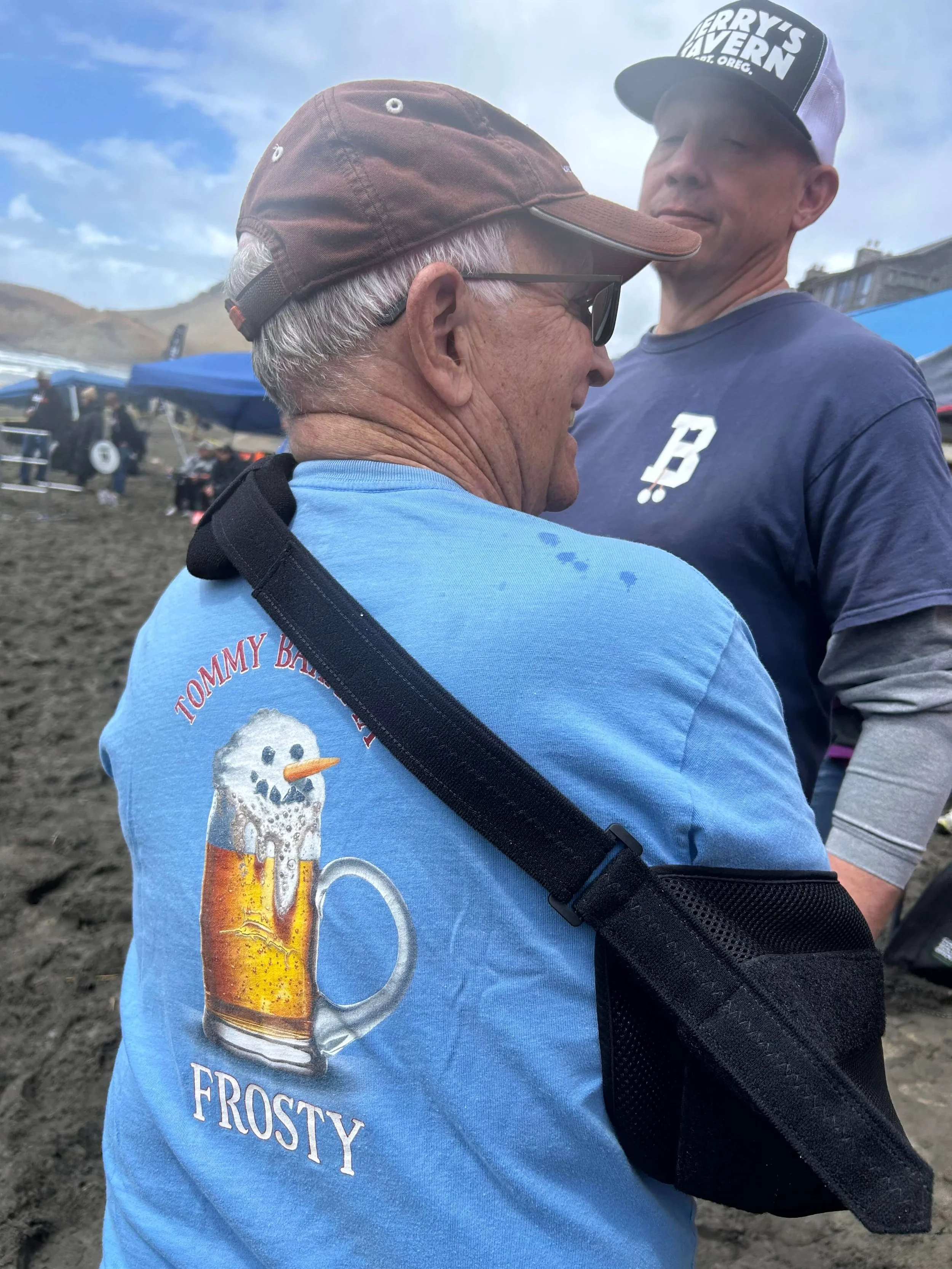
Frosty Comer, at 80 the oldest participant in Sling 2026, won two matches in the adult division, toughing it out after recent shoulder surgery
“We have a lot of kids play, and a lot of them who have come back,” Randy says. “What is great to see is how many kids grew up playing Slingball, and now are in college or have jobs in the real world and are coming back. I can’t wait for them to get married, have kids and continue on the tradition.”
Entrants arrive from throughout the Northwest. Some come up from California, “and we have a New York contingent, some of them transplanted,” Randy says.
Representatives of various regions compete with one another.
“There is a Vancouver crew, an Idaho crew, a Bonny Slope/Beaverton crew,” he says. “They fight for bragging rights.”
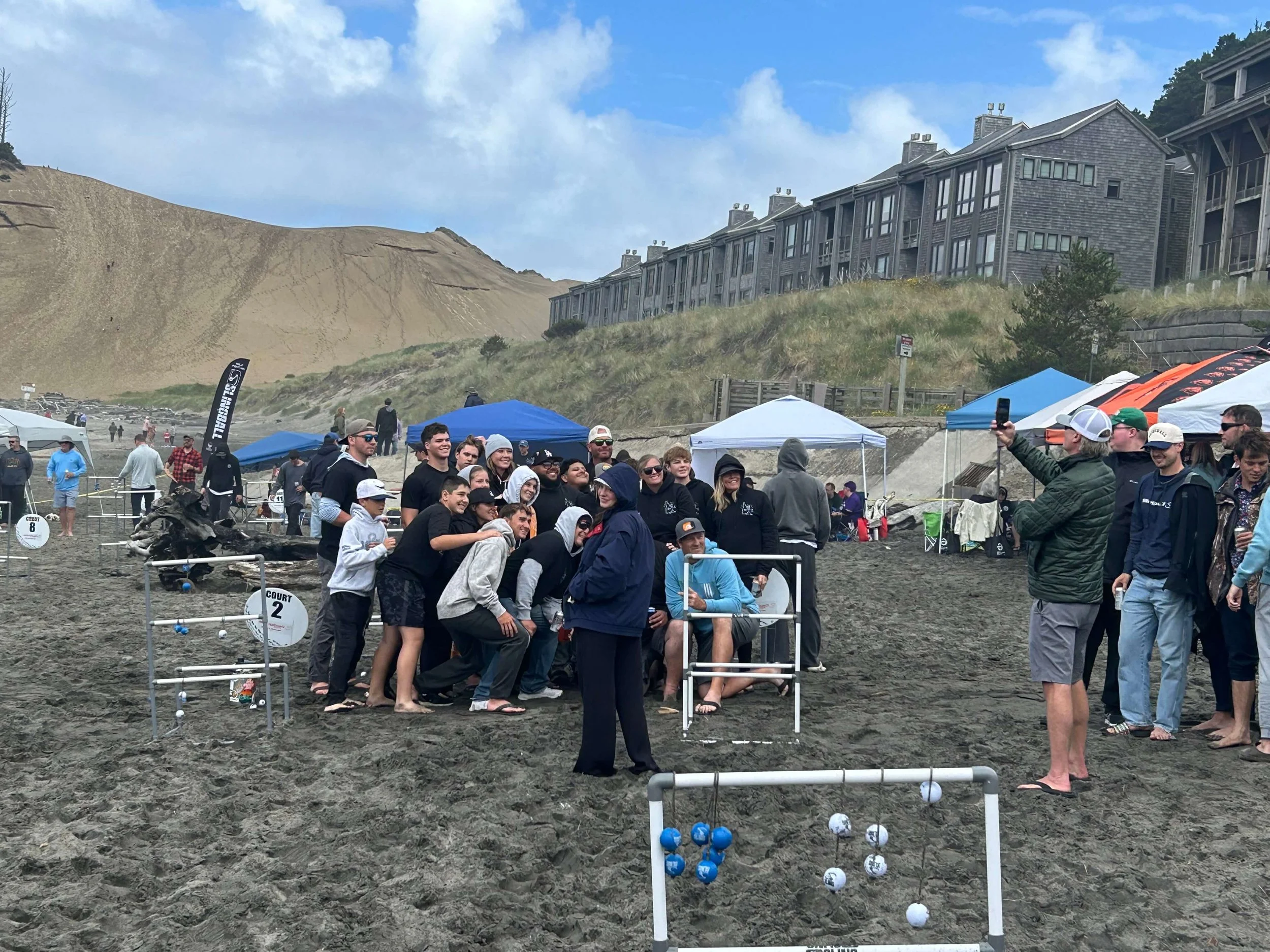
The “OC” group representing Idaho gathers for a photo op at Sling 2026
Marty Ogno is one of those transplants from the Big Apple, now living in West Linn. He has participated in about a dozen of the Slings through the years.
“I was here by chance the first year,” Ogno says. “We were camping and came by here. I saw these guys and asked what they were doing. They explained things, and I was all in.”
Ogno met Brian Cook while working security with U.S. Bank, “and we became friends after that,” Ogno says. “The growth of this thing has been amazing to watch. It’s a wonderful group of people who put it together. There is a competitive end to it, and there is some trash-talking, but it’s all in good fun. Never any back-biting. Everybody has a good time, we get the money into a good cause, and you can enjoy the beach on top of everything else.”
There has been only one female champion — Angie Menchaca of Nampa, Idaho, in 2019. It took her awhile, though. In her eighth year, she won the title. That pleased her, but the overall experience for her, husband Justin Rodriguez and their three boys has been important, too.
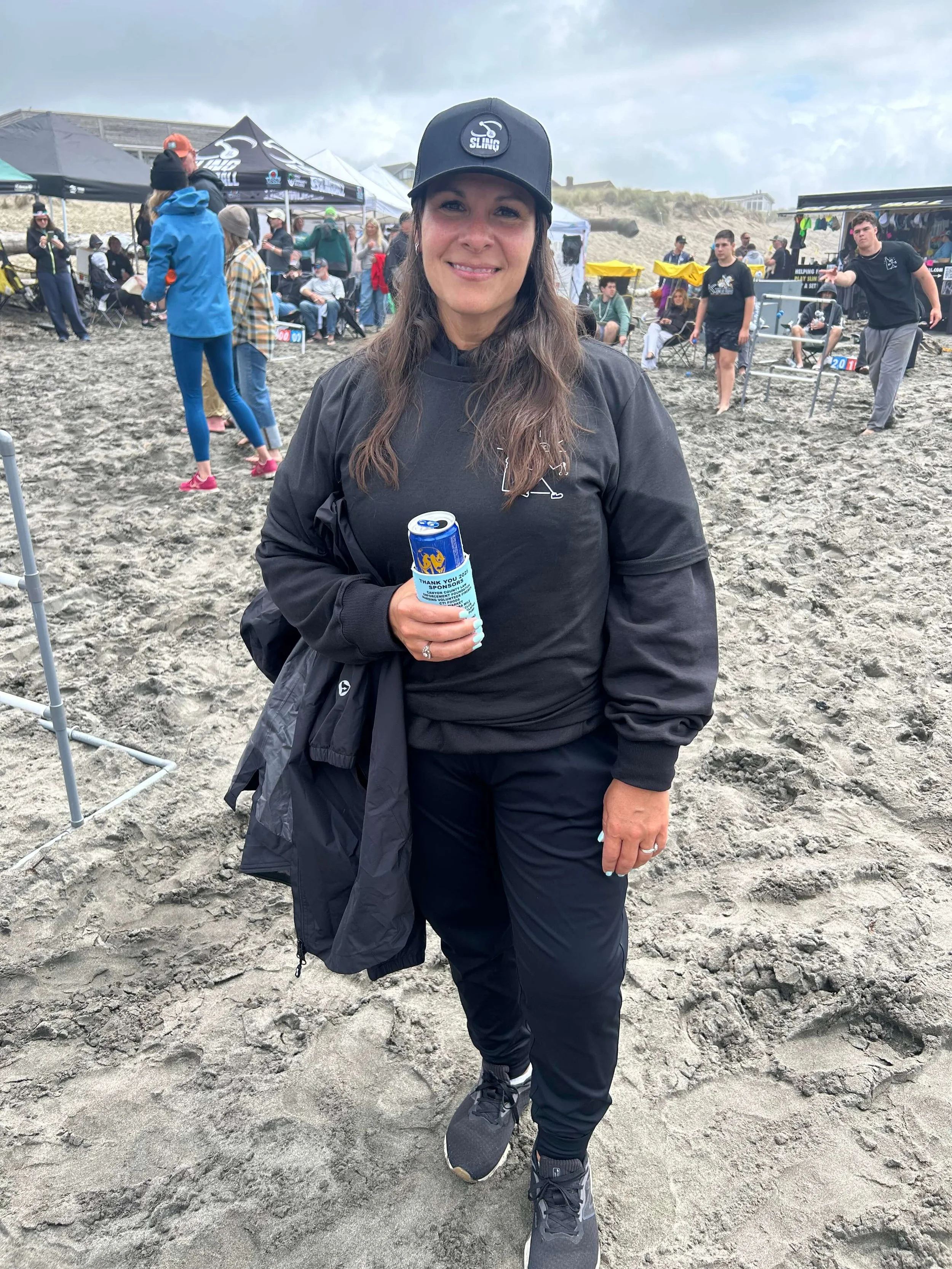
Angie Menchaca is the only female champion in the tournament’s 19-year history
“We have met people from all over the Northwest,” she says. “There is a competitive aspect to it that makes it super fun, but it’s just a good family-building time. Our kids grew up playing when they were in the kids’ division, and now they are in the adult division. It is a bonding experience where we can enjoy our time with each other for a good cause.”
The champion is awarded the “Sling” Cup — a play off soccer’s FIFA World Cup. There is a tradition that goes with the presentation ceremony.
“If you win it all, you get your drink of choice, and drink a little bit of it, and then dump the rest on your head in celebration,” Randy says. “Usually, it’s beer. If it’s a kid, it has to be root beer.”
In recent years, there has been another tradition — a “Champions Dinner” held on the Friday before the tournament. It is the brainchild of past champions Jeff Wenckus (2017) and Craig Cook (2018). The champion each year is awarded a green jacket, much like what is customary with the winner of the Masters Tournament.
“I was the first green jacket guy,” says Cook, who serves as CXO (chief experience officer) for Cook Solutions Group. “In 2018, Patrick Reed won the Masters, and that year he was showing up at every sporting event obnoxiously with the green jacket on. So (at the 2019 Slingball Tournament, I showed up with a green jacket. It helped that Jeff had won the previous year, so he added to it.”
“We had 12 or 13 (former champions) at the dinner this year,” says Wenckus, who has participated in 15 Sling tournaments over the years. “As you can imagine, it is very guarded, very exclusive. It is an awesome event, but some people — like Aaron Angelo — have resorted to stealing a green jacket. He wants to be a part of the group so badly.”
The real champions know who they are, though.
“I am glad I snuck in to win a green jacket (in 2022), because it is getting harder,” says Ronan Eggleston of Camas, Wash. “There is more and better competition every year.”
Wenckus summarizes the reason to participate in succinct terms: “No. 1, a great cause, but also a great time, great atmosphere, family and friends, food and beverage. Nothing better. We look forward to it every year.”
“If you show up once, you feel it, and you know you are coming back,” Craig Cook says. “There is a community of Slingball people that you want to be a part of.”
Randy Neu has never won a title — he has twice been runner-up — but is pleased to be on the organizational end of what has become an important event on the summer calendar.
“Beyond helping people living with MS, we love bringing families and friends together,” Neu says. “They keep coming back and they tell their friends about it, and they come, too. It’s an organic way of spreading the love. Whether you are someone afflicted with MS or not, you can come out and have a great time. We thank everybody who supports our cause.”
For more information about Slingball go to slingball.com.
“You can buy a set, or some merchandise, or just donate,” Neu says.
► ◄
Readers: what are your thoughts? I would love to hear them in the comments below. On the comments entry screen, only your name is required, your email address and website are optional, and may be left blank.
Follow me on BlueSky.
Follow me on X (formerly Twitter).
Like me on Facebook.
Find me on Instagram.
