There’s Irish stew cooking in Milwaukee with Casey, Murphy
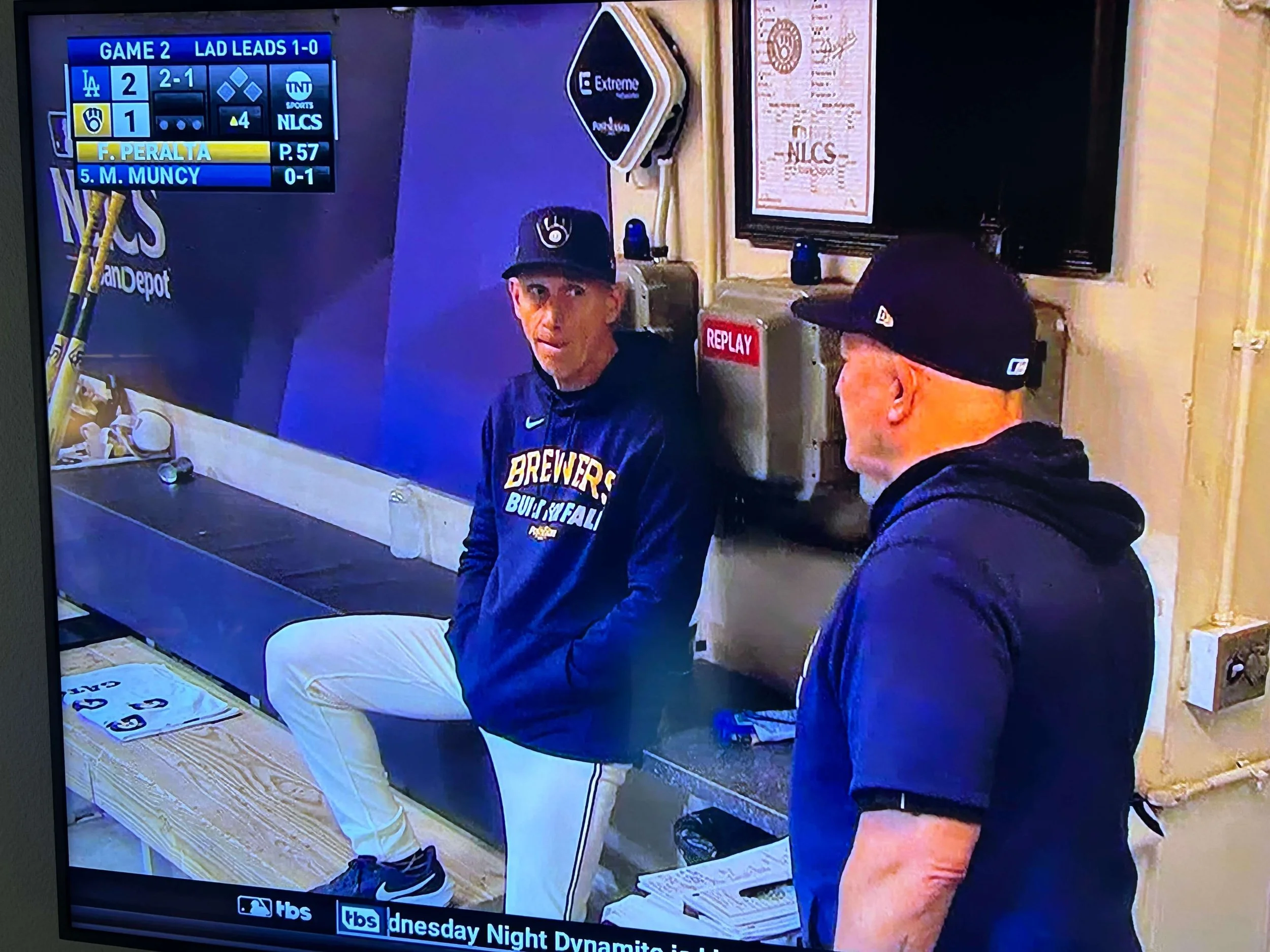
Pat Casey (left) with manager Pat Murphy in the Milwaukee dugout during the 2025 NLCS
Updated 3/27/2026 7:20 AM
When the Milwaukee Brewers open the regular season Thursday against the Chicago White Sox at American Family Field, Pat Casey won’t be there. But he will be in spirit.
Casey returned to his Corvallis home last week after spending five weeks with the Brewers at their American Family Fields spring training complex in Phoenix.
It was the second spring training and third season in which the former Oregon State coach has served Milwaukee manager Pat Murphy in player development.
“It was good, because I get to be around the young guys,” Casey says. “We had most of our 40-man roster there, so there were a lot of players who are not going to make the club. But they have a lot of talent in that 40-man pool.”
Indeed, the Brewers have plenty of talent. They were good enough to finish the 2025 regular season with the best record in the major leagues (a franchise-record 97-65) and beat the Chicago Cubs in the National League Division Series before being swept by the L.A. Dodgers in the NL Championship Series.
Milwaukee also have an outstanding leader in Murphy, who was honored as NL Manager of the Year last season. It was the second of back-to-back MOY awards for Murphy, who became only the third man to achieve that distinction, joining Atlanta’s Bobby Cox (2004 and ’05) and Tampa Bay’s Kevin Cash (2020 and ’21).
Murphy a—nd Casey, both 67 years old, locked horns for 15 seasons as head coaches in the Pac-10 from 1995-2009— Murphy at Arizona State and Casey at OSU. It was a fierce rivalry and one of mutual respect and admiration between two of the nation’s premier coaches.
Murphy left ASU via forced resignation in 2009 after the NCAA investigated his program for illegal student-athlete employment and recruiting. Murphy was ultimately found innocent of the charges but the program was sanctioned and banned from postseason play three years later for lack of institutional control.
In 2010, Murphy was hired by the San Diego Padres and managed the Northwest League Eugene Emeralds in 2011 and ’12. He managed Padre affiliates at the Triple-A level from 2013-15 and served as interim manager for the Padres for 96 games in ’15 after Bud Black was fired. After the 2015 season, the Brewers hired Murphy as bench coach, a position he held through 2022. When Craig Counsell left to become manager of the Cubs before the 2023 season, Murphy moved into the managerial role with the Brewers.
Murphy asked his old friend and foe to join his staff on a part-time basis during the ’23 season. Casey did and enjoyed it enough that he started the ’24 campaign with the Brewers in spring training. Though the job was still part-time, he spent a considerable amount of time helping out not only with the big-league club but with its minor-league affiliates as well.
Casey was with the Brewers for the entire run of their 2025 postseason, beginning with their five-game elimination of the Cubs in the NLDS.
“It was a really good experience,” he says. “The players were playing at such a high level. Everything is elevated, just like the Regional and Super Regional in college. Everything gets amped up. Everybody comes with your best game.”
There was personal pleasure for Casey in seeing his former player at OSU, Matt Boyd, who pitched for Chicago in the series. He failed to get out of the first inning in a 9-3 Milwaukee victory in the opener but was outstanding in Game 4, shutting out the Brewers on two hits in 4 2/3 innings of a 6-0 Cubs victory.
“It worked out just great,” Casey says. “He struggled (in Game 1), came back and was really good (in Game 4), and then we won the series.”
The Dodgers swept the Brewers in the NLCS, but they didn’t overwhelm them, winning two games by one run, one game by two runs and the fourth game by four runs.
“The Dodgers were playing at an extremely high level,” Casey says. “The Brewers had to do everything in their power to have the best record in baseball. They knew that was their one chance.”
The Dodgers ranked second in team payroll among the MLB’s 30 teams in 2025 at $321 million, barely behind the New York Mets at $323 million. The New York Yankees ($293 million) and Philadelphia Phillies ($284 million) were next. The Brewers ranked 23rd at $115 million. (Seattle was 16th at $146 million.)
And it is getting worse. According to Sports Illustrated, the Dodgers’ projected outlay in payroll and luxury tax for the upcoming season is $527 million. Last year, they paid $169.4 million in taxes alone — more than Milwaukee paid in player salaries. The Dodgers have nearly $1.1 billion in deferred player salary in their coffers.
“The Dodgers can sign anyone they want, can get anybody they want at the trade deadline, because they have the money,” Casey says. “They can rest a pitcher like (Blake) Snell for six weeks during the season to get him ready for the playoffs. They can do what they want with (Shohei) Ohtani, too. The Brewers can’t afford to do that. They don’t have that kind of money, so they are not getting those kind of guys. When the Dodgers came to the playoffs, their plan was laid out. Snell was fresh and Ohtani s ready to throw.”
Casey watched from the Brewers dugout when Ohtani provided a performance for the ages, swatting three solo home runs while pitching six innings of two-hit shutout ball in a Game-4 close-out victory.

The Dean of Portland Sports is now on BlueSky.
“To be 100 feet away from a guy who hits three home runs in a game of that magnitude — it was pretty impressive,” Casey says.
During spring training this year, Casey served a similar role as the previous season.
“You just do what you do at a baseball park,” says Casey, who retired from his coaching job at OSU after claiming his third College World Series title in 2018. “I help where I can. There is a lot of watching and monitoring drills. We have a (coaches’) meeting every morning. That is where you talk about who you saw doing what, how you liked it and so on.”
The Brewers’ big-league roster during spring training included all of the players who will comprise the opening-day roster of 26.
“Then there are four or five players who have a chance to make it, and then some others who are in camp who will wind up starting the season in the minors,” Casey says. “But by the time I left, everybody was pretty much punched in (to the major league roster) except a couple of spots.”
Casey learned quickly that working with pro baseball players is different than coaching college kids.
“In college, if a batter is in the cage and you see him do something (that needs correction), you take care of it,” he says. “At the big-league level, unless a player asks, you don’t offer a lot of help. There are players who will walk over and ask, ‘Does it look like I am staying through the ball there? Do you think I am pulling off the ball?’ There is less instruction, especially with the big-leaguers, unless they ask for it. We are there to assist them if they want, to help monitor the situation.
“When I talk to a player about hitting, I find I am much more inclined to listen to him and see what he’s telling me before I offer any instruction. There is no push like in college to say, ‘Let’s meet in the cage tomorrow and take some swings.’ ”
Casey says his time working alongside Murphy — two Irish boys of the same vintage — “has been awesome.”
“We look out the same window,” Casey says. “He is going to manage; he is not going to just sit there and watch. He has expectations of how he wants his guys to play. He is very astute at who he visits with and in what manner. He was a (Brewers) bench coach for seven years. He got to see it all.”
Through that experience, Murphy has learned how to handle players as they prepare for a season.
“If you have an established big league player, maybe an All-Star or a premier player, they have a little more freedom to have more work the way they want it,” Casey says. “If you are a 10-year vet, you may say, ‘I need X amount of at-bats in spring training,’ and the organization respects that. Whatever it may be, there are unwritten rules there that are followed, because they are in the best interest of someone playing 162 games for you. The season is a grind.”
Casey has been impressed with the way the Brewers run their ship.
“There is a ton of detail work in the organization before you are ever getting on the field,” he says. “It starts with the morning meeting and what today (in practice) is going to look like, what the emphasis is going to be. What is so cool, you have so much room and so many fields, there are days where you have only two hitters on one field and you work with just those two guys. There are so many people who work out there on the fields, be it coaches, managers, trainers, equipment people, IT people, players just don’t go out on the field to shag (balls) anymore.”
Even so, says Casey, baseball is still baseball.
“I say this to Murph all the time: Really, the game never changes,” he says. “Things within the game — the rules, new technology, new training procedures — that stuff changes all the time, but the game never changes. You gotta get people out. You have to pick the ball up and throw it across the diamond. If you pitch and defend in the big leagues, you are going to win, and we defend at a very high level.”
Last season, they ran and they hit, too. Milwaukee led the NL in stolen bases (164), tied for first in batting average (.258), and was second in runs scored (806) and hits (1,423).
“The Brewers run the bases better than any team in baseball, and it is a priority,” Casey says. “A purist would be impressed to come into our big-league spring training facility and see us working on baserunning.”
But with the Brewers, there is less margin for error than with the richer clubs.
“Murph had a great line this year: ‘We have to thread the needle,’ ” Casey says. “That is what we have to do in our organization. I have learned so much about why things happen.”
Casey understands why the Brewers chose to trade ace Freddy Peralta, who was 17-6 with a 2.70 ERA and finished fifth in NL Cy Young Award last season, to the Mets for a pair of prospects. Peralta is entering his contract year in ’26.
“Freddy is a premier, front-line pitcher, but the Brewers had to look at it from a business standpoint,” Casey says. “They were not going to sign the guy to a huge contract; that is not how they work. And if they kept him until the trade deadline, they were not going to get the same value. Sometimes teams are forced to do that because of their payroll.”
Casey says the Brewers manage their budget well.
“They do an amazing job with the payroll they have and the players they acquire,” he says. “Their scouting system is terrific. They bring in players who play the game the way they want it to be played. They win games in Milwaukee because they do a lot of things that are overlooked in baseball, and they do them better than anybody else.
“They move runners over, they defend, they do things that aren’t in the stat book, like going from first to third (on a single). We are absolutely the best at that. We practice it. We have a plan. It is something that is worked on all the time. They do an amazing job of not taking the freedom away from the big swing if (a hitter) can do damage, but also letting them understand that we value on-base percentage and having a good knowledge of the strike zone.”
Casey says nothing he has seen from Murphy in his two-plus seasons with the Brewers has surprised him.
“I knew it would be this way going in,” Casey says. “When you coach against people over a five- or 10-year period, you know. If you play Mike Gillespie (the former USC coach), you better defend, you better pitch, you better have your head on a swivel. Because if you don’t, they will take advantage of it. Same with Murph (at Arizona State).
“Those things haven’t changed for him, how he handles players, how he talks to them and how he does what he has to do. Although sometimes those things get altered because they need to be.”
Casey believes the Brewers will be even better offensively than they were last season. He mentions 22-year-old centerfielder Jackson Chourio, who hit .270 with 21 homers and 78 RBIs in ’25; catcher William Contreras, who hit .260 with 17 homers and 76 RBIs, and DH Christian Yelich, the slugger with a .265 average, 29 homers and 103 RBIs. Also, 25-year-old Brice Turang, who hit .288 with 18 homers and 81 RBIs. “He is as good, if not the best, as any second baseman in baseball,” Casey says.
Casey is also high on first baseman/outfielder Andrew Vaughn, the former California standout who was picked up in a midseason trade with the White Sox. Vaughn, who hit .189 with Chicago, batted .308 with nine homers and 46 RBIs in 64 games with the Brewers.
“I happened to be there the day Vaughnie came in,” Casey says. “I told Murph, ‘I couldn’t get the sum-bitch out in college.’ (Vaughn) walks in the dugout and we spent some time talking. I told him, ‘Just be the very best Andrew Vaughn you can be; I couldn’t get you out (at Oregon State).’ The very first at-bat, he hits a home run. He comes over smiling and says, ‘I just need you in the dugout.’ He will be good for us this year.”
Pitching is more of a question mark. The projected starting rotation includes Jacob Misiorowski, Brandon Sproat, Chad Patrick, Kyle Harrison and Brandon Woodruff. Quinn Priester, who went 13-3 with a 3.32 ERA as the No. starter a year ago, is being shelved until May with a wrist injury.
“People will look at the staff and say, ‘Losing Freddie, somebody else has to step up,’ ” Casey says. “But most of the staff is back. The closer (Trevor McGiil, who had 30 saves) is back, and so is the set-up guy (Abner) Uribe, who was tremendous (3-2, 1.67 ERA).”
Casey spent between 35 and 40 days working with the Brewers last year and nearly as much time visiting minor league clubs for appraisals of the prospects. He envisions a similar schedule this season.
“That is what we do in player development — go in and watch those guys, provide a report on them,” he says. “The Brewers have such a great system. They have people go in all the time, whether it is the roving minor league hitting instructor or whatever.”
Casey has enjoyed rekindling a friendship with Longview, Wash., native Rick Sweet, manager of the Brewers’ Triple-A affiliate, the Nashville Sounds. Sweet, 73, was manager of the PCL Portland Beavers from 2001-03 and began his college playing career under ex-Oregon State coach Jack Riley at Lower Columbia CC.
“Rick and I have enjoyed the hell out of it, two Northwest guys talking about the old times,” Casey says. “It is rewarding doing what I am doing, and I enjoy it. I don’t like doing anything if it doesn’t have substance to it. Doesn’t matter to me if I am working with the big-league club or in the minor league system. If I am in Nashville I feel the same way I do in Dodger Stadium. If I can help someone, I am happy. I like talking the game. Murph and I will talk about the game. We will talk about situations. We will talk about people. It is the same as it was at Oregon State, talking to Bailes (Pat Bailey) and Nate (Yeskie) about things.”
In January, Casey was inducted into the American Baseball Coaches Association Hall of Fame in Columbus, Ohio.
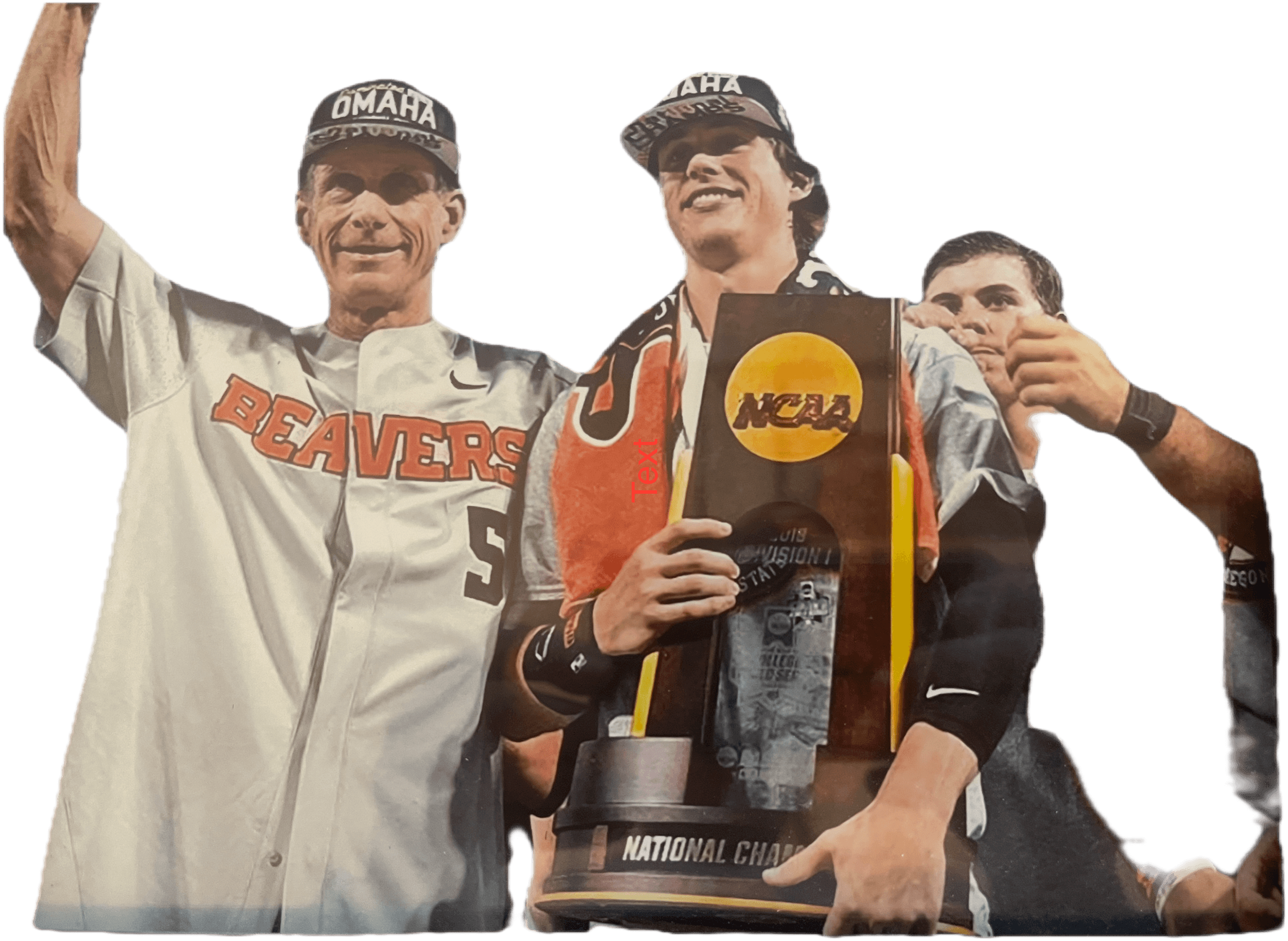
Pat Casey, with son Joe holding the trophy, after Oregon State’s College World Series championship in 2018 (courtesy Casey family)
“As a 35-year member of the organization, they had to let me in,” jokes Casey, who is also a member of the state of Oregon, Oregon State, George Fox and University of Portland sports halls of fame as well as the College Baseball Hall of Fame. “I remember going to my first ABCA Convention when I was at George Fox. I drove down with (Former Linfield coach) Scott Carnahan. I was inducted in the same class with Sam Piraro, who was at San Jose State forever. We played them my first couple of years at Oregon State. He was really good to me as a young coach.”
Casey is humbled by all of the honors from his coaching career.
“I accept these things — and I mean it — on behalf of everybody who was with me along the way,” he says. “That is the hard thing about individual awards. It is the result of a cumulative effort of many people. That goes from your players to your coaches to trainers to team doctors to SIDs.
“The thing I miss more (about college coaching) than anything is being around so many great people on the ballfields. I never tried to make it bigger than it was. I never tried to do anything other than make things the best they could be for all of us.”
Casey has seen the current Oregon State team play twice, when he called streaming video broadcasts at the Frisco (Texas) Classic early in the season.
“It was a blast to watch them play,” Casey says. “Their pitching depth is really good. Offensively, they are going to keep getting better because they are young. Over the last six or seven years, they have had a first-round bat in the middle of the order with guys like (Jacob) Melton, (Travis) Bazzana and (Gavin) Turley. They don’t have that type of guy this year, so they are more balanced.
“They defend really well. You miss certain pieces. (Former catcher) Wilson Weber behind the plate was a real leader. But the coaches are doing a great job with them, and they are going to be just fine.”
► ◄
Readers: what are your thoughts? I would love to hear them in the comments below. On the comments entry screen, only your name is required, your email address and website are optional, and may be left blank.
Follow me on X (formerly Twitter).
Like me on Facebook.
Find me on Instagram.
