The sports photogs: They shoot, and they score
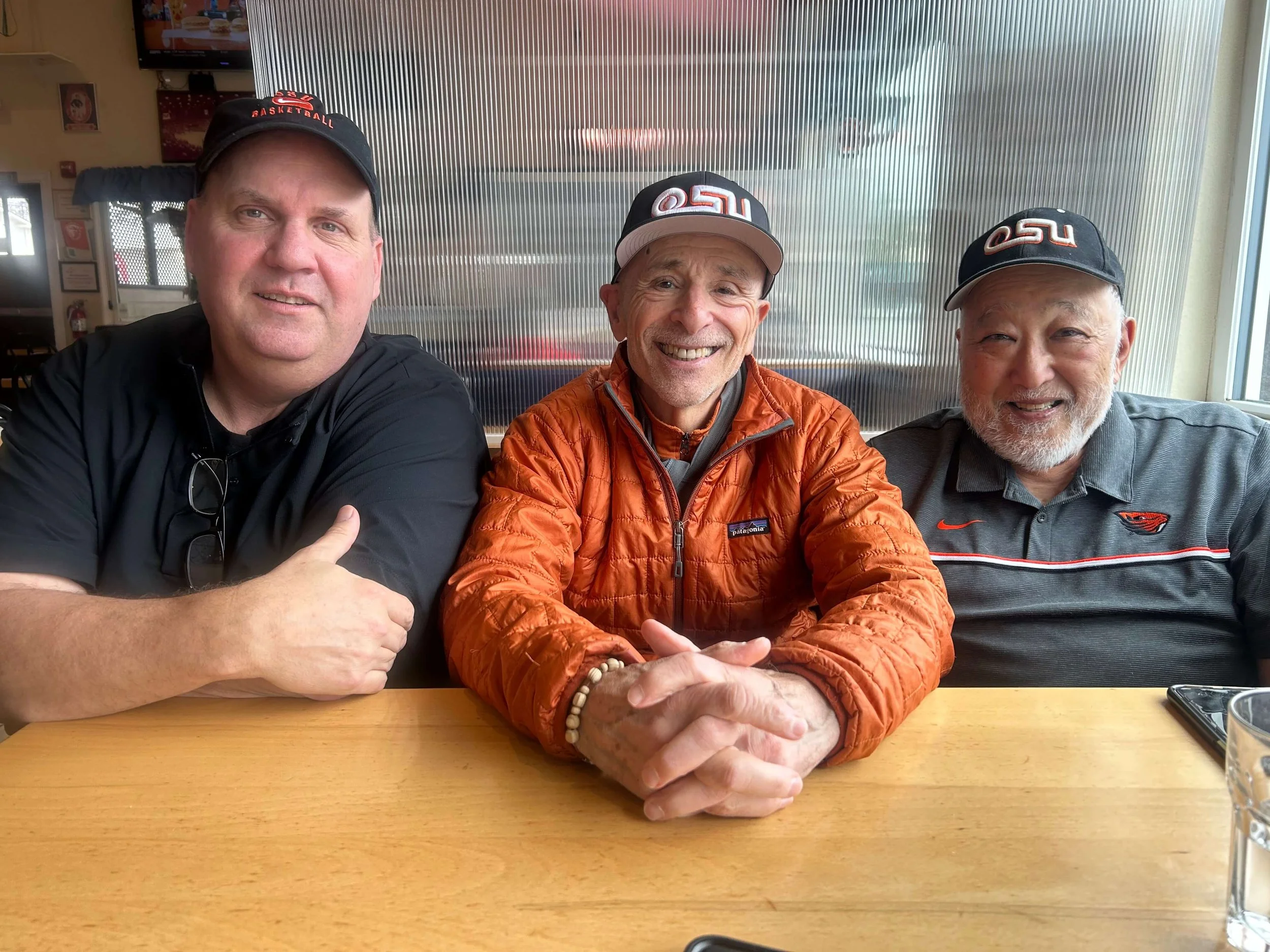
The esteemed photographers profiled in the story, from the left Karl Maasdam, Dominic Cusimano, and Dave Nishitani
Updated: 4/21/2026 10:55 PM
CORVALLIS — Sports photography is an art, but in some ways, it is also a science. Coming up with a great sports shot takes knowledge, preparation, timing, a good camera and, of course, a little luck.
One of the best I ever saw was Brian Lanker, who worked for the Eugene Register-Guard in the 1970s and ‘80s and also free-lanced for Sports Illustrated and Life Magazine. I knew Brian a little and always admired his work. SI had a number of great ones through the years, including Walter Iooss and Neil Leifer.
During my time with the Oregon State Barometer, I worked with Dennis Dimick and Chris Johns, who rose to prominence in the national photography world. I had the pleasure of working with several who were very good at the Oregon Journal, Oregonian and Portland Tribune, among them Roger Jensen, Ross Hamilton, Steve Nehl, Brent Wojahn and Jonathan House.
Since I started kerryeggers.com in 2020, I have received excellent photo help from three gentlemen who live in Corvallis and are affiliated with Oregon State — Dominic Cusimano, Karl Maasdam and Dave Nishitani. I gathered them for a recent lunch and interview session and asked them to share a few of their favorite sports photos through the years.
► ◄
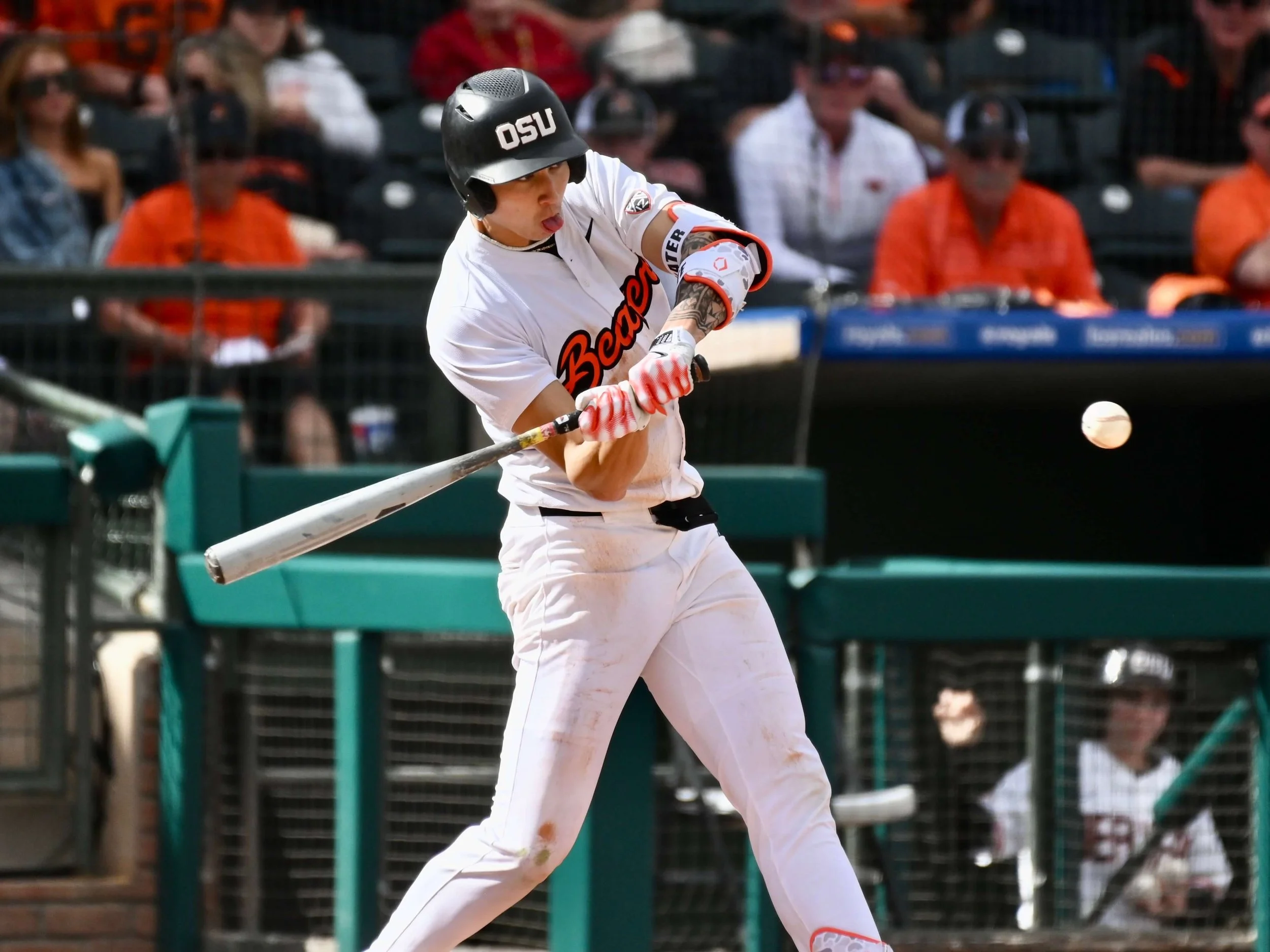
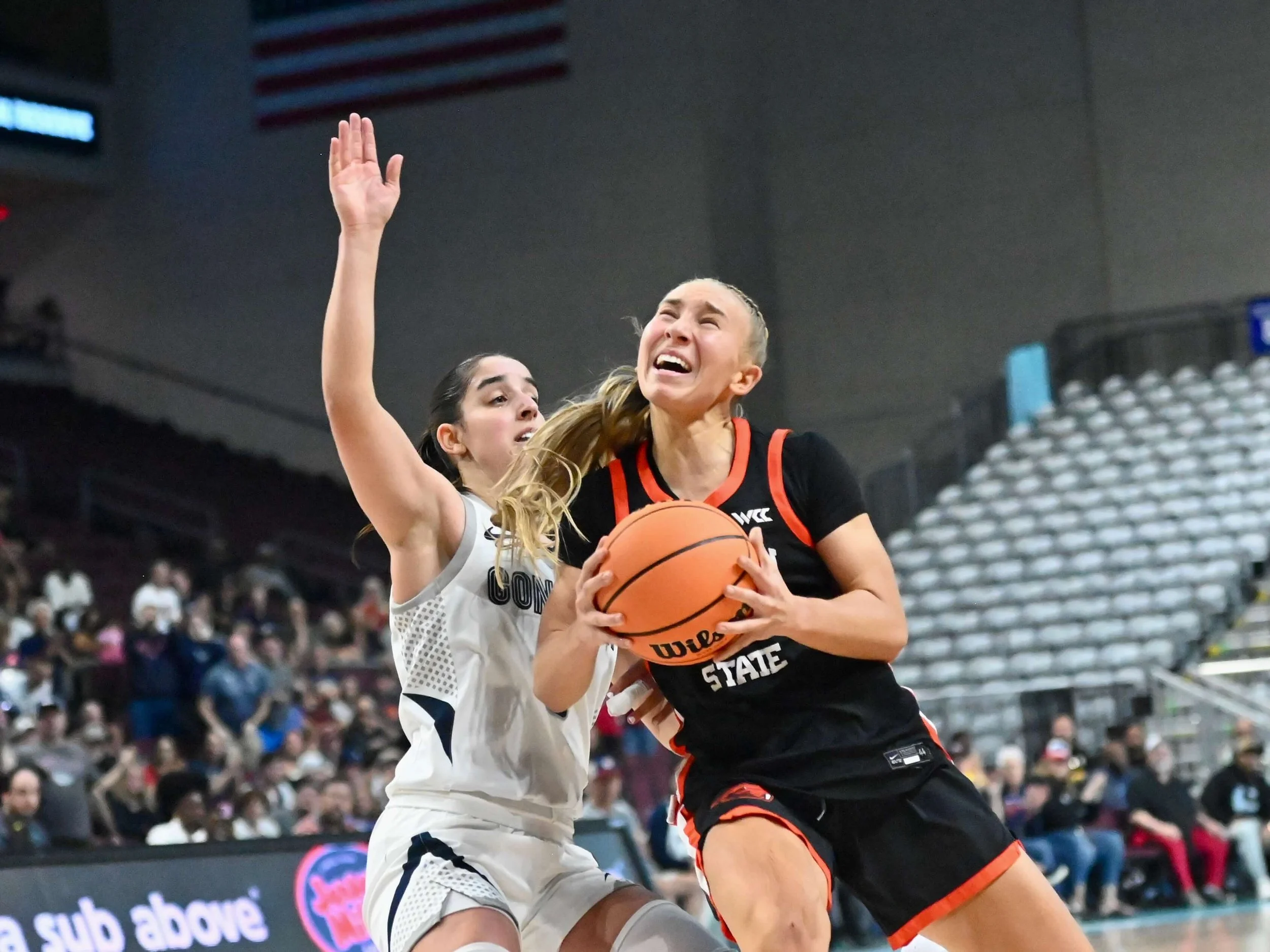
Let’s start with Cusimano, 76, the amateur of the group. A Brooklyn native and graduate of Saint Francis University in Brooklyn. Dom and wife Barbara, who were wed in 1978, moved to Oregon in the early ‘80s and have been in Corvallis since 1988. Both were educators. Dom taught physical education in the Corvallis School District for 25 years. Barb worked at Oregon State for 25 years; her specialty was training K-through-12 PE teachers. Among her students: OSU women’s basketball coach Scott Rueck and OSU Sports Hall of Famer Jim Wilson, now radio analyst for Beaver football.
“At Scott’s first press conference (in 2010), he thanked Barb,” Dom says proudly.
Dom’s first camera was a Pentax gifted to him by his grandfather.
“All the men on my mother’s side were longshoremen,” he says. “My grandfather would bring stuff home off the ship. He brought a camera home when I was 12 or 13 and he said, ‘It fell off the ship.’ I took a lot of pictures of friends, just playing around. I always enjoyed taking pictures.”
Fast forward to the 2000s, when Mike Riley was football coach at Oregon State.
“Mike had open practices that the public could attend,” Cusimano says. “I would take my camera to practice and shoot some pictures. That is how I started to get interested in sports photography. Two or three years into it, I started to study more about it, because I was an athlete and loved taking photos of people moving.”
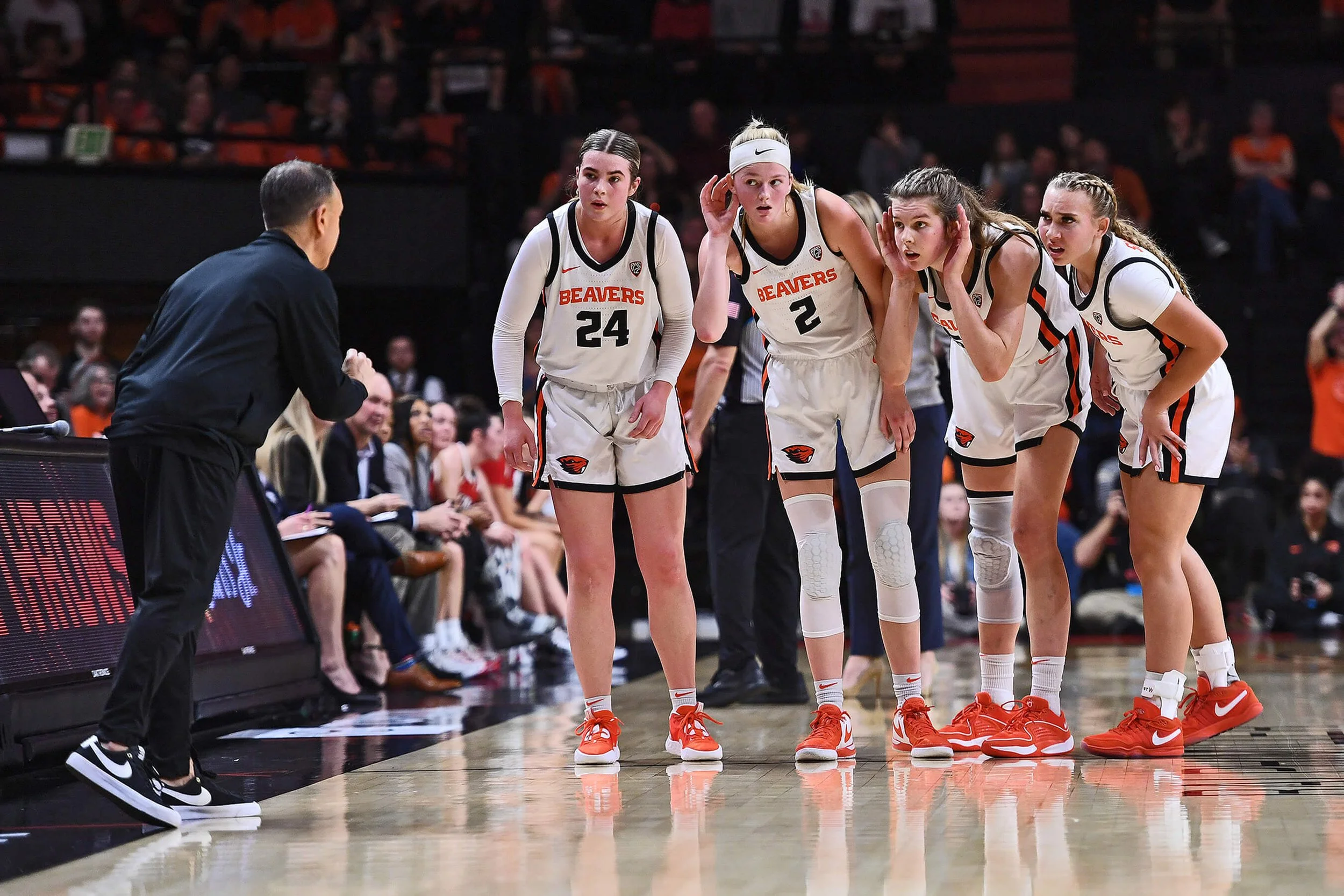
Cusimano cranked up his interest during the early part of the Rueck era at OSU.
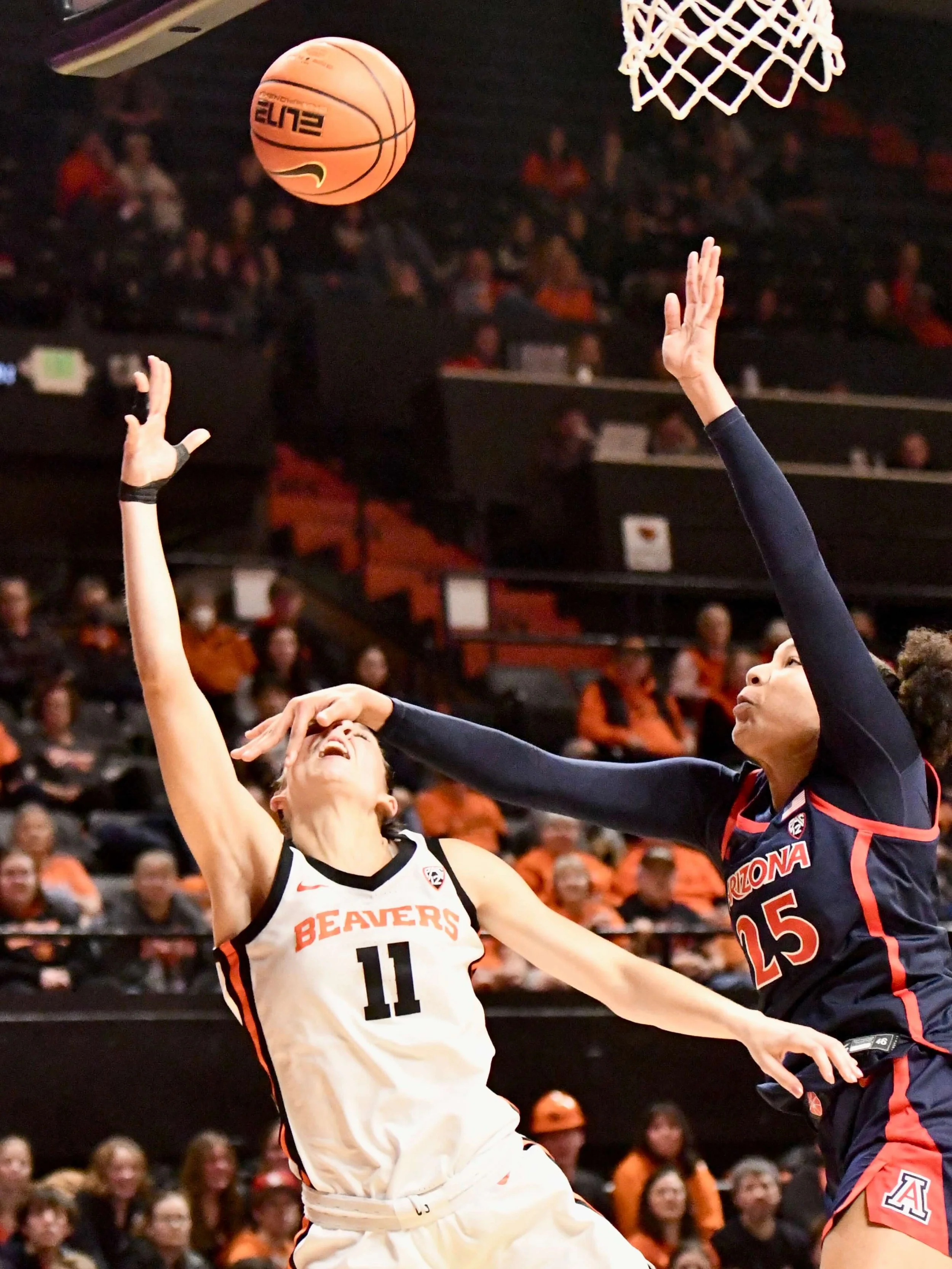
Arizona’s Breya Cunningham (25) turns out the lights on OSU’s AJ Marotte, who converts a basket and a three-point play in 2025 (courtesy Dominic Cusimano)
“By then I had a Nikon D500,” Cusimano says. “I started taking the camera to Gill and taking pictures from our seats in the third row behind the Beaver bench with a 300-mm lens. Somewhere along the line I got a media pass. I would sit with Barb for a quarter, go down on the floor for a quarter, and go back and forth.”
Cusimano does not shoot for Oregon State.
“They have the Beaver creative team, which is constantly shooting photos and video, and I don’t want to interfere with that department in any way,” he says. “I appreciate that my credential is a courtesy and I don’t work for the school, so I want to respect that relationship.”
But he provides pictures for the players and their families, and posts collections of them on Facebook.
“I share photos with parents and sometimes players if I get to know them personally, and if they ask,” he says. “I post photos after each women’s home game on my Facebook page, and on three Beaver-related sites (Pure Orange, Beavers Behind Enemy Lines, Oregon State Women’s Basketball Hoop Scoop).”
In 2017, Cusimano began to publish an annual yearbook, which he makes available to the public. (For information, reach out to Dom via email at mugs2650@comcast.net.)
“Proceeds from that offset costs to upgrade my equipment,” Cusimano says. “Since I started, I have had three cameras and a couple of different lenses.”
At the end of each season, Cusimano puts together a slideshow for each Beaver senior, which he posts on YouTube and places on a thumb drive for each of them.
“These have photos of the players from each year they have been with the program,” he says. “If a player has been here for four years, I would have in the range of 400-500 photos for each of them.”
For many years, the Cusimanos have traveled to Surprise, Ariz., for the Beavers’ annual early-season baseball tournament there. Since Mitch Canham has been coach, Dom has been able to shoot photos from the field. He provides photos for coaches, players and families and, again, posts on Facebook.
“In February, I put together a Google-shared album for each of the games in Surprise and passed the links along to the parent group for them to share and use as they want,” he says.
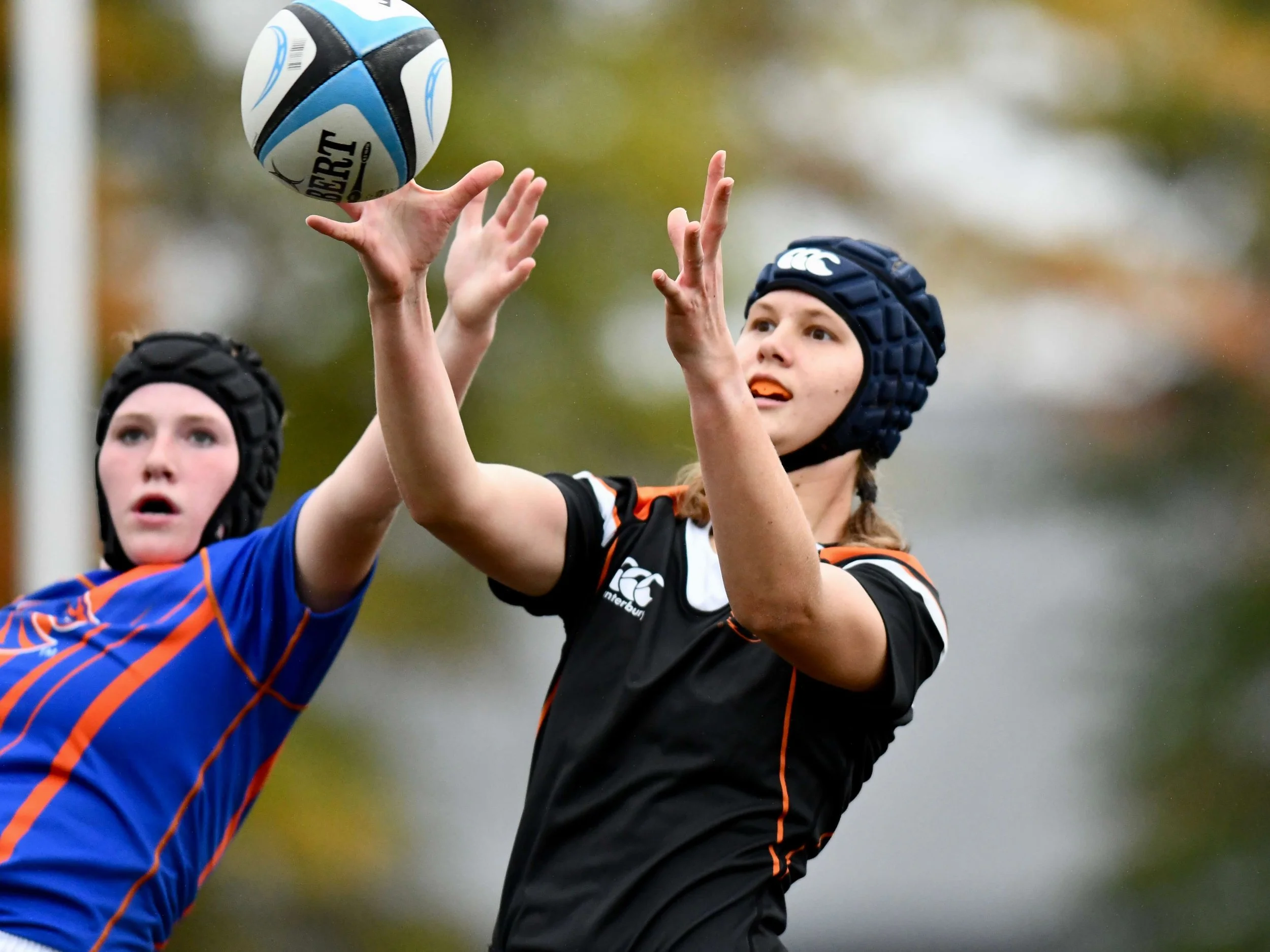
Cusimano shoots OSU wrestling meets and also has shot photos at Beaver club rugby matches and at rowing meets.
“(Head rowing coach) Mike Eichler grew up on Long Island, and his parents grew up not far from where I grew up,” Cusimano says.
As a fan, “baseball is my favorite sport, but it is a hard one to shoot,” he says. “I feel like I am improving, but it is a lot harder than basketball. Basketball is more predictable. You have a sense of where the ball is going to go. I am enjoying shooting baseball, though, and want to do more.”
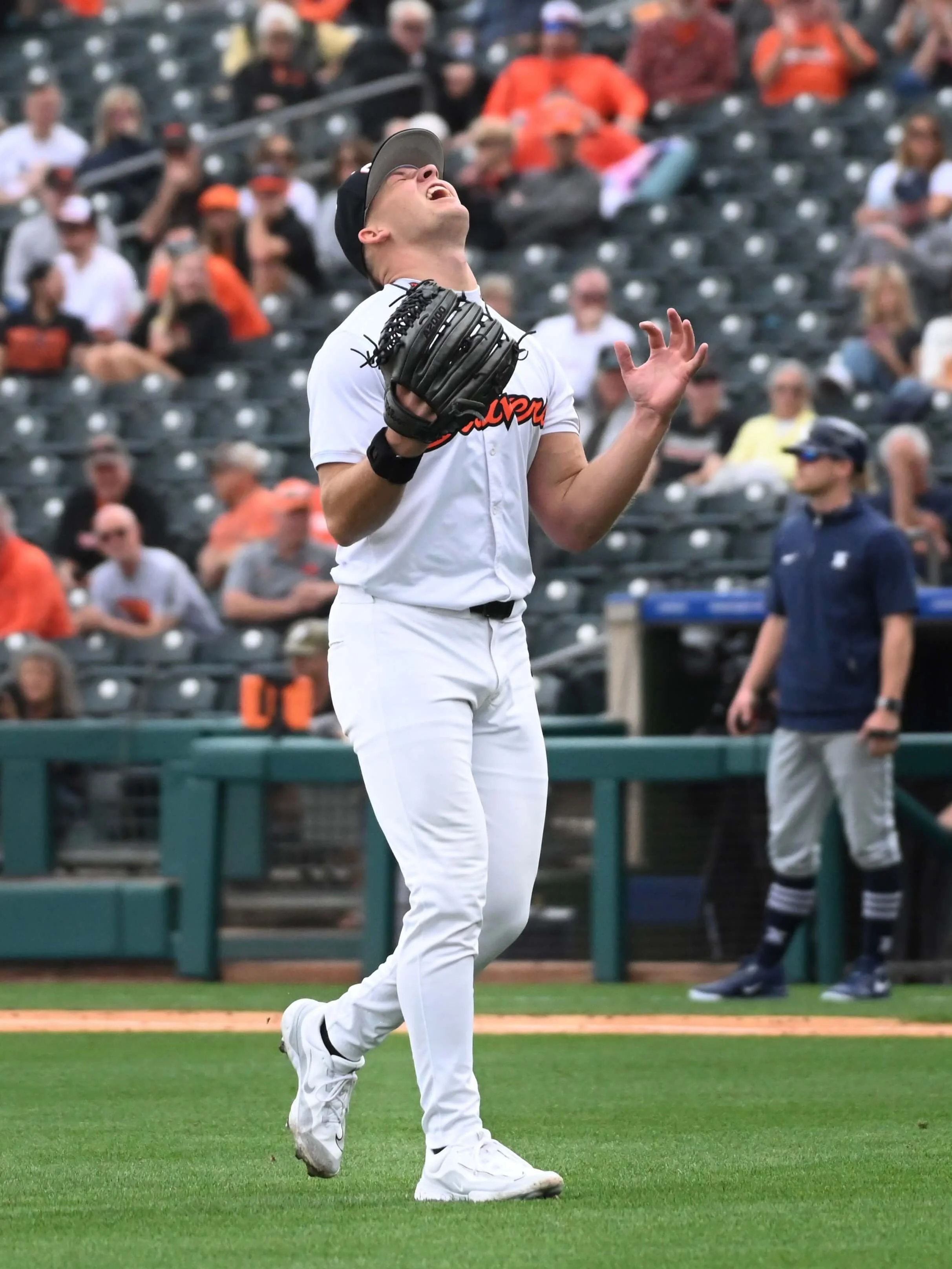
Southpaw hurler Nelson Keljo thanks the stars after an inning-ending strikeout in 2025 (courtesy Dominic Cusimano)
The conversion from spectator to shooting with professional photographers is a work in progress.
“Sometimes I have to tell Dom, ‘No cheering on the sidelines,’ ” Maasdam says with a laugh.
“ ‘Nish has told me that, too,” Dom says.
“Dom and I met in women’s basketball in 2016,” Maasdam says. “He started popping up at games. He is always very conscious about not being in our way, which is nice. It’s fun to tell him to stop cheering, which I don’t do as much anymore. It doesn’t work.”
“I pick my spots,” Cusimano says with a smile.
Dom has great appreciation for the other two photographers in the booth on this day.
“I am sitting here with my photographic mentors,” he says. “I have the utmost respect for both of them. I am a fan of theirs. I love watching them work. I appreciate that they allow me to be in their space. I’m just a guy having fun.”
► ◄
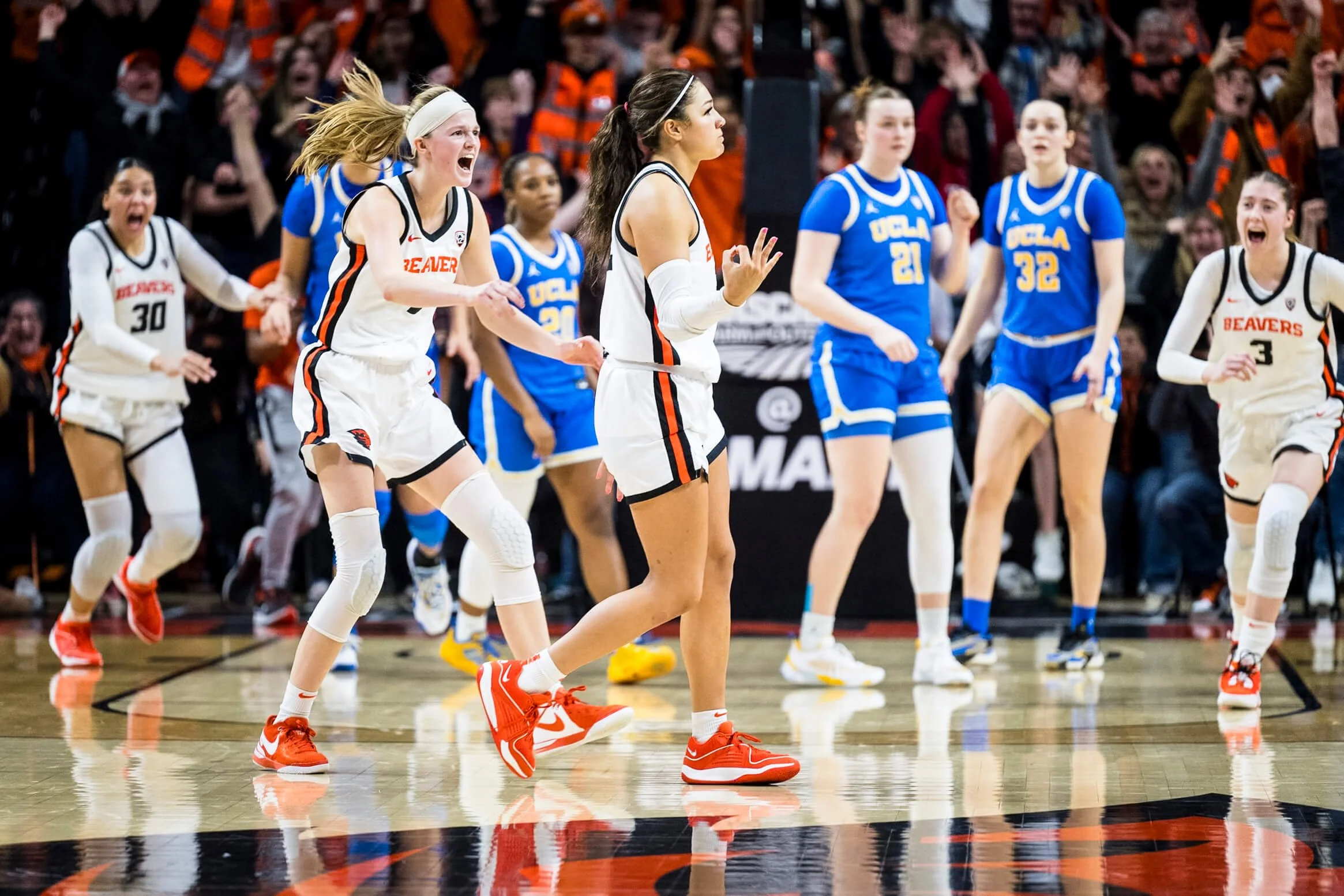
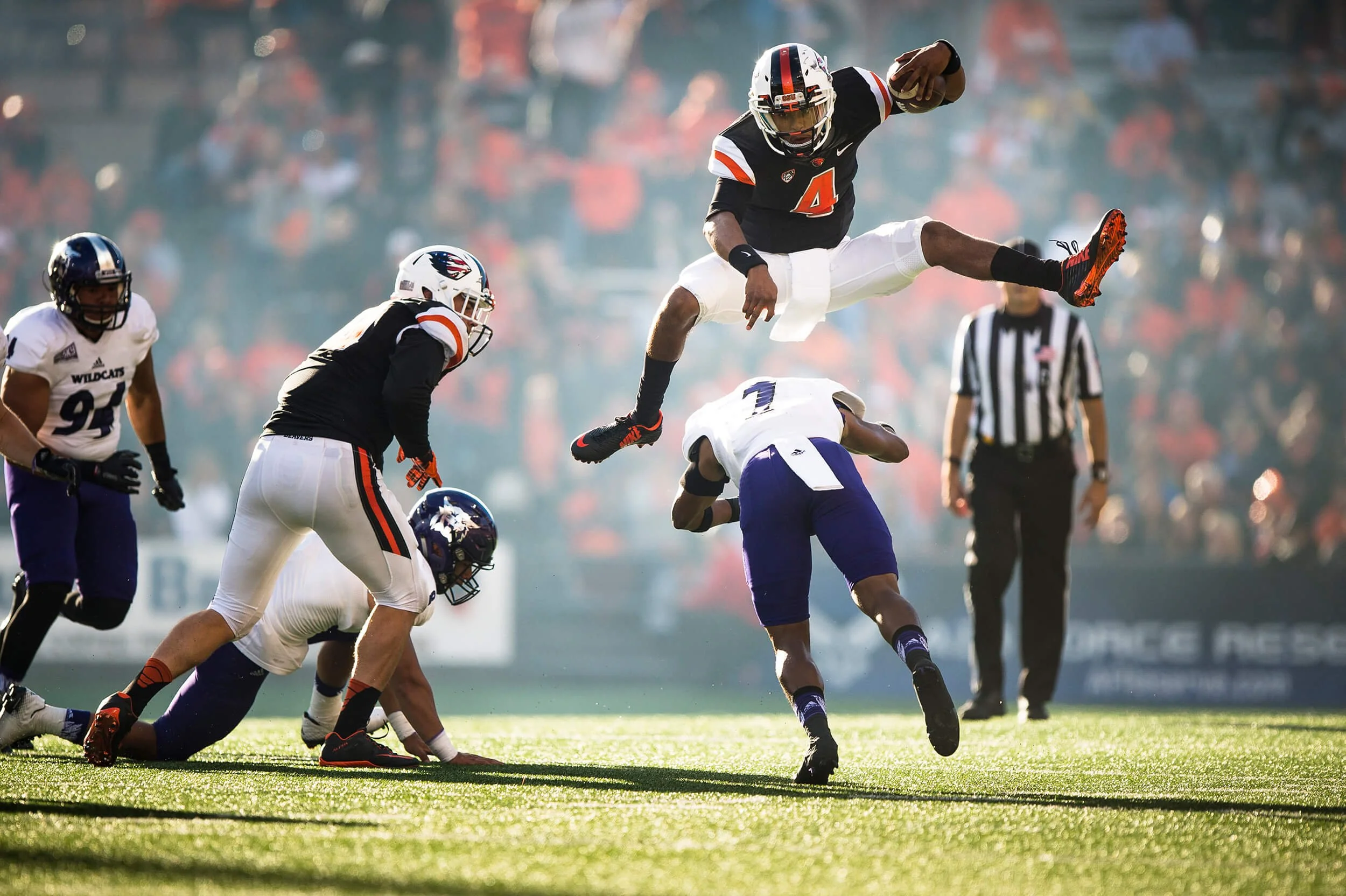
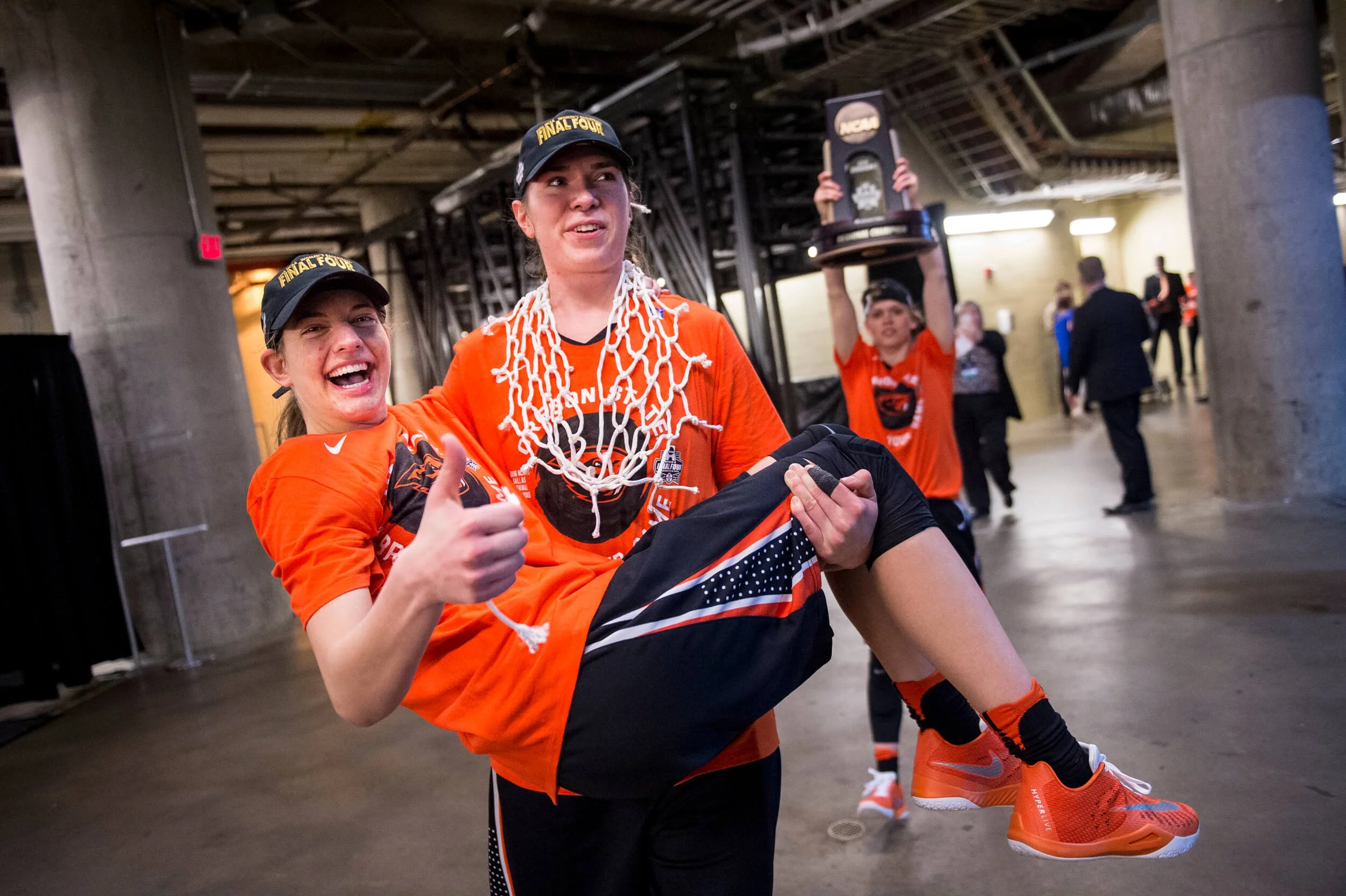
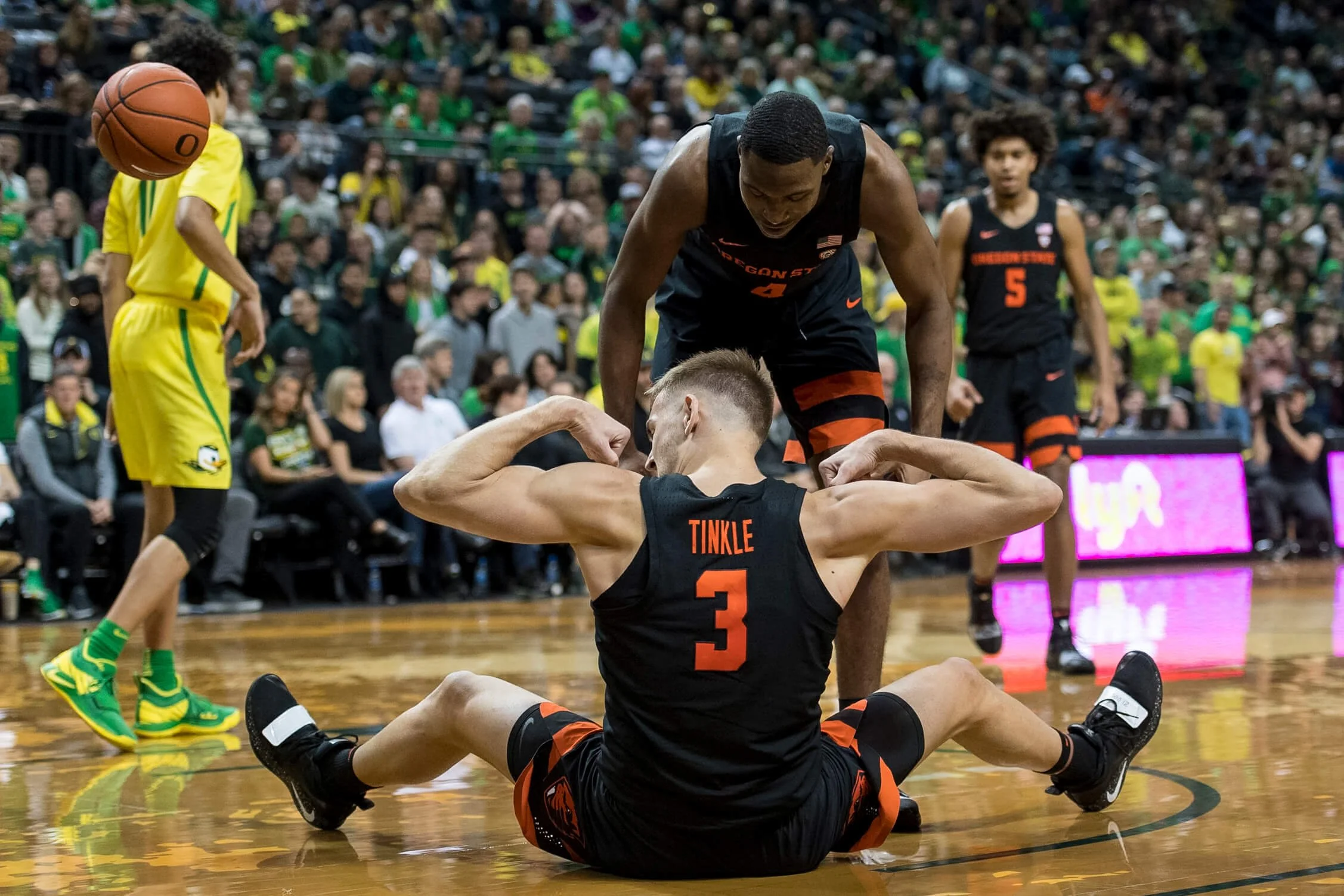

Of course Karl Maasdam is a professional photographer. In eighth grade, he attended a two-week photography workshop in a journalism class.
“I knew right then,” says Maasdam, 56. “I’m like, ‘I am going to be a photographer.’ ”
Karl’s mother, Sharon Maasdam, wrote for The Journal and Oregonian.
“I always loved the newspaper, so I wanted to be a newspaper photographer,” he says. “And I loved sports. My goal was to work for Sports Illustrated.”
Like Cusimano, Maasdam has a Scott Rueck connection. They are both 1987 graduates of Hillsboro’s Glencoe High.
“We grew up together,” Karl says. “We were neighbors. I went to school with Scott every year from kindergarten to college.”
Maasdam shot photos for the yearbook at Glencoe.
“The yearbook advisor had been a newspaper photographer, so he was of great help to me,” he says.
Most of Karl’s family members attended Oregon State, and Karl followed suit. He shot for “The Beaver” Yearbook as a freshman and for the Daily Barometer newspaper after that. His first job out of college after graduation in 1992 was for The Astorian in Astoria. In 1996, he and wife Shari moved to Corvallis, where he took a job shooting for the Gazette-Times.
“We thought I would be there for two years, and then move to where there was a bigger paper,” Maasdam says. “But we came here and loved it. We instantly knew we didn’t ever want to move.”
Maasdam worked with the GT until 2004, when the Maasdam children were young.
“I was tired of sports because of the nights and weekends, and when your kids are little, you miss everything,” he says. Shari, an accountant, provided health benefits for the family. Karl worked as a freelance photographer, shooting weddings and, beginning in 2005, working part-time for the OSU Foundation.
“They have been my best client over the years,” he says.
Maasdam opened a photography studio in Corvallis in 2007. In 2013, he took a part-time gig shooting sports for the OSU athletic department.
“Especially football,” Karl says. “They needed someone to travel and shoot games. My kids were older, so I could do it. It was perfect timing to get back into sports.”
Soon Maasdam was working with an old friend — Rueck, a forerunner of coaches using photo shoots with recruits.
“He was way early on that, before football or men’s basketball,” Karl says.
Maasdam travels with the Beaver football team to all away games and shoots home games, too. With other sports — “men’s and women’s basketball and baseball are the big ones” — he shoots home games and travels during the postseason.
“I shoot all of the sports at some time or other, but not every game,” he says. “Baseball is my favorite sport to shoot. Everything is so different. You can never get the same shot twice. You have to pay attention the whole time. It is outdoors, plus I love baseball. It lends itself to good photos.”
The key?
“Paying attention, and to separate yourself from the game,” he says.
Cusimano laughs as he hears Karl’s comment.
“I miss a lot of shots when I get wrapped up in the game,” Dom says.
Another key from Maasdam: “I tell the young kids, ‘No face, no ball, no photo.’ ”
That is the best advice he gave me — have a ball in every photo in basketball,” Cusimano says. “I love shooting Kennedie (Shuler, OSU women’s point guard) on defense. Her offense speaks for itself, but the intensity of her look on defense. …”
Maasdam: “There are some players — and Kennedie is one of them — whom you cannot take a bad photo of. She is so intense. (Former Beaver guard) Jamie Weisner was another.”
Maasdam has taken more football pictures than any other sport.
“Shooting football is kind of like basketball,” Maasdam says. “It is about knowing the down and distance, the direction the ball is going, the plays and tendencies. Do we run to the right more? Do we run to the left more?
“As a photographer, you have to get low so you can see eyes better and (the players) look more dominant. When newspapers were king, you would see every photographer on their kneepads shooting photos. (The photos) just looks better, and it is easier to see the eyes. I tell the (football) players who wear face shields, ‘You might look cool, but we want to see your eyes.’ Now, it is harder to get up, because I am old.”
He shares a laugh with three men who are many years his senior.
“With football, you get some of the ballet of the sport — the body positioning, the poetry, the gracefulness,” Maasdam observes. “Imagine making big men look graceful.”
Among Maasdam’s career highlights: Shooting Oregon State’s Elite Eight victory over Kim Mulkey’s Baylor Bears in the 2016 women’s basketball Elite Eight in Dallas, and OSU’s College World Series baseball championship in 2018 in Omaha.
It is not all football, basketball and baseball for Maasdam, though. He traveled to Oklahoma City with Oregon State for the 2022 Women’s Softball World Series and to Cary, N.C., with the Beavers for soccer’s “College Cup” Final Four competition in 2023.
“College World Series softball is such a great event,” he says. “And I liked shooting the College Cup. I love soccer.”
► ◄
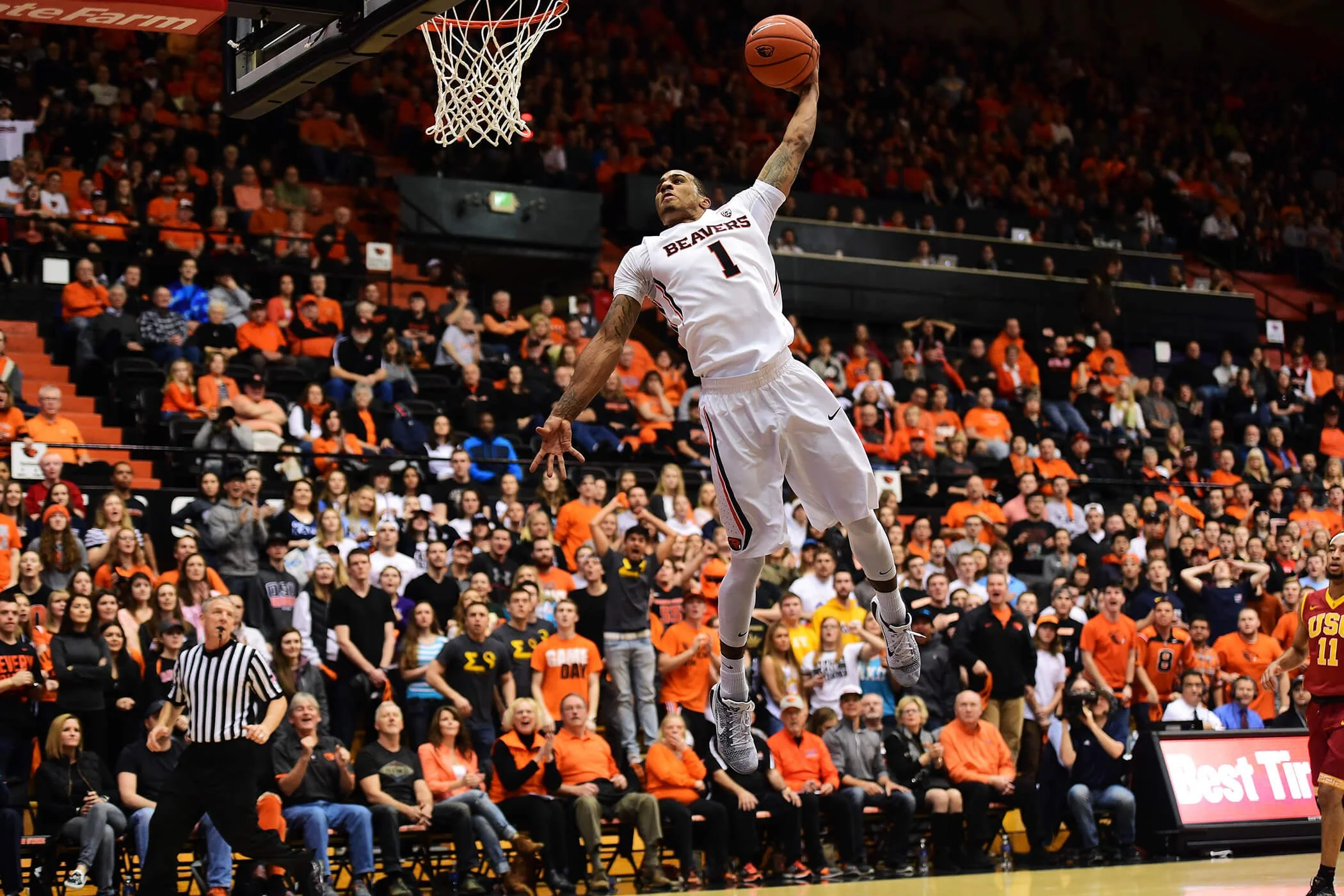
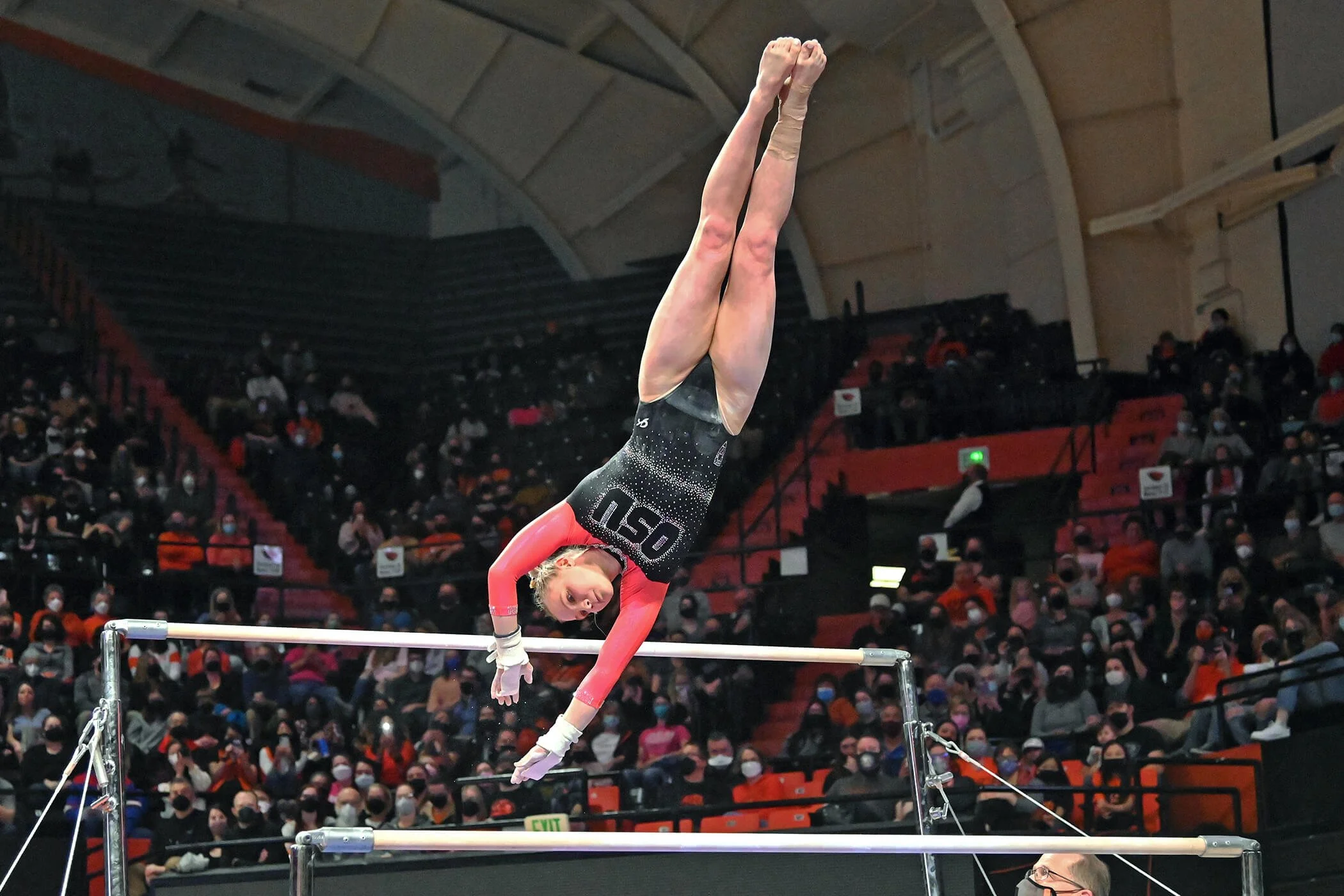
Maasdam is creating a legacy. Dave Nishitani already has one.
Says Maasdam: “It doesn’t happen as much anymore, but when I first started shooting for Oregon State, every place we went I would get asked, ‘Hey, do you know Nish? What is Nish up to?’ ”
Nishitani is long-retired from his job with the OSU Bookstore and mostly retired from shooting photos for OSU athletics, though you will still see him at a Beaver athletic event with camera gear from time to time.
Nishitani started taking photos for the athletic department in the early 1970s, when the sports information director was John Eggers, my father. Nish shot photos for sports information for more than 50 years.
An Ontario native, Nishitani stayed home for his first two years of college at Treasure Valley CC before transferring to Oregon State in 1968.
“That year, a friend of mine was visiting Japan, so I had him buy me a camera while he was there,” Nishitani says. “I think I paid $150 for a Nikkormat with a 50-mm 1.4 lens.”
As a junior in 1968-69, Nish shot photos for “The Beaver” yearbook and got interested in sports photography in particular. Then the first draft lottery since World War II got in the way.
“My (college) deferment ran out,” he says. “I was in the first draft lottery in 1969. My number was two.”
To protect himself from getting drafted while still enrolled at OSU, he at first joined the Oregon National Guard unit in Ontario, and soon transferred to the unit in Corvallis.
“We had to go to drills once a month,” says Nishitani, who never did active duty. “I soon transferred from the Guard to the 104th Division Army Reserve.”
The local Reserve unit headquarters were in Vancouver, Wash. Nishitani became the post’s primary photographer.
“I did a lot of (photography) for the military for about 24 years,” he says. “I stayed in the Reserve for 37 years.”
In the early ‘70s, Nishitani was the only student intern working with my dad’s assistant, Rod Commons, who was a fine photographer in his own right.
Meanwhile, while still a student, Nishitani landed a part-time job in the OSU Bookstore’s photography department. After graduation, he became a full-time employee and worked his way up to managing the department and, later, the photo lab. He worked there for 41 years until his retirement in 2013.
During that time, camera sales became a major business for Nishitani.
“I kept in contact with a lot of news photographers, so a lot of people started buying (product) from me,” he says. “At one point, the Bookstore was the third-largest Nikon dealer in the state.”
“Every news photographer on the West Coast bought cameras from Dave,” Maasdam says.
“One year, I completely outfitted every photographer at the Seattle Times,” Nishitani says.
“I met Nish when I was in school,” Maasdam says. “I bought a camera from him, a used Nikon S2.”
Nishitani also became a mentor.
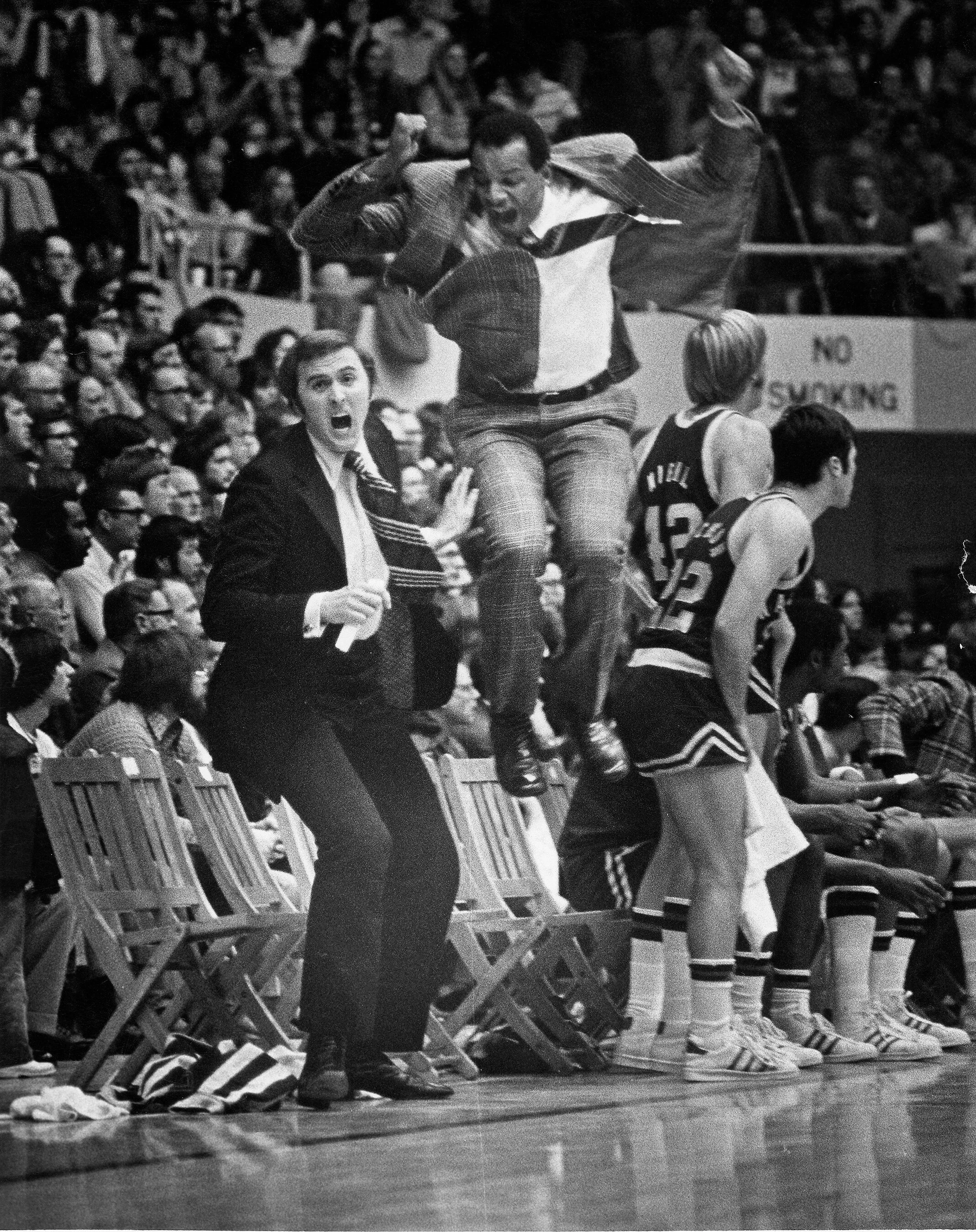
Washington State coach George Raveling displays David Thompson-like jump reach during a game at Gill Coliseum in the late 1970s (courtesy Dave Nishitani)
“When I first came to school and Gary Payton was playing (basketball), the baselines were crowded (with photographers),” Maasdam says. “Dave would tell us, ‘You can sit here. Scoot up. You don’t have to hide.’ He was helpful to everyone. Everyone knew who Nish was. Newspaper photographers can be jerks. He would tell us, ‘You guys work for the Barometer. Don’t let anyone intimidate you or make you move.’ ”
Nishitani and Maasdam are members of a mutual admiration society.
“I have learned a lot from Karl, too, just by watching him and looking at his photos,” Nish says. “You think, ‘Gosh, not bad.’ ”
Among Nishitani’s career highlights: Shooting the “Orange Express” basketball team of the early 1980s and the Payton era in the late ‘80s, and the Beavers’ Fiesta Bowl victory over Notre Dame in 2001.
“The Fiesta Bowl was a great thrill,” he says. “To sit there and have to put up with these arrogant Notre Dame fans in the events leading up to the game was hard to take. But then the second half of the game, the (Fighting Irish’s) whole side of the stadium was empty. All you could see was the (Notre Dame) band and a sea of orange.”
Nishitani’s favorite sport to shoot: Gymnastics.
“There is great variety with all the different events,” he says. “It is a challenge to try to move around and shoot from different angles. But it is fun.”
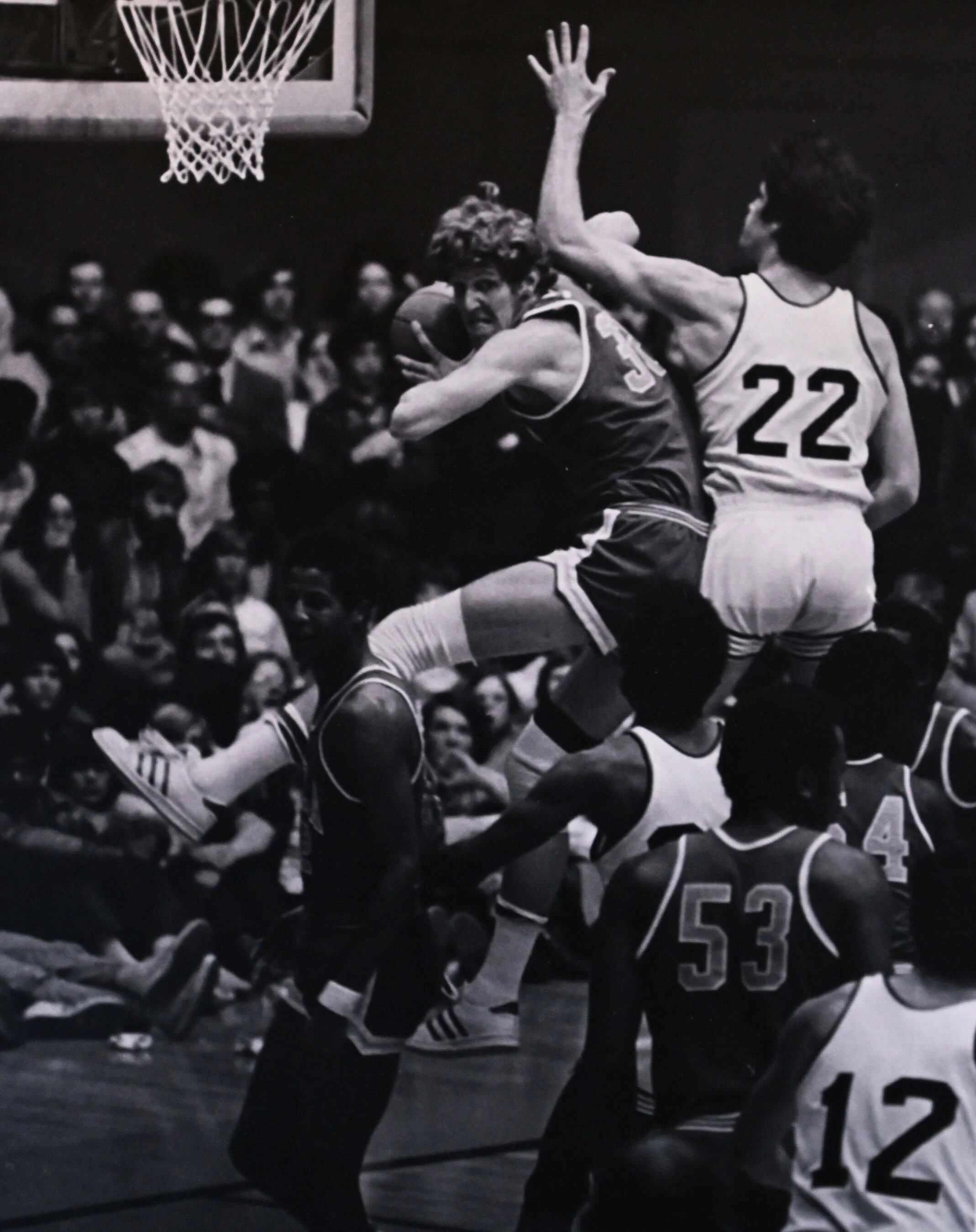
UCLA’s Bill Walton means business as he snares a rebound away from OSU’s Neil Jurgenson at Gill in 1973 (courtesy Dave Nishitani)
The rigors of sports photography have taken their toll on Nishitani’s body.
“I am still able to shoot from a seat (in the stands) during games,” he says. “I just do it for fun now and put them out on Facebook. If I have anything worthwhile, I give it to the athletic department.”
► ◄
Readers: what are your thoughts? I would love to hear them in the comments below. On the comments entry screen, only your name is required, your email address and website are optional, and may be left blank.
Follow me on BlueSky.
Follow me on X (formerly Twitter).
Like me on Facebook.
Find me on Instagram.
