
Updated 9/9/2026 1:42 PM, 9/10/2026 9:02 PM
By now, most Major League Baseball fans are aware of the Automated Ball-Strike System (ABS) that was implemented prior to the 2026 season.
Opinions are like cell phones — everybody has them (don’t they?), and they certainly vary on the value of ABS. But in this case, it would seem that opinion is heavily on the side of the system being a home run.
Current MLB umpires might challenge that assertion, just as players are challenging their balls and strikes at a high level. Through Aug. 31, there had been 8,841 challenges in Major League games, with an overall success rate of 53.7 percent.
The ABS system “is amazing,” Cleveland Guardians left-fielder Steven Kwan says. “There is definitely a learning curve to it, but it is a great addition.”
“I love ABS, though I was not big on it when it started,” says veteran minor league manager Rick Sweet, now with the Nashville Sounds. “It has won me over.”
“It has been a lot better than I thought it would be,” says Pat Casey, the former Oregon State coach now working part-time in player development with the Milwaukee Brewers. “The idea is to get calls right, and it does that.”
“I think the fans like it,” former MLB umpire Dale Scott says. “Overall, it has been accepted pretty much. The challenge system itself has been very successful. As an umpire, though, it would be a challenge to be critiqued in real time, especially if there are two or three challenges in a single at-bat.”
The ABS system, using Hawk-Eye camera pitch-tracking technology, has pinpoint accuracy. It is said to possess a median error rate of under .2 of an inch, making it more precise than human umpires.
The current system being used at all levels of pro ball has the umpire calling balls and strikes. Each team gets two challenges per game, retains each successful one and loses its opportunity for the rest of the game after two failed challenges. In extra-inning games, a team gets an additional challenge per inning.
Only the batter, pitcher or catcher can initiate the challenge by tapping his cap or helmet within two seconds after the pitch. The umpire then grants the challenge. With the technology available, the process takes only a few seconds. It either validates the ball or strike call, or corrects it.
The independent Atlantic League was the first to use ABS — aka “robot umpires” — at its 2019 All-Star Game. It was experimented with in the MLB’s Arizona Fall League beginning in 2021. The Florida State League, a low-A minor league, also started using it that year. It was put into use at five Triple-A stadiums in 2022, and in 2023 it expanded to all games at the Triple A level, sometimes with and sometimes not with a challenge system.
“We were the guinea pigs,” Sweet says. “We had it for three years before the majors started using it.”
During the first year at Triple-A, the ABS system was used with no challenges. ABS called every pitch. After the pitch, the plate umpire — wearing an earpiece — would be notified whether it was a ball or strike. If the system glitched, he would be there to make the call.
“That was terrible,” Sweet says. “They got rid of that almost immediately and went to half and half — three days all-ABS, three days with the challenge system. We did that for a couple of months, and then they threw the all-ABS away.”
“They would have a 10-game series — five of them challenge, five of the other,” Dale Scott says. “Challenge won. The fans liked challenge better. (Baseball officials) polled the players and managers, and it was pretty decisive that they preferred the challenge system, too.”
In 2025, MLB used the ABS system in spring training for the first time, and it was used at the All-Star Game that season. Seattle catcher Cal Raleigh was the first player to request a challenge. He won.
Catchers have been both the most prolific and the most successful in this first MLB season with ABS being fully implemented. Total challenges through Aug. 31: By catchers 4,641; by batters 4,041, by pitchers 159. Catchers were winning 58.5 percent of their challenges. Batters had won 48.6 percent, pitchers only 40.9 percent.
“If the catchers are at 58 percent, that means 42 percent of the time they are wrong,” former MLB umpire Jim Joyce muses. “They tell the pitchers, ‘Don’t challenge anything. Every pitch you throw, you think it’s a strike.’ ”
Teams don’t want to burn both challenges early in a game. And certain players will be given more leeway than others.
“There is a strategy to it,” says Casey, who works closely with Milwaukee manager Pat Murphy. “Managers have to give the catcher and hitter the freedom to do that. But Mike Trout is going to have a lot more freedom than Wade Meckler. And if it is the first inning and a 2-0 count, it is not a good decision for a hitter to challenge.”
Some other ABS stats as of Aug. 31, courtesy of Baseball Reference:
Team with the highest success rate: Cincinnati, 63 percent. The lowest: Pittsburgh 45 percent.
Challenges by inning: With two challenges remaining, the first inning has had the most, 834. The ninth inning has had the least, 586. With one challenge left, the ninth inning has had the most, 574. The first inning has had the least, 33.
Ball-strike count: The first pitch of an at-bat has had the most, 2,002. Next most are 0-1 (892), 1-1 (872), 1-0 (822), 2-2 (814) and 3-2 (812). The 3-0 count has had the least, 109.
Challenges made by a batter:
Most challenges: Sal Stewart, Cincinnati, 45 (26 successful, 19 not, 58 percent); Bryce Harper, Philadelphia, 43 (20-23, 47 percent); Nolan Schanuel, Arizona, 36 (20-16, 53 percent); Gary Sanchez, Milwaukee, 35 (14-21, 40 percent); Jose Altuve, Houston 31 (20-11, 65 percent).
Most successful challenges: Stewart 26; Altuve, Harper and Schanuel 20 apiece; Kevin McGonigle, Detroit, 18.
Most unsuccessful challenges: Harper 23; Sanchez 21; Stewart 19; Isaac Collins, Kansas City, 18 (10-18); Ceddanne Rafaela, Boston, 18 (6-18).
Best percentage (minimum 10 challenges): CJ Abrams, Washington, 10-2 (83 percent); Nick Kurtz, A’s, 9-2 (82); 3. Davis Schneider, Toronto, 13-3 (81).
Lowest percentage: Jorge Mateo, Atlanta, Jorbit Vivas, Washington, Jose Fermin, St. Louis, all 2-8 (20 percent).
Challenges by a catcher:
Most challenges: William Contreras, Milwaukee, 149 (78-71, 52 percent); Tyler Stephenson, Cincinnati, 119 (82-37, 69 percent); Victor Caratini, Minnesota, 111 (68-43, 61 percent)
Most successful challenges: Stephenson 82, Contreras 78, Caratini 67.
Best percentage (minimum 40 challenges): J.T. Realmuto, Philadelphia, 48-13 (79 percent); Carson Kelly, Cubs, 50-20 (71 percent); Sal Perez, Kansas City, 46-19 (71 percent), Kyle Higashioka, Minnesota, 30-13 (70 percent).
Lowest percentage: Brandon Valenzuela, Toronto, 22-30 (42 percent).
Challenges by a pitcher:
Most challenges: Freddy Peralta, Tampa Bay, 7 (4-3); Drew Anderson, Detroit, 6 (4-2).
Most unsuccessful challenges: Cristopher Sanchez, Philadelphia, 5 (0-5).
Challenges of umpire ball/strike calls per game (minimum 19 games):
Most challenges: Hunter Wendelstedt, 27 games, 152 (5.63 per game); Charlie Ramos, 19 games, 104 (5.47); Sean Barber, 23 games, 123 (5.35).
Fewest challenges: Adam Hamari, 26 games, 85 (3.27); Erich Bacchus, 25 82 (3.28), Carlos Torres, 23 games, 79 (3.43).
Highest percentage overturned (minimum 19 games): Andy Fletcher 19 games, 67 of 97 (69.1 percent); Adrian Johnson, 19 games, 66 of 101 (65.3); Manny Gonzalez, 24 games, 71 of 111 (64.0).
Lowest percentage overturned: Dexter Kelley, 19 games, 36 of 89 (40.4); Jansen Visconti, 24 games 35 of 86 (40.7); Mark Ripperger, 26 games, 45 of 108 (41.7).
Most calls overturned in a game: Allen Porter, 11 of 13, Aug. 28, San Francisco vs. Arizona; Clint Vondrak, 11 of 16, June 8, Milwaukee vs. A’s.
Worst game: Bill Miller had eight calls challenged in an Aug. 28 game between Cincinnati and the Cubs. All were successful.

I have always considered the vertical strike zone to be between the batter’s armpits and the top of his knees while in a batting stance. In general, that remains true. But technology, and the ABS system, has changed things.
“This isn’t technology that is judging pitches that were being called in the old three-dimensional strike zone,” says Scott, who umpired in MLB from 1986-2017. “This technology couldn’t do that accurately or consistently, so they had to change the strike zone. Umpires today are calling a different zone, one that is two-dimensional. It doesn’t start at the front of the plate; it starts at the middle of the plate, which is 8 1/2 inches deeper (than the front).
“What is really different is the top part of the strike zone. It used to be the mid-point between the top of the pants and the shoulders. Now, the rule is 53.5 percent of a batter’s height when he is standing straight up.”
Jim Joyce, who umpired in MLB from 1989-2016, sees a horizontal change in pitch calls in the ABS system.

Former MLB umpire Jim Joyce likes the ABS system, but not without the challenge option attached to it (courtesy Jim Joyce)
“The algorithms are from the middle of the plate instead of the whole plate,” says Joyce, who lives in Beaverton. “They are saying the low strike is not as low as it used to be. ZE liked the low pitch. Now it is totally different. The (current umpires) I have talked to say it is more of an upper strike zone than a lower one. That tells me a lot.
“When I first started, everybody complained that we didn’t call enough low pitches. With ZE, we started calling a true low strike, but now it has flipped again, and (the strike zone) is up a little bit.”
“I have seen a lot of pitches that were called strikes and were overturned by ABS (for being) low,” Scott says. “They were strikes at the front of the plate, but by the time the ball goes through the middle, they are below (the zone).
“You hear all this scuttlebutt about how the umpires are missing those pitches, revealing just how bad they are. That’s a little over the top. It really shows how good they are, because they are getting overturned on calls that are .1, .2, .3 (inches off the plate). Those are extremely close.”
The top of the zone, by the way, was 51 percent of a batter’s height in 2022 and ’23, then was raised to 53.5 percent in ’24 after pitcher complaints. The bottom of the zone was originally set at 28 percent of the batter’s height and has been at 27 percent since ’22.
Scott believes those standards are difficult to judge, in part because of the batter’s crouch.
“First of all, a batter isn’t going to swing at a pitch standing straight up,” says Scott, a Eugene native who divides his time these days between homes in Portland and Palm Springs. “And secondly, where is 53.5 percent? It is an arbitrary number that I am supposed to know? I was always able to determine where the midpoint is, but to figure out what 53.5 percent is when he is in a hitter’s stance, trying to hit the ball? That is more difficult. It is a different zone that umpires are calling now.”
► ◄

Former MLB umpire Dale Scott, here straightening out Texas catcher Gerald Laird, says the ABS system has made the plate two-dimensional in terms of calling balls and strikes (courtesy Dale Scott)
Technology has long been used by MLB to evaluate and grade its umpires in calling balls and strikes. QuesTec, with high-resolution cameras to track flight path, speed and placement of every non-contact pitch, was the first system used beginning in 2001. Zone evaluation (ZE), an internal video and data-tracking program, was introduced in 2009 to replace QuesTec.
“The ABS system is more accurate because of the technology,” Scott says.
During Scott’s time working in the league, umpires had “buffer zones.”
“The plate is 17 inches wide,” he says. “If you add the almost three inches of a baseball, the plate widens to something like 22 inches. I never was quite clear where QuesTec’s line was. But there is no doubt that ABS has shrunk the zone by not judging the pitch until (it crosses) the middle of the plate. It is a smaller zone, no doubt.”
Many of the MLB’s younger umpires have experience with the ABS system. Not so with the veteran arbiters.
“The senior umpires worked with it during spring training the last two years, which amounts to about eight total games behind the plate,” Scott says. “Then they were thrown into the fire. It takes a long time to get a consistent strike zone. To get it in that short of real time is difficult to do.”
“The guys who have been around awhile and didn’t work under this system in the minor leagues are having more of a problem with it,” Joyce says. “The younger guys who are used to the system came in with an advantage. They have a better idea of where to be at with their strike zone, as compared to the older guys who have had a hard time adjusting to it.”
Joyce and Scott say the current MLB umpires are under fire with the ABS system.
“There is no question the older guys are working hard to get a better score,” Joyce says.
“If I were working right now, I am not going to call pitches that I think are strikes,” Scott says. “I am going to call pitches that I think ABS thinks are strikes. Why wouldn’t I? I don’t want to get overturned. As an umpire, your goal is to not get overturned. If ABS says that’s not a strike, then I am not going to call it a strike, period. You learn that as you learn the system.
“I am glad I don’t have to work with it, quite frankly. I can’t imagine in an important part of the game, I whack somebody out on strike three and it is overturned. The next pitch, I whack him again, and it is overturned, and you are missing by a fraction of an inch. That would be really frustrating.”
Joyce says during the final year he worked in MLB, the ZE system showed umpires were right on 96.6 percent of ball/strike calls.
“That was pretty good,” he says. “So they instituted a system to get 3 1/2 percent of the pitches right — maybe 10 a game.”
One thing that has frustrated me this season favors the pitchers, in my opinion. Many balls that an umpire calls strikes are challenged by catchers and won when just a sliver of the ball touches the strike zone. To the naked eye, it looks like a ball. Not so, Joyce says.
“The one thing they didn’t do is change the strike rule, which is that if any part of the ball passes through the strike zone, it is considered a strike,” he says. “The question I have, is any umpire good enough to call a pitch that is .01 of an inch (on or off the plate)? Is a hitter good enough? Is a batter good enough? Are we that good? No, I’m sorry. The machine wins there.”
“I see a pitch sometimes (called a strike) and I think, ‘No way that is a strike,’ ” Sweet says. “Then we go look at it on our I-pad in the dugout. We know at the bench within two to three seconds whether it was a ball or strike. Yeah, maybe barely, but it is a strike.”
There have been at least a couple of occasions where the plate umpire didn’t see a cap tap and failed to award a challenge. In the games in which I saw that happen, none of the base umpires stepped in to provide their perspective and perhaps get the challenge approved.
“I am sure they can,” Scott says. “If I am on the bases and I see an obvious tap and the plate umpire for whatever reason doesn’t see it, I can see jumping in there.”
► ◄

Dale Scott, here conversing with the Yankees’ Derek Jeter, says he is glad he doesn’t have to work with the new ABS system (courtesy Dale Scott)
Expanded instant replay came into play in MLB during the 2014 season. Each manager gets one challenge a game on things such as close plays at each base, whether a ball down the line is fair or foul, etc. If it is successful, he retains the challenge. If it fails, his team loses the right to challenge the rest of the game.
Says Scott: “I liked it. I was thrilled when I would miss a steal call at second — called the guy out and it was overturned (and called) safe -- and the next guy hit it off the wall and that scored the winning run. I was glad I wasn’t the story. Same with two outs in the late innings of a close game, if I would call a guy out on strikes and it was off the plate and it gets overturned. At least I wasn’t the story.”
Joyce is most famous for the mistake he made on June 2, 2010, when he called a runner safe at first base on a play that would have been the end of a perfect game by Detroit pitcher Armando Galarraga. The runner was clearly out. Joyce was openly apologetic afterward and admitted his error, and Galarraga was gracious about it. Instant replay would have saved the perfect game and corrected Joyce’s error. (In 2024, ESPN E60 broadcast an outstanding documentary titled “28 Outs: An Imperfect Story,” examining whether MLB should move to officially recognize it as a perfect game.)
“I am the poster boy for instant replay,” Joyce tells me. “I told that to commissioner (Rob) Manfred (exactly five years later) on June 2, 2015, when I was with a group of umpires sitting with him at a game in Detroit. He asked us what we thought of instant replay. I said, ‘I wish we’d had it five years ago.’ ”
Joyce likes the ABS system, too, to a point.
“If this is their answer to trying to make the game perfect, so be it, but please don’t go any farther,” he says. “Nobody knows how accurate the ABS system is, but it is probably as close as we are going to get. I am OK with that, as long as it is with the challenge system. But I don’t want to see a World Series or playoff game ended on a challenge on a 3-2 pitch, two outs, bases loaded.
“If this is as far as it goes, I can live with it. But be careful what you wish for. If it goes much farther, I am afraid of what it will do to the game.”
Joyce means going to a system where ABS calls all the pitches, as was initially done at the Triple-A level.
“I won’t be shocked if eventually (MLB goes) to a full ABS system,” Scott says. “I don’t think they are going to do that, but I would not be surprised if they did, just because of people not accepting an inaccurate call. A plate ump would still call interference, foul tips, hit batsmen and so on.
“They always tell plate umpires: Be consistent. You might call a pitch that is an inch outside a strike, but if you do it for everybody, they adjust and know where you are at. That is not good enough anymore. You have to be accurate, period. That is what this ABS system does.”
Scott brings up another point that I hadn’t thought of.
“It is so easy now (for a fan) to sit on a couch with an app and bet on baseball,” he says. “It used to be if (an umpire) called a guy out on strikes at the end of a close game, it was, ‘You just screwed my team.’ Now they are saying, ‘You just cost me $100.’ It’s a different rage. There is a lot of push for the umpires not just to call a game consistently. Now it is, ‘We want everything accurate.’ ”
Managers, coaches and players — and probably fans — like two things about the ABS system in particular. One is how quickly a verdict is issued, unlike in the NFL or NBA, when a review can take a lifetime.
“The key is that it is quick,” Casey says. “The answer is there almost immediately. The other thing it has done is made umpires more accountable. If an umpire is working a game in the dead of summer in Cincinnati, when it is 100 degrees and it is late in the game, he might like to get the job over with (and might make some calls accordingly). It makes umpires work through the entirety of the game.”
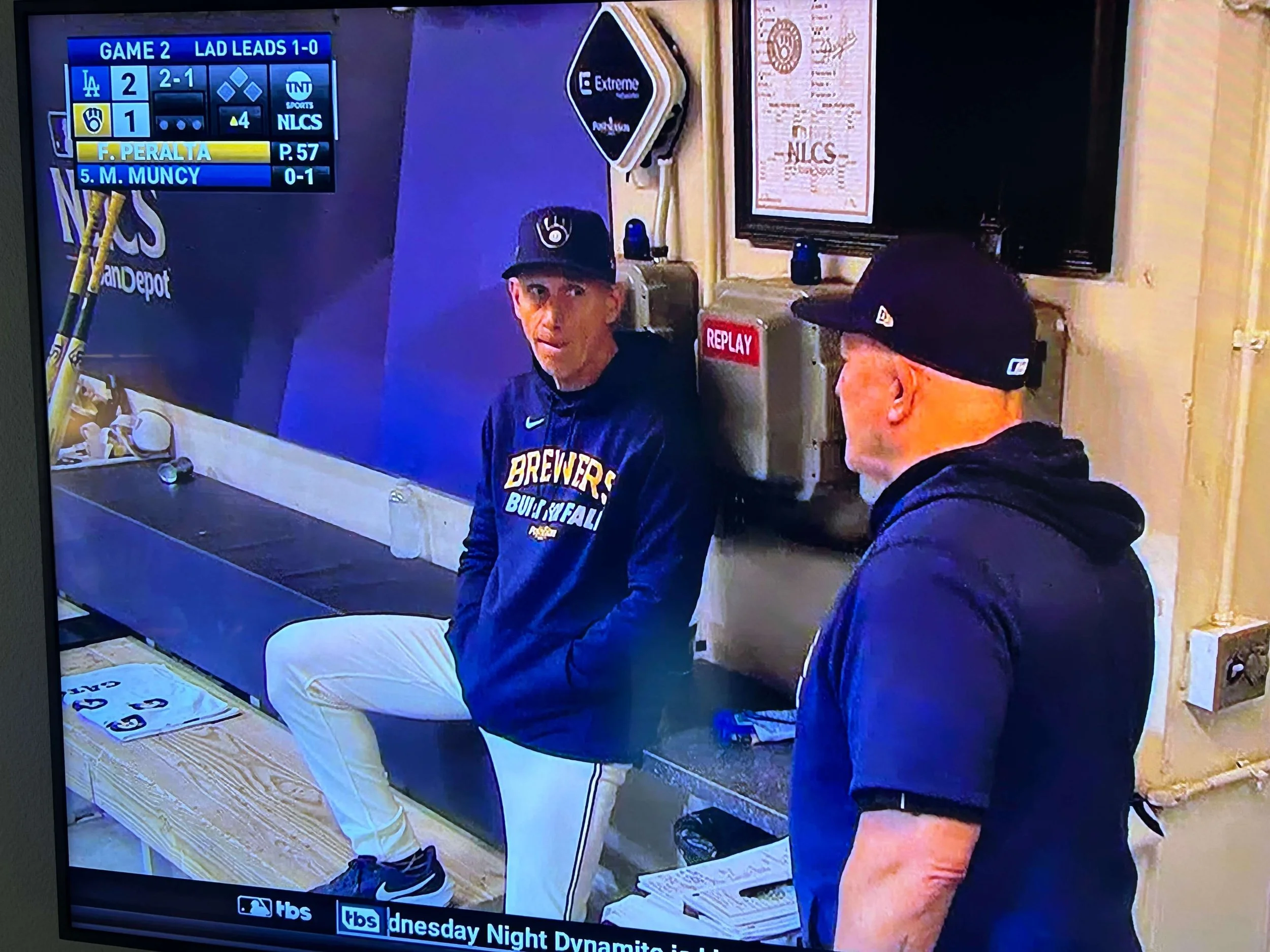
Pat Casey, here with Brewers manager Pat Murphy during last year’s playoffs, thinks the ABS system will eventually be used in college baseball
Kwan agrees with his college coach at Oregon State.
“It keeps umpires accountable; it just makes them better,” he says. “Nobody wants to be embarrassed on a big stage. Earlier in the year, you had to use ABS a little more. As the year has gone by, the umpires have tightened up their zone. In big moments, you leave it in the player’s hands to make a challenge — it’s not up to the umpire. That is only a positive.
“There is some gamesmanship to it, which is fun. It doesn’t take that long. I don’t see much of a negative side to it. I haven’t been very successful in my challenges, though. I think I’m about three for 10.” (Actually, Kwan has won seven and lost seven. Another ex-Beaver, Boston’s Adley Rutschman, has won two-thirds of his challenges at catcher — 34 of 51. But he also has the distinction of having challenged two pitches on one at-bat as a catcher and losing both, in a game on May 28 while still with Baltimore.)
Sweet and another Triple-A manager — Dave Brundage of the Sacramento River Cats — give ABS a thumbs up, too, for many of the same reasons as Kwan.
“It has added a new dimension to the game, not only for the players but for the fans,” Sweet says. “The fans enjoy it. It doesn’t slow the game down. It has changed the game, and it is a good change. It makes the game better. It used to be that umpires could expand the zone. Now they can’t. They have to go with the zone.”
“There are a lot of positives to the system,” says Brundage, the former Oregon State star. “I wish there were a check-swing challenge, but I guess we can’t have everything. (ABS) has cleaned up the game as far as umpires determining the outcome. But it holds everybody accountable — not just the umpires, but the pitchers, the hitters, the catchers.”
The challenge is so popular, it might be extended.
“I would be in favor of instituting more challenges,” Joyce says. “I wouldn’t have a problem with that.”
“I would not be surprised if (MLB) tweaks the number, increases it to three (challenges),” Scott says. “If you have burned the two challenges and you really need one late in a close game, some would say, ‘That’s your fault if you use the challenges up.’ That is true. But I could see where baseball would say, ‘Let’s give them another one.’ ”
What is next? ABS is coming to the college game. On Aug. 27, the NCAA approved the ABS challenge system for Divisions I through III beginning next season. It will be optional for teams and available in both regular-season and postseason play as part of what is being called an “experimental rule.”
The SEC used it as a trial run at its conference tournament in May. Presumably, not all schools will be able to afford the technology in ‘27. So we’ll see how much the system will be used at first — but in the major programs, at least, for sure.
► ◄
Readers: what are your thoughts? I would love to hear them in the comments below. On the comments entry screen, only your name is required, your email address and website are optional, and may be left blank.
Follow me on BlueSky.
Follow me on X (formerly Twitter).
Like me on Facebook.
Find me on Instagram.
