Terry Baker at 85: Still a man to be admired
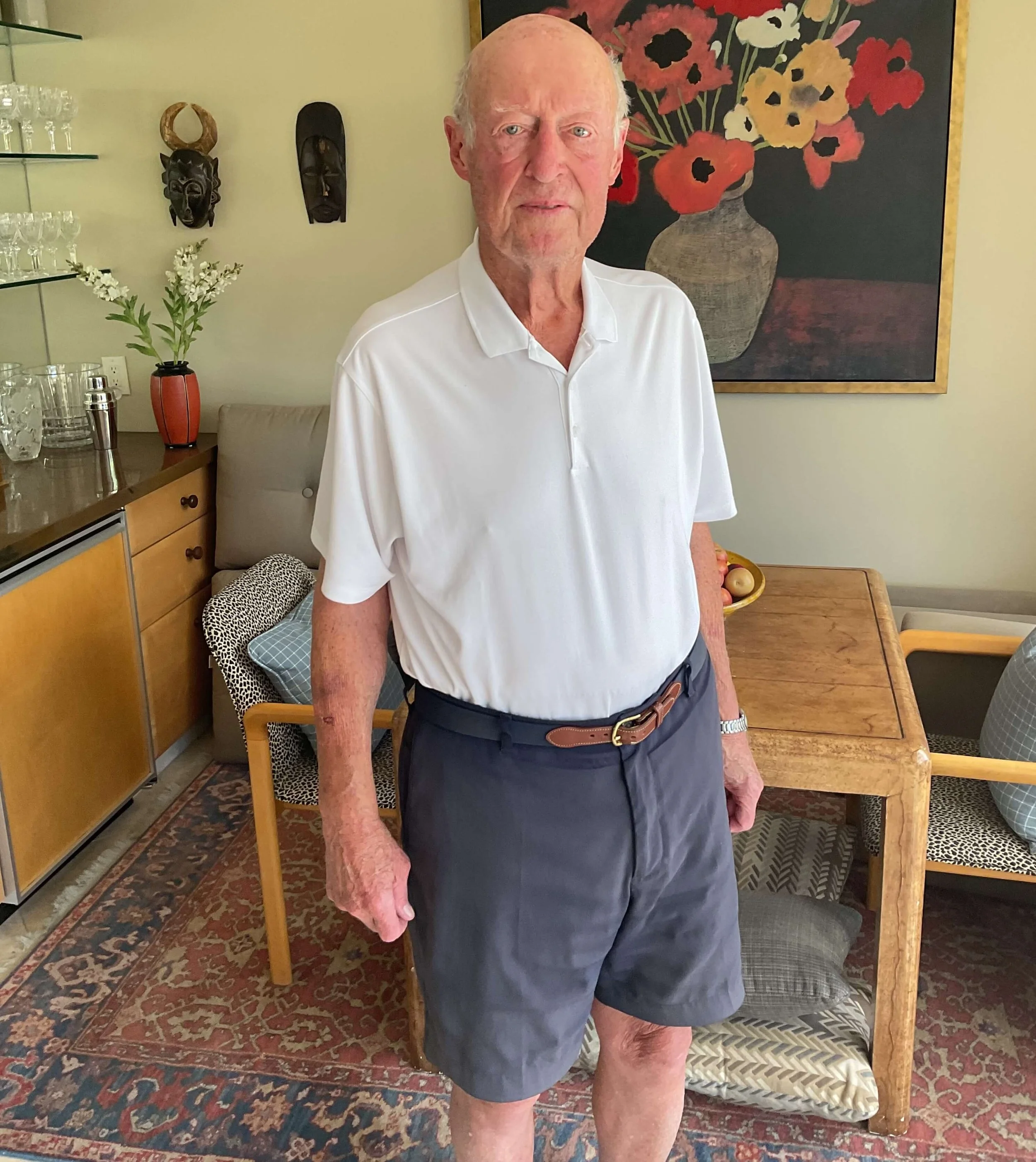
Terry Baker, arguably the greatest all-around athlete in the state of Oregon’s history, says he is in “pretty good health” as his 85th birthday approaches (courtesy Barbara Baker)
Updated 5/23/2026 7:55 PM
It seems like only yesterday that Terry Baker was throwing passes and running wild on the gridiron and helping guide Oregon State to the Final Four in basketball.
Well, maybe not yesterday. It has been more than six decades since Baker’s marvelous athletic skills were on display, leading him to become the first Heisman Trophy recipient from west of the Mississippi.
On Tuesday, Baker turns 85 years old. Terry seems to be taking it in stride when I ask him how it feels to reach that number.
“Lucky, I guess, considering the fact that my brother Gary died at age 57 of ALS,” he says from his condo in Indian Wells, Calif., where he and wife Barbara spend the winter and early spring months. “I have lifetime friends who are dealing with dementia now.
“I have had some health problems recently, but have conquered them for the time being, thank God. I just talked to my dermatologist the other day. He said that half of his patients are now over 85. People are living longer these days.”
Two years ago, a surgeon performed a cryoablation to remove a cancerous growth on a kidney.
“It had been detected several years before, and my urologist was keeping watch on it,” Baker says. “Then all of a sudden, (the growth) started to take off and get larger. He said, ‘Now we treat it.’ ”
The surgery “went fantastic,” Terry says. “Just had a follow-up MRI last week and there was absolutely no change.”
Baker has had back issues for years, “but I can deal with that,” he says. “The back is stiff when I get up in the morning, but I’m not complaining.”
Terry and Barbara take a 40-minute walk nearly every day along Desert Willow Golf Club in Palm Desert.
“We have a routine we follow,” he says, adding with a chuckle, “my No. 1 objective is to look for golf balls while we are doing it. I find I would almost rather look for golf balls than play.”
Golf, though, is his favorite pastime. While in the Palm Desert area, he hits balls several times a week and regularly plays rounds with friends he has made in recent years. Once a seven-handicap, he scores a bit higher these days.
“I go out there and hit balls and work at it and keep thinking, ‘I am going to get better,’ ” he says. “I played with a neighbor here who brought along a guy who had been a pro at Cherry Hills Country Club (south of Denver). He is 85, too. He says, ‘I hit what I think is the best drive of my life and it is 40 yards short of where I was hitting a few years ago.’ You can’t beat the age thing.
“I have friends who fall and hit their heads, and life has changed. My doctor gave me an order: ‘You shall not get on any ladder.’ I am not going to. There are things here I need to fix, but I’ll wait til I get some help.”
The Bakers return to their home in Portland this week. Terry will soon get together with boyhood friend Harry Demorest for an outing at Heron Lakes.
“I see a lot of Harry when we are in Portland,” Baker says. “There are five of us who have been in a golf group the last three or four years. The three other guys are Ducks — Jim Henry, Bob Pallari and Kirk Hay — but we have all become very good friends and play about twice a week in the summer. I am looking forward to getting back with the group and playing with them.”
Baker was listed at 6-3 and 200 pounds during his playing days with the Los Angeles Rams. Today he says he weighs 207.
“Maybe five years ago, I was in the 240s, and then I stopped eating as much,” he says. “Now when Barb and I go out to dinner at a pizza place, we both eat one slice of pizza and that’s all, and we are full. I am eating less, and I eat better, with a lot of vegetables.”
In 2011, Baker retired from his law practice doing mostly trial work and business litigation with Tonkon Torp LLP in Portland. He has two children from his first marriage — Brian lives in Vancouver, Wash., and Wendy lives in Southern California — and four grandkids. Barbara has two grandchildren stemming from her first marriage.
Terry and Barbara, his high school sweetheart at Portland’s Jefferson High, have been married for 30 years. It was Demorest, also a Jeff grad, who alerted Terry that Barbara’s first husband had died.
“I either called or sent her a card,” says Baker, who was divorced from first wife Marilyn. “When she responded, she asked about Gary. I told her he had ALS, and she said she would like to see him. So I picked her up and took her for a visit with Gary. One thing led to another, and we got back together shortly thereafter.”
Marilyn died several years ago from cardiac arrest.
“She and Barbara were good friends,” Terry says. “We invited her to all kinds of dinners and family things. Marilyn owned this condo before we did. When she died, her kids didn’t want it so we bought it from her estate.
“Over the years, Marilyn and I kept in touch. I miss her still. I do. No question about it. Makes me tear up to think about it.”

I take Baker back to the early ’60s, when he had what seemed an idyllic four years at Oregon State.
“It was a great experience for me for a lot of reasons,” he says. “One, I got a good education. That benefitted me a great deal.”
Terry was an honor student in mechanical engineering, a member of Pi Tau Sigma engineering honor society and, as a senior, president of Phi Delta Theta fraternity. He was an Academic All-American. When he was honored as the Sports Illustrated “Sportsman of the Year” in 1962, the cover referred to him as “scholar-athlete Terry Baker.”
“I don’t know that engineering was what I really wanted to do,” he says. “My brother Richard (who died in 2021 at age 87) was a mathematician/physics major. He ridiculed engineering, saying it was like a liberal arts degree compared to physics.”
Terry was a three-sport star at Jeff — all-state in football, basketball and baseball — and though he considers himself left-handed, was as ambidextrous as anyone I have known. He threw the football left-handed, was lefty-dominant in basketball and writes and eats left-handed. He threw the baseball right-handed, though, because his family could afford only one glove, and used hand-me-downs from Gary. He golfs right-handed, batted right-handed, kicked a football right-footed and, though I doubt that he participates anymore, bowled from the right side.
Baker came to OSU to play for Slats Gill on a basketball scholarship but was also expecting to play baseball. He did not play football as a freshman. He starred on the Rook basketball team and turned out for baseball in the spring, expecting to play Rook ball for coach Paul Valenti. Then football coach Tommy Prothro, who was well aware of Baker’s skills on the gridiron, asked him to attend “just one” football team meeting.
“I was practicing baseball and everything was getting rained out,” Baker recalls. “Prothro played me like a violin. After the meeting, he lists me as second-team tailback on the depth chart. I am thinking, ‘If I am already second team, I might as well go out and play.’ ”
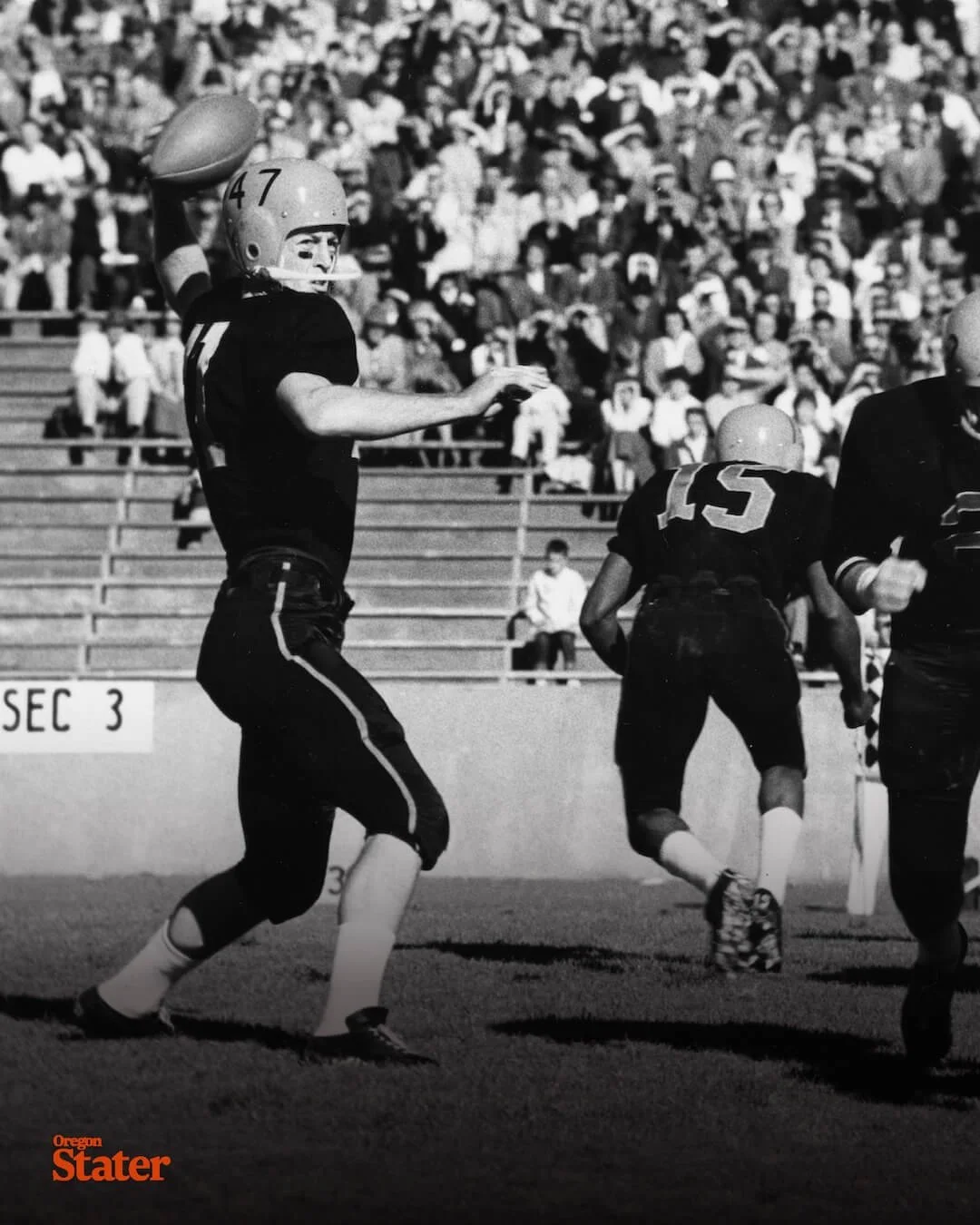
Baker, here throwing a pass as a sophomore tailback at Oregon State, transitioned to quarterback for his final two college seasons
Prothro used the single wing offense in those years. Rich Brooks was starting tailback on the Rook squad in 1959 and expected to be in the mix behind starter Don Kasso as a sophomore.
“All of a sudden, I get to spring practice and I am fourth-team wingback,” Brooks says.
Baker and Kasso split time at tailback in 1960. Prothro then switched to the T formation in ’61 to take advantage of Baker’s passing skills to go with his ability to run the ball.
“Terry was immediately the guy at quarterback,” says Brooks, who moved over to defense and became a starter at safety. “The team just looked better with him at the controls. He was a phenomenal athlete, but you would never know it the way he acted. He acted like it was no big deal, but he was a big deal to everybody else.”
Prothro was an intellectual, a master at bridge, and one who kept a professional distance from his players.
“Tommy was not ‘Tommy’ then,” Baker says. “After I became a lawyer and did some legal work for him, I began to call him that. But when I played for him he was ‘Coach Prothro, yes sir!’ One of our linemen was named Tom, and when he made a good block I would say, ‘Way to go, Tommy,’ and Prothro would look at me sideways. But when we switched to basketball, it was ‘Slats,’ not ‘Coach Gill.’ You had to know how Slats operated. We had a fantastic relationship.”
Baker was a three-year starter at guard in basketball. He was one year ahead of Mel Counts, a sweet-shooting 7-foot center out of Marshfield High and the central figure in Gill’s offense during Baker’s final two seasons.
“I have the highest regard for Terry as both a player and person,” says Counts, who went on to a 12-year NBA career, winning titles his first two seasons, and is now retired and living in Corvallis. “He had a high athletic IQ and is certainly one of the greatest all-around athletes to come out of Oregon. His leadership was critical for us. He understood the game. Didn’t make a lot of turnovers. He was a team player, no question about that. Super smart with plenty of ability. Mentally tough. Good guy. I liked Terry. Everybody liked him.”
Frank Peters and Jim Jarvis were sophomores when Baker was a senior so played only one season with him. Peters, a scrappy 6-3 guard who also starred on the baseball team and climbed all the way to Triple-A in pro ball, was like Baker a member of Phi Delta Theta fraternity.
“We roomed together one term,” says Peters, retired and living in Portland. “He may have been a little more serious about academics than I was. We worked out a little bit together in baseball. He had a good curveball. He could have played college ball, for sure.”
During his three years playing football, Baker would come out for basketball after the schedule had begun. Somehow, he made it work. And he made a difference, especially his senior season.
“Jarvis and I were both sophomores, and early in the season we were trying to find ourselves,” Peters says. “When Terry came on after football was over, without even saying anything, he put things all together and we started winning. He was like a third coach behind Slats and Paul (Valenti). All of a sudden, I knew what I had to do. Before that, I was a young player just trying to play. When Terry came onto the scene, I knew I had to play defense and hit short jumpers that he would set up on a drive.”
“We were floundering a little until he arrived on our team, and then we took off,” Counts says. “Terry was the missing piece to getting to the Final Four.”
Baker served as a mentor to Jarvis, too, that season.
“I was having a difficult time shooting,” says Jarvis, retired and living in Corvallis. “My confidence was down. Terry comes in and, just by being there, there was an immediate difference. He didn’t boss you around. If he saw you make a mistake, he might come over and say, ‘Next time, try this.’ He led by example more than anything.”
Steve Pauly was probably Baker’s closest friend on the basketball team. Pauly, out of Beaverton High, bonded with Baker when they were teammates in the Shrine Football Game after their senior year.
“We became buddies, a pair wherever we went,” Baker says.
They made a recruiting trip together to Bay Area schools California and Stanford and decided to become a package deal. Oregon State won out. Pauly was a two-sport athlete, too, a decathlete in track and field who became national AAU champion.
“I loved playing with Terry,” says Pauly, retired and living in Portland. “Such a good athlete and teammate. The important thing to him was to win the game, not how many points he scored. It all came together for us our senior year.
“He was so competitive. He didn’t want to lose. I remember Terry talking about football one time. He said that in a hectic game, when a play was going he could visualize everything, and the game would slow down for him. I suppose it was the same for him in basketball, where he could see the court, and he knew where to pass the ball. He had that great court sense. Jarvis did, too. Any time in a game was always the same for Terry. He was so even-keeled. That is an asset that is tough to get. You have to not let things bother you. Terry was that way.”
In a 1987 story I wrote for Northwest Magazine, The Oregonian’s Sunday supplement, Gary Baker had said something similar about his brother.
“Terry always took advantage of his opportunities,” Gary told me. “In pressure situations, he played the final two minutes in control, unemotionally compared to most people. To be a champion, you have to be that way.”
In our recent interview, I ask Baker his thoughts about that.
“I don’t know that I ever felt pressure during a game,” he says. “Some people are better (at performing in crunch time) than others. I never considered myself special in that regard. In basketball, we had Mel Counts and some other good players. I distributed the ball to whoever was hot at the moment. I considered my job to be more running the offense than to be the guy in the clutch at important times.”
The Baker/Pauly era almost didn’t get started. After the trip to the Bay Area, the recent high school graduates returned to the Portland area. Late that night, they decided to drive to Corvallis to tell Gill they were going to Oregon State the next morning.
“At the time, I-5 was being built but it wasn’t finished,” Pauly recalls. “Terry was driving my car. We were between Portland and Salem and I fell asleep. All of a sudden, I felt the car vibrate. I woke up and looked over and Terry had his head on his chest. He had fallen asleep, too.”
The car had swerved on the road into a field. Baker awakened and quickly steered back onto the shoulder.
“I will never forget looking down and seeing a rabbit running in front of the car,” Pauly says. “I drove the rest of the way.”
Baker commanded respect, both with his abilities and the way he carried himself.
“His talent as an athlete was almost beyond belief,” says Jarvis, who also played baseball at Oregon State and went on to minor league baseball and basketball in the ABA. “With all the publicity he got, Terry was not one to exude cockiness. He was like your regular buddy. He got the most out of his physical talents he could have gotten.”
Brooks, who would go on to some fame as a head coach at Oregon, Kentucky and with the St. Louis Rams, was especially close to Baker during the college years. His wife, Karen, would cut Terry’s hair.
“He told me once, ‘You are going to make a good breeder,’ ” Karen Brooks says.
“Terry was the most solid guy in the world and a tremendous athlete,” says Rich, now retired while splitting time between homes in Eugene and La Quinta, Calif. “In today’s age, he would be the highest-paid player in college football. He was outstanding in every phase — sports, school, personal life, everything. A quality human being. He was, and still is, a quality human being.”
Gordon Queen was a sophomore backup to Baker at quarterback. They were also fraternity brothers. Terry was, in fact, Gordon’s big brother in the house.
“I nicknamed him ‘Weasel,’ ” Queen says. “He had a running style where his head and legs would go opposite his body. He was a hell of a lot faster than people gave him credit for.”
(Weasel was one I hadn’t heard about. “Everybody at the Phi Delt house had to have a nickname to put on a beer mug,” Terry explained to me.)
Queen succeeded Baker at quarterback and threw 16 touchdown passes in 1963, tying him with Oregon’s Bob Berry for the national lead that season. During Queen’s first two years as OSU, he roomed with Baker for a couple of terms.
“Terry was an excellent student, but he had a little trouble staying awake while he was studying,” says Queen, retired and living in Sparks, Nev. “I would have to go tap him every once in awhile and wipe the slobber off his books.
“We played the same position, but we weren’t competitors. Nobody competed with Terry Baker. Terry was one of those guys who had it all. He was an excellent open-field runner and escape artist, a little bit soft throwing the ball but smarter than hell. He didn’t make very many mistakes. Best of all, he was a down-to-earth guy, a tremendous friend. Terry was the real deal.”
Peters also puts Baker in a special category.
“Terry was interested in what you were doing with your life,” Peters says. “He wanted to find out what you were about, to know about you individually. He made my life better by my association with him. He helped me out later on when I had some difficult times, and he did it in a sincere, honest way without compromising the values that Slats Gill demanded.
“I have been around a lot of big-time athletes, and I don’t know anybody who reached the level he did and was still a regular guy like he is. Terry is an Oregon treasure, truly one of a kind. I don’t recall anybody ever saying a bad thing about him. His brother Gary was a good guy, too. The mother did a great job with them. They are really good people.”
•
Terry says his father, Max Baker, left the family for another woman when Terry was five. From that point, his mother Laura raised the three boys by herself. Laura worked as a checker at such stores as Fred Meyer, Owl Drugs and Sears to make ends meet.
“My mother never referred to (Max) by his name,” Terry says. “He was always ‘that good-for-nothing SOB.’ I was so lucky to have her. She let us boys play ball in the summer. We didn’t have to get jobs to help bring in some money. She let us live a wonderful life. And she worked herself to death.”
Laura would sometimes cover for Terry, too. One year when he was in grade school, he skipped school to watch the Pacific Coast League Portland Beavers’ season opener at Vaughn Street Park.
“I am a fan, listening to (radio broadcasters) Rollie Truitt and Bob Blackburn,” Baker says. “They allowed about three rows of people to stand and watch the game in right field. My friend Jack Gilbert and I decide to skip school and go to the game. We lay down on our bellies and get under the rope and watch the game.
“I get home and tell my mom I need an excuse note for missing school. She writes it out: ‘Please excuse Terry’s absence. He was home ill yesterday.’ I take it in to school. The Journal comes out that afternoon and there is a picture that shows me and Jack lying down in the outfield. And I don’t think anybody did a damn thing about it.”
Terry’s father figures through most of his life were his coaches.
“I have been extremely lucky,” he says. “I have benefitted from a lot of very wonderful people helping me, including Slats and Tommy Prothro. I was very close with my three high school coaches — Tom DeSylvia in football, John Neeley in basketball and Andy Pienovi in baseball. And Wes Claussen at Ockley Green Grade School.”
Suddenly, Terry Baker is telling stories.
“It is amazing what you remember about your life,” he says. “I can’t tell you what I had for lunch two days ago, but I remember Wes Claussen. He sees me playing basketball in about the sixth or seventh grade. I am sitting on the sidelines, watching the school team warm up for the game. The basketball comes rolling over to me. Rather than just throwing it to one of the players, being the show-off that I am, I shoot it from the sideline and make the basket. Claussen comes over, takes me by the hand and gets me a uniform. I suit up and get on the (eighth grade) team right then.
“Before school started every morning, we would play basketball in the gym until they rang the bell and you had to report to your classroom. A lot of times, I would get into some argument or fight with somebody who was fouling me. Claussen would come over and say to me, ‘Butch’ — everybody called me Butch back then — ‘you have to learn to control your emotions. If you can do that, someday you will get a free ride.’ And I’m thinking, ‘What in the hell is a free ride?’ He was talking about getting a scholarship, saying I was going to be good enough to play college athletics.
“My eighth-grade year, I get sent to the principal’s office for fighting on the playground, or what the hell. He says, ‘You gotta quit getting in trouble.’ Next time I get sent to him, he says, ‘All right, your punishment is, I am going to give you this book to read. I want a report in two weeks.’ He hands me ‘Crime and Punishment.’ But you know what? All those people helped me.”
•
The Heisman Trophy experience was much different in 1962 than it is today. Through the season, Baker was says he was pretty much oblivious to his candidacy or what it would mean to his future life. He just played football, game to game, week to week, as Oregon State — three years after the break-up of the Pacific Coast Conference — played an independent schedule.
The Beavers started the ’62 season 2-2 with losses at Iowa (28-8) and in Portland against seventh-ranked Washington (14-13) on the day after the Columbus Day storm. After that, they reeled off seven victories in a row, culminating with a 6-0 win over Villanova in the Liberty Bowl on an icy field at Philadelphia Municipal Field. The game’s only score came on a 99-yard touchdown run by Baker, wearing tennis shoes on a day when football cleats were virtually useless.
“You only had to see that run out of the end zone,” says Queen, “to know what kind of an athlete Terry was.”
Baker finished the season as the national leader in passing yardage (1,738) and total offense (2,276 yards) and tied for the lead in touchdown passes (15). He was a unanimous All-American. Well before then, though, the Baker-for-Heisman campaign had begun.
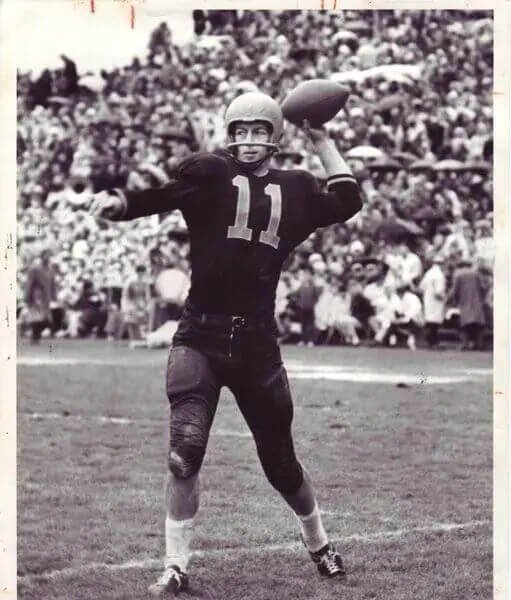
As an OSU senior Baker led the nation in total offense and passing yardage and earned unanimous All-America honors
My father, John Eggers, was Oregon State’s sports information director at the time. Before the season, he met with Prothro, who knew he had a special player in Baker, one who would be in the running for national awards. Dad felt if there wasn’t an Eastern prejudice in balloting for the Heisman, at least Eastern voters weren’t getting enough information about candidates on the West Coast.
So he hatched a plan. He compiled a list of the media across the country who voted for the award. After each game through the season, he gathered quotes from the opposing coach about Baker. On Sundays, Dad would go to Western Union and send a telegram — they came to be called “Terry-grams” — with the quotes along with Baker’s stats to each of the voters. He also mailed postcards with similar information to the national media.
Whether or not it made the difference is a matter of conjecture, but Baker wound up as the Heisman Trophy winner. Dad always said Terry would have won the award, anyway.
“Your Dad was ahead of the time,” Baker says today. “I can thank him for getting me the Heisman.”
Terry also says this: “In hindsight, I was aware that Prothro was wanting my statistics to be good. A couple of games in which we had a good lead, he came over and told me, ‘Terry, I am going to let you run the team until we score another touchdown, then I’ll let Gordon (Queen) play. But I want to get you some yardage.’ ”
There was no national television show announcing the Heisman recipient. This is how Baker learned that he was the winner:
“I am in an Engineering class. A phone rings, and the professor says, ‘The athletic director wants to see you in his office.’ I thought, ‘What did I do now?’ I walk down to Spec Keene’s office (at Gill Coliseum). He says, ‘You have a phone call here from New York.’ The guy on the line says, ‘Terry, you have won the Heisman Trophy.’ That is the way they announced it then. We talked for a couple of minutes, then I said, ‘Well, thanks. I have to get back to class.’ ”
Baker made the transition from football to basketball swiftly in December, flying to meet the team in Lexington for the Kentucky Invitational. Oregon State fell to seventh-ranked West Virginia 70-65 in the opener, but beat Iowa 61-55 the next night. That started the Beavers on a seven-game win streak and a stretch in which they went 20-4, ending with an 83-65 romp past fourth-ranked Arizona State in the Regional final.
That sent OSU into the Final Four in Louisville and a matchup with top-ranked Cincinnati. Unfortunately, Baker was ill with a flu bug that week. He went scoreless on 0-for-9 shooting with six turnovers in a 79-35 defeat. Baker was only a little better the following night, hitting 3 of 11 shots and scoring seven points in an 85-63 defeat to second-ranked Duke.
“I had run out of gas,” Terry says today. “I couldn’t sleep at night. I was just beat. But Slats did a wonderful thing for me. He arranged for me to play golf (at Corvallis Country Club) any time I wanted for free. I took up golf that spring of my senior year.”
•
After winning the Heisman and being chosen by the Los Angeles Rams with the No. 1 pick in the 1963 NFL draft, Baker was hooked up by OSU alum Buck Grayson with Portland attorney Mo Tonkon.
“Buck said, ‘Terry is going to need somebody to advise him and help him when he goes pro,’ ” Baker says. “They knew I didn’t have a father.”
Tonkon said he would be happy to help with advice. It was a fortuitous relationship that would pay off for Terry in the future.
By virtue of a 1-12-1 record in 1962, the Rams gained the first pick in the ’63 draft. Harland Svare was the head coach, only 32 and in his first full season in the position. Roman Gabriel, who would go on to play 16 NFL seasons and participate in four Pro Bowls, was in his second season with L.A. and his first as the starting quarterback. Veteran Zeke Bratkowski would serve as Gabriel’s backup as the Rams went 5-9. Baker, the third-string QB, started one game and played in four, completing 11 of 19 passes for 140 yards with four interceptions and rushing for 46 yards on nine attempts.
The next season, rookie Bill Munson — who also wound up playing 16 years in the NFL — came to the team and divided time at quarterback with Gabriel. Baker, switched to a halfback position, got into only five games, gaining 82 yards on 24 carries and catching eight passes for 92 yards as the Rams went 5-7-2.
In 1965, with Munson starting 10 games at quarterback and Gabriel four, the Rams backtracked to 4-10. Baker saw action in nine games, starting three at halfback. He rushed for 82 yards and a touchdown on 25 attempts and had 22 receptions for 210 yards and two TDs.
That was it for Baker in the NFL. After the Rams went 4-10 in 1965, Svare was fired and replaced by George Allen, who waived Baker in the preseason in 1966. But not before watching Terry run a very fast time in the 40 — Terry doesn’t recall what it was — during an early practice session.
“He was surprised with my time and said, ‘Have him run it again,’ ” Baker says. He had the same impressive clocking the second time. “I have to believe,” Terry says, “that I was fast enough to be a halfback.”
Baker played the 1967 season with the Edmonton Eskimos of the Canadian Football League as backup to Frank Cosentino at quarterback. Terry completed 23 of 36 passes for 344 yards and one TD with two interceptions, ran for 120 yards and a score on 36 carries and had nine receptions for 103 yards. And then, at 26, Terry Baker was a former football player.
“My pro football career got goofed up,” he says now. I’ll say. Terry wasn’t given a chance at quarterback in the NFL, moved to a different position after his rookie season. It was a different world in the NFL back then.
“In that era, Fran Tarkenton was an exception, but mostly teams wanted a drop-back passer who would stay in the pocket and throw the ball,” Baker says. “That’s not the kind of quarterback I was. When the Rams drafted me, they probably overlooked the fact that I wasn’t the classic drop-back passer. That was the hiccup of my pro career.”
The Rams played an exhibition game against Dallas in Multnomah Stadium prior to the 1963 NFL season. The game sold out quickly. Everyone wanted to see Terry Baker play. He started and played one quarter — two possessions — then sat on the bench, giving way to Gabriel for two quarters and Bratkowski for one. Thousands of spectators left the place somewhere between disappointed and steaming mad at Svare, who frankly should have played Baker most of the damn game. As a 10-year-old, I was one of them. But Baker isn’t critical of his former coach.
“I liked Harland,” Terry says. “He was a great guy.”
In college, Baker would experience a sore arm on occasion. It happened again his rookie season with the Rams.
“We would have practices where the quarterbacks would be throwing pass after pass after pass,” he says. “My arm would get sore, and eventually my arm was hurting. Things weren’t sophisticated in those days in the medical sense. (Team medical personnel) didn’t know squat about what they were doing.”
During the preseason of his second NFL season, “I got injured because they had me in a weightlifting program that nobody supervised,” Baker says. “I pulled a muscle near the groin and it screwed me up. The next week, they moved me to halfback.”
When I consider Baker’s skills as a football player and see quarterbacks such as Patrick Mahomes and Josh Allen excelling in the NFL, I think he would have thrived in today’s game. Does Terry feel the same way?
“Not really,” he says. “I am not trying to be modest here. Those guys have better arms than I ever had. I was a sore-armed pitcher and a sore-armed quarterback. Even now and then pitching in high school, my arm would get sore. When we won the state championship my senior year (at Jeff), I didn’t pitch a couple of playoff games. I pitched the championship game when we beat The Dalles (7-1), but I was well-rested.”
•
NFL salaries were so low in the 1960s that all players had jobs in the offseason. (Baker’s rookie contract was a three-year deal for $90,000, including a $15,000 signing bonus.) After his rookie season, Baker got employment in Portland at Pacific Power.
“Mo Tonkon’s office was in the same building,” Terry says. “He would take me to lunch now and then. Toward the end of that summer, before I had to go back to the Rams, Mo says, ‘Why don’t you think about becoming a lawyer?’ ”
Baker decided to go for it. He passed a required aptitude test to qualify for law school. Once he got back to Los Angeles, he paid a visit to the USC Law School office.
“I walk over just before school is starting and say to the woman behind the reception desk, ‘I would like to go to law school here,’ ” Baker says. “She says, ‘Did you file an application?’ I said, ‘No, do you need to?’ She asks if I have taken the aptitude test, and if so, if I have the results. I have them. She looks at them, says to wait here and goes back into another room. She comes back in a couple of minutes and says, ‘You are admitted.’ ”
After his third and final year with the Rams, Baker graduated from law school and received a job offer from one of the two biggest law firms in Los Angeles.
“They said, ‘If you come to work here, we will put your name in as member of the L.A. Country Club,’ ” Terry says. He turned it down, opting to return to Portland. After his one CFL season, Baker sought Tonkon for advice.
“I needed a job immediately,” Terry says. “Mo said, ‘Go to work at the best firm in town — Davies, Biggs, Strayer, Steel and Boley.’ I applied, and they hired me. It was a wonderful firm. I loved all the partners I worked with.”
In the summer of 1970, the firm gave him a leave of absence to serve on an eight-person presidential commission tasked with reporting to Richard Nixon on unrest in the country through those times. This was right after the Kent State shootings. A federal judge in Los Angeles was appointed to head the commission. He contacted Baker and asked him to join up. He spent the summer in Washington D.C.
“I roomed with three guys who had clerked on the U.S. Supreme Court,” Terry says. “One of them became a professor at Stanford Law School. One member of the commission was a former governor of Pennsylvania. Another became dean at the Stanford Law School. When we were done, we met with Nixon, and he thanked us for the report.”
After three years with Davies Biggs, Tonkon offered Baker a job with his firm, Tonkon Torp.
“It was a dilemma,” Terry says. “Mo had been so good to me, yet (the people at) Davies Biggs were wonderful, too. One of the partners there, George Frasier, said, ‘You are just like the hog running up and down the trough, trying to figure out where to start eating first.’ Finally I joined up with Mo, and life couldn’t have been better.”
Baker says he still receives fan mail regularly, asking for his autograph.
“Some people not only want me to sign something, they want my opinion on things,” he says. “One of them asked, ‘Who had the most influence on your life?’ I answered, ‘Mo Tonkon.’ ”
•
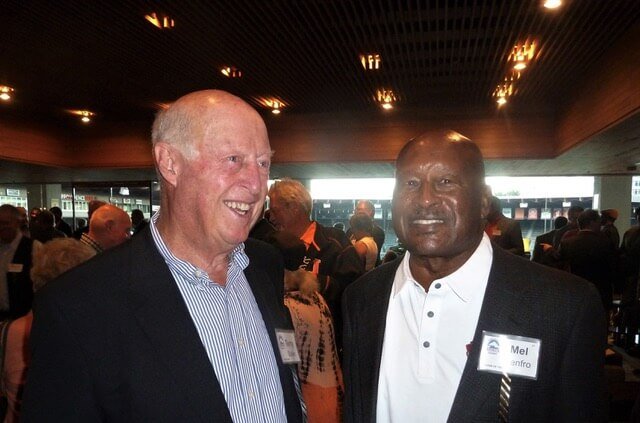
Baker with high school teammate Mel Renfro at an Oregon Sports Hall of Fame banquet a few years ago
As our interview concludes, I ask Terry if he has finally grown comfortable with being known as “Terry Baker, Heisman Trophy winner.”
“I guess so,” he says, and I detect a slight sigh. “But it was a long time ago. It has nothing to do with what kind of person I have been and what I have done since.”
Pause.
“One of the guys I play golf with kept telling people who would join our group that they were playing with a Heisman Trophy winner,” Baker says. “Finally I said, ‘Gosh, would you quit telling people that every time we play?’ Unfortunately, with his memory, he can’t remember what I told him.”
I laugh, and Terry does, too.
When I wrote the Northwest Magazine piece with him nearly 40 years ago, Baker said this about his senior year at Oregon State: “It was really a dream year. If you wanted a Hollywood script, you could change a couple of things — we could have been undefeated in football and won the NCAA title in basketball — but it was an incredible thing.”
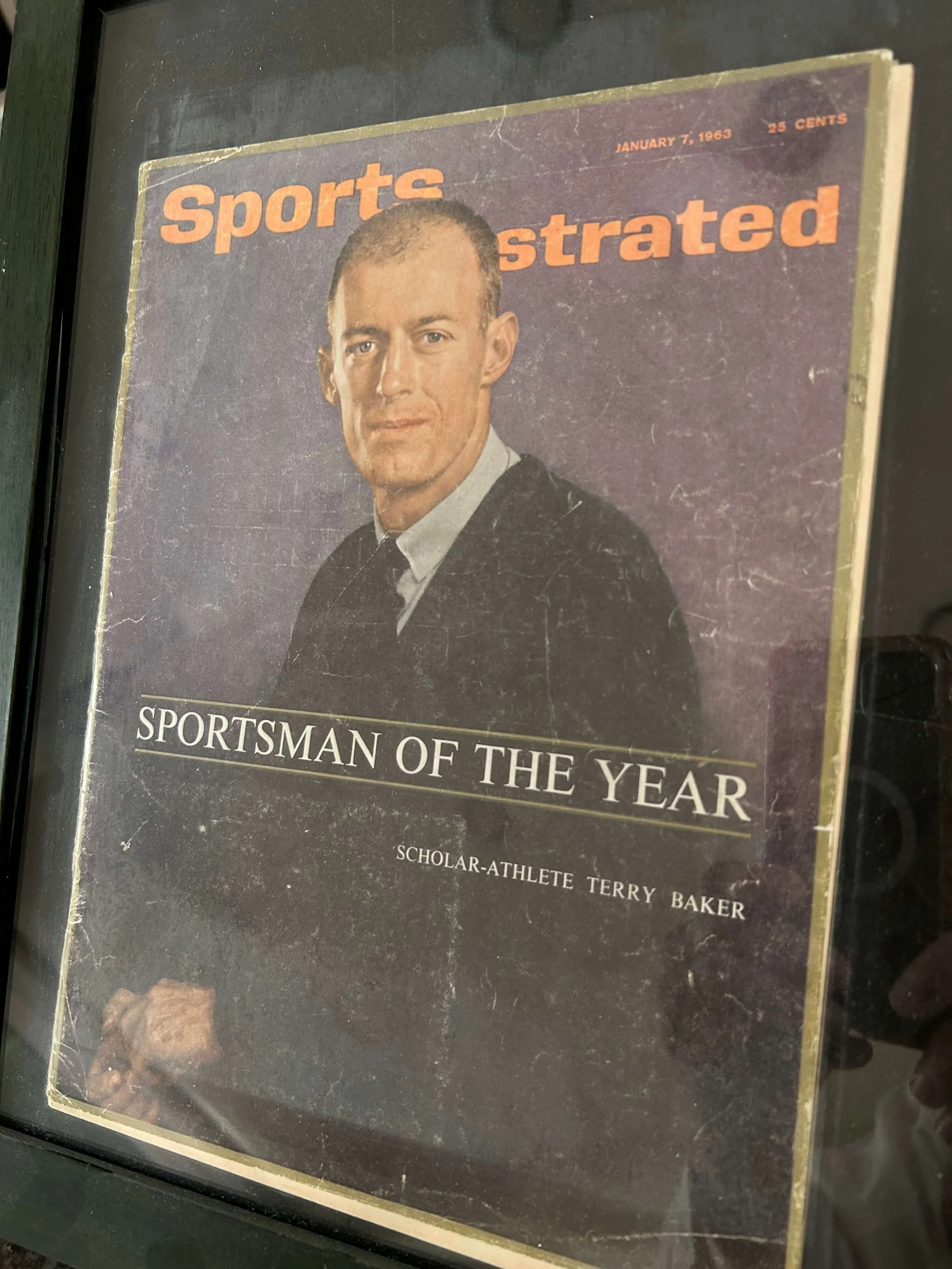
Baker was Sports Illustrated’s “Sportsman of the Year” in 1962
Does he still feel the same way?
“It was like a dream,” he says. “It was unbelievable. I will be playing golf and (his playing partners) will find out I won the Heisman somehow, and they will bring it up. and I’ll say, ‘Yeah, what I really like is that we went to the Final Four, too. And what we (accomplished) happened with a bunch of great, ordinary guys.”
There is a move afoot to get a statue of Baker erected on the Oregon State campus, preferably somewhere between Gill Coliseum and Reser Stadium. Sounds like a no-brainer to me. I hope it can happen sooner rather than later.
► ◄
Readers: what are your thoughts? I would love to hear them in the comments below. On the comments entry screen, only your name is required, your email address and website are optional, and may be left blank.
Follow me on BlueSky.
Follow me on X (formerly Twitter).
Like me on Facebook.
Find me on Instagram.
