Rueck on Beavers in Pac-12 2.0: ‘We’ll be a tough out every night’
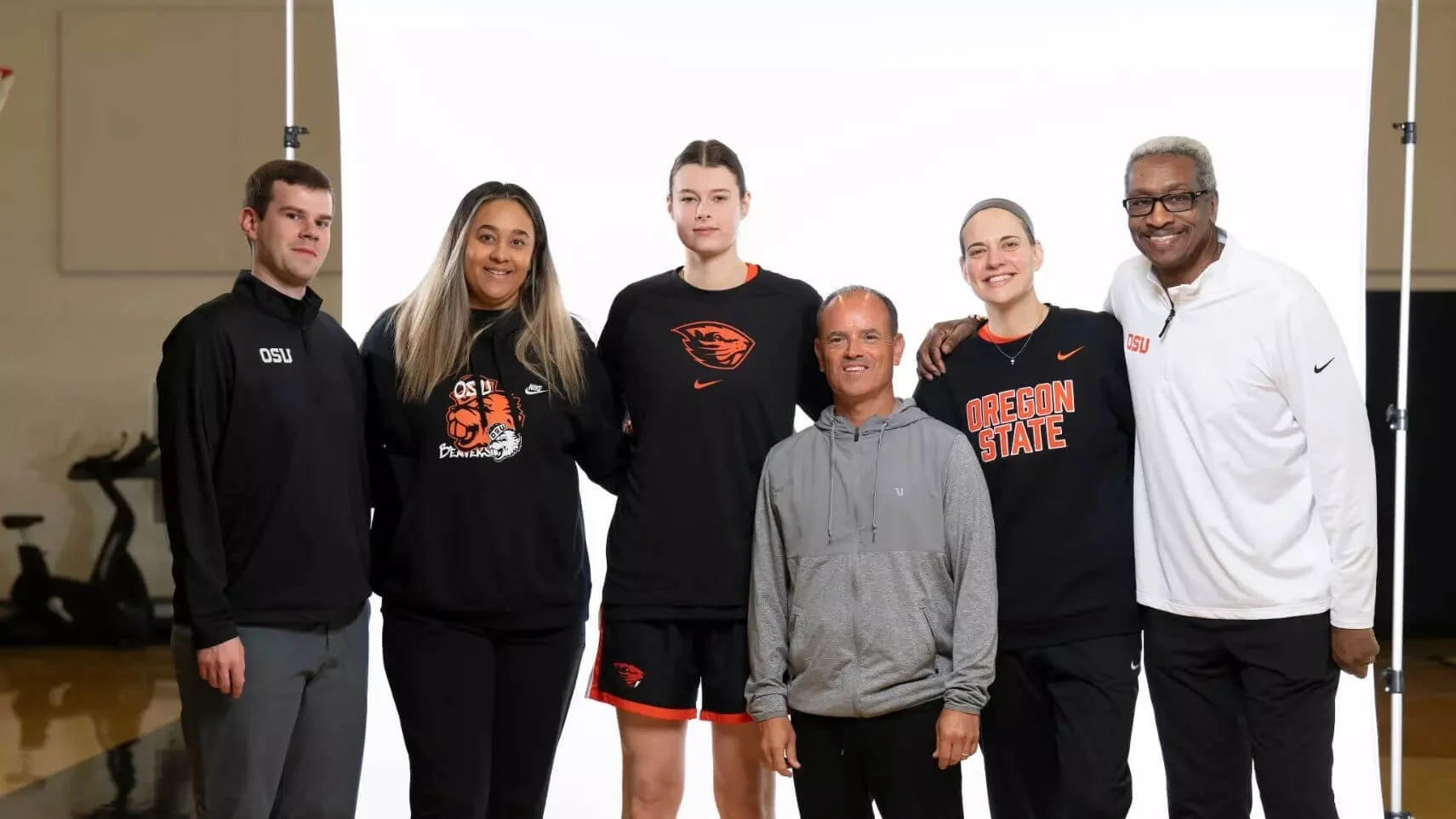
Recruit Mariia Ignatchenko, a native of Ukraine, is flanked by OSU coaches (from left) Jared Vedus, Deven Hunter, Scott Rueck, Sydney Wiese and Eric Ely (courtesy Karl Maasdam/OSU sports communications)
CORVALLIS — Scott Rueck’s 17th season at the helm of Oregon State women’s basketball begins officially on Nov. 1 when the Beavers play host to Seattle Pacific in an exhibition game at Gill Coliseum.
Wait a minute — 17 years? Can it really be?
“Time flies,” Rueck tells me with a laugh during a recent 45-minute interview.
“I’m telling you, it’s hard to believe. Well, in some ways I can believe it, but it was a long time ago. It’s weird to say it, I can tell you that much. I still feel like the new guy.”
Rueck is 56 now, a five-time Pac-12 Coach of the Year, much more seasoned than the fresh face who arrived on the scene to pick up the pieces of the disastrous Lavonda Wagner era in 2010. Rueck had built a powerhouse Division III program at George Fox, fashioning a 288-88 record overall, including 178-50 in Northwest Conference play, and had taken the Bruins to a 32-0 record and a national championship in 2008-09. But this was a much more difficult challenge.
That first season, the Beavers had only two returnees from the previous season — senior El Sara Greer and sophomore Angela Misa. Freshman Alyssa Martin and JC transfer Earlysia Marchbanks came in, but Rueck had to fill out his roster with walk-ons. Before the season, he staged open tryouts.
“We had 57 players show up and kept four, including one of my former players at George Fox (Sage Indenti),” Rueck says.
The Beavers wound up with 11 players on the roster, six of them freshmen, and two of the reserves played a total of 17 minutes all season. They finished 9-21 overall and 2-16 in Pac-12 play, including a 61-59 victory over Oregon that almost defied belief.
“Without a doubt, one of the favorite wins of my career,” Rueck says now. “I will never forget it. It was a special day.”
I had been at a men’s Civil War game in Eugene earlier in the day and decided to stop by and watch the second half of the women’s game at Gill on my way back to Portland. The OSU women were 1-11 in conference play going into the game, but had played the Ducks pretty well in an 81-72 loss a month earlier before a crowd of 12,320 in the first-ever women’s game at Matt Knight Arena.
I poked my head into the Coliseum and peeked at the scoreboard. Oregon led by 20 points. I almost got back into my car and headed home. But I stayed, and witnessed a comeback for the ages.
“We had played them tough in Eugene, and we were feeling pretty good,” Rueck recalls. “We had beaten Washington, and now we have (the Ducks) on our homecourt. But the first half, they couldn’t miss and we couldn’t get anything done.
“I will never forget being in the locker room, down 20, and saying, ‘OK, this is disappointing.’ But the team fought like crazy, and El Sara put us on her back in the second half. I still have the game ball in my office at home signed by the players on that team.”
Rueck calls that game “an inflection point” that led to a recruiting class that featured Jamie Weisner, Ruth Hamblin, Deven Hunter and Samantha Seigner, a group that won a Pac-12 championship and reached the Final Four in 2016.
There has been a lot of winning ever since. Rueck enters the 2026-27 season with a 339-182 career record at OSU, with 13 winning seasons over the past 14 years, nine 20-win seasons, three Pac-12 titles, nine NCAA Tournament appearances, a Final Four and an Elite Eight finish in 2023-24 with a team that had no seniors and seemed poised for a run at a national championship the following season.
Then things imploded. The Pac-12 broke up. All of the major pieces from the Elite Eight team transferred out. Oregon State moved into the lesser West Coast Conference in 2024-25 with no starters and only four letter-winners returning.
Rueck cobbled together a group that started the season 3-7 but gathered momentum as it went on. The Beavers finished the regular season 16-15 overall and 12-8 for fourth in the WCC. Then they knocked off San Francisco, Gonzaga and Portland in succession to win the WCC Tournament and gain an NCAA Tournament bid. The Beavers lost 70-49 in the first round, but getting there was a big deal.
Last season, Oregon State was fourth in the WCC again, going 23-12 and 13-5, though the season ended on a sour note with a home loss to Wisconsin in the first round of the WNIT.
And now, as they head into Pac-12 2.0, armed with eight key returnees and an impressive recruiting class, there is optimism among the OSU coaching staff that Beaver women’s basketball as we know it will be back.
The past two seasons, Rueck and his assistants were forced to go internationally for talent. The 2024-25 team had six foreign players; last season there were 10.
Says Rueck: “For those two years of chaos, where there was so much uncertainty surrounding our future and it was so public, the conversations we were having with high-ranking American (recruits) and families kept getting down to the question, ‘Where are your games going to be shown? Who are you playing against?’ My answer was, ‘I don’t know,’ and that’s a deal-breaker. That’s why our roster moved mostly international, because those athletes didn’t care about those things and they remained open to us.
“Once we proved we would remain competitive through all of this, all of a sudden the families we have normally recruited over the years opened up to us once again. This (recruiting) class is proof of that. We weathered the storm and we did it largely successfully. I have loved our last two years. This is a more traditional Oregon State class, historically speaking. I am excited about them.”
Seniors Tiara Bolden and Lizzy Williamson have departed from last year’s team. But the other three starters and three key reserves will return along with five newcomers from the 2026 recruiting class. And maybe Catarina Ferreira, the best player on OSU’s 2024-25 club.
“Until the Covid and conference disruption, we didn’t have many transfers,” Rueck says. “The last two years, we have had three total, and all left for (more) playing time. They all left with a hug. It is wonderful to have so many players back, wanting to continue to build on what we have done.”
Part of that is due to the family atmosphere of the OSU program and the relationship Rueck and assistants Hunter, Sydney Wiese, Eric Ely and Jared Vedus have built with the players. Part of it is an uptick of NIL and revenue-share funding that Rueck says gives Oregon State at least a fighting chance to attract recruits and retain top players.
“We have had to step up in that area,” he says. “That is a part of the equation now. As rev share and NIL have become a part of it, we have adapted and been able to participate. We are competitive in every way nationally now.”
The four incoming freshmen and JC transfer Mariia Ignatchenko arrived on campus in late June and stayed through the end of July. That overlapped with two weeks of the returnees being in town.
“We had the whole group together, 10 hours a week, which was great,” Rueck says. “It was encouraging to see what they are capable of.”
The freshmen went home for the month of August while the returnees stayed for a couple of more weeks. Everybody returned to Corvallis on Sept. 8. Official practice begins on Thursday.
Over the years, Rueck’s teams have featured many quality “bigs,” players such as Hamblin, Marie Gulich, Taylor Jones and Raegan Beers.
“This team will be slightly different — not quite as big as we have been,” Rueck says. “But we are mobile and athletic throughout the roster. It might be the fastest team I have ever had. We have mobile bigs who are more along the hybrid lines rather than the true centers I have normally had.
“That will allow us to be creative in the way we do things. We will be able to be a little more flexible defensively. We will be able to open up the floor more, because we can shoot from all five positions all game long, all the way out to the 3-point line.”
As usual, Oregon State was a solid defensive team a year ago, holding opponents to shooting .374 from the field and .305 from 3-point range and yielding only 61 points a game. The Beavers were mediocre at the offensive end, however, shooting .436 from the field, .333 from the 3-point line and averaging 67 points per contest. And with 14.4 turnovers a game, taking care of the ball was an issue.
“We were inconsistent offensively,” Rueck says. “Kennedie (Shuler) had to carry a heavy load. Our offensive possessions felt more like a fight than beautiful execution, where the ball moves faster than the defense. Kennedie could go, Tiara could go, Jenna (Villa) could go, but they had to create for themselves. It wasn’t necessarily from execution.

“This year, I have a feeling the ball is going to move a little bit quicker with the makeup of this team. There are lots of ways to win, and last year’s team found a way. This year it will be a bit different. There is potentially more of an upside offensively. We have a chance to be a little more fluid, where one person doesn’t have to do it all.”
That will be especially true if Ferreira — the MVP of the WCC Tournament in 2025 — is back. The 6-foot wing missed all of last season following knee surgery and has applied for a medical redshirt year that has not yet been approved by the NCAA.
“We are working on it, hoping she will be eligible,” Rueck says. “We are in the middle of it. Compliance is handling it. She is practicing with us, waiting for clearance.”
When do they expect to get a ruling?
“We have no idea,” Rueck says. “It is out of our hands at the moment.”
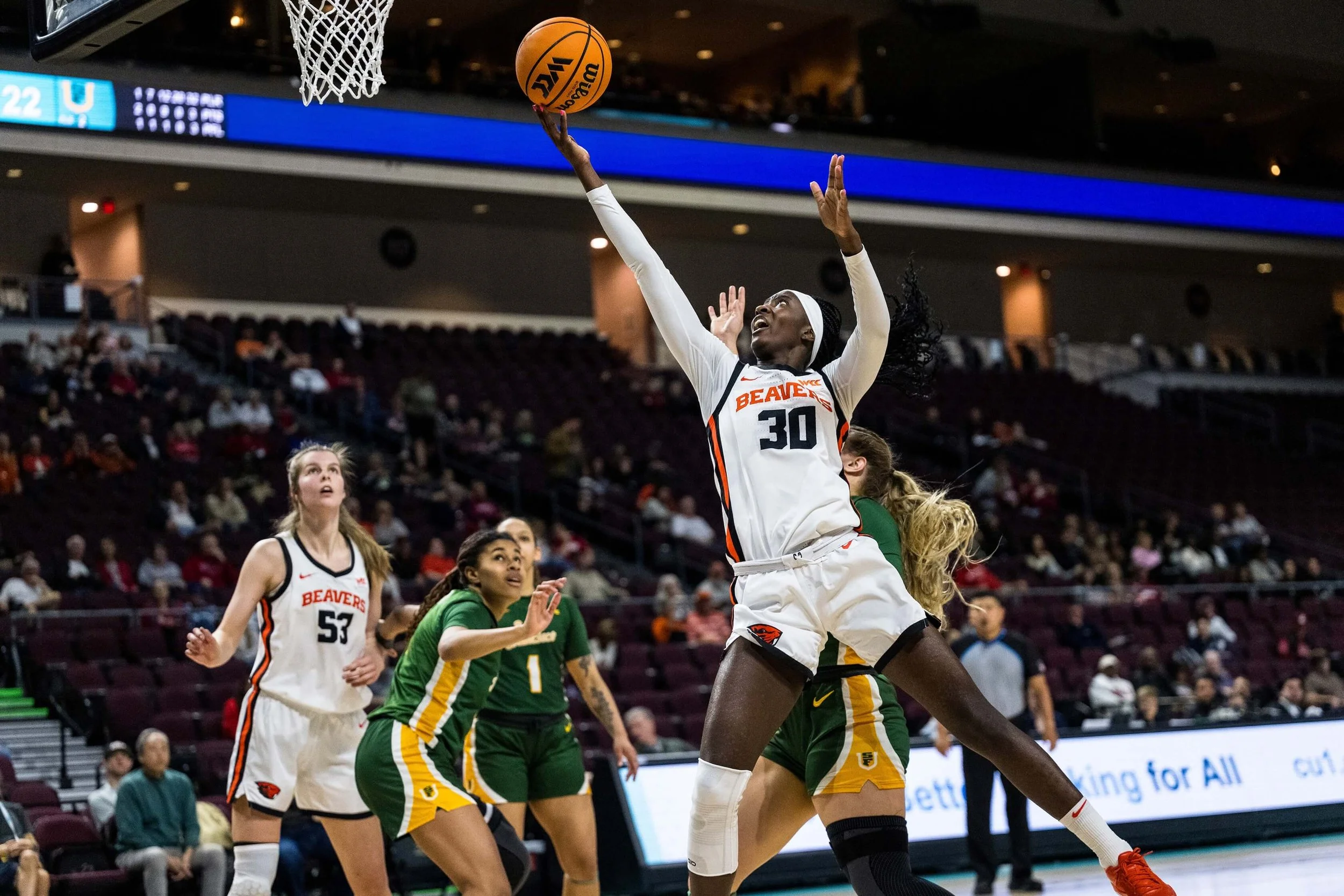
The NCAA has not yet ruled on the appeal for eligibility by star wing Catarina Ferreira Coach Scott Rueck enters his 17th season at the Beaver helm (courtesy OSU sports communications)
Ferreira is healthy now and wiser for the year spent watching plenty of Beaver basketball from the bench.
“She has always been like a coach on the floor,” Rueck says. “It was so fun to get to coach her (in 2024-25), to watch her evolve, to see how she would understand concepts and remind her teammates. She is a little bit like an assistant coach — that is how she operates. Now that is even more valuable with a year of watching, understanding things from the sidelines.
“If we were to have her this year, Cat will be as good as she wants to be. Whether it is for us or professionally, she has a lot of great basketball ahead of her.”
Shuler was the straw that stirred the drink for the Beavers last season. The 5-6 point guard averaged 12.5 points and led the team in assists (5.4) and steals (2.0). Her Achilles heel was shooting from the foul line (.567) and 3-point line (5 for 38, .132).
“Kenn trained like crazy this summer,” Rueck says. “She has prepared herself for what is ahead at the highest level. She looks great and is ready to lead us. She has worked on the 3, and is using it. I am excited for that to continue to develop for her.”
After a transfer from Washington State, the 6-1 Villa stepped right in and led Oregon State in scoring (14.9) while shooting well from 3-point range (.375) and superbly from the foul line (.881).
“As much success as Jenna had last year, she also learned a lot,” Rueck says. “She understood the defensive end of the floor at another level. She took rebounding to another level, too. The next challenge for her: ‘Not only can I put up 30 points, how much can I create for my teammates with the defense focusing on me?’ ”
A new NCAA rule permits athletes to play five seasons over a five-year period.
“I am fine with it,” Rueck says. “I had never looked at it from the perspective of the student-athlete who does not get a Master’s degree. If you suffer an injury (and stay a fifth year), you get (the chance) to get one. If you don’t, you don’t. I had never considered that angle before. Looking at the complexity of what eligibility has turned into — so chaotic and random and confusing — bringing some order to that by making a more simplified rule makes sense to me.”
So, I ask Rueck, does that mean that Shuler and Villa could return for a fifth season in 2027-28?
“I believe that is correct,” he says. “That is our understanding.”
The other returning starter is 5-10 junior Ally Schimel, who started every game last season and led the team in 3-point accuracy at .427. Schimel’s only downfall in my book, I tell Rueck, has been her reluctance to shoot, or to put the ball on the floor and create.
“I am excited for that (to start to change) this season,” he says. “It is perfect timing for that. She just does whatever the team needs, but there is more there. If the team needs a bucket, I think she will step up and do it.
“There is still a ways to go for Ally to continue to add layers to her game. What I have learned about her, though — it is really hard to have her off the floor, she is so valuable out there.”
Last year’s three freshmen — Lara Alonso, Katelyn Field and Keira Lindemans — should come back as improved products.
Alonso made the biggest impact a year ago as first off the bench, averaging 4.9 points and 4.7 rebounds in 16.1 minutes. The 6-3 southpaw from Spain will challenge for a starting role this season.
“Lara came back after being home for five or six weeks, and she looks different,” Rueck says. “She is in incredible condition and brought a level of confidence back with her. It demonstrated how much she wants to be great.
“She seems to have made massive strides. She never stops moving. She crashes the boards and plays with relentless energy. She focused on her right hand finishing around the basket, and is getting a ton of shots up to enhance her perimeter game. She is poised for a big-time year.”
Field and Lindemans, both Australian wings, should contend for greater minutes after playing sparingly in 2025-26.
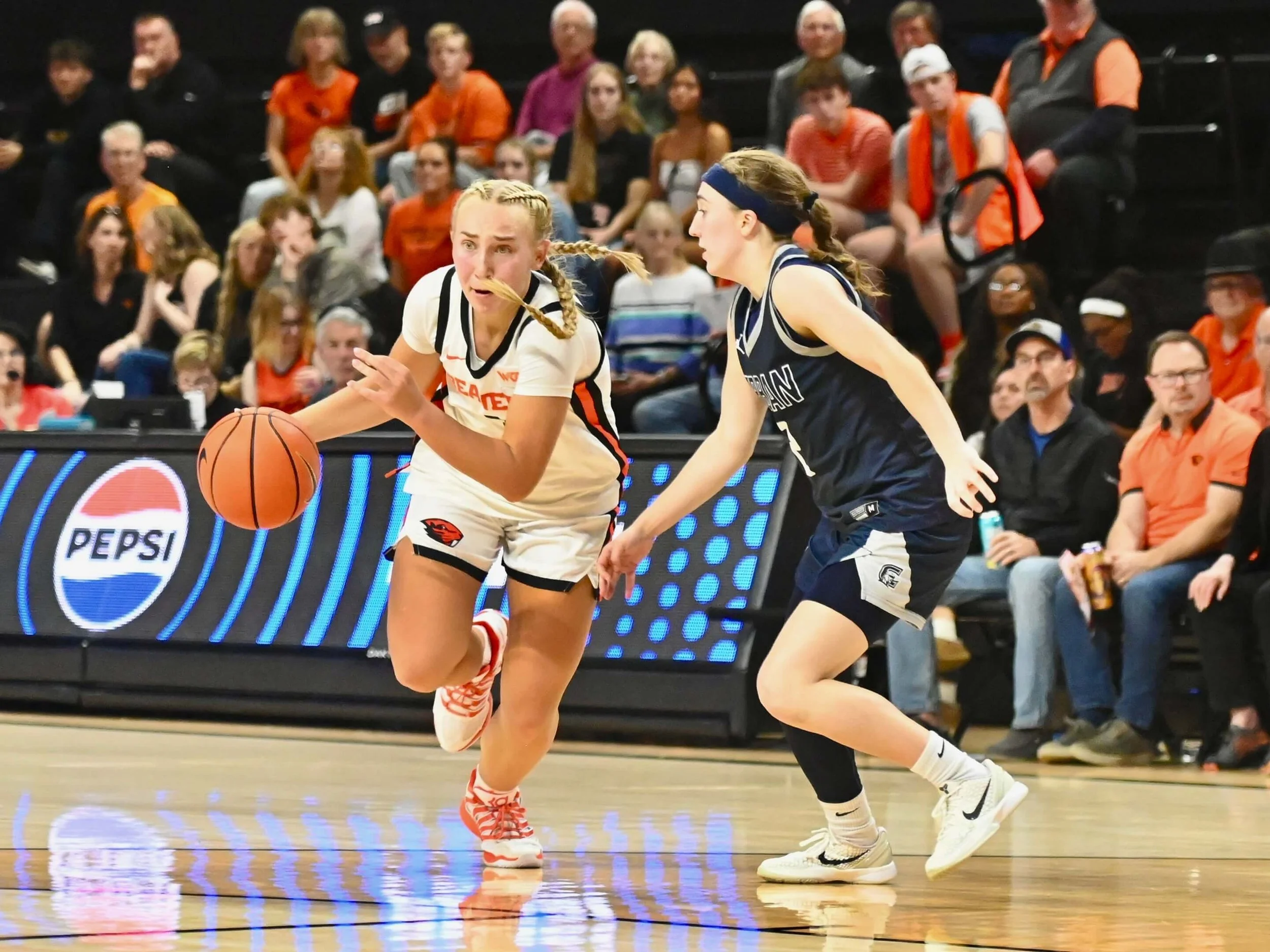
Point guard Kennedie Shuler runs the show for the Beavers on both side of the ball (courtesy Dominic Cusimano)
“Katie is a sniper, growing in her confidence, in her ballhandling ability and understanding what she is capable of defensively,” Rueck says. “Every team needs people who stretch the floor (with perimeter shooting ability); that’s what she does.
“Keira is maybe the most versatile player on the team. She has post moves to be jealous of and is one of the most explosive athletes we have. It is difficult to keep Keira in front of you. She is getting to the rim and finishing well.”
The other returnee is 5-8 point guard Mackenzie Shivers, who missed the 2024-25 season with a knee injury and played only 46 minutes in 12 games last season. “She will have the opportunity to earn more minutes this season,” Rueck says.
One of the recruits — 6-1 wing Genesia Mayele of France — isn’t coming. “It just didn’t work out,” is all Rueck will say.
The other five newcomers could all contend for major playing time.
Ignatchenko, a native of Ukraine, is a 6-4 junior who averaged only 4.4 points and 3.7 rebounds at Salt Lake City JC last season. Rueck likes her upside.
“Mariia was a tennis player in the Ukraine for eight years,” he says. “That teaches agility, quickness and hand-eye coordination, and to be a good tennis player, you have to have finesse, touch and fine-motor ability.
“You see that when she plays basketball. She is a hybrid big, very comfortable with the ball away from the basket, and she is agile, quick around the hoop and can jump. There is going to be a learning curve for her adapting to our level and our program, but she is showing signs of becoming an impactful player.”
Taylor Young is the most decorated of the four freshmen. The 5-9 guard from Crater was the top prep senior in Oregon and the state’s 5A Player of the Year, leading the Comets to a state title while breaking the 5A Tournament scoring record. She tallied 840 points as a senior — second only to Gaston’s Sheri Van Loo’s 851 in 1979-80 — averaging 35 points while shooting .568 from the field and .464 from beyond the arc.
“Taylor is a gifted athlete, a competitor, a winner,” Rueck says. “She has every skill in the book. She can play the point or off the ball. She is one of those guards who, if she gets in traffic near the rim, the game slows down for her. She makes great decisions. Defense is different at this level, but she is way ahead of where a typical first-year player is at that end of the floor. She will be in the mix for starting, for sure. She impacts the game so positively.”
Evelini Smith is a 6-4 center who played at St. Mary’s High in Stockton, Calif., the same school from which the Beavers recruited past stars Ali Gibson and Kat Tudor. Smith averaged 12.4 points and 7.5 rebounds on a CIF section championship team.
“Evelini is a fierce competitor,” Rueck says. “She is a shot-blocker, a rebounder, and she has a power game. She plays with a physicality that is impressive. You don’t want to play against her — she is that level of a competitor. My vision for her is to be a hybrid big. As she pursues a pro career someday, she will be a face-up who can go inside. We are fortunate to have her.”
Ashley Uustitalo is a 5-9 guard who averaged 14.8 points, 5.2 rebounds and 3.6 assists as a senior at Lake Washington (Wash.) High, a 3-point shooter and her league’s MVP.
“Lots of similarities with Taylor,” Rueck says. “They are both primarily ballhandlers, but can score and play off the ball as well. They’re not the biggest kids, but they play big. And they are so skilled, it doesn’t matter.
“Ashley played in the state tournament all four years and was their primary threat on all of those teams. And she is a little bit ahead of where I expected defensively.”
The numbers for Maggie Warpus as a senior at Chenango Falls (N.Y.) High are startling — 23.4 points, 14.2 rebounds, 3.7 steals and 2.3 blocked shots while shooting 49 percent from the field and 35 percent from 3, all in a 32-minute game.
“Lower level, smaller school, small town (4,700) outside of Binghamton,” Rueck says with a chuckle. “She never came out of a game for her high school team. She was on a good AAU that played in a tournament in California two summers ago, and Eric Ely saw her.
“If there is a definition of a sleeper, it is Maggie. We like long shooters, and that is what she is. She was under-recruited for what she is capable of. She is in a phase where she is adapting to the physicality of this level. She is the perfect ‘stretch 4’ for us, with excellent defensive timing and feel for the game. She has a chance to have an outstanding career.”
The new Pac-12 will be no cinch. Four teams — San Diego State, Colorado State, Boise State and Gonzaga — won 24 or more games last season.
“This conference is going to be extremely competitive,” Rueck says. “You don’t have to look any farther than the coaches. Everybody has won at some point.
“I am excited mostly about the stability of having a conference, something tangible to be able to recruit to. And I am excited to see this conference grow.”
I won’t be surprised to see Ferreira, Shuler, Villa, Schimel and Alonso as the starting five against Seattle Pacific in the exhibition opener. Or if Ferreira isn’t eligible, perhaps Young in an ultra-small but quick lineup. Or maybe Rueck goes big with Ignatchenko in the middle.
Does he believe he has a team capable of challenging for a conference title?
“I do,” Rueck says. “This team has the right makeup competitively. We are not the biggest team. Might be one of the smallest teams I have had. But our skill level makes up for some of that. If we can rebound and match physicality, we will be a tough out every night.”
Oregon State’s non-conference schedule is formidable, with games at Arizona, against Vanderbilt at the Jacksonville Classic and against BYU and Oregon in Corvallis. The Beavers have an Eastern road trip that features games at Columbia and Princeton, the top two teams in the Ivy League last year.
“It might be the toughest non-conference schedule we have ever had, and that is by design,” Rueck says. “We need to be tested going into the conference.”
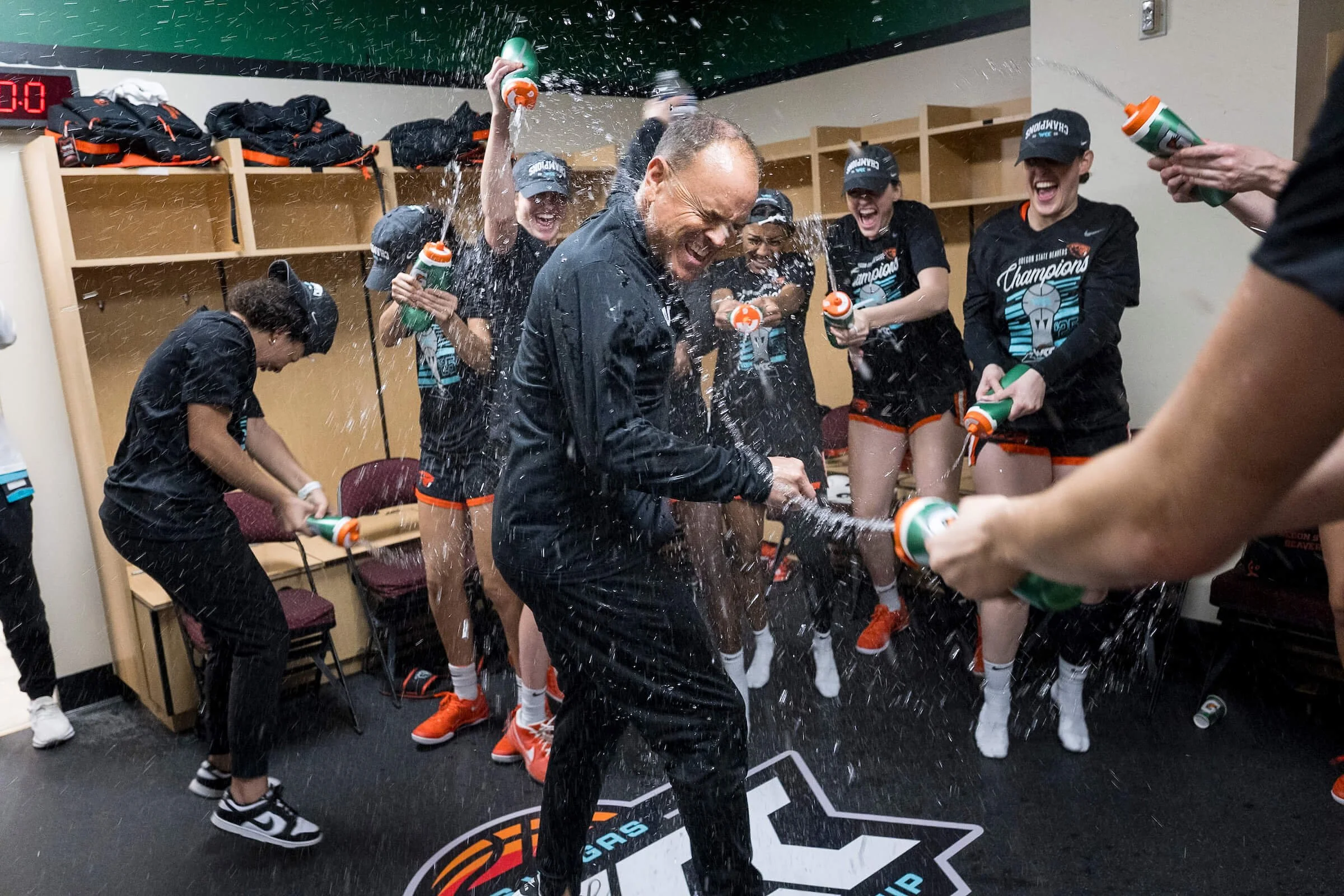
Coach Scott Rueck, here celebrating a WCC Tournament championship in 2025, is entering his 17th season at the Beaver helm (courtesy OSU sports communications)
The “now” looks pretty good for the Beavers, and the future, too. They beat out Stanford, Oregon, Arizona, Utah and many other major programs for a commitment from Berkley Jones, a four-star guard from Eagle, Idaho. The 5-10 Jones averages 30.2 points and 9.0 rebounds as a junior, shooting 60 percent from the field, 47 percent from 3-point territory and 85 percent from the free throw line. She will look good in a Beaver uniform in 2027-28.
► ◄
Readers: what are your thoughts? I would love to hear them in the comments below. On the comments entry screen, only your name is required, your email address and website are optional, and may be left blank.
Follow me on BlueSky.
Follow me on X (formerly Twitter).
Like me on Facebook.
Find me on Instagram.
