Rick Wise’s MO during his long MLB career: ‘A fastball with an idea behind it’
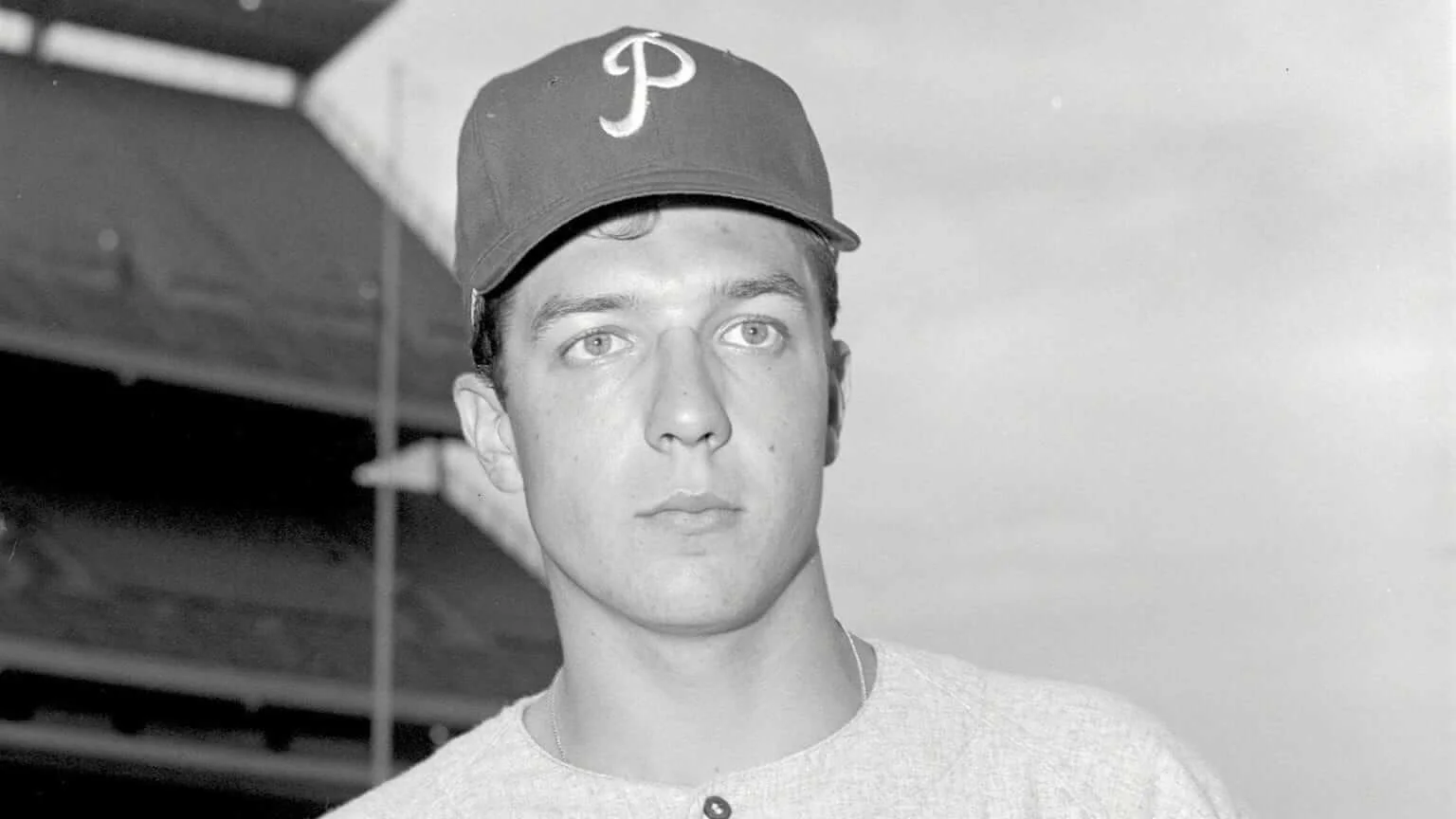
Rick Wise’s first seven MLB seasons came in a Phillies uniform
Updated 7/17/2026 9:50 AM
I had an event recently for my new book, “Scrolls of a Sports Scribe,” at The Springs, a senior living center in Lake Oswego. The first person in the theater rolled in on a wheelchair, an athletic-looking guy wearing a short-sleeved shirt with a “Red Sox” insignia.
We struck up a conversation. “You a Red Sox fan?” I asked. “I played for them,” he said.
I’ve heard it all, so I’m leery of such statements.
“Kerry Eggers,” I said, extending my hand.
“Rick Wise,” he said, meeting it with a firm shake.
Rick Wise!
Indeed, one and the same.
The Rick Wise with 188 victories, 138 complete games and 30 shutouts in a Major League pitching career that covered 17 years, plus two innings of one game before retiring in 1982 at age 36. Ten seasons with double-figure wins. Two All-Star games, including a victory. One World Series appearance, including a victory.
And author of one of the greatest individual performances in MLB history, which I will get to in a minute.
The former Madison High great, now 80, has had a rough go of it in recent years. He lost his wife of 54 years, Susan, who died in 2021. In the last couple of years, leg problems brought on by neuropathy have left the once supple body of a tremendous all-around athlete unable to walk.
Two recent surgeries over a 20-day period — to his neck and lower back — have helped.
“Now he is getting back feeling in his legs,” says younger brother Tom Wise, also a standout athlete during his time at Madison. “He is trying to walk in his walker. His goal is to get to a cane. He is doing great. He is much better now than he was two months ago.”
A week after the book event, I spend an hour and a half with Rick at The Springs, discussing his career and life in general. The last time we had talked was for a newspaper article written many moons ago, so I am not sure what to expect. Over 90 minutes, I sense a good spirit and a kind heart. On the way to his room, he takes the time to speak to several residents with whom he has become friends during his three months at The Springs. He half-smiles, half-grunts when I ask how it feels to turn 80.
“Not too bad,” he says. “I have my ailments and stuff. That goes with age. All in all, I am doing pretty good.”
“Rick has been humbled with some of his best buddies passing away,” Tom Wise says. “He misses those guys. Every day he gets up, he is thankful that he is doing OK.”
I am thankful Rick is willing to spend some time with me. He has quite a story to tell.
On June 23, 1971, Wise did the unthinkable. The 6-1, 185-pound right-hander hit two home runs and pitched a no-hitter in the Philadelphia Phillies’ 4-0 victory over the Cincinnati Reds at Riverfront Stadium.
The feat has never been matched in MLB history. Not by Babe Ruth. Not by Shohei Ohtani. A few weeks after the 55th anniversary of that monumental evening, I ask how Rick feels about that after so many years.
“Pretty exceptional, when you consider all the games that have been played in the Major Leagues,” he says.
According to AI, more than 220,000 games have taken place in the 150 years since MLB’s roots began with the founding of the National League in 1876. More than 11,000 pitchers have thrown at least one inning. No other pitcher has hit two homers and thrown a no-hitter, before or since. The designated hitter went into effect in both the National and American leagues in 2022. Unless there is another rule change, it will never happen again.
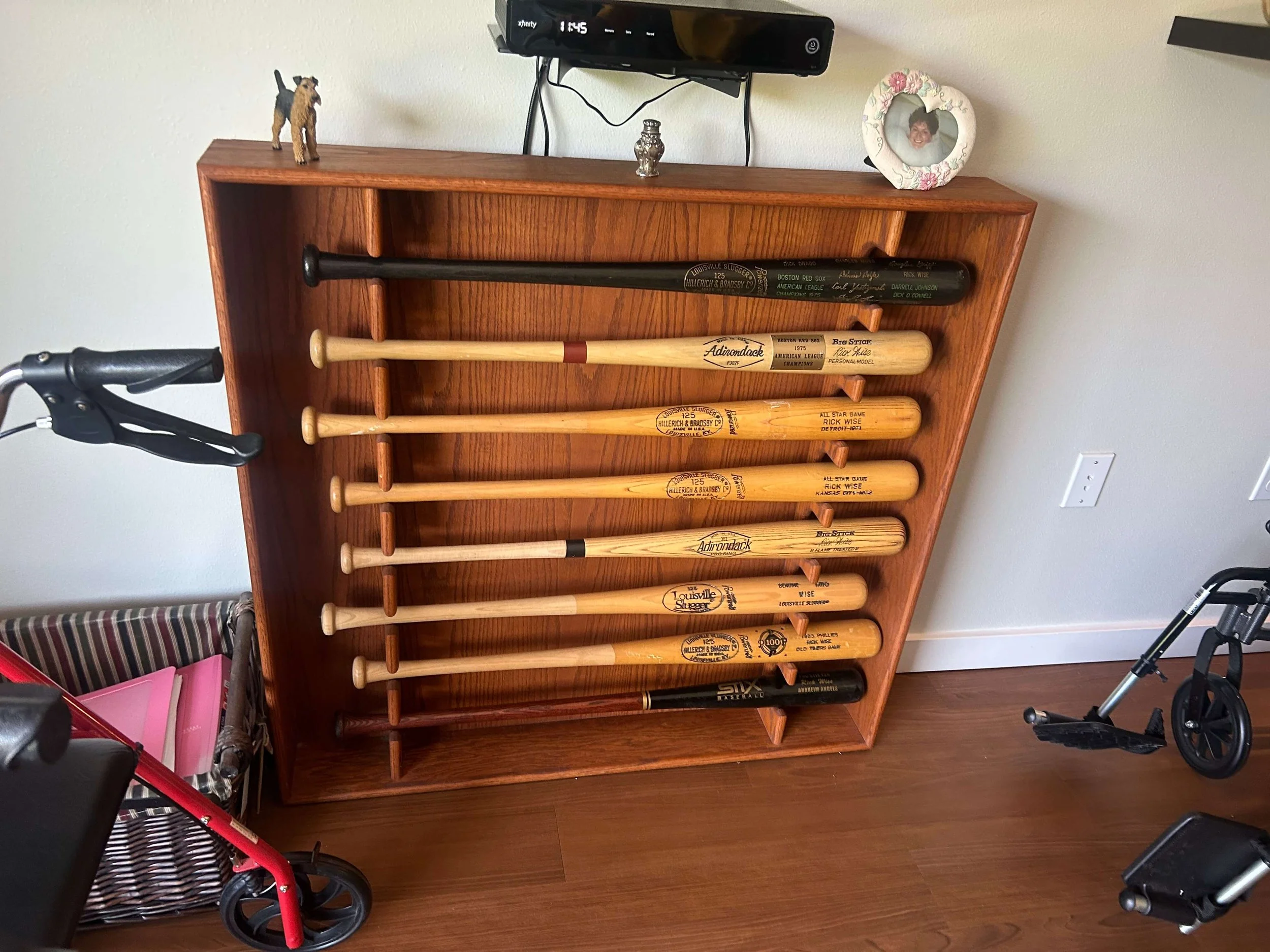
Rick, one of the best-hitting pitchers of his era, keeps a collection of his bats at home (courtesy Rick Wise)
The bat, glove and ball Wise used in the historic game have been displayed at the National Baseball Hall of Fame in Cooperstown, N.Y., since the late ‘80s, when he was pitching coach for the Single-A Auburn (N.Y.) Astros in the New York-Penn League.
“We weren’t far from Cooperstown,” he says. “I contacted (Hall of Fame officials) and said I wanted to donate them. I brought them down there, and my family and I got the chance to see the Hall of Fame.”
As a youngster growing up in Portland, Rick dreamed big dreams about what he hoped would be a professional baseball career. Amazingly, beyond those dreams came true.

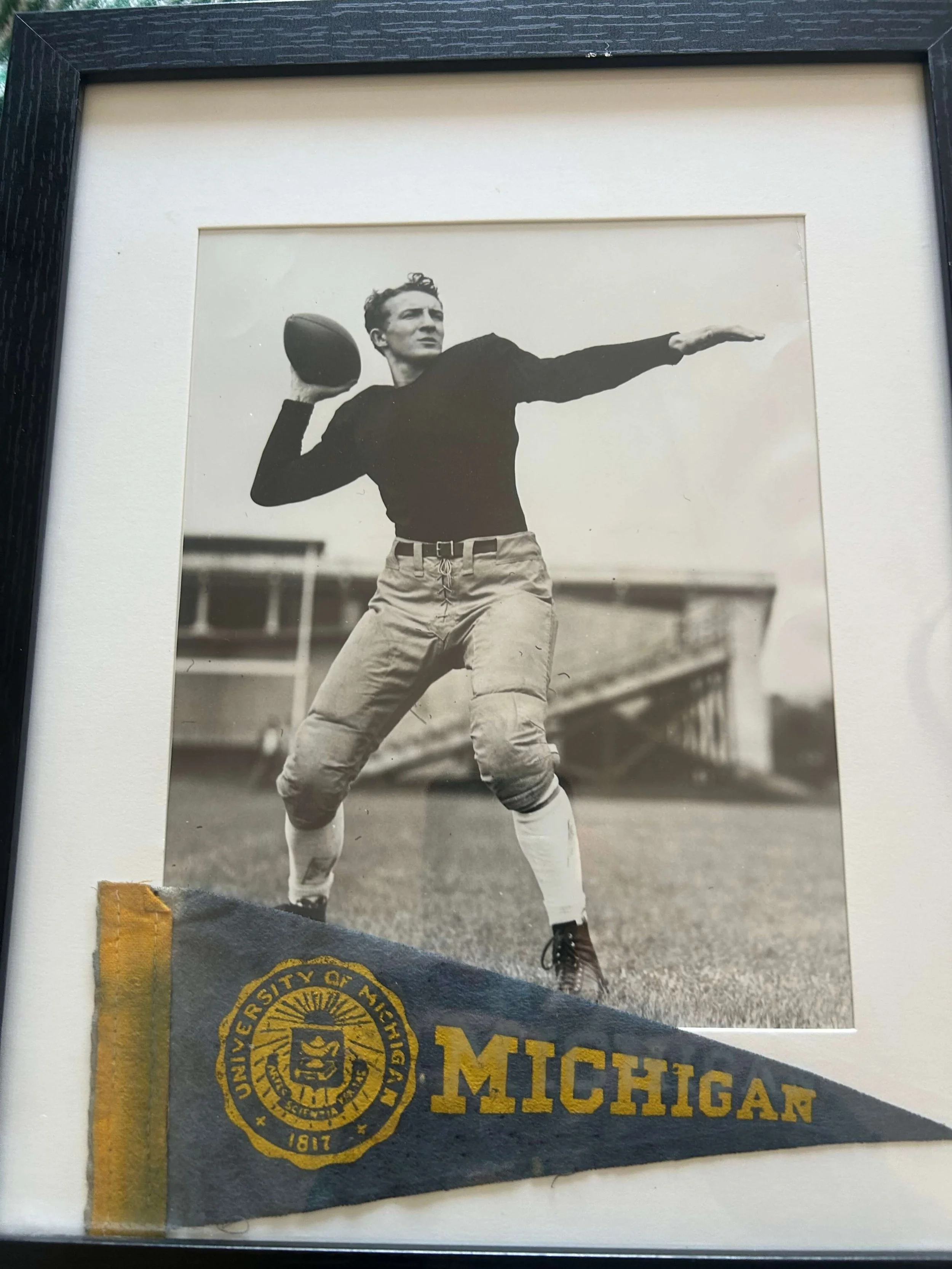
Rick Wise’s father, Cliff, was a football and baseball star at Michigan (courtesy Rick Wise)
Rick was the second of five children raised by Cliff and Barbara Wise. Cliff was a football quarterback and captained the baseball team at Michigan (Rick has been a lifelong fan of the Wolverines). In the early 1950s, Cliff moved the family to Oregon to accept teaching and coaching jobs in the Portland Public Schools. He spent 34 years as a coach and athletic director at Benson Tech.
The three boys were athletes, growing up in the ‘50s in a world that was very different than today. There was little specialization. There was no Xbox.
“Every season that came along, we played that sport,” Rick says. “We weren’t down in the basement playing video games. We were out the door at the crack of dawn. Playing sports is what we grew up on.”
Middle son Robert — always called “Babe” — played football under the great Otto Graham at the Coast Guard. Tom, the youngest boy, was a three-sport star at Madison and a key member of the Contractors team that in 1969 became the only Oregon team ever to win the American Legion World Series. He signed with the Astros out of high school and hit .260 with 34 homers in four seasons in the minor leagues, rising as high as Double-A before knee problems ended his career at age 22.
Says Rick: “No doubt in my mind, Tom would have been a big-leaguer.”
Rick, though, was the family’s athletic North Star. At Madison, he was an All-PIL quarterback and second-team all-league in basketball. But baseball was his specialty from an early age.
At 12, he teamed with another future big-leaguer, Keith Lampard, to lead Rose City to the 1958 Little League World Series title in Williamsport, Pa.
“The experience was wonderful,” Wise says, “but it was nothing like it is now — televised, former major leaguers doing the announcing.”
Three years later, at age 15, Wise threw a no-hitter for Portland and drove in the only run in a Babe Ruth World Series game in Glendive, Mont. (I looked it up: In 1961, Glendive had a population of about 7,000. It is smaller than that today. How did they get a Babe Ruth World Series?)
Fast forward to 1975, when Wise earned a victory in one of the most famed games in World Series history — Boston’s 12-inning Game 6 win over Cincinnati.
“I think that is the only time it has been done — two amateur and one major league (World Series appearances),” Wise says.
Several MLB pitchers came through Portland during that era, including Larry Anderson, who pitched 17 years in the big leagues; Mickey Lolich, who played 16 years and was a World Series hero for the Detroit Tigers, and Wayne Twitchell, who had a 10-year MLB career and was a teammate of Wise in the 1973 All-Star Game. Rick never met Lolich — 4 1/2 years his senior — and never saw him pitch. But he knows Anderson and was friends with Twitchell, who died at age 62 in 2010.
“I used to hunt with Wayne out by Sauvie Island,” Wise says. “He had a goose and duck hunting club out there. Really good guy.”
Tom Wise was fortunate to have a couple of family members teach him the ropes in baseball.
“I looked up to Rick, but I also looked up to Dad,” says Tom, 74, who lives in Portland, is president of the Portland Old-Timers Association and runs a bar, “Last Stop PDX,” on the South Waterfront. “He was a great role model. He taught me all the techniques of the game.
“When Rick was playing high school ball, all of us (younger) kids looked at Madison baseball like it was the Major Leagues. We showed up to all the games, chased foul balls and had a blast.”
Rick won only one state high school championship at Madison, but there is a caveat. During his sophomore season in 1961, the Senators knocked off Reynolds and Beaverton in the playoffs en route to the finals, but had to forfeit both games and were eliminated for use of an ineligible player.
As a senior, he went out on a high, pitching and playing shortstop on a state championship ballclub. Wise threw a no-hitter with 16 strikeouts in a 5-0 win over Pendleton in the finals at Multnomah Stadium. A week later, he struck out 22 batters in a nine-inning victory in the State-Metro series at Lents Park.
This was in 1963, two years before institution of the MLB draft. Organizations could sign any players they wanted.
“There were four or five clubs pursuing me, all for about the same money,” Wise recalls. “Before the (State-Metro) game, one of the scouts came up to Mom and Dad and said, ‘It might not be a good idea for Rick to pitch this game. If he does poorly, his value will go down.’ They told him, ‘He’s pitching.’ I never saw the guy again.”
It wasn’t a given that Rick would sign.
“Dad wanted me to go to college, because he was an educator,” he says. “I would have probably gone to Oregon to play for Don Kirsch.”
But Wise chose to go pro, signed by Phillies scout Glenn Elliott — a former Oregon State player — for a $12,000 bonus. He was among those players considered a “bonus baby.”
The rules at the time dictated any player with a signing bonus of $4,000 or more had to be protected by the parent club over the next year or be subject to a waiver and the loss of the player to another franchise. The player had to be carried on the big league active 40-man roster for a full season. So after signing in June 1963 and pitching 12 games, with nine starts, for Bakersfield in the Class A California League, Wise spent the 1964 season with the Phillies as an 18-year-old.
“(Outfielder) John Briggs and I were up the whole year,” Wise says. “We didn’t deserve it.”
But Wise did fine, going 5-3 with a 4.04 ERA in 25 appearances, including eight starts in a rotation that featured veteran Jim Bunning and 25-year-old Chris Short. That was the Phillies team that blew a 6 1/2-game lead with 12 games to play, losing out to St. Louis on the final day of the regular season.
“People have never forgotten that in Philly,” Wise says. “Art Mahaffey (the No. 4 starter) is still incensed with (manager) Gene Mauch. He kept pitching Bunning and Short every two days the last two weeks. He could have given Bunning and Short at least another day’s rest.”
Wise spent the entire 1965 season with Triple-A Arkansas and started the 1966 campaign with Triple-A San Diego before being called up by the Phillies in early June. That was the end of his minor league career. For seven seasons, he was in a Philadelphia uniform, benefitting from the experience of pitchers such as Bunning, Short and Larry Jackson.
“It was about learning how to conduct yourself, a work ethic, and learning the game at the highest level,” Wise says. “The Phillies didn’t want to teach me a slider early on. It’s an easy pitch, too. I had basically fastball/curveball. In high school, it was just fastball. No one could hit it.”
How fast was Wise’s heater?
“I have been asked that a lot,” he says. “I figure probably mid-90s. My thing was control. I never had a control problem in my life. The best pitch in baseball is a fastball with an idea behind it.”
► ◄
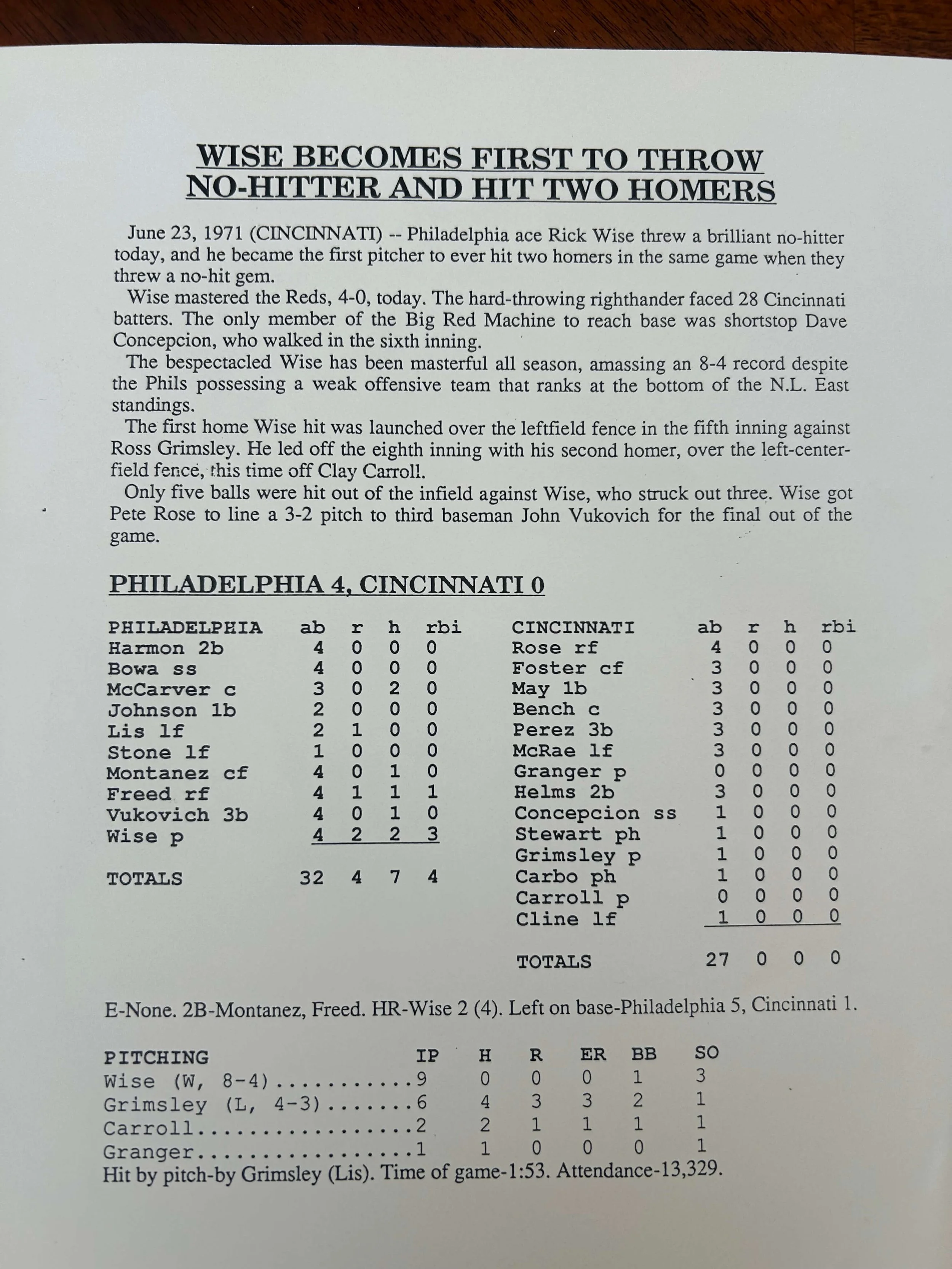
Who says hitting two home runs and pitching a no-hitter in a big-league game can’t be done? (courtesy Rick Wise)
Wise joined Philadelphia’s regular rotation in 1967 and held onto the spot for five years. His time there reached a zenith in ’71 on that fateful evening in Riverfront Stadium, the year after the “Big Red Machine” had won 102 games and the National League pennant. The lineup was stacked. There were Hall of Famers Pete Rose, Johnny Bench and Tony Perez. There were greats such as George Foster, Lee May, Hal McRae, Tommy Helms, Dave Concepcion and Bernie Carbo, the latter who became a friend and teammate of Wise in St. Louis and Boston.
The Reds weren’t as good in 1971, finishing 79-83 and fourth in the NL West. It was the only time from 1970-76 they won fewer than 95 games. But they still had a formidable, dangerous crew of hitters.
Rick had been slowed by a flu bug the week before the game.
“My previous start, I hadn’t made it out of the fifth inning,” he says. “I was really sick. Then we were on to Cincinnati, and it was my turn to pitch. And I did. That’s what you do. You don’t miss it.
“Warming up, it felt like the ball was stopping halfway to the plate. I was still weak. But the Reds helped me. They were offering early in the count and putting the ball into play.”
The Phillies were a lousy team that season, ending the regular season at 67-95 and in last place in the NL East. Their lineup was much less imposing than the Reds, with Tim McCarver batting third and Deron Johnson cleanup. They managed only seven hits on that night — and two of them, both bombs, were by the pitcher.
Wise jacked a Ross Grimsley slider in the fourth inning and followed with a blast off reliever Clay Carroll in the eighth, both to left field, to produce three of Philadelphia’s runs.
Meanwhile, Wise was workmanlike in shutting down the Reds. He walked one and struck out three in a game that took only one hour and 53 minutes. Cincinnati’s only baserunner was Concepcion, who walked in the sixth. The Reds had only five flyouts.
“I wasn’t really a ground-ball pitcher,” Wise says. “I was a high-ball pitcher. But it worked out well. After the third inning or so, I had sweated most of the remnants of the flu out of me and kept getting stronger.”
When Wise got Rose to line out to third to end the game, bedlam broke loose among the Phillies.
As far as all-around performances go, the only one that might top it came five years earlier, when Tony Cloninger hit two grand slams and had nine RBIs while throwing a complete game in the Braves’ 17-3 win over the Giants.
Wise’s exploits at the plate weren’t that much of an anomaly. He tied an NL record for a pitcher by hitting two home runs in a game twice that season. He also had another tremendous performance against the Cubs in September, a game in which he retired 32 straight batters and got the game-winning hit in the 12th inning.
Rick swatted six of his career 15 round-trippers in ’71. He would have had many more had he not spent six seasons with Boston and Cleveland in the American League, which employed the designated hitter during a time when the NL did not.
“I would have loved to hit in Fenway,” says Wise, who batted .195 for his career, though he was over .200 in six of the 11 seasons in which he batted.
In those years, pitchers would get 20 to 25 minutes of batting practice at home. On the road, only the starting pitcher got any swings, and that was every five days.
“I always thought I had an advantage (over the opposing pitcher),” Wise says. “I could hit, and I could bunt. I always worked at it during spring training. If you couldn’t bunt, you would be pulled in the sixth or seventh inning of a close game.”
Wise had a legendary quip about the designated hitter rule: “It is like having somebody come in and shoot free throws for Wilt Chamberlain.”
► ◄
Rick made the All-Star Game in 1971 but didn’t pitch. He made it again in 1973 and was the starter, going two innings, yielding two hits and one earned run, and got the win in a 7-1 NL victory.
Wise was traded twice for Hall of Famers. After the 1971 season, the Phillies sent him to St. Louis for Steve Carlton. In ’72, Carlton famously won 27 games and the Cy Young Award for a Philadelphia team that went 59-97 and ended up 37 1/2 games back of Pittsburgh in the NL East. Wise didn’t disappoint, either, going 17-14 with a career-best 2.88 ERA as the Cardinals finished fourth in the division at 75-81.
Before the 1978 season, Wise was sent from Boston to Cleveland in a deal that brought Dennis Eckersley to Boston. Eckersley fashioned a 20-8 record and finished fourth in Cy Young voting for the Red Sox, who went 99-64, a game back of the Yankees in the AL East, and did not make playoffs. Wise had the worst season of his career, going 9-19 with a 4.34 ERA as a bad Cleveland team finished 69-90 and in sixth, 29 games back of the Yankees.
Wise looks back fondly at his two-year stint with the Cardinals.
“I loved St. Louis,” Wise says. “I loved the Midwest. I loved the knowledge of the fans there and the history there. There was a lot less meanness than the fans in Philly and Boston had. They could get on you something awful. And the travel was easier.”
In St. Louis, Wise was the No. 2 starter behind Bob Gibson, who was 19-11 with a 2.45 ERA in 1972 at age 36.
“A great pitcher even then, and an incredible competitor,” Rick says.
After two seasons, the Cardinals packaged Wise and Carbo in a trade that brought back Reggie Smith and Ken Tatum from Boston. The Red Sox were loaded, featuring such stars as Carlton Fisk, Carl Yastrzemski, Jim Rice, Fred Lynn, Dwight Evans and Cecil Cooper and pitchers Wise, Luis Tiant and Bill “Spaceman” Lee.
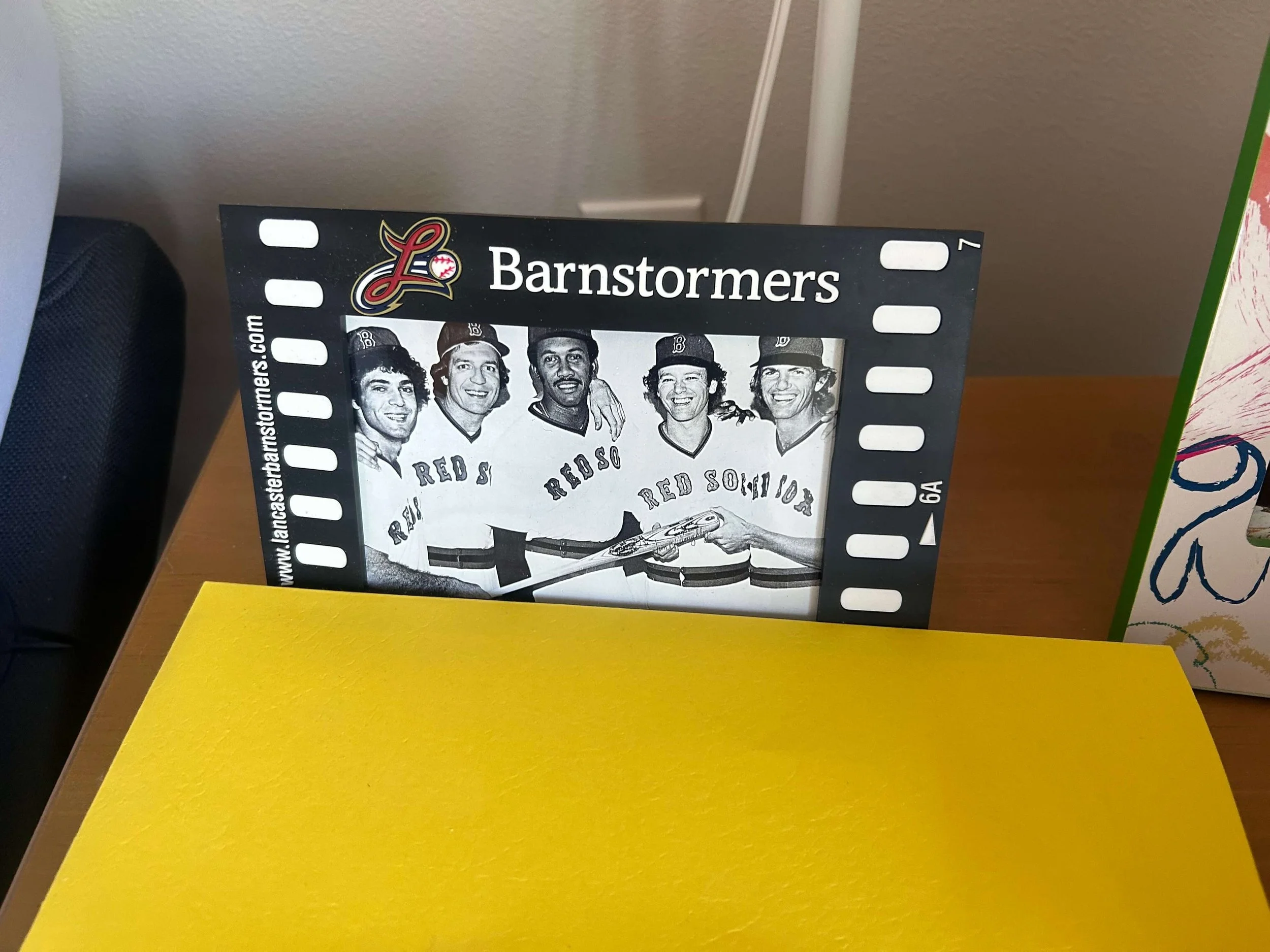
From left, Bernie Carbo, Rick Wise, Ferguson Jenkins, Jim Willoughby and Bill Lee, who formed the “Buffalo Head Gang,” a group of irreverent Red Sox players who enjoyed terrorizing manager Don Zimmer (courtesy Rick Wise)
During his first year there, Wise suffered the most serious injury of his career, a torn triceps muscle that limited him to a 3-4 record in nine starts. He came back in 1975 with one of his best seasons, winning a career-high 19 games with 12 losses and a 3.95 ERA. He came within an out of a no-hitter against Milwaukee.
That led to the only postseason appearance of his career for a Boston team that went 95-65 to win the AL East, as Lee and Tiant each threw exactly 260 innings and Wise 255 1/3.
In the AL Championship Series, Boston faced the three-time defending World Series champion Oakland A’s, who had won 98 games to claim the AL West title. They were led by Reggie Jackson, Joe Rudi, Gene Tenace, Claudell Washington, Bert Campaneris and Sal Bando, with everybody but the 20-year-old Washington in their prime. Wise threw the clinching Game 6 victory, yielding six hits and two earned runs through 7 1/3 innings.
Boston, with Rice sidelined due to a broken hand, faced Cincinnati in the World Series. In Game 3, Wise lasted only 4 1/3 innings, giving up four hits and five earned runs, including homers to Bench, Concepcion and Cesar Geronimo. The Red Sox rallied from a 5-1 deficit to force extra innings but lost 6-5 in the 10th.
There were five days between Games 5 and 6 because of three rain delays, so Boston manager Darrell Johnson bypassed Wise to go with Tiant, who had started Games 1 and 4.
Wise wound up as the winning pitcher, coming on in relief in the 12th. He gave up two hits but no runs in the four-hour marathon in which Fisk hit a walk-off home run that stayed just fair inside the left-field foul pole for a 7-6 win.
“One of the greatest games ever,” Wise says. “Carbo never gets the credit because of Fisk’s dramatics at home plate (during his home run). Fisk doesn’t make it to home plate if Bernie doesn’t hit (a three-run pinch-hit) homer to tie the game in the eighth. He also had a pinch-hit homer in Game 3.”
In Game 7, the Red Sox had a 3-0 lead into the sixth but lost 4-3 when the Reds scored a run in the top of the ninth.
► ◄
Wise was disappointed with the trade to Cleveland, though he rebounded after the 1978 season to go 15-10 with a 3.73 ERA in 34 starts in 1979 for the last of his 10 seasons with double-digit victories. “We had some good individual players, like Andre Thornton,” he says, “but we weren’t a very good team.”
A free agent for the first time after the 1979 season, he signed a five-year, $1.95 million contract with San Diego, by far the most lucrative deal of his career.
“After seven years (in the majors), my annual salary was $25,000,” Wise says. “The minimum salary today is $800,000 (actually $780,000). I tell people, Mom and Dad had me a little too early. Otherwise I would be on an island somewhere — my own.”
He chuckles, then adds, “but it’s OK. It was a labor of love.”
Wise’s time with the Padres was injury-plagued. Though he posted back-to-back ERAs of under 4.00, he was a combined 10-16 in 45 starts in 1980 and ’81.
“I had three managers and two general managers in two-plus years,” Wise says. “That was bad — real bad.”
Wise pitched two innings in one game of relief to start the 1982 season, then was released.
“(Manager) Dick Williams came in and cleaned out the roster of everyone over 30,” he says. “There was nothing wrong with me.”
Wise, then 36, wanted to continue playing, but the timing of getting cut couldn’t have been worse.
“You get released in April, the rosters are pretty much frozen,” he says. “No one is going to break up a team that just left spring training.”
Wise was paid by the Padres for the more than $1 million owed on his contract, but he was still disappointed the way his career ended.
“I wanted to get to 200 (career) wins,” he says. “I know I would have gotten it.”
After that, Wise began a 25-year career as a pitching coach, “at every level of the minor leagues, plus independent ball,” he says. During much of that time, the family was living in the Portland area, with Susan working as an RN at Tuality Hospital. Unfortunately, Rick was bilked by an unscrupulous financial advisor during that period. Rick declared bankruptcy in 1990; he was about $1.4 million in debt.
“I enjoyed coaching, but I had to keep working to make money, because we had lost everything to financial mismanagement of my funds,” he says. “We lost our big home at Bald Peak through the doings of my so-called business agent. He took a few of us down.”
In 2008, Wise retired from coaching at age 63. It was the end of 42 years in pro ball, most of it a very good experience.
He pitched 506 games, 455 as a starter, with 804 walks and 1,647 strikeouts in 3,127 1/3 innings and a fine 3.69 ERA. He ranks 152nd on the career win list. He was the first pitcher to score wins against all 26 MLB teams before expansion took it to 32 teams. He was durable, with nine seasons with more than 200 innings pitched. The Giants’ Logan Webb led the majors in 2025 with 207 innings. It is a different world today.
“Yes it is,” Wise says. “There was no pitch count in my day. The opposition would dictate when you would be taken out. If they were hitting you all over the place, goodbye. Ninety, 100 pitches, five innings and you are done for the game? Come on. They based our salaries on innings pitched.”
With such high volume of innings year after year, how did starting pitchers of his era avoid injuries?
“That’s a good question,” he says. I offer that today’s pitchers are throwing at a higher velocity, which puts more strain on the pitching arm.
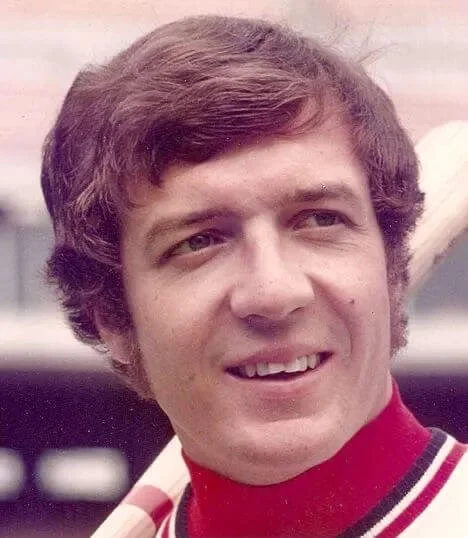
Wise doesn’t care for the way the MLB game is played today
“Today’s pitchers don’t throw high 90s for nine innings, because they don’t go nine innings,” he says. “They go five or six. I could see a reliever throwing 15 pitches at that speed. (Milwaukee’s Jacob) Misiorowski is exceptional.
“I tell people, if it is out of the strike zone, a 104-mph fastball is a ball. You still have to throw it over a 17-inch plate.”
Was Sandy Koufax the fastest thrower of his era?
“For nine innings, maybe,” Wise says. “Jim Maloney threw hard. Don Wilson. No, Nolan Ryan was probably the guy.”
I have other quick questions. Favorite manager to play for?
“Red Schoendienst,” Rick says. “A players’ manager. A lot of times, (Joe) Torre and Gibson made out the lineup. Red was an easy-going guy.”
Favorite teammate?
“Mike Ryan, my catcher with Philly,” he says. “He was my best friend, no doubt about it.”
By my count, Wise played with 13 Hall-of-Famers — Gibson, Yastrzemski, Bunning, Brock, Torre, Rice, Fisk, Ted Simmons, Lou Brock, Ferguson Jenkins, Ozzie Smith, Dave Winfield and Rollie Fingers. The best player of the best?
“A lot of them,” he says. “Gibby, of course. Bunning was outstanding. Brock was something else.”
Toughest batter he ever faced?
“People ask me that all the time,” he says. “All of them were. Sometimes it was the guy batting seven, eight or nine in the order I couldn’t get out. Hank Aaron was tough. Billy Williams was another. The greatest all-around player was (Willie) Mays.”
Wise says he doesn’t watch much baseball on TV.
“I don’t recognize the game today,” he says. “I don’t like it. It was pretty darn good without making those radical changes. Putting a (ghost) runner at second base (in extra innings)? Come on. Throw over (to first base) only twice? Can you imagine how much Maury Wills or Lou Brock would take advantage of that? Geez, it’s ridiculous.”
► ◄
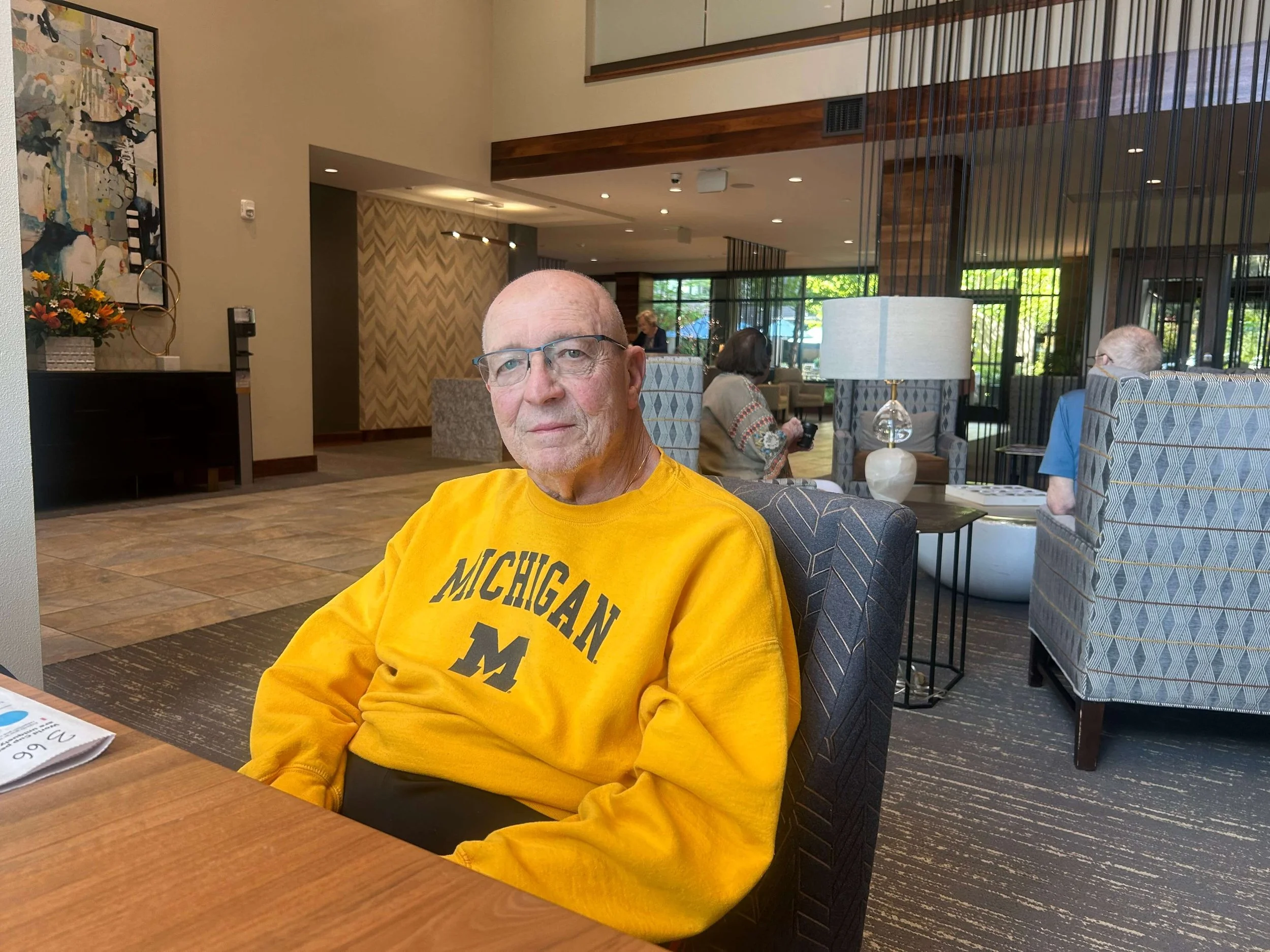
Rick Wise’s 17-year Major League career featured 188 regular-season victories, two All-Star Games, a World Series win and one of the greatest individual games in MLB history
Rick was doing pretty well physically until the last year or two. He developed spinal stenosis, which affected his lower extremities.
“My legs just kind of left me,” he says.
“In February, he lost feelings in his legs,” Tom says. “We had to 911 him a couple of times.”
Today, as he recovers from his fourth back surgery and tries to regain the ability to walk, Rick has been thrown a life line by Tom, his wife Sue and their daughter Casey.
“Tom drives me everywhere,” Rick says. “I call him ‘Uber Tom.’ I wouldn’t go anywhere if it wasn’t for him.”
“Rick is so appreciative,” Tom says. “The three of us have been his caretakers.”
The loss of Rick’s wife “was a big blow,” Tom says. “He loved her to death. But she is in a good place. She is looking down on him, and he is doing much better with the reality of that.”
Rick has two children: Richard Jr. lives in Tacoma and Stacey is in Forest Grove.
“Lots of grandkids,” he says, “and I just became a great-grandfather.”
Tom says he and his oldest brother have grown closer in recent years.
“We have a much better relationship than during his playing career, when I didn’t see much of him,” Tom says. “He is a great guy — quick-witted, with a dry sense of humor. He keeps in contact with a lot of guys he played ball with. He thinks the world of that time in his life, and his teammates.”
And his lot in life these days? That’s OK, too.
“Why not?” Rick asks with a shrug. “What is, is.”
► ◄
Readers: what are your thoughts? I would love to hear them in the comments below. On the comments entry screen, only your name is required, your email address and website are optional, and may be left blank.
Follow me on BlueSky.
Follow me on X (formerly Twitter).
Like me on Facebook.
Find me on Instagram.
