Mac is back in the Pac-12, this time at Oregon State
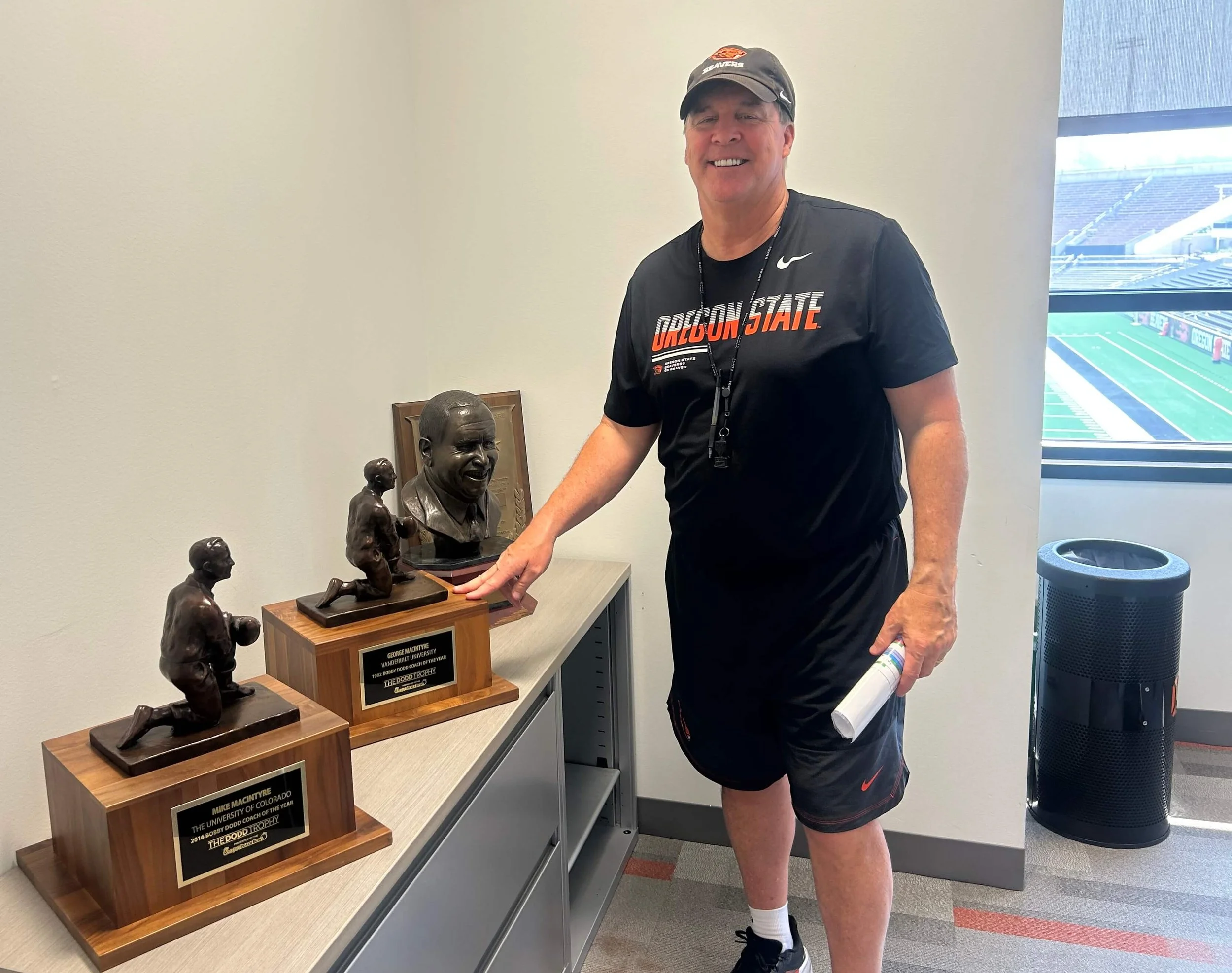
Mike MacIntyre poses with matching trophies won by him and his father, George MacIntyre, the only father and son to claim the Dodd Trophy as National College Football Coach of the Year — Mike at Colorado in 2016 and George at Vanderbilt in 1982
CORVALLIS — Since he began a peripatetic coaching journey in 1990 as a grad assistant under Ray Goff at Georgia, Mike MacIntyre has had 15 changes of address in 36 years.
He wouldn’t mind if Corvallis is the final destination.
“Love this place,” the 61-year-old Oregon State defensive coordinator said Thursday from his office overlooking Reser Stadium. “I am excited about the opportunity to coach here. I am pleased that Coach (JaMarcus) Shephard called and wanted me to come here.”
The call came in early February, as Shephard was putting the finishing touches on his first staff at OSU. They had never met.
“I had never talked to JaMarcus before he called,” says MacIntyre with the slight drawl beckoning to his days growing up in the Deep South. “I was surprised to hear from him. I was humbled.”
Shephard had already hired Ricky Brumfield as special teams coach. Brumfield had coached special teams and outside linebackers and served as associate head coach for the 2022 season under MacIntyre at Florida International.
“Ricky called me and said, ‘Coach Shephard was asking about you,’ ” MacIntyre says. “But I didn’t think he would call me.”
Shephard called, and things came together quickly with the first-year head coach and the veteran who has been coaching college football since JaMarcus was in second grade.
Six months into their relationship, a bond has formed.
“I have been enjoying getting to know him,” MacIntyre says. “He is a phenomenal person, a family man and an excellent coach who truly cares about his players. I am excited about his opportunity here.”
MacIntyre has head coaching experience at San Jose State, Colorado and Florida International, 31 years coaching in the college ranks and five seasons in the NFL under his belt. Last season, he coached outside linebackers and was a special advisor to head coach Jeff Lebby at Mississippi State in the SEC.
Shephard’s call lit a light bulb for MacIntyre and Trisha, his wife of 37 years.
“I have done this for a long time,” MacIntyre tells me. “Being in the fourth quarter of my coaching career, we felt this was a good place for us. We would like our next stage to be me mentoring and helping show the way to some of the younger coaches. And we could try to show how you can keep a family together in this crazy business, with its ups and downs and having to move.”
At Oregon State, MacIntyre is coaching safeties and serving officially as co-defensive coordinator with Cort Dennison, though MacIntyre will call signals from the press box on game day.
“I am calling it, so if the guys are screwing up, yell at me,” MacIntyre says with a grin. “Cort and I are working together, and he does a phenomenal job. Cort is a lot brighter than I am — he is really smart and has been at a lot of places already in his young career. It has been a lot of fun working with him. He brings a lot of knowledge and helps me in different ways.”
The defensive staff, which also includes Brumfield, Joe Seumalo, Mark Hagen and Dan Rowe, combines for more than 150 years of coaching tenure. Dennison has been a defensive coordinator at both Louisville and Idaho.
“It is an experienced group of guys,” MacIntyre says. “We are working really well together. I am fortunate to have men with that much talent and knowledge around me.”
MacIntyre is a coach’s kid. His father, George MacIntyre, coached at the college level for 20 years, including a stint as head coach at Vanderbilt from 1979-85. Mike played safety for his father at Vandy during George’s final two seasons there.
“A wonderful experience,” Mike says. “I really enjoyed it. It was an exciting time for me. My dad was a great coach and an unbelievable man.”
The senior MacIntyre’s Vanderbilt teams improved from 1-10 to 2-9 to 4-7 to 8-4 in 1982, the year that he won the Bobby Dodd trophy as National Coach of the Year. Thirty-four years later, George’s son won the award, taking Colorado to a 10-4 record and the Pac-12 South championship in 2016. They are the only father and son duo to have won the award.
George resigned after the 1985 season to go into private business, and Mike transferred to Georgia Tech for his final two years, playing safety for Bill Curry as a junior and Bobby Ross as a senior. Curry left after Mike’s junior year for Alabama and would serve 20 years as head coach of D-1 programs.
“Bill was a masterful coach,” MacIntyre says. “I am very thankful to have played for him.”
Ross would go on to be a head coach in the NFL for nine years with the Chargers and Lions.
“Bobby was an incredible coach, meticulous about everything, and we had George O’Leary as defensive coordinator (who would become Georgia Tech’s head coach from 1995-2001),” MacIntyre says. “It was a great staff.”
Early in his coaching career, MacIntyre moved from Georgia to a full-time position at Davidson to Tennessee-Martin to Temple and finally in 1999 to Ole Miss, where he first coached receivers, then defensive backs. From that point on, MacIntyre was always coaching on the defensive side of the ball, coordinating at Duke, Ole Miss and Memphis.
There was a five-year stint in the NFL from 2003-07, the first four seasons with Bill Parcells as secondary coach of the Dallas Cowboys. The Cowboys had winning records three times and made the playoffs twice during that time but never won a postseason game.
“Coach Parcells was a great mentor to me,” MacIntyre says. “We still talk. One thing he taught me was, ‘Mike, always coach to your own personality. I will tell you to do certain things, but you don’t have to do it the way I do it.’
“He was a master at reading a room, at motivating the players, at building a roster, which helps you in today’s world. I learned a lot from him about practice management. He understood how to win in the NFL, and a lot of that carries over to college. I enjoyed my time with him.”
After a year as secondary coach with the New York Jets, MacIntyre spent two seasons as defensive coordinator at Duke under David Cutcliffe, the first two of Cutcliffe’s 14 years as the Blue Devils’ head coach. Cutcliffe was a quarterback guru who worked with the likes of Peyton and Eli Manning, Tee Martin, Daniel Jones and Erik Ainge (along with former baseball great Todd Helton, once his QB at Tennessee) during nearly 40 years coaching at three schools — Tennessee, Ole Miss and Duke.
“They ought to put a statue of Coach Cutcliffe up at Duke,” MacIntyre says. “What he did there was amazing. Incredible man, incredible coach. I learned so much from him. Of anyone I ever coached with, he was my (main) mentor.”
MacIntyre got his first head coaching opportunity in 2010 at San Jose State, which was coming off a 2-10 season and had experienced only three winning seasons since 1993. The Spartans, competing in the Western Athletic Conference. were 1-12 the first season, 5-7 in 2011 and then 11-2, setting a school record for victories that still stands. The only losses were 20-17 to Stanford in the season opener and 49-27 to Utah State. The Spartans finished the season with seven straight wins, beating Bowling Green 29-20 in the Military Bowl in Washington DC.

“I cherish that time,” MacIntyre says. “I have a special place in my heart for that group of young men and the people there. After I got the job, I was hearing, ‘If you don’t win, we’re dropping football.’ That motivates you.
“(The players) stayed and achieved a lot in three years together. We have gotten together since then, and they say if it were in today’s era, a lot of them wouldn’t have stayed. But to a man, they told me, ‘Coach, I’m glad we didn’t leave. Look at what we accomplished. We would have made some money, but it would have been gone quickly.’ They are all still close and have done well in life.”
That season got MacIntyre the head job at Colorado, where he took over another floundering program that had gone 1-11 the year before under Jon Embree. The Buffaloes had losing records and went a combined 2-25 in Pac-12 play in MacIntyre’s first three years, but it all came together in 2016. Colorado flipped to 8-1 in conference play and 10-4 overall, with MacIntyre earning the National Coach of the Year honors.
“It was a magical season,” says MacIntyre who recently texted the ’16 team’s quarterback, Sefu Liufau.
Says MacIntyre: “I said, ‘It’s been 10 years ago now, Sef. You were coming off a lisfranc (foot injury). Nobody thought you could do it …’ ”
MacIntyre pauses for a few seconds. He is getting emotional. He is teary-eyed, choked up at the memory.
“Except us,” he says finally. “And you took us there.”
He shakes his head.
“Wow. It was really, really magical for all of us. When that group of players were freshmen, Oregon took a knee at the end or they were going to put 70-something points on us (the final score was actually 57-16 in favor of the No. 2-ranked Ducks). Three years later, we go into Eugene and beat them (38-35), and my kids went from here (hands held down low) to here (hands held high). And they didn’t look back.”
That would be the pinnacle of MacIntyre’s coaching career. Colorado dipped to 5-7 overall, and 2-7 in Pac-12, in 2017. The next year, the Buffaloes started 5-0 but finished with seven straight losses. MacIntyre was fired before a final 33-21 loss to California.
He got one more head coaching opportunity, at Florida International from 2022-24. The Panthers went 4-8 all three seasons, and MacIntyre was let go after the ’24 campaign.
► ◄
MacIntyre’s path has led him to Oregon State and the new Pac-12.
“I am glad the conference stayed alive,” he says. “I know it is going to be a very good league. I expect to see this league benefit from the changes coming up in future years. I am hoping it becomes a lot like the old Pac-12.”
MacIntyre says he feels good about the talent he is seeing on the defensive side two days into training camp, but the pads haven’t even gone on yet, and it is still almost a month away from the Beavers’ Sept. 5 opener at Houston.
(An aside: Coaches, players and some media still call it “fall camp,” but preseason practice sessions are held the middle of summer, so that is a misnomer. We could call it “summer camp,” but I choose to call it “training camp.” I have similar thoughts when coaches refer to watching “film,” which hasn’t been true for many years. I always substitute “video.”)
“The old saying is, until you get out there and play a game, you don’t know for sure,” MacIntyre says. “We are young and thin in a few places, and depth matters. There are going to be some bumps to get through, but we will do that.
“Coach Parcells always said, ‘Knowledge equals confidence equals playing fast. The knowledge is there with our players. I am hoping once we put the pads on, we will see us make a few plays, play a little faster.”
When I ask who has caught his eye on defense through spring ball and the first two days of summer, he mentions linemen Takari Hickle, Tevita Pome’e, Jacob Schuster and Daniel Matagi. I ask about cornerback Exodus Ayers, who missed all of last season due to an arrest for domestic violence charges but is on the OSU roster this season. MacIntyre pleads ignorance about Ayers’ legal problems but confirms he is practicing and, as far as he knows, eligible to play.
MacIntyre’s goal for the Beaver defense this season?
“Keep the other team scoring one less point than we score, whatever that is,” he says, smiling. “That is our expectation every game.”
Besides football and family — he and Trish have three grown children, Jennifer, Jay and Jonston — MacIntyre’s passion is with the national “Be the Match” registry, which connects patients with bone marrow donors. Trisha MacIntyre lost her mother to ovarian cancer.
“I started doing it at San Jose State, and we have done it everywhere I have been a head coach,” Mike says. “I would like to start it up here next spring.”
Over the years, the McIntyres have been responsible for 1,600 registrations leading to eight lives being saved. In 2018, Mike was presented with the Rod Carew Leadership Award for his involvement.
“It is a wonderful program, and it has been a neat thing to do,” he says. “Every once in awhile we have gotten an email that says, ‘Saved another life.’ The truth is, all those people who got tested and gave and did what they did, they are the heroes. We were just able to help facilitate it.”
As I prepare to leave McIntyre’s office, he says he would like to say something about Mike Riley for the story. (I had mentioned to him that Riley told me they had gotten together for dinner in Corvallis recently.)
“Mike was a great coach and is a class act,” McIntyre says. “I enjoyed getting to know him when I was coaching in the Pac-12. Over the years, we have stayed in touch. When I got here, he showed up at practice one day, and it was so great to see him and get reacquainted. I look forward to him being a great sounding board for us, no doubt about it.”
► ◄
Readers: what are your thoughts? I would love to hear them in the comments below. On the comments entry screen, only your name is required, your email address and website are optional, and may be left blank.
Follow me on BlueSky.
Follow me on X (formerly Twitter).
Like me on Facebook.
Find me on Instagram.
