For Moore and Oregon State’s pitching staff, everything is new
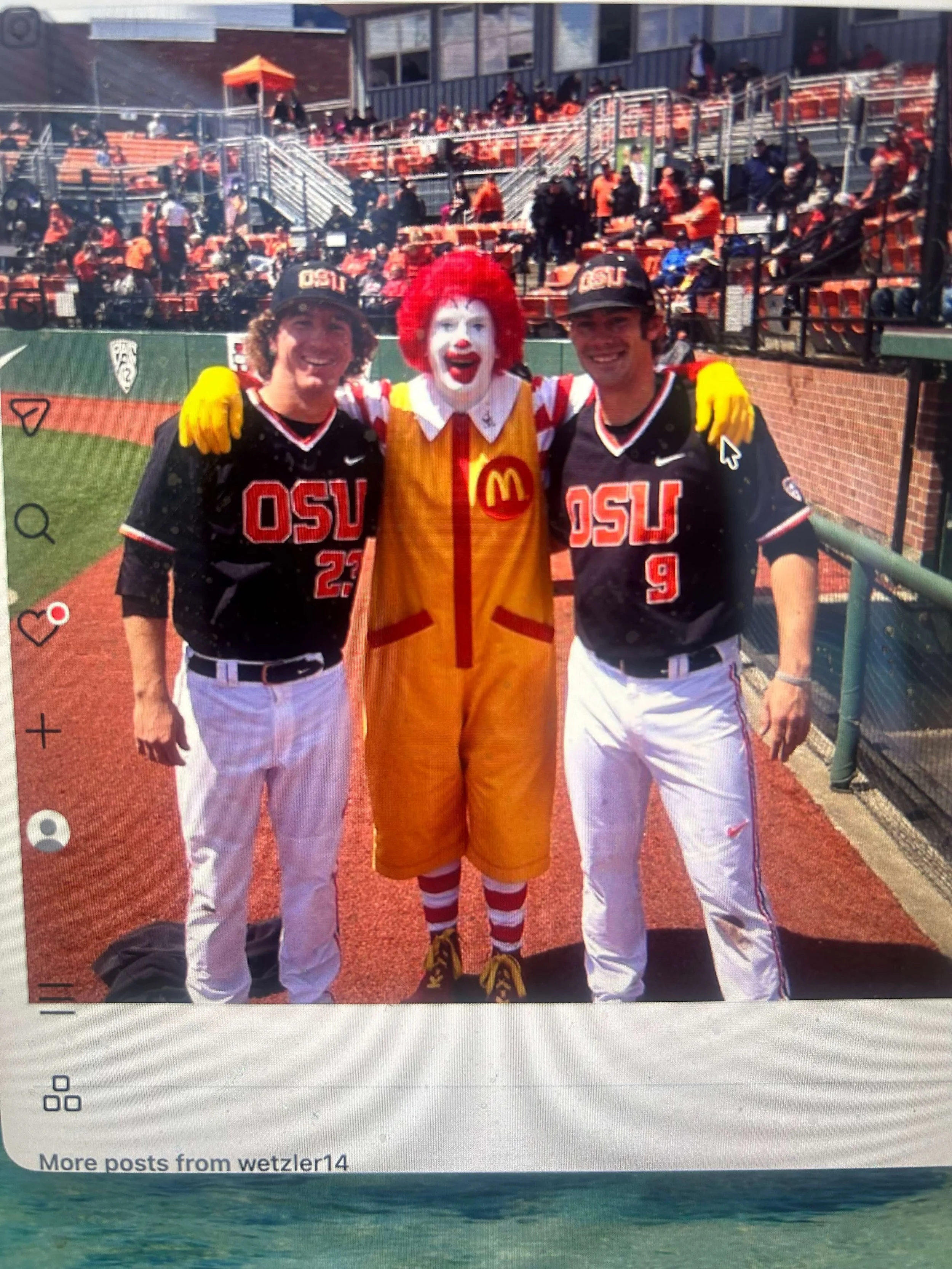
College roommates Andrew Moore (left) and Ben Wetzler (right) with a friend prior to a game in 2014 (courtesy Ben Wetzler)
CORVALLIS — You think your life has been busy this summer? Probably not compared to that of Andrew Moore.
Oregon State’s new pitching coach and wife Tayla have a new baby — a son, Maverick — giving them a household that includes two boys and two girls.
Add on Andrew’s move from his job as pitching coach of the Triple-A Columbus Clippers, finding a new home in Corvallis and getting established on the job at OSU and it has been, well, busy times.
“Been a lot going on,” Moore tells me during a recent interview. No kidding.
Moore signed on to replace Rich Dorman — who left for a pitching coach position at Florida — on June 20. More than two months in, his work load has been considerable, even though it is the off-season.
“It has been mostly about jumping into the portal and recruiting and trying to get familiarity with a lot of the arms we have here,” Moore says. “We had quite a few holes to fill.”
From the 2026 team that went 45-14 before the season ended at the Eugene Regional, the Beavers lost seven pitchers to the MLB draft, including starters Ethan Kleinschmit and Eric Segura and closer Albert Roblez. Also gone are freshman sensation Trey Morris and fireballer Zach Edwards, who went with Dorman to the Gators.
Barring late additions, when the Beavers open fall camp on Sept. 14, Moore’s staff will number 16 pitchers — seven transfers, five incoming freshmen and only four returnees. That doesn’t count All-America right-hander Dax Whitney, who is unlikely to pitch next season following Tommy John elbow surgery, and right-hander Tyler Bellerose, whose status is uncertain after an April auto accident.
“We have a lot of guys excited to have opportunities to step up,” Moore says. “Fall camp is right around the corner. The guys are ready to get rolling, ready to compete for some spots and help get this place back to Omaha. That is what we are all working for. We know we are going to face a competitive schedule out of the gate, but we will work our butts off in the fall to be ready to come out and compete with some of the best teams in the country next season.”
Moore has met with the majority of his pitchers and communicated via phone or text with all of them.
“We have a good chunk of guys on campus now,” he says. “I was in the weight room with some of them yesterday; they were getting after it. They have been floating in and out, so I have been able to visit with them. There are a lot of new faces and pitchers I am trying to get acclimated to. It is going to take some time.
“It has been a lot of building relationships, building trust with the players. I haven’t been able to work with them too much yet. I have been out at summer ball, monitoring what they have been doing, trying to slowly build the trust and the relationships that is important for all coaches to have.”
Moore, 32, arrives with ample street cred. An All-America pitcher during his time at Oregon State from 2013-15, he has major-league pitching and minor league coaching experience. Those familiar with the former North Eugene High ace believe head coach Mitch Canham made a wise choice selecting him to oversee OSU pitching.
“I absolutely love Andrew Moore,” says Pat Casey, the Hall of Famer who coached Moore at Oregon State. “Every time I have talked to him in recent years, he has been pumped about what he was doing in pro ball. But he always said he would love to get back to college baseball.
“That he gets to come back here is just not only great for him, but great for the program. The guy is for real. He is a phenomenal young man. He will be a great teacher, a great motivator. He is the epitome of what Oregon State baseball is all about.”
Moore was a middle-schooler growing up in Eugene when Oregon State won back-to-back College World Series championships in 2006 and ’07. He remembers watching games at Goss Stadium and following the Beavers, who included Canham, the catcher and team captain.
It was ironic, then, that Canham wound up as Moore’s manager for a brief time in the Seattle Mariners’ organization in 2019 with the Double-A Arkansas Travelers. Moore had made it to the big leagues with Seattle for part of the 2017 season but was back in the minors pitching for the Travelers in ’19 before getting a second call-up. On June 2 that season — Moore’s 25th birthday — Canham and pitching coach Pete Woodworth called him into their office following a game.
“They were like, ‘We just want to sing you happy birthday,’ ” Moore recalls. “They sang it, and then they said, ‘You’re going to Seattle.’ That was a special day.”
Moore was the only Travelers player Canham got to deliver that good news to. Eleven days later, he was hired as Oregon State’s head coach.
“Andrew had been a dominant pitcher (at Oregon State), and people here spoke highly of him,” Canham says. “When he showed up at Arkansas, it put a big smile on my face — a former Beav in there. To get to tell him he was going to the majors on his birthday? It doesn’t get much better than that.”
Moore had two of the greatest seasons as a pitcher in Oregon State history. As a freshman in 2013, he was 14-2 with a 1.79 ERA, setting a school record for victories and earning consensus All-America and Pac-12 Freshman of the Year honors on an OSU team that went 52-13, won the conference and made the College World Series. As a junior two years later he was 7-2 with a 1.91 ERA, again earning All-America laurels in a rotation that included Freshman All-American Drew Rasmussen.
Matt Boyd — now a 12-year MLB veteran and a starter for the Chicago Cubs — was a junior at OSU when Moore was a freshman.
“Matt was the initial teammate who had a big impact on my career,” Moore says. “The fall of my freshman year, coach (Nate) Yeskie pushed him to take me under his wing. We had multiple sit-down situations where Matt showed me what his day-to-day, week-to-week process and general outline looked like. That opened my eyes to what it takes to be really good at this level. It changed my perspective and pushed me to instill some of the discipline it takes to be great.
“As an older guy, I was able to be on the other side and help Drew and Luke Heimlich and a few other young pitchers. We had a group that was extremely close and genuinely wanted the best for each other but also wanted to compete and outdo one another. My freshman year, when I was pitching Saturdays. ‘Matty B’ would go out and throw seven shutout innings. The next day, I would try to one-up him, and we would have Ben Wetzler trying to do that on Sundays. That is where good staffs come from — friendly competition and brotherhood, where things naturally develop.”
Moore pitched in the pro ranks for eight years, wearing eight different uniforms before retiring after the 2022 campaign.
“I am very proud of my career,” Moore says. “I would love to have played 20 years in the big leagues and made a ton of money, but I got to reach a goal that I had set for myself when I was a kid. Honestly, you dream about it but it feels so far away at times. Being able to experience that and do it with a great organization, with family close by, to be around a lot of family friends — that meant a lot to me.”
Moore went 1-5 with a 5.34 ERA in 11 games with the Mariners in 2017. He pitched one more game in the majors, giving up six hits and four earned runs in 4 2/3 innings for Seattle after his call-up in 2019.
“Going through some struggles challenged me to grow and stretched me in ways I needed to be stretched,” he says. “That is why the one day in the big leagues in 2019 meant so much to me. I went through being a pretty bad pitcher for a big stretch that year. I was able to re-fall in love with the game, put together some good appearances and starts and get one more day up there.”
After that, Moore struggled with several injuries, undergoing internal brace elbow surgery in 2021 while in the Detroit Tigers chain.
“I got two more years of playing, and I could throw pretty much every day without pain,” he says. “It was cool to be on the early end of a surgery that is going to continue to help elongate careers and keep guys on the field. Maybe it wasn’t a Hall of Fame career, but it is one I am extremely proud of and look back on with great fondness.”

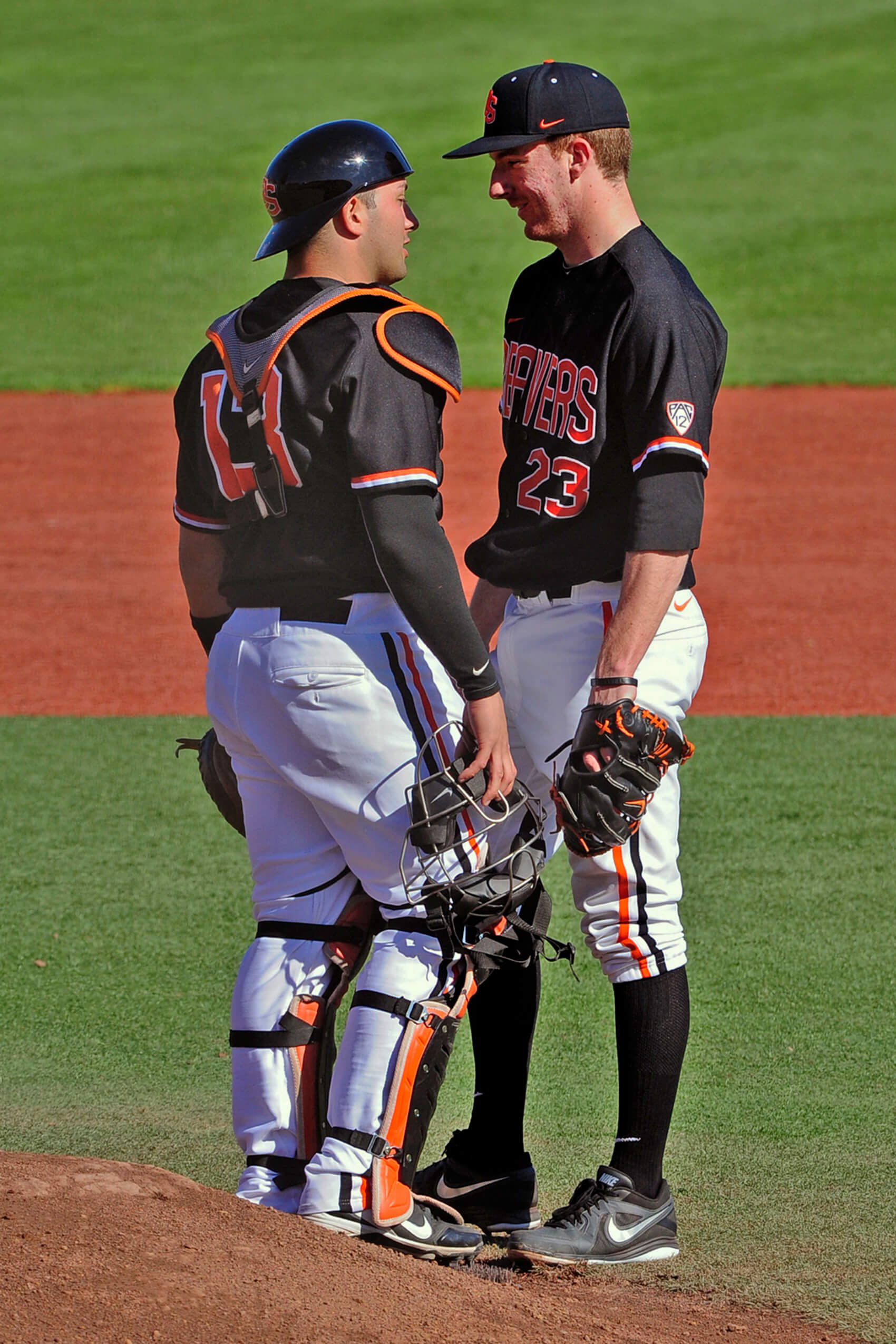
Moore, here with catcher Jake Rodriguez in 2013, says “all roles are on the table” with his pitching staff in 2027 (courtesy Dave Nishitani)
After his playing career ended, Moore served as pitching coach for three seasons in the Guardians’ farm system at High-A and Triple-A before leaving in June for his alma mater.
Canham says Moore has already bonded with the rest of the OSU coaching staff, which includes ex-Beaver players Ryan Gipson, Joey Wong, Ryan Gorton and Zak Taylor.
“It has been tremendous,” Canham says. “Every coach has been extremely impressed. Everyone said the same thing: ‘This guy will not only make the players better, he is going to make me better.’ Every coach felt he is going to make us better coaches, better men, better communicators.
“The way Andrew treats people, the way everyone in the clubhouse loves and appreciates him, how good a human being he is, how diligent he is with his work … it’s exciting for me.”
Moore says Canham’s offer to join the OSU staff was too good to pass by.
“This is more than just a job for me,” he says. “There are a lot of family dynamics and deciding what was best for my family. There was familiarity and belief in this program. I had gained trust already with Mitch. I played with Joey in the minors. I have known Gip for multiple years. Gorto, Zack — all these guys I have relationships with. Built-in trust in the relationships was a big part of my wanting the job.”
Since they worked together in Arkansas, Moore has felt a close relationship with Canham.
“Mitch has had a big impact on my life through the conversations we have had and the leadership he showed in 2019 when I was in a pretty tough spot in my playing career,” he says. “I respect the man he is, the leader he is, and the things he instills in this program through modeling what hard work and perseverance looks like. I am looking forward to coaching alongside him and seeing what we can get done on the field.”
There are many who know Moore well who think he will do just fine.
“He will be fantastic,” says Casey, now working part-time in player development for the Milwaukee Brewers. “He will develop pitchers. He will build great relationships. He is going to be all in.
“As a player, his competitiveness was off the charts. You are talking about a 6-foot, (185-pound) right-hander making the big leagues — you better have something special. Before the draft, the Mariners called and asked if I liked Andrew Moore, I said no. There was a silence. I said, ‘I love Andrew Moore.’ The stuff was good, but he had tremendous competitiveness, and he could command the zone. He knew how to pitch. You talk about a guy who got everything out of himself he could possibly get. That is a credit to his perseverance and makeup.”
Rasmussen, now an All-Star for the Tampa Bay Rays, says much the same thing.
“I have not seen him as a coach, but to see Andrew as a competitor, and knowing him as a person, I couldn’t be happier that he is our new pitching coach,” Rasmussen says. “It is going to be an incredible hire. His dedication, his work ethic, everything I got to see from the playing perspective is going to directly translate. He is an A-plus human being, and that will help him build relationships. Once relationships are built, it is easier to push your message across to players.
“Andrew is one of a kind. He truly is a special person. I have no doubt he will be an incredible pitching coach at Oregon State.”
Ben Wetzler Holmes (he was known as Wetzler in college but Holmes in the pros) was 30-4 with a 2.55 ERA from 2012-14 during a brilliant Oregon State career. At 34, he has pitched at 19 stops in a dozen years in the minor leagues. Moore and Wetzler were roommates at OSU during Moore’s freshman year.
“The day of his first career start, he packed and repacked his bag probably 12 times,” Wetzler tells me. “You could see the nerves. He was meticulous about everything.”
Wetzler, who now lives in Verrado, Ariz., says Moore was “an unbelievable teammate.”
“Andrew was on the straight and narrow, but never said no to showing up and being there for the other guys off the field,” Wetzler says. “We would go to basketball games together. We were completely different people but bonded through baseball.
“He attacked his playing career exactly the same way he has transitioned into coaching. He is dedicated to his craft almost to a point a CEO would. He went through the player development side but also practiced the mental side of it. He had a detailed approach you don’t often see from young guys coming to college. A lot of times, they are deer in the headlights. He wasn’t that way. He took it all in stride. He was learning every possible thing, but was really good at compartmentalizing the different aspects of the game and working on them individually and taking it to a competitive atmosphere.”
Wetzler calls it “a home run hire.”
“He is going to be amazing,” he says. “He has been prepping for this since he hung it up as a player. We have had many conversations over the past few years. He got into (coaching in) pro ball to learn a more advanced way of player development, seeing the grand scheme of things. It is the perfect route to becoming a pitching coach at a big-time college.
“In college, you are in charge of a smaller number of pitchers than in pro ball, but you also have a personal element of the individual lessons and training. Andrew has learned to communicate at a much higher level (than college). He is a home-state kid, an undersized guy who built himself into a major league pitcher. He will be able to relate to any type of athlete or kid.”
Steven Kwan arrived at Oregon State in the fall of 2015, just after Moore left school for the pros. After Kwan had verbally committed, former OSU infielder Andy Peterson, then an undergrad assistant, showed him a highlight video of the 2013 Beavers.
“I watched it over and over,” says Kwan, now an All-Star and Gold Glove left-fielder for the Cleveland Guardians. “Andrew Moore seemed to be in the middle of all of that. He was kind of a god to me. I got to meet him when he came back a few times to campus. He was great as he always is.”
After Moore began coaching in the Guardians system in 2024, he had discussions with Kwan during spring training.
“We would talk about a bunch of different (former) Beavers,” Kwan says. “Being able to chat it up with a local legend was always super cool to me.”
The hiring of Moore, Kwan says, “speaks to the community of Oregon State. Mitch was a huge figure; now he is the head coach. Andrew was a huge figure; now he comes back. It is really cool to have homegrown guys come back. It will be exciting to see what they are going to accomplish.”
The man who worked the most with Moore during his playing career at Oregon State was Yeskie, now the pitching coach at Louisiana State.
“I remember when we had Andrew up to Corvallis for his recruiting trip,” says Yeskie, who won a national championship with LSU in 2025. “We liked him for a lot of reasons, and it was a little sweeter because he came out of Eugene.
“Andrew was one of the best I have had in my career. He won a lot of games and kept us in a lot others, and did things that people don’t see. As a junior, he led a bunch of freshmen to a Regional in Dallas, and he beat Texas 5-4. When he went to the Mariners in the second round (of the 2015 draft), I was so happy.”
Yeskie is pleased that one of his prodigies will sit in the seat he once held.
“Andrew will do a great job,” he says. “Having grown up in the Northwest and having been to the big leagues, he has done a lot of things that are relative to what his kids will experience and what they are trying to achieve. He knows what that program is about. He has a good demeanor. He is extremely likable, a hard worker. I am excited to see how this is going to go for him.”
•
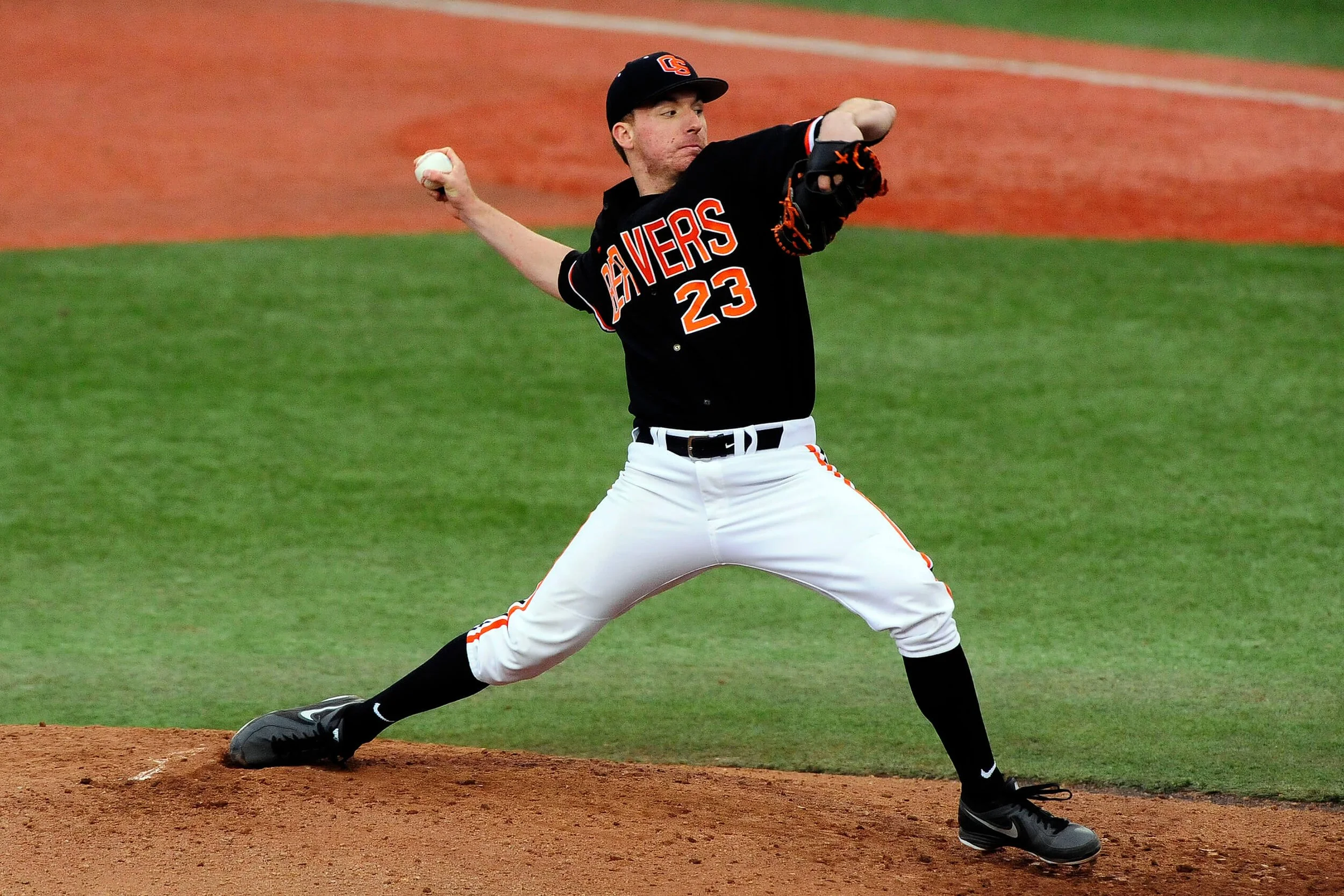
Once an All-America pitcher at Oregon State, Andrew Moore is now pitching coach at his alma mater (courtesy Dave Nishitani)
Oregon State fans will see an almost entirely new pitching staff in 2027. There will be competition for every spot in the rotation and the bullpen.
“All roles are on the table,” Moore says. “It is going to come down to what we see in the fall.”
One pitcher who will play a key role is Zach Kmatz, who had a disappointing sophomore season for the Beavers but enjoyed a successful summer in the Cape Cod Summer League. The 6-3, 235-pound right-hander was 3-0 with a 1.20 ERA — second-best in the league — in 12 relief performances for the Brewster Whitecaps, yielding 21 hits with 11 walks and 30 strikeouts in 30 innings. He was Cape Cod Pitcher of the Week in late July, pitched in the All-Star Game and was named first-team all-league.
“That’s an incredible summer,” Moore says. “It was really impressive what Zach was able to put together. We have had multiple conversations on general development things. He was good about sending video and giving thoughts after his outings. It was cool that he went out of his way to provide that communication. I am proud of the work he put in this summer.”
What role might Kmatz play next season?
“Hard to say,” Moore says. “The stuff is good enough — especially when his fastball is in the mid-to-upper 90s — to be a top-end closer. But there is the physicality and arsenal there to be a starter. It comes down to what he is most set up to do and what will help our team compete in the best possible way.”
Senior Connor Mendez had a disappointing junior campaign after a transfer from Linn-Benton CC, going 2-3 with a 7.27 ERA in eight appearances and seven starts. He shined in his final outing, though, allowing two hits and one earned run with one walk and three strikeouts in 6 1/3 innings in an 8-3 win over Portland. The 6-foot, 215-pound Mendez was 3-0 with an 0.53 ERA in four starts with San Luis Obispo in the California Summer League, yielding only five hits and one earned run with 31 strikeouts in 17 innings. He made the All-Star team and pitched into the playoffs.
“Connor had an extremely good summer,” Moore says. “He made some good strides. He will compete with a weekend (starting) spot.”
Senior Noah Scott was also disappointing last season, going 2-1 with a 5.48 ERA in 23 innings over 16 appearances. The 6-4, 240-pound right-hander pitched for the Bourne Braves in the Cape Cod League, going 1-3 with a 5.13 ERA in seven games and 26 1/3 innings.
“Noah had some outings that didn’t go how he wanted, but he finished with a very good start in the playoffs,” Moore says. “The thing that sticks out to me about him is that he wants the ball. He wants to be on the mound in big situations. He has shown some premium stuff. We are going to work to push him as an older guy to take on some of the leadership role.”
The other returnee is sophomore Trevor Kaiser, who pitched only 1 1/3 innings in one game last season. The 6-5, 235-pound right-hander pitched for the Bend Elks in the West Coast League this summer, going 1-3 with a 6.59 ERA in eight games.
“Trevor has been working through some mechanical things and finished with some competitive outings,” Moore says. “With all slots open, he is looking to see if he can come in and earn a spot.”
Bellerose, who suffered serious injuries in the car mishap, “has been making progress,” Moore says. “He has worked extremely hard to get to where he’s at. What this year looks like for him, I don’t think any of us know right now. We will see in the next few weeks.”
Whitney will be with the OSU program next year, working to rehab from the surgery. What are the chances the 6-5, 220-pound right-hander might see action by season’s end?
“Impossible to put a for-sure answer on that,” Moore says. “I have been through elbow surgery. Everyone’s timetable is different. The process of coming back can go poorly when you put expectations on it. We all want Dax to pitch, but it is our responsibility to do what is best for him long-term. He is going to pitch a long time in this game. We need to make sure we are doing the right things to support that.”
There is little doubt that Whitney will do what he can to mentor the Beaver pitchers.
“Mitch has talked about how Dax wants to be an assistant pitching coach and be around,” Moore says. “Dax has that mentality that, even if he is not on the field, he is going to help our team win games and help guys get better.”
Among the transfers is Brennan Seiber, who was 6-2 with a 4.93 ERA in 42 innings and 19 appearances, one start, for Vanderbilt last season. The 6-4, 240-pound senior right-hander pitched for the Orleans Firebirds in the Cape this summer, going 0-2 with a 7.11 ERA in 12 2/3 innings and four games.
“Brennan has shown the ability to pitch well in the SEC environment,” Moore says. “He can throw strikes and induce groundballs. If you can do that at Goss (Stadium), typically you are going to be a very good pitcher. He added the sweeper in the Cape. He has a good sinker and a good feel for what he is doing. We see him as a guy coming in to compete for big innings and potentially start right away.”
Carson Boesel was 1-0 with a 4.75 ERA in 36 innings over 21 appearances for Washington last season. This summer, the 6-5, 220-pound sophomore was 2-2 with a 2.10 ERA in 30 innings over seven games with seven walks and 33 strikeouts with the Wenatchee AppleSox, making the West Coast League All-Star Game.
“He had a really good summer,” Moore says. “The stuff is there. He can come in and compete for big innings.”
Ben Cushnie was a force out of the bullpen for Southern Cal last season. The 6-3, 200-pound junior left-hander was 0-0 with a 1.64 ERA and a .179 opponents batting average in 22 innings over 18 appearances for the Trojans.
“Ben is very much in the conversation to compete for big innings for us,” Moore says.
So, too, is Jaxon Baker, who was 0-1 with a 6.32 ERA in 17 appearances, four starts, with Long Beach State in 2026. The 6-6, 200-pound sophomore left-hander was 3-0 with a 1.39 ERA in six starts and 32 1/3 innings for the Mat-Su Miners in the Alaska Summer League.
“He had a very impressive string of starts in Alaska,” Moore says. “He is another guy we are eager to see pitch for us.”
The Beavers landed two pitchers from Division II Montana State/Billings — junior right-handers Sam Coxen and Cade Queen. Coxen, 6-2 and 170, was 6-4 with a 4.48 ERA in 13 starts and 80 1/3 innings. Queen (no relation to Wyatt), 6-2 and 225, was 4-2 with a 4.31 ERA in 11 starts and 54 1/3 innings.
“They are a couple of kids we brought in early in the portal and are excited about,” Moore says. “They have showcased the ability to have premium stuff and throw strikes at a lower level. We will expose them to some of the cool technology we have here, which we hope will help some of their stuff trend up.”
The other transfer is 6-1, 225-pound junior right-hander Dylan Hicks, who had an excellent season for Everett CC, going 1-1 with an 0.75 ERA in 14 appearances and 36 innings.
Moore says he is still familiarizing himself with Oregon State’s five incoming freshmen, but there is little doubt there is some talent there.
“This program has always had freshmen contribute right away,” Moore says. “That is the expectation for this group. There is also going to be a learning curve. That is part of the growing process.”
Grady Saunders is a 6-2, 185-pound right-hander from Springfield’s Thurston High, the top-ranked player and pitcher in Oregon and the MaxPreps Player of the Year who was considered the top major league prospect in the Northwest from the high school ranks. He was 7-3 with a 1.89 ERA, striking out 84 in 59 1/3 innings, and hit .531 as a third baseman for the Colts last spring.
“I have known the family since I played here and have known Grady since he was pretty young,” Moore says. “I have followed him closely. He is a very athletic. We are excited to see him get into the weight room, get bigger and stronger, and expose him to some better competition. I have no doubt he will step up to the challenge and provide some innings for us in a big way.”
August Ware is a 6-5, 230-pound left-hander who had a 1.93 ERA and a .144 opponents batting average, striking out 101 in 50 2/3 innings for Glencoe High last spring. He was 1-1 with a 5.11 ERA and 16 strikeouts in three games and 11 innings this summer for the Ridgefield Raptors in the West Coast League.
“Being a bigger kid and a lefty with awesome stuff puts him in position to battle for innings right away,” Moore says.
Neal Burtis, a 6-1, 175-pound southpaw from Maple Valley, Wash., was 6-0 with an 0.45 ERA for Tahoma High in the spring. He pitched for the WCC Corvallis Knights this spring, going 0-1 with a 9.53 ERA in 11 1/3 innings and five appearances.
“His delivery creates some unique angles that help his stuff play up better,” Moore says. “He makes an extremely uncomfortable at-bat for hitters, especially lefties.”
The other two freshman arms are both right-handers — 6-3, 200-pound Everett Burdett, the No. 3-ranked player in New Mexico out of La Cueva High, and 6-2, 195-pound Julian Sabourin, the No. 8-ranked player in Canada from Ancaster, Ontario.
► ◄
Readers: what are your thoughts? I would love to hear them in the comments below. On the comments entry screen, only your name is required, your email address and website are optional, and may be left blank.
Follow me on BlueSky.
Follow me on X (formerly Twitter).
Like me on Facebook.
Find me on Instagram.
