A visit with Bucky Buckwalter, who has seen just about it all
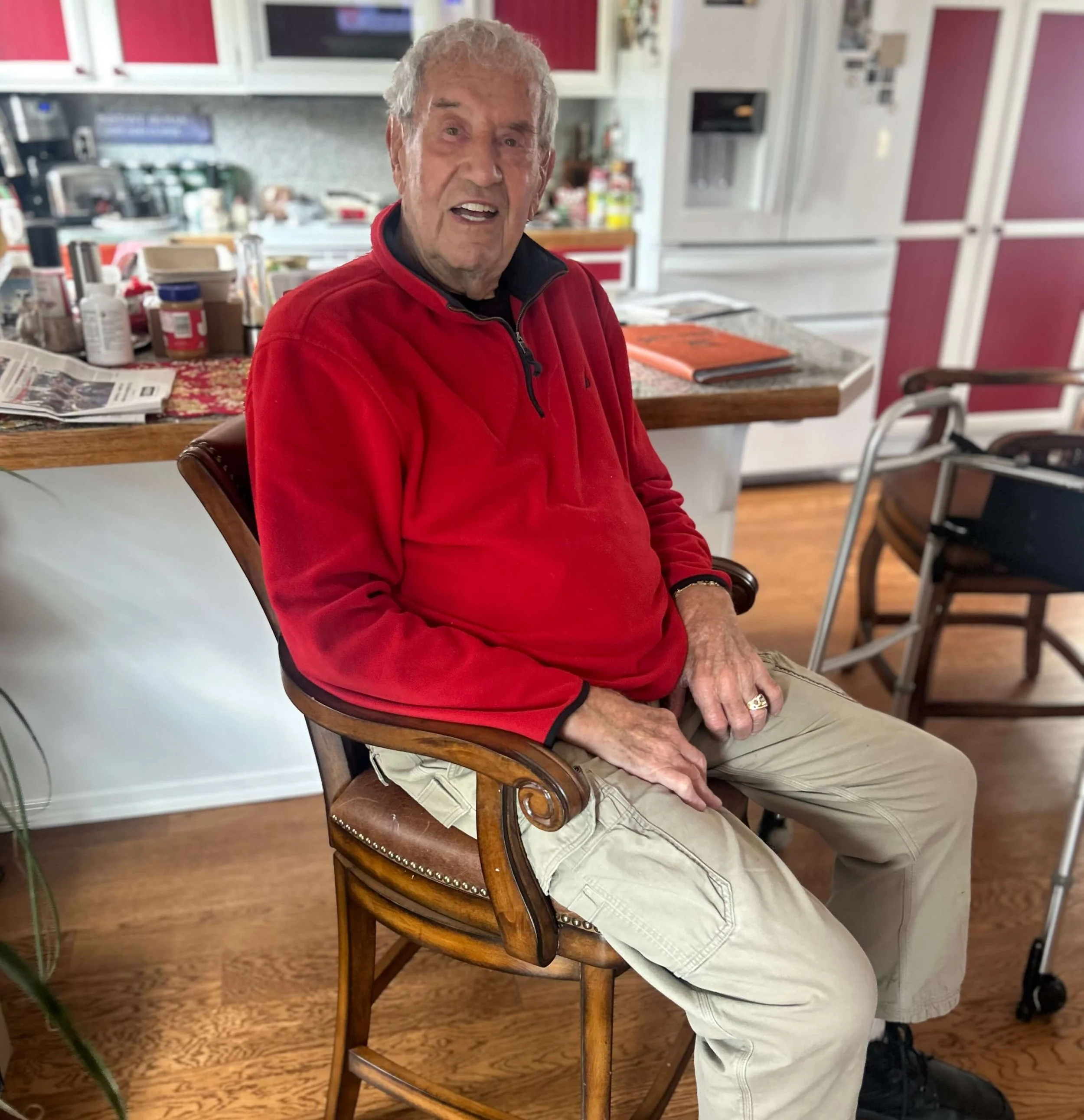
Few NBA coaches or executives have had more interesting experiences though their career than Bucky Buckwalter
He moves about his one-level home at Summerfield Estates in Tigard slowly with a walker to help with balance. The years have slurred the diction at times. The mind and the memories are firmly intact, though, as Bucky Buckwalter, 92, advances through his years as a nonagenarian.
“When I was young, 75 seemed over the hill,” says the long-time coach, scout and executive of the Trail Blazers with a smile. “Ninety-two is hard to fathom. I feel pretty good. You lose your legs first. The wheels go. I have to use the walker, but my health is really pretty good.”
Buckwalter can look back at his long career with pride and fondness. A pioneer of international scouting in the NBA and the architect of some of the most accomplished teams in the history of the Portland franchise, Buckwalter’s credentials include a 1991 selection as Sporting News NBA Executive of the Year and a place in the state of Oregon’s Sports Hall of Fame.
But life always has its challenges as the years go by. In November, Paula Buckwalter, Bucky’s wife of 47 years, passed away at age 84. He is now living alone for the first time in forever.
“It has been hard,” admits Bucky, a change in life amplified by the fact that nearly all of his contemporaries are gone. “My son Bryan looks out for me. So do my granddaughters. I have a housekeeper and a nurse on call if I need her. I usually don’t need her.”
Bryan Buckwalter, 59, is in his 36th year working as a cameraman for Blazer Broadcasting. He lives in Bay City on the Oregon Coast but still keeps a close eye on his Pops, knowing that Paula’s death has made life more difficult.
“It is a huge loss, but I always say that Dad is a rock star,” the junior Buckwalter says. “Everything thrown at the guy, he just handles. He is going to have some decisions to make in the next year, but as long as his brain is as sharp as it is, I am just there to support him.
“Between me and my daughters, somebody (looks in on Bucky) every other day, at least. He knows, though, that he can’t stay in the house by himself forever.”
During a two-hour conversation at Bucky’s home, we cover a lot of ground. He is a Portland treasure, the last living link to the Blazers’ early years. His is a life worth celebrating.
Morris Buckwalter Jr. wasn’t known as Bucky for awhile. When he served as student body president as a senior at La Grande High in 1951-52, he was Morris. That changed in the fall of his sophomore year at the University of Utah after sports information director Harry James asked what he had done during the summer vacation.
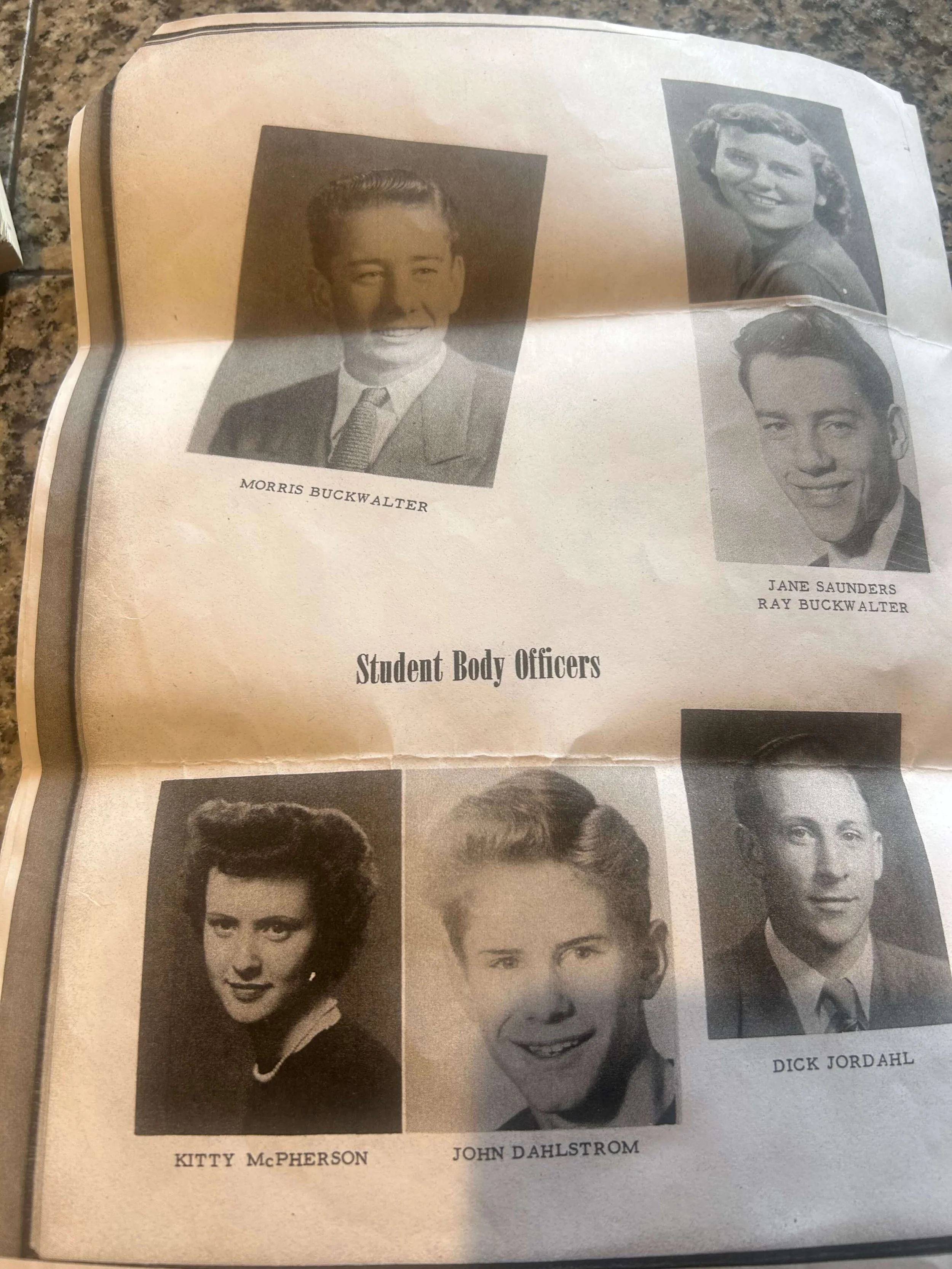
Besides excelling in sports, Bucky served as La Grande High’s student body president as a senior for the 1951-52 academic year (courtesy Bucky Buckwalter)
“There was a get-together at my Dad’s ranch,” Buckwalter told him. “I was there herding the cattle and breaking the broncs.”
“Breaking the broncs? Bronco-busting Bucky,” James shot back.
“He started it, and eventually it stuck,” Bucky says.
Morris was the oldest boy and second of six children to Morris and Thelma Buckwalter. The senior Buckwalter, who had grown up on a sheep ranch in eastern Utah, was employed by the Utah Woolen Mill. His territory included Oregon, central Washington and Idaho, and he settled his family in La Grande.
Morris Jr. was born in 1933 in the heart of the Great Depression. Times were tight for the Buckwalter family, “but you weren’t aware of that as a kid,” he says. “We got along fine. Making a living in those days wasn’t easy, but my father worked hard. My mother was a good cook and we always had our own vegetable garden.”
For years, the Buckwalters lived in a tiny house. Before Bucky’s eighth-grade year, as the family added children to the fold, Morris Sr. built a “beautiful brick house,” his son says, “that allowed us all to have our own bed. It cost $30,000 and was the most expensive house in La Grande that year.”
La Grande was a town of about 7,000 people through Bucky’s formative years in the 1940s (the population now is 13,000). Sports was the lifeblood of the small eastern Oregon community. The father of one of Bucky’s friends was superintendent of the La Grande public school system. He was instrumental in helping ensure that coaches in the grade and junior high school sports programs used the same principles as the high schools.
Bucky began playing basketball in grade school. His father erected a hoop in his yard, which became a hub of activity among the neighborhood boys.
“Dad didn’t know much about basketball or sports,” he says. “But one day when I was about eight he took me out and gave me some shooting advice. He said, ‘What you need to do is let your eyes guide your hand, and follow through.’ Turns out, those two things were pretty important. I grew up shooting late into the night, still out there shooting until it was too dark to see it go through the hoop.”
The Buckwalters attended a Mormon church, which turned out to be a boon for Bucky.
“They had a big gymnasium,” he says. “My friends and I would play basketball there on Saturdays.”
Buckwalter got good coaching as a youth. In seventh grade it was a young Ted Wilson, who would go on to the NAIA Hall of Fame after a 20-year career at Linfield. In eighth grade it was Jack Rainey, who later was head coach at both La Grande and Albany High and then coached and was in athletic administration at Oregon State, also serving 18 years as baseball commissioner of the Pac-10 North.
“We had good coaches and good teams,” Buckwalter remembers. “When I was in eighth grade, we came to Portland to play in a huge tournament at Hill Military Academy. The bunch of hillbillies from La Grande ended up winning the tournament.”
Buckwalter played football at La Grande High, an end who averaged 39 yards a punt and was all-league as a senior. Basketball was his sport, though. As a 6-1 guard, he was a three-year starter and two-time all-league selection. The Tigers made it to the state AAA tournament all three years. They won the consolation trophy his sophomore year, lost in the consolation finals his junior year and advanced to the semifinals his senior season, losing to eventual champion Lincoln 55-42. The Cardinals featured 7-3 Swede Halbrook, who averaged 38.9 points that season and would later go on to stardom at Oregon State and eventually make the NBA. Buckwalter had the defensive assignment.
“I think I held him to 32 points,” he says with a laugh. “There was no three-second rule, no goaltending rule. He was a very talented player for a 7-footer of that era.”
Buckwalter was joined in the Tigers’ starting backcourt that season by his brother Ray, then a sophomore. Bucky was a first-team all-state selection, but received scant attention from the in-state college coaches, Slats Gill at Oregon State and Bill Borchers at Oregon.
“They wrote me letters,” Bucky says, “and one time an Oregon State alum visited with me on his way through town. But then they turned me over to the fraternities and had them write letters. Seemed like they considered La Grande to be part of Idaho or something. They had no knowledge of what was going on in our part of the state.”
Out-of-state coaches held more interest. He was recruited by both BYU coach Stan Watts and Utah coach Vadal Peterson. Both of Bucky’s parents had graduated from Utah; the Utes won out.
After a season with the Utes’ freshman team, Buckwalter — who had filled out to 6-3 and 185 — was a three-year varsity starter, but not for Peterson, who retired after Bucky’s freshman year. In his place was Jack Gardner, who left his post at Kansas State to come to Salt Lake City. Gardner — later enshrined in the Naismith Basketball Hall of Fame — brought 6-8 Jerry Bergen with him, and 6-4 Art Bunte transferred from Colorado. Both had to sit out the 1953-54 season as Gardner’s first Utah team went 12-14. Buckwalter was the leading scorer that season, averaging 9.5 points and 6.3 rebounds from his off guard position.
With Bunte and Bergen in the fold, the Utes were the pride of the Mountain States Athletic Conference the following two seasons. Billed as the “B-Boys,” Bunte, Bergen and Buckwalter spearheaded teams that went 24-4 and 22-6, claiming back-to-back conference championships and reaching the Sweet Sixteen in 1955 and the Elite Eight in ’56.
Early in Bucky’s junior year, Utah opened eyes by upsetting top-ranked and defending national champion LaSalle 79-69 at Madison Square Garden. The next week, the Utes lost to the team that replaced LaSalle as No. 1 — Kentucky — 70-65 in Lexington after leading by four points with two minutes to go.
Both years, Utah was ousted by San Francisco, which went on to win consecutive NCAA titles. Gardner used the 6-4 Bunte, who averaged 21.9 points and 9.0 rebounds and was first-team All-American as a senior, to defend 6-9 Bill Russell.
“But really, nobody could guard him,” Buckwalter says. “(The Dons) also had (guards) KC Jones and Hal Perry. You would take the ball out and feel good if you get it to midcourt with those guys pressuring you.”
Buckwalter averaged 7.9 points and 8.8 rebounds as a junior and 9.9 points and 9.4 rebounds as a senior.
“I wasn’t all that good,” he says. “I was a guard but I got a lot of rebounds. I wasn’t a scorer; I was a scrapper.”
•
During his four years at Utah, Buckwalter was in the Army ROTC program. Upon graduation, he was given a commission and sent to Honolulu for two years.
“Couldn’t believe my luck, that I got that assignment,” he says. “I had a pretty good two years in Hawaii.”
Among Buckwalter’s duties were player/coach on the division artillery.
“Our general was a big fan and started betting on games,” Bucky recalls. “I would give him tips before each game, and he would place a bet. He won all kinds of money on our team.”
After discharge, Buckwalter spent a year studying international law at the American Institute of Foreign Trade in Phoenix and had a job lined up in Mexico City. But his father needed help on his Utah ranch, so Bucky enrolled in graduate school at Utah and began doing some scouting for Gardner. Soon Bucky was hired as an assistant coach with the Utes, a position he held for eight years. It was a great education for a young coach. The Utes had winning records seven of the eight seasons, with five 20-win campaigns and two trips to the Final Four. The feature player during that era was 6-9 Billy McGill, “who invented the jump hook,” Bucky says. As a senior in 1961-62, McGill was a consensus All-American who led the nation in scoring at 38.8 points per game and was the No. 1 pick in the ’62 NBA Draft.
“Jack was an outstanding coach,” Bucky says. “Everything was organized. When we went to practice, it was all written out exactly what he was going to say. I learned a lot from him.”
Academics were important in those days. Buckwalter recalls showing around a talented JC recruit from California — “good player, not a good student,” he says.
“I know you are a great player and are going to do well, but we expect you to do schoolwork and graduate,” Buckwalter told him. “That is very important.”
“Oh yeah, Coach, no problem, I’ll do all that,” the player responded. “I’ll be like Bill Bradley and get a Highway Scholarship.”
Bucky digested that for a moment, then said, “You mean a Rhodes Scholarship?”
“Oh yeah, that’s what I mean,” the player said.
In 1967, Buckwalter got his first head job at Seattle University. Over five seasons, the Chieftains compiled a 78-54 record, going 20-8 and making the NCAA Tournament his second campaign. In 1972, Tom Nissalke was hired as head coach of the SuperSonics and took on Bucky as an assistant.
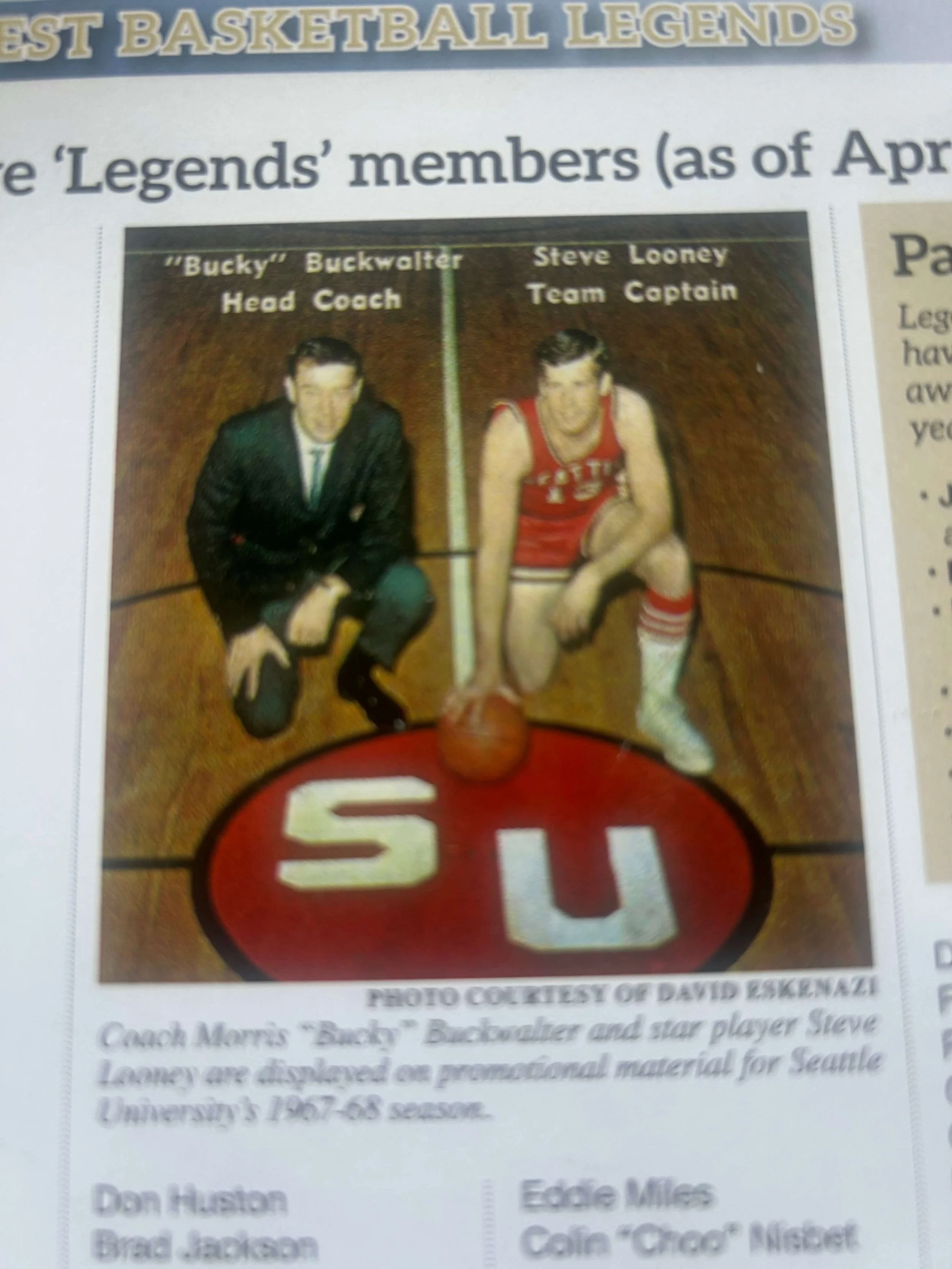
Buckwalter during his first season as head coach at Seattle University (courtesy Bucky Buckwalter)
“That was good for awhile,” he says. Not for long, though. Seattle’s front line featured Spencer Haywood, John Brisker and Jim McDaniels, “who all had been ABA All-Stars,” Buckwalter says. There was also talent in the backcourt, including veteran Dick Snyder, Butch Beard and a young “Downtown Freddie” Brown.
Haywood averaged 29.2 points and 12.9 rebounds, but the Sonics weren’t a winning combination. Owner Sam Schulman had little patience, firing Nissalke after a 13-32 start and elevating Bucky, who finished out a miserable season with a 13-24 mark.
Buckwalter tells the legendary story involving Brisker on an early road trip shortly after he took over the head job.
“John was a pretty good player, but an awfully strange kid,” Bucky says. “There were stories from his ABA days, that he would carry a knife in his sock to practice in case somebody gave him a bad time. He was ready to pull his knife out and chase somebody around the gym.”
One stop was in Detroit, Brisker’s hometown. The night before the game, Buckwalter ran into Brisker, accompanied by two brothers, in the lobby of the team hotel. Brisker introduced them to the coach.
“He says, ‘This is Jerry,’ and in the conversation tells me Jerry had just been released from the federal penitentiary for shooting a cop,” Bucky says. “And he says, ‘This is Jim, who just got out of the state pen for armed robbery,’ ” Bucky says.
Brisker asked if there were a possibility of getting tickets for his brothers for the game. Bucky wasn’t about to say no.
“I got them a couple of tickets right behind our bench,” he says. “We are not doing well early on, John is out of the game and the brothers are starting to chirp at me behind the bench. It got to the point where I turned around and said, ‘Cool it, I am going to put John back in the game in a minute.’ One of the brothers pulls back his coat to show a revolver. I thought it would be a good time to sub in John.”
Brisker scored 21 points in 33 minutes of a 106-104 Seattle victory.
“Afterward, we go back to the bar in the hotel, and the brothers come up and have their arms around me,” Bucky says. “We are the best of friends. I decided then and there that coaching was a dangerous profession.”
Buckwalter was not retained as coach after the season, but was kept on as assistant general manager to Bill Russell, who was brought in as both GM and head coach. The Sonics finished 36-46 in 1973-74.
“I’m not sure Russ took the job as seriously as he could have,” Bucky says. “As a great player sometimes you think you can transfer that to your players. Our center (Jim Fox) was no Bill Russell.”
•
Buckwalter’s next job was as GM of the ABA’s Utah Stars. Among the first — and for sure the most important — of his duties out of the chute was to find a big man for new owner James Collier.
“He told me, ‘We gotta get a center,’ ” Bucky says. “I said, ‘I’ve seen tape of this high school kid in Florida who everybody is talking about. He is pretty good.’ ”
The kid was Moses Malone, a 6-11 manchild being recruited by nearly every major college program in the country. Lefty Driesell won the battle and signed him to a letter of intent with his Maryland Terrapins, who had a backcourt featuring John Lucas and Brad Davis and a national championship in mind.
The NBA had a rule prohibiting teams from signing players straight out of high school. The ABA had no such rule, though no team had signed a prep star to that point. Utah chose Malone in the third round of the league’s draft. That meant a lot of teams passed on taking a future Hall of Famer.
“I don’t think anybody else had the audacity to think a high school kid could be good enough to play in the ABA,” Bucky theorizes.
Driesell sent an assistant coach to Malone’s hometown of Petersburg, Va. for a spell the summer of 1974.
“He and Moses’ mother (Mary) became very good friends,” Buckwalter says. “It was a battle to get (Moses’) ear. But we started making inroads.”
Bucky says he spent a good portion of that summer in Petersburg. “For about five weeks, I lived down there,” he says. “(Collier) joined me toward the end.”
By ABA rules, the Stars had to sign Malone by Sept. 1. In the week prior, Driesell and several of his assistants came to Petersburg to protect their turf. On one of those nights, they were at the Malone home for a visit.
“We knew they were there,” Buckwalter says. “There was a big hill overlooking the Malone house. (Collier) and I wanted to keep an eye on what was going on that night. We were crawling over this field trying to see what was happening down below. Then we heard shots fired in the background. This was in a bad part of a bad town. Shots were fired pretty regularly in that area. Dogs were barking. It was a little scary.”
The Maryland congregation departed, and Buckwalter and the owner entered the house. Bucky figured it was time for some fast negotiations. Reports through the years were that he brought out either $5,000 or $25,000 in $100 bills.
“I don’t think it was that much,” Bucky says today. “But I put down some money on the coffee table — it was actually an orange crate — and told Moses, ‘You need some walking-around money.’ A little later, I said, ‘You need a better car.’ I had a picture of a Mark IV, and I pulled that out and showed it to him. I said, ‘This is your car if you sign.’ He looked at it and said, ‘Hmm. Can I have a phone in the car?’ I said, ‘Yes.’ He looked out the window for a moment, then said, ‘Could it have a TV?’ I said, ‘Yes.’ He said, ‘OK. I’ll sign.’ ”
Mary Malone — who made $100 a week as a supermarket checker but wanted her son to go to college — was not in the room when her son signed a five-year contract worth nearly $1 million, plus a signing bonus of the Mark IV.
“She had a lot of influence, but Moses was a pretty independent young guy,” Buckwalter says. “A phone and a TV in a car? You gotta go for it.”
For maximum exposure, Collier decided to hold the press conference announcing Malone’s signing in New York.
“I told him the New York media would kill Moses, who wasn’t much of a talker,” Buckwalter says. “But the owner insisted. Before it started, I prepped Moses to just be brief and say something like, ‘I’m glad to be here. Let’s get started.’ So Moses gets up there in front of the media and starts talking about all the things that happened in his life. People in the audience were shocked. Then the media started asking tough questions, and he handled it all beautifully for a half-hour. That was the last time I heard Moses talk like that.
“Years later, we took Moses and a bunch of NBA players on a tour to China, and we had a glass of wine together. I asked Moses if he remembered that time. He said yeah, and he started telling me chapter and verse of what he had said. Moses was not as dumb as people thought.”
Before the 1974-75 season started, coach Joe Mullaney resigned due to the Stars’ dire financial situation. Collier moved Buckwalter into the coaching position and took over himself as GM.
As the first high-schooler to go directly to the pros, Malone had an exceptional rookie season. The 6-11 center averaged 18.8 points and 14.6 rebounds — including a league-high 5.5 offensive boards — and made the All-Star Game.
“From the day Moses arrived, coming from an all-black town to Salt Lake City, he made the transition incredibly fast,” Bucky says. “There was never a question that he was going to excel as a pro. He would work before and after practice. He had the talent and the desire. You could tell he was going to be good.”
It didn’t go as well for Buckwalter, who had Malone and a solid guard quartet of Ron Boone, Roger Brown, Wali Jones and John Roche but little else. Collier was cash-strapped and Bill Daniels — the team’s previous owner — took over the club. Daniels fired Bucky after 56 games with a 24-32 and replaced him, ironically, with Nissalke, who finished out the season.
•
Later in 1975, Bucky had an opportunity that was a portent of the future. A friend working for the U.S. State Department lined him up with an associate coaching job with the Brazilian national team, focusing on defense. During the fall, the team went on an international tour.
“We did pretty well,” Bucky says. “We went in and beat the U.S. team. We go to Europe and beat Italy, and they have a good team. We get beat in Greece, but then we go to Russia when they were still the Evil Empire. They had probably the best team in the world and one of the best players in (Alexander) Belov. And we beat them — maybe not a good idea.”
As the Brazilian players celebrated on-court after the game, security guards with rifles converged and escorted them to the locker room.
“We all get dressed, and they take us to our hotel and lock us in our rooms,” Bucky says. “The next morning we get on the plane to go to Paris. I have an American passport. They look at it and say, ‘No, no, no, no.’ They are convinced I am a CIA spy.
“They take me off the plane to a back room and interrogate me for about an hour. I said I wanted an English consulate. They said no. Fortunately, the head of FIBA (the international governing body of the sport) was a Brazilian guy. He gets off the plane and tells them, ‘If you don’t let him go, none of your teams will be sanctioned to play a FIBA game again.’ He grabs me, takes me up on the plane and we fly to Paris. I live for another day.”
In 1976, Buckwalter began work as a college scout for the Trail Blazers, hired by Stu Inman, the team’s director of player personnel.
“The first player I scouted was Johnny Davis,” Bucky says, the reference to the rookie guard who played an instrumental role in Portland’s NBA championship run in 1977.
Buckwalter scouted college players for the Blazers for three years, also coaching the Fresno Stars of the Western Basketball Association to a 25-23 record in 1978-79. Beginning in ’79, Jack Ramsay added him as an assistant coach, and he remained in a dual role through 1985.
“I scouted and coached, but enjoyed the scouting more,” Buckwalter says. “The longer we went, the more we decided I should scout full-time.”
When Inman left for Milwaukee in 1986, Buckwalter took over as Portland’s director of player personnel. Soon his title was vice president/basketball operations, and he remained in that capacity until 1992. He continued scouting, building his reputation as a forerunner to the NBA’s global scouting scene.
Buckwater had been introduced to the international game while coaching at Utah in the 1960s, when the Utes brought in several foreign teams for exhibition games. He also saw the talent displayed by BYU center Kresimir Cosic — who came to be known as the “father of Yugoslavian basketball” — in the early ‘70s.
“We saw some good international players, and I started paying more attention to them,” Buckwalter says.
Bucky’s first scouting trip abroad was to Italy in the mid-‘80s. About that time he became interested in 7-3 Arvydas Sabonis after watching an 18-minute tape of the Lithuanian lug playing professional ball at age 16.
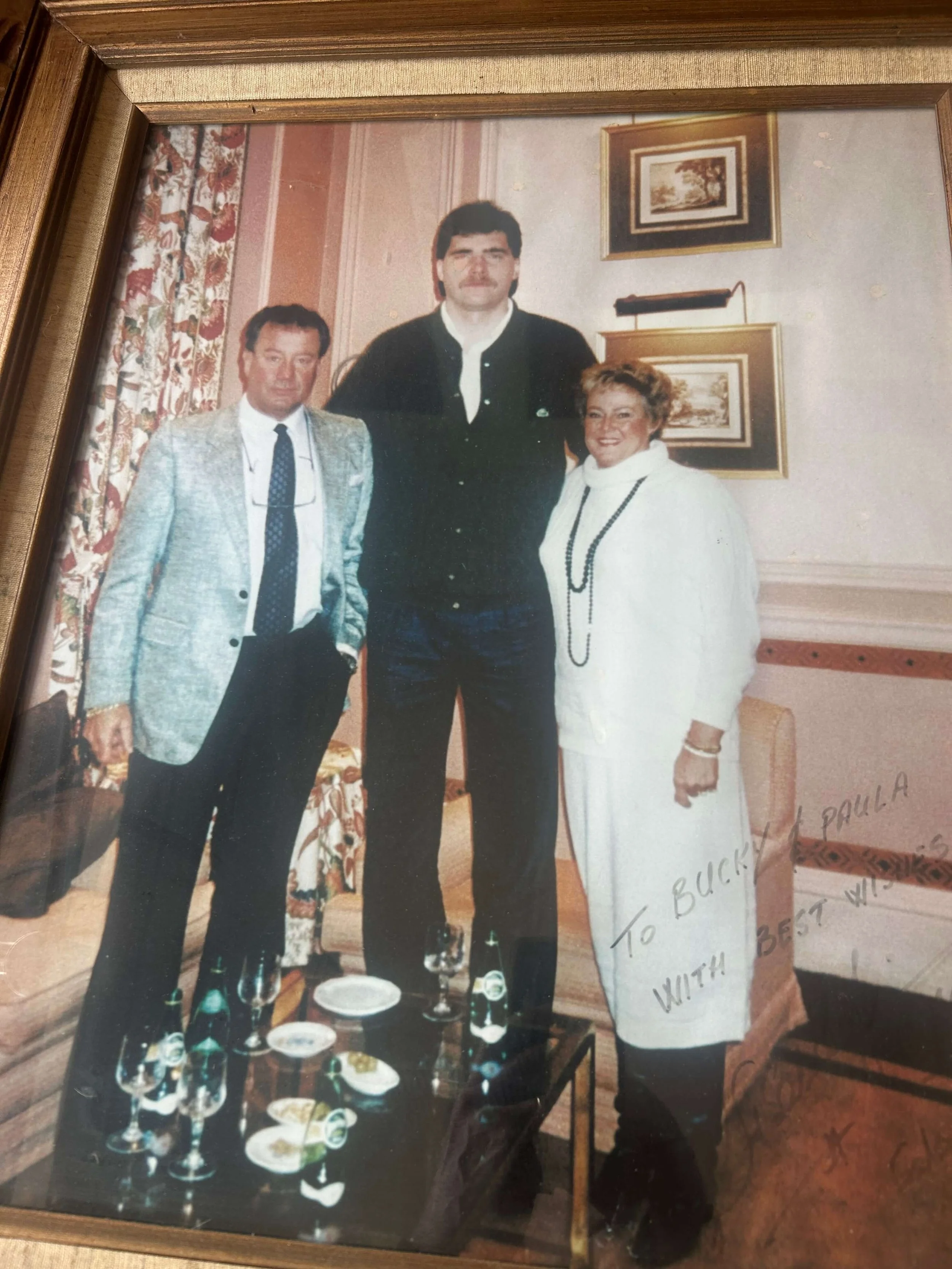
Bucky and wife Paula flank Arvydas Sabonis, one of Bucky’s greatest “recruits” for the Blazers (courtesy Bucky Buckwalter)
“I couldn’t believe some of the things he was doing on the basketball court,” says Bucky, who eventually called friend George Fisher, an American who was coaching in France and had played against a young Sabonis. Bucky began in pursuit of the big man and convinced owner Larry Weinberg on the idea of drafting a European at a time when it wasn’t in the thought process of most NBA teams. (New Jersey took Spanish forward Fernando Martin in the second round of the 1985 draft. The Nets traded Martin to Portland for a future second-round pick; Martin played 24 games for the Blazers in 1986-87. He died in a car accident in 1989.)
The Blazers chose Sabonis with the 24th pick in the 1986 draft. It took them nine years to get him in a Portland uniform. Buckwalter flew to Madrid after the draft to visit with Sabonis, who was playing for the Soviet national team and was heavily supervised to prevent defection.
A Lithuanian official helped organize a 3 a.m. meeting between Sabonis and Buckwalter, who was staying at the same hotel as the Soviet team. The Lithuanian was there to interpret the conversation.
“Do you want to play in the NBA?” Bucky asked Sabonis.
“Yes, of course,” he said. “I want to play against the best. But I can’t defect, or they will mistreat my family.”
Bucky told Sabonis he understood.
“We want you to play for us, too, but we will do it the right way,” Bucky said. “We want you to be happy and satisfied. We want your family to be safe.”
Soon thereafter, Sabonis twice ruptured an Achilles tendon, an injury he later attributed to overuse by the Soviet national team. Both times it required major surgery. He flew to Portland with a Soviet doctor, Kestukis Vitkus, and spent three months in the spring and summer of 1987 doing rehab under the supervision of Blazer Dr. Robert Cook.
“Arvydas enjoyed his time in Portland that summer,” Buckwalter says. “Somehow, he fell in love with the idea of being a cowboy. We got him size-16 boots and a cowboy hat. He loved to get on his motorcycle and ride about and play cowboy. He was so happy to be away from the Russian thing. (Lithuanians) did not take kindly to the Russian occupation.”
Both Vitkus and Cook recommended Sabonis take the 1988 year off to let the Achilles heel heal, but the Soviet Union pressed him into duty at the Seoul Olympic Games. I covered the Games for The Oregonian and watched as Sabonis, limping slightly, helped the Soviets claim the gold medal and beat the U.S. in a semifinal showdown. As chronicled in my most recent book, “Scrolls of a Sports Scribe,” I caught up with Sabonis after one of his games in Seoul. He offered only short answers.
News had just broken that the Soviets had agreed to allow four players, including Sabonis and Sarunas Marciulionis, to play in the NBA the following season. When I asked Sabonis if he intended to do that, he responded, “Maybe I will play. I don’t know. After the Olympics …”
Did he desire an NBA career?”
“Yes, of course,” he said.
The next year, Marciulionis played for Golden State as a 25-year-old rookie, beginning a seven-year NBA career a tough, fine-shooting guard. Not Sabonis, though. Soviet coach Alexander Gomelsky convinced him he wasn’t ready for the NBA and persuaded him to play professionally in Spain.
“Gomelsky had figured out that he could make some money (on Sabonis) through the Spanish Federation,” Buckwalter says.
Sabonis played six seasons in Spain, the last three for Real Madrid, with sensational results in the latter stop, claiming a pair of EuroLeague Player of the Year trophies. Meanwhile, the Blazers were quietly working behind the scenes to get Sabonis to Portland.
“We went through a bunch of hoops,” Buckwalter says. “Weinberg was connected with Armand Hammer, a prominent (U.S.) businessman who was allowed to do business in Russia. We hired him to help us. He went to the Soviet Sports Federation. No go. Then we went through their basketball federation. It was impossible to talk to anybody. We offered a couple of million dollars. They said no. We went through our State Department. They tried to help but couldn’t.”
Through six years, “we kept communication with Arvydas,” Bucky says. “I told him, ‘Even with your injury, you can play in the NBA.’ And finally he came over.”
Sabonis arrived in Portland in 1995 at age 30 and spent seven seasons in a Blazer uniform, even with his legs worn down by injuries through the years. For my money, Sabas ranks behind Bill Walton as the best big men in franchise history.
“One of the best passers ever, and the first big man who could shoot 3’s,” Buckwalter says. “It would have been interesting to see what he could have done before the injuries took their toll. If we had gotten him during the (Clyde) Drexler era, I think we would have won a championship or two.”
•
The Blazers got plenty accomplished during the Buckwalter years, drafting Terry Porter late in the first round and Jerome Kersey and Cliff Robinson in the second round. Scouts loved Robinson’s talents displayed at UConn but were wary of his attitude. Portland plucked him with the No. 36 overall pick.
“I watched him play and thought, ‘God, that kid is good,’ ” Buckwalter says. “Shortly before the draft, I spoke with his coach (Jim Calhoun), who said, ‘The stories about Cliff are not true. He is a good kid.’ ”
On draft night, Buckwalter sat in the Blazers’ war room and watched Robinson slide into the second round.
“I couldn’t believe it,” Bucky says. “After he wasn’t taken (at No. 35), I said, ‘I don’t care what anybody thinks of him, we are taking him.’ ”
The 6-10 Robinson was a major force off the bench for Portland’s NBA Finals teams of 1990 and ’92, contributing at both ends of the court and from all three front-court positions. He spent eight of his 18 NBA seasons with Portland and made it his home before his untimely death from cancer in 2020 at age 53.
Buckwalter’s best move, however, was the trade that sent Sam Bowie to New Jersey for Buck Williams.
“We worked on that for six months,” Bucky says. “(Nets GM) Harry Weltman and I went back and forth. I had different people call him. I was trying to convince him that Sam would be good for him, and then I said I would throw in a first-round pick. It took forever to get it done. And when it got done, I couldn’t believe it.”
Shortly before the trade was consummated, Buckwalter had a conversation with Lakers GM Jerry West.
“The one thing you need is a power forward,” West told him.
“I knew by then we had Buck, but I didn’t say anything,” Bucky says now. “When he found out, he called me and said, ‘You dog! You knew you had him when we talked, didn’t you? Well, you got your guy.’ ”
After back-to-back first-round playoff eliminations in 1993 and ’94, Portland owner Paul Allen fired coach Rick Adelman. Geoff Petrie, the team’s senior vice president/operations, resigned and was replaced by Bob Whitsitt, which was the beginning of the end of Buckwalter’s run with the organization. Whitsitt began unloading the veterans who had gotten the Blazers to the Finals only two years before.
“He talked about going in a new direction,” Buckwalter says. “I wanted to keep our guys. I felt like we had a chance to get to the Finals again. We had different views on the direction of the franchise. He said, ‘You’re good at scouting. We’ll keep you on as a senior scouting consultant.’ I said OK.”
Buckwalter stayed until 1997, when he left the club at age 64, satisfied with his long career with one club.
“It is unusual to get to stay with a franchise for almost 20 years,” he says.
Buckwalter switched his focus to the U.S. Basketball Academy, a state-of-the-art basketball training facility located east of Eugene near Tokatee Golf Course in the Cascade Mountains. He worked closely with Bruce O’Neil, the USBA president and founder who forged a relationship with the Chinese Basketball Federation. O’Neil made 130 trips to China and trained more than 2,000 Chinese players, coaches and administrators at the site in Blue River.
“We worked with a lot of countries, but once we made the connection with the top people, coaches and federation of China, that became our emphasis,” Buckwalter says. “I went to China 10 or 12 times over about a five-year period. They had money and wanted to get involved with the U.S, because they considered us ‘the basketball geniuses.’ We brought their athletes over and taught them English while they learned basketball. We ended up making big bucks out of it.
“I loved it. Got to see China. I love the Chinese. Great people. Hard-working, smart. Even now, with all the things the Chinese have gone through politically, they are a unified people. Confucius still reigns there, still the Chinese lynchpin.”
•
It is worth mentioning that as a young man, Buckwalter had cameo roles in a pair of feature films — “Pillars of the Sky” at age 22 in 1956 and “McQ” at age 40 in 1974.
“Pillars of the Sky” was a Western featuring Jeff Chandler, Dorothy Malone, Ward Bond and Lee Marvin. Filmed in and around La Grande, the “pillars” were the mountains around Wallowa Lake.
“I was a stand-in for Chandler, who was about 6-4,” Bucky says. “Instead of being an extra and getting $15 a day, I got $25 a day as a stand-in, which was huge at that time. I put on a cavalry uniform and rode a horse.
“I got to know all the actors, particularly Lee Marvin. He was one of the funniest men I have ever been around. Chandler was a very good-looking guy, a popular actor, but dumb as a rock. He had a hard time memorizing the lines. I remember Ward Bond used to give him a bad time. All in all, It was a good movie.”
“McQ” was about a rogue police sergeant (John Wayne) working under a stern captain (Eddie Albert) who got involved with a litany of shootings and killings. The movie was shot in Seattle during Bucky’s final year living in the city. He played a lieutenant who had one speaking line — “Professional all the way.”
“In the mornings before we started shooting (film), John would get the script of what he was going to do that day,” Bucky recalls. “He would read it over in about five minutes and then just be John Wayne the rest of the day. He loved to play Liar’s Poker. He had all these dollar bills with five or six ones (on the serial number). He would gather the guys, then he would take all our money. He got joy out of that.
“John was a delightful man. At the end of the movie, he gave me a coffee cup with ‘to Bucky from the Duke’ inscribed on it. It’s a prized possession. I still have it somewhere.”
•
Life is lonelier now for Bucky without the company of Paula, whom he had been with since 1978.
“She was very smart, had a great sense of humor, and loved to travel just like me,” he says. “We went to Mexico several times. She was great for me. And she became a real basketball fan. She got to the point where she was an aficionado.”
Bucky hasn’t been to Moda Center for a Blazer game during the past two seasons, but still watches most of their games along with many others on TV.
“At first I wasn’t sure I liked the new rules and the way the game was being played these days, but it is growing on me,” he says. “You have to run the floor and shoot 3’s, whatever your position, and you have to play defense. It is a faster game now, a lot like hockey in that way. You are using the whole floor. I still like the mid-range shot, but the game is about 3’s now. It used to be there were two guys — (Steph) Curry and (Damian) Lillard — who shot from 30 (feet). Now it seems like everybody, including the centers, can shoot the long ones. I have gotten to the point where I really enjoy it and have gotten to appreciate the skills of some players.”
Like Portland’s Deni Avdija.
“When he gets a rebound, he takes off and often gets all the way to the basket, and finishes or gets fouled,” Bucky says. “That was the thing I loved about Clyde. He was a great rebounding guard. He would get it and go. I used to encourage that. That is what Deni does. In today’s game, it is even more effective. You can jump into people and the defenders can’t do anything about it.”
Second-year center Donovan Clingan has impressed Buckwalter, who clearly maintains an affinity for the home team.
“Can’t believe he is only 22 years old,” Bucky says. “He is very important to us with the rebounding and blocked shots. He has a nose for the ball now. Last year, I was critical of him. He was pretty mechanical early on. But he has improved and is starting to look like an athlete. Seven-footers don’t always have that. And he has a bit of an attitude. I love that.
“I love (Toumani) Camara. First time I saw him play defense full-court guarding a guy, I thought, ‘Who does that?’ He is an important piece. His determination and commitment to defense carries over to his teammates. We are starting to play pretty good defense now.”
Buckwalter is a believer in the Blazers’ acting coach, Tiago Splitter.
“It will be a big mistake if they don’t rehire him,” Bucky says. “He has been an assistant and a head coach in Europe, where the game is fast and in the open court, and he was a champion. He comes here and the reason they hire him is his background. If we are going to continue to play the style we play — which we should — who is going to do a better job coaching them than him? The players like and understand him. They should keep him.”
Bryan Buckwalter is understandably proud of his father for his accomplishments, but also for the man he has been and for the standards he met.
“I admire my dad’s ability to see players not just their talent, but to see who they are,” he says. “It is no accident that he drafted Jerome and Terry. They were remarkable people, not just basketball players.That always meant something to him, and that translated to success for the organization.
“It was important for him to get out in the world early on, going overseas and seeing what was out there. His career transcends all those areas of basketball, from the college game to the Wild West of the ABA to the NBA, not necessarily bending but pushing the rules. He was always good at that.
“As smart as he is, I never understood how he became a glorified basketball coach. He is one of the smartest guys I have ever met.”
Bucky is humble about that part of it. As our interview ends, though, he can’t help but offer some advice for NBA commissioner Adam Silver.
“I started playing basketball when I was eight years old,” he says. “Eight to 92 — that’s a long time, 84 years of my life. I have enjoyed the people I have met, the competition I have had and the fact that basketball has changed to involve the world. There should be a world championship played every year — the champions of each continent playing for the role of world champion. I think Silver is thinking about that. Or at least, he ought to be.”
► ◄
Readers: what are your thoughts? I would love to hear them in the comments below. On the comments entry screen, only your name is required, your email address and website are optional, and may be left blank.
Follow me on BlueSky.
Follow me on X (formerly Twitter).
Like me on Facebook.
Find me on Instagram.
